


Have you heard the rumors? Bluesky is being called the new X. But is it really?
Are you wondering if you’re missing out by not using Bluesky — either for personal use or, more importantly, for your business? Instead of trusting the hype, let’s break it down.
What is Bluesky’s social network and who is it best for? Is Bluesky really the next big thing, or just another fleeting trend?
We’ll check whether this new kid on the block is worth exploring for marketing purposes, how it differs from X, what audience it has, and why there is such a fuss around it.
Once you weigh the pros and cons, you’ll be able to decide whether or not to try this marketing channel.
Table of Contents
What is Bluesky Social?
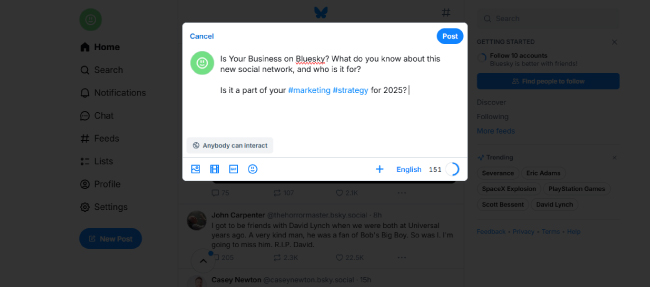
Bluesky is a social media platform where users can post short messages (up to 300 characters). It’s a mini-blogging platform, that supports images and text, and you can post, like, share. Its feed is easy to navigate and simple in a good way.
Right from the start, you get to choose what you’re interested in, shaping your feed around your preferences.
From a design and functionality perspective, it’s easy to see why people perceive it as a Twitter double.
But hey, that’s expected since the Bluesky project was originally within Twitter (back in 2019).
Back then, Twitter CEO Jack Dorsey had an idea to tweak Twitter and give users more control over their content. Thus, the project Bluesky began.
That’s probably why even the logos for Twitter and Bluesky look similar (one with a bird and one with a butterfly, same color, same idea, different animal).
Jay Graber led this project, and the original idea about Bluesky was to build an open social protocol for public conversation.
Who Owns Bluesky
What started as a project in 2019 legally left the Twitter nest and became an independent company in 2021, owned by software engineer Jay Graber and the Bluesky team. Jay has been the CEO of the company since August 2021 and a member of the Board.
However, though Bluesky was an independent legal entity, Bluesky Social PBLLC (Public Benefit Limited Liability Company) was financially dependent on Twitter until late 2022.
Other members of the Board are Jeremie Miller, the inventor of Jabber/XMPP, Mike Masnick, and Kinjal Shah. Jack Dorsey, the original initiator of Bluesky, left the Board in May 2024.
Bluesky Monitoring Now Available in Mentionlytics!
Monitor your brand mentions, discover trends, and assess your competitors’ performance in Bluesky with the power of Mentionlytics!
Why is Everyone Switching to Bluesky?
Several factors have driven people to switch to Bluesky. We highlight the main ones below.
- Exclusivity: Initially, its invite-only access created an air of exclusivity — people wanted in simply because they couldn’t join freely. This sense of scarcity fueled interest and made early access feel valuable.
- Opportunity to build an audience: Journalists, academics, and influencers were among the first movers, seeing Bluesky as a fresh, untainted space for serious discussions. Creators also recognized an opportunity to build an audience early before the platform became too crowded.
- Open-source AT Protocol: A major thing is that Bluesky isn’t controlled by a single tech giant. Users appreciate the ability to customize their experience with different feeds, thanks to its open-source AT Protocol.
- Changes on X: Meanwhile, Elon Musk’s takeover of Twitter — now X — fueled even more migration. His changes, including renaming the platform, altering privacy policies and terms of service, allowing AI to use posts for machine learning, and introducing paid features, draw away many users.
- U.S. presidential elections: Lastly, one of the biggest spikes in Bluesky’s user growth happened right before and during the 2024 U.S. presidential election, once again linked to Elon Musk’s X changes and political involvement.
How is Bluesky Different than Twitter?
Speaking of Bluesky as an X competitor, we’ve already mentioned the similarities, but let’s look at the differences.
Decentralization vs. Corporate Control
Bluesky is built as an open source on the AT Protocol, meaning it’s decentralized — users can choose different servers, create custom feeds, and even move their accounts without losing followers.
X (Twitter), on the other hand, is fully controlled by its owner and operates under one centralized system, where users have zero ownership over their data.
Algorithm Freedom vs. Forced Engagement
Bluesky lets users customize their own feeds, making the experience more organic and personalized. Introduced in June 2024, this feature enhances the onboarding experience by allowing users to discover and connect with communities more efficiently.
X, however, with its algorithm, prioritizes paid content, political hot takes, and whatever drives engagement (algorithmic choice is more powerful than the users’ preferences).
No Ads (For Now) vs. Ad-Driven Algorithmic Feeds
Bluesky currently runs without ads, while X has become a battlefield of promoted posts, sponsored replies, and “For You” tab clutter.
Pretty aggressive monetization — like paid verification and AI-driven ad targeting — has made X sometimes feel like an ad-infested engagement farm.
Whether Bluesky stays ad-free remains to be seen, but for now, it’s a much cleaner experience.
Features for Marketers vs. Bare-Bones Simplicity
X offers DMs, polls, post scheduling, and analytics (though many of these are now locked behind paid tiers).
This makes it a marketer-friendly platform where brands can track engagement, interact privately with followers, and run surveys.
Bluesky, on the other hand, has none of these tools — no DMs, no built-in analytics, and no interactive engagement features like polls.
While this keeps the platform clean and conversation-focused, it also makes it less appealing for businesses looking to track performance and build direct relationships with customers.
Who is Attracted to Bluesky Social Media Platform?
To understand who is attracted to Bluesky’s social media, let’s examine how its user base has evolved over time.
The timeline goes like this:
- February 2023: Bluesky launched as an invite-only iOS beta and initially had around 2,000 users (journalists and writers, tech enthusiasts and developers, artists and creatives, and marginalized communities).
- April 2023: Android app release, and, at that moment, it had a small community of around 25,000 users.
- September 2023: User count reached 1 million.
- February 2024: Public launch of the Bluesky app with over 3 million users.
- November 2024: Explosive growth! Over 20 million users, fueled by the U.S. presidential election.
- December 2024: Approached 25 million users.
- January 16, 2025: Reached 27.65 million and counting (2 million new users a month)!
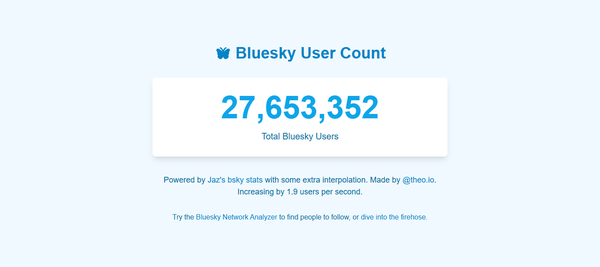
Source: Bluesky User Count
The highest spikes were in February, September, October, and November 2024.
We already know that the app went public in February, which explains the spike. November (7.85 million downloads on App Store and Google Play) was the presidential election in the USA.
But let’s not forget that millions of users fleet to the alternative social app from Twitter when Elon Musk took over and started changing its policies and features.
No surprise then that over 55% of Bluesky users are from the USA.

Source: Backlinko
Overall, the Bluesky social network attracts a diverse mix of users, but the core audience falls into a few key groups:
1. Former Twitter (X) Users Seeking an Alternative
- Many users left X after Elon Musk’s takeover due to policy changes, paywalled features, and algorithm shifts.
- These are users who liked Twitter’s old structure but wanted a cleaner, ad-free, and decentralized alternative.
2. Journalists, Academics & Thought Leaders
- Many writers, journalists, and researchers moved to Bluesky early on, seeing it as a serious discussion space without algorithmic manipulation.
- Unlike X, where engagement is often driven by controversy, Bluesky’s chronological feeds make it easier to follow meaningful conversations.
3. Tech Enthusiasts & Open-Source Advocates
- Since Bluesky runs on the AT Protocol (open-source and decentralized), it appeals to developers, privacy advocates, and those who support digital autonomy.
- These users are often early adopters of new technology and are interested in custom feeds, open APIs, and algorithmic control.
4. Artists & Creators Looking for a New Platform
- Some artists, writers, and musicians have migrated to Bluesky, looking for a more community-driven space without heavy ad promotion or pay-to-play algorithms.
- Bluesky social app doesn’t yet have monetization tools, but many independent creators use the platform to build an audience early before the platform scales.
5. Marginalized Communities Seeking Safer Spaces
- The invite-only system (before the public launch) helped keep early communities curated and supportive.
6. Users Who Are Just Curious (or Skeptical)
- Of course, many people signed up just to see what the hype was about.
- Some stayed, while others realized Bluesky wasn’t quite “Twitter 2.0” yet and left.
Why Consider Bluesky as an Alternative Marketing Channel
While it lacks some traditional marketing features, that’s actually part of its appeal. No ads, no algorithm-driven content suppression — just direct reach. You can engage with your audience organically without spending a dime.
Let’s elaborate a bit on these things from a marketing perspective.
First of all, you don’t have ads to diminish your content creation effort. Every marketer knows that if you’re creating great content, you will still have to boost it a bit with ads because all your competitors do that.
Well, not on Bluesky.
The beauty is that you can easily show up in a feed of the audience interested in your niche. And you don’t have to spend a fortune on that. Purely organic, and target-focused.
If we add that the number of Bluesky users is on constant growth, there’s the answer to your question.
Our Review of Bluesky: Pros & Cons for Marketers
We tried it, we analyzed it, and here’s what we have found.
1. Familiar Interface = No Learning Curve
Let’s start with the obvious win — you open your account, and everything feels familiar. The interface, the interactions, the preferences… who remembers the old Twitter?
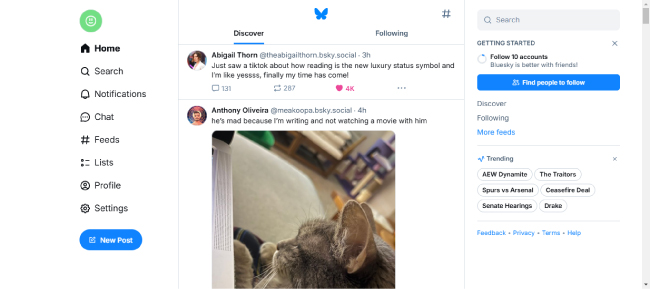
For user experience, it’s a solid 10/10 — clean, intuitive, and frustration-free. No confusing onboarding or complex settings. It takes just seconds to sign up, and you’re in.
✅ Great for: A smooth transition from Twitter/X with no learning curve.
❌ Not ideal for: Those expecting a radically different experience.
2. Less Competition = First-Mover Advantage
Bluesky is still relatively new, meaning brands aren’t flooding it with paid ads yet. If your business focuses on tech, Web3, journalism, or digital communities, getting in early could help you establish credibility before the platform scales.
✅ Great for: Thought leadership, brand-building, and community engagement.
❌ Not ideal for: Direct response marketing or quick conversions (yet).
3. No Ads (For Now), So Organic Reach Matters More
Unlike X, Bluesky doesn’t have paid promotions, boosted posts, or ad placements. That means your content actually reaches people based on relevance and their preferences — not just ad budgets.
Bluesky might be a good experimental channel if your business thrives on authentic engagement rather than paid reach.
✅ Good for: Building trust and visibility without pay-to-play algorithms.
❌ Not ideal for: Paid campaigns, as there’s no ad system (yet).
4. No DMs, Polls, or Advanced Analytics = Limited Marketing Tools
Bluesky lacks DMs, polls, analytics, and promotional tools, making it less ideal for direct customer interactions, tracking engagement, or running surveys.
✅ Good for: Organic brand discussions, creating communities, and early brand presence.
❌ Not ideal for: Data-driven marketing strategies or lead generation.
5. Bluesky’s Algorithm = More Control, Less Noise
Bluesky allows users to customize their feeds, meaning businesses can curate their presence in a way that’s impossible on X, Facebook, or LinkedIn. If your audience is active here, you can tailor your messaging and be part of niche discussions.
It’s one of the most significant advantages from our point of view because micro-communities and nano-influencers are one of the top social media trends for 2025.
✅ Good for: Brands in niche industries, tech, and open-source communities.
❌ Not ideal for: Mass-market products that rely on hyper-targeted advertising.
6. Bluesky’s Growth Is US-Centric (For Now)
Currently, more than half of Bluesky’s users are in the US, with smaller but growing communities in the UK, Japan, Canada, and Brazil. If your target audience is primarily in these regions, it might be worth testing.
✅ Good for: US-based brands looking to tap into early adopter communities.
❌ Not ideal for: Global brands needing broad international reach.
7. Smaller User Base = Limited Reach
While Bluesky’s user base is constantly growing, it’s still tiny compared to other social media platforms.

According to Bluesky User Counter as of Jan. 16th, 2025 & Statista
✅ Great for: Building brand awareness without heavy competition.
❌ Not ideal for: Brands needing mass reach and scalable paid campaigns.
Final Verdict: Should You Use Bluesky for Marketing?
- If your brand is looking for early exposure in a decentralized, ad-free environment, Bluesky is worth experimenting with.
- If you rely on paid advertising, advanced analytics, or direct customer messaging, Bluesky isn’t there yet.
Whether Bluesky becomes a major marketing channel or stays niche depends on how it evolves in the future.
Is Bluesky Worth Exploring After All?
As a marketer, you’re probably asking, “Should I open a Bluesky account for my business or my client?” The answer? It depends on your industry and goals.
However, we can’t ignore Bluesky’s growing influence, especially in the U.S. market. With digital marketing trends shifting toward organic, authentic, and niche-driven content, it’s worth considering Bluesky as part of your marketing strategy for the year ahead.
Are you planning to expand your marketing activities on Bluesky? Then, try Bluesky monitoring with Mentionlytics now — track your mentions, discover trends, and assess your performance in this new channel effortlessly!

