


Does ChatGPT, Perplexity, or any other AI engine mention you, and what does it say when it does? AI visibility tools can track your mentions, prompts, sources, rankings, and competitive position. But dashboards are built for analysis. Your CEO, manager, or client probably wants something simpler: a report showing where your brand appears, how it compares with competitors, and whether its visibility in AI is improving or quietly disappearing.
An AI visibility report turns raw monitoring data into a clear picture of how prominently and accurately your brand appears in AI-generated answers. It helps teams measure performance, identify visibility gaps, and decide what to improve next.
In this guide, we’ll explain which metrics and KPIs matter and show you how to create an AI brand visibility report with Mentionlytics.
Table of Contents
What is an AI Brand Visibility Report?
An AI brand visibility report is a structured overview of how often, where, and in what context a brand appears in AI-generated answers across major AI platforms such as ChatGPT, Perplexity, Gemini, Copilot, Google AI Mode, and Google AI Overviews.
Unlike a traditional SEO report, which focuses on rankings, clicks, and organic traffic, an AI visibility report examines whether AI platforms mention or recommend your brand when users ask relevant questions.
And questions became longer… According to Google, prompts in AI Mode became three times longer compared to traditional Google Search queries.
So, this kind of AI visibility tracking can reveal whether your company appears for a prompt such as “What are the best PR agencies in Europe?”, how it is positioned in the generative engine’s answer, how it is described, and which competitors appear alongside your agency (or instead of it).
An effective report also translates this information for different teams:
| Team or Role | What they need from the report |
| Executives | A concise overview of competitive position, risks, and progress |
| SEO teams | Prompts, citations, content gaps, and pages influencing AI answers |
| Content teams | Topics to create, update, expand, or clarify |
| PR teams | Publications and third-party sources shaping the brand’s AI presence |
| Brand teams | Brand positioning, accuracy, sentiment, and competitor comparisons |
| Product marketing | How AI platforms describe products, features, and differentiators |
| Agencies | Clear, client-ready evidence of results and emerging opportunities |
The purpose isn’t to squeeze every available number into a PDF and hope the colorful charts look convincing. A useful AI brand visibility report explains what changed, why it matters, and what the business should do next.
What Metrics to Include in AI Visibility Reports?
A complete AI visibility report should answer four questions:
- How visible is the brand compared to its competitors?
- On which platforms and prompts does it appear?
- How do AI platforms present it?
- What sources and citations may be influencing those answers?
The following metrics provide a complete picture without turning your report into a PDF packed with numbers.
Brand Visibility Score
You should start your report with the AI visibility score for your brand, which shows how consistently your brand appears in AI search and LLMs for the prompts being tracked. It gives your client, CEO, or head of team a straightforward metric for answering: “When people ask AI this prompt, how likely are we to show up?”
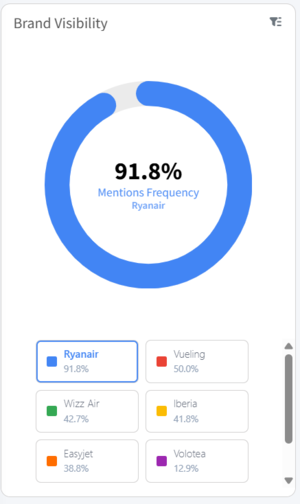
Mentionlytics calculates this score from your monitored prompts and presents it alongside your competitors.
Brand Visibility Change Over Time
A single visibility score is only a snapshot. The Brand Visibility Change Over Time chart reveals whether your presence in AI-generated answers is growing, declining, or moving sideways with impressive determination compared to your competitors.
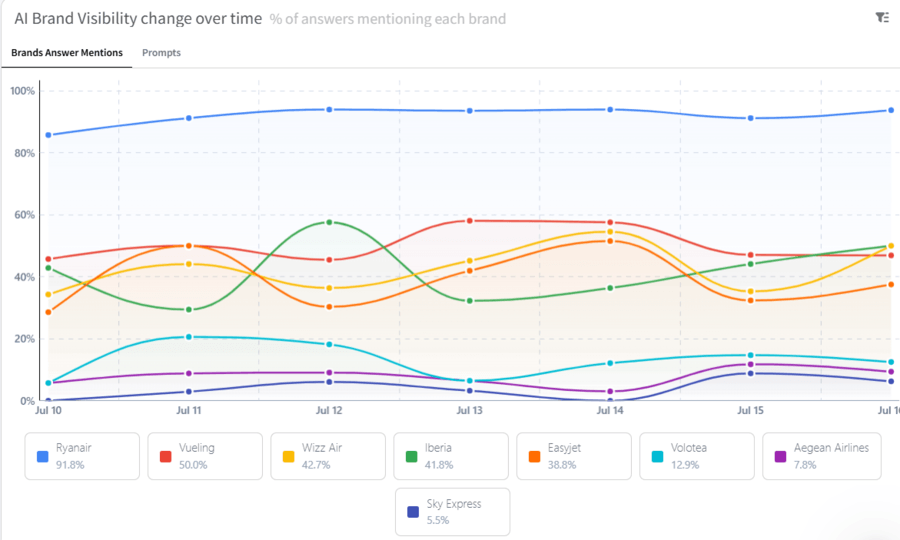
Use it to compare reporting periods and annotate important changes, such as:
- Publishing or updating key content
- Launching a PR campaign
- Earning coverage from an authoritative publication
- Releasing a new product or feature
- Receiving significant positive or negative attention
- Being overtaken by a competitor
Brand Visibility per LLM
Now you want to show how often each AI model mentions the brand. Mentionlytics breaks down Brand Visibility across ChatGPT, Gemini, Perplexity, Copilot, Google AI Mode, and Google AI Overviews for your brand and your competitors.
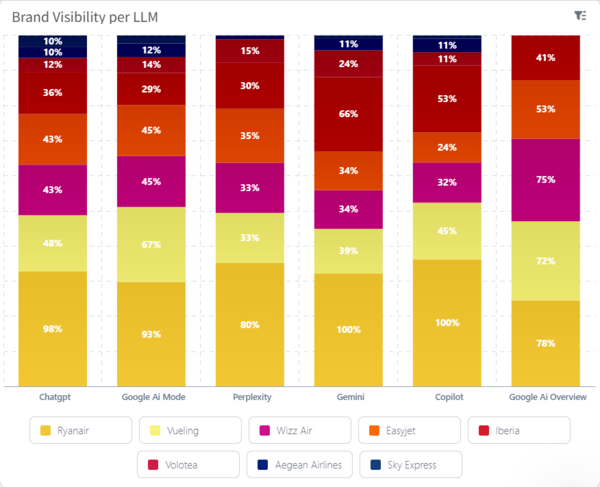
This comparison can reveal that your brand performs well in ChatGPT but rarely appears in Perplexity, or that Google’s AI experiences cite your content while other platforms prefer third-party sources.
Include visibility by LLM to identify:
- Your strongest and weakest AI platforms
- Platforms where competitors dominate
- Sudden platform-specific changes
- Where your generative engine optimization efforts (GEO) should be invested further
One blended score can hide these differences. Your brand could look reasonably visible overall while being practically invisible on an AI platform important to your audience and that’s a huge miss!
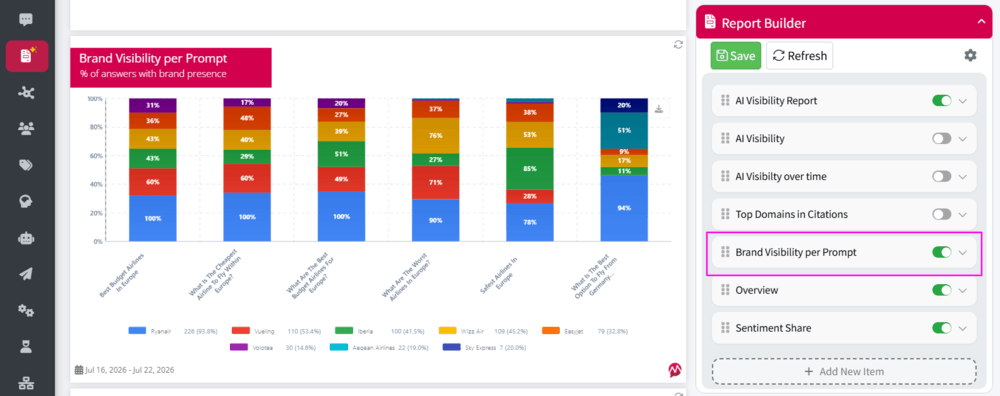
Brand Visibility per Prompt
Brand Visibility per Prompt shows which monitored questions generate appearances for your brand and which leave the stage entirely to competitors.
For example, Ryanair might have the leading score for “the cheapest airline to fly within Europe” but not for “the safest airline in Europe.” That gap is more actionable than a general visibility score because it points toward a specific audience, use case, or product association that needs strengthening.
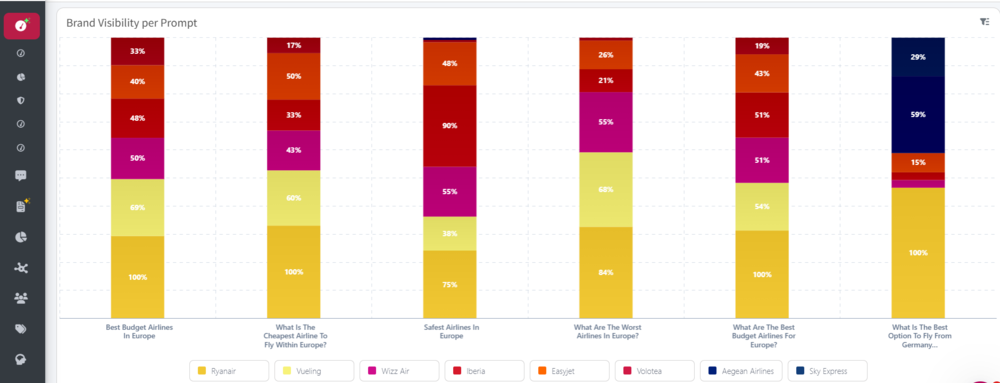
Group prompts by theme or intent in your report, such as:
- Informational prompts
- Comparative prompts
- Transactional prompts
- Instructional prompts
- Branded and reputation-related prompts
This makes it easier to identify content gaps, weak product positioning, missing comparison pages, unclear documentation, and questions that deserve a dedicated frequently asked questions (FAQ) section or campaign.
Average Sentiment
Average Sentiment measures whether AI-generated answers discuss your brand positively, negatively, or neutrally.
This is where an AI visibility report becomes particularly valuable for reputation management. High visibility is not automatically good visibility. A brand may appear frequently because AI platforms repeatedly mention poor reviews, pricing complaints, a product failure, or an outdated controversy. Fame has never promised to be helpful.
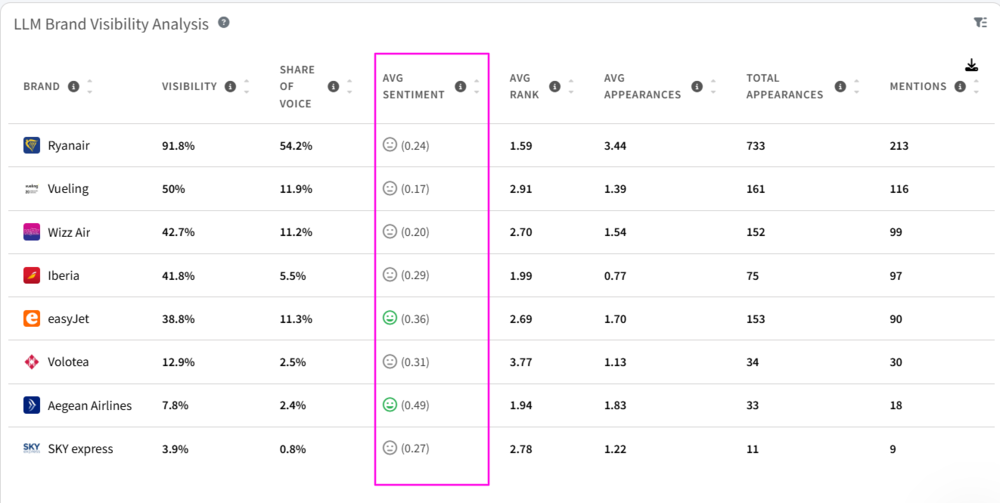
Break sentiment down by:
- Prompt
- AI platform
- Brand versus competitors
- Reporting period
- Positive, negative, and neutral answers
Pay particular attention to prompts generating negative descriptions or inaccurate claims. They can reveal reputation risks that an overall visibility score would happily conceal.
Sources Used in AI-Generated Answers
Citation sources show which domains and pages AI platforms use when answering your tracked prompts. These may include your website, competitor websites, review platforms, industry publications, Reddit discussions, comparison articles, YouTube videos, or news coverage.
AI mentions and citations are not the same: a model can mention your brand without linking to it, while a citation points to a specific source. If you see that someone is frequently mentioned as a source, that may indicate they have a strong online footprint and influence AI search engines with their opinion.
Include:
- Your most frequently cited domains and pages
- Third-party sources influencing brand descriptions
- Sources supporting competitor recommendations
- Outdated, incorrect, or negative sources
- Valuable publications where your brand is absent
- Persons frequently cited
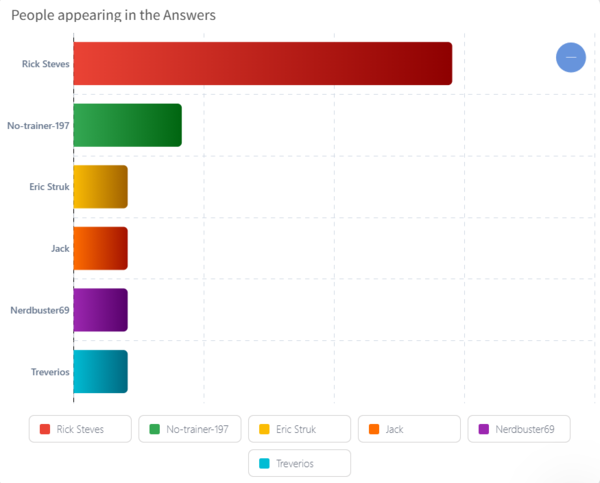
This data can uncover PR opportunities, pages worth updating, sources to approach for inclusion, and content formats AI platforms repeatedly trust.
Top Citation Domains per Prompt
If you want to present which source impacted a specific prompt the most, you should consider including the Top Citation Domains per Prompt.
This helps you identify which websites, forums, news, or blog posts influence the results the most. It reveals to you why the AI model chose to mention you or your competitors within the answer.
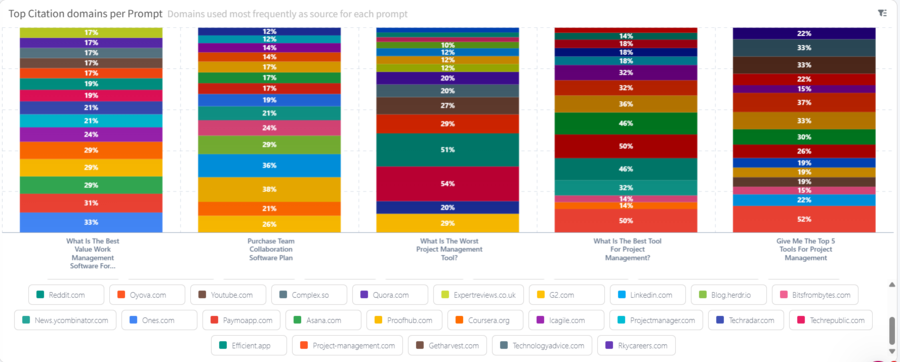
It can also reveal which domains you should target through content, SEO, or PR efforts.
For example, if competitors appear because AI platforms repeatedly cite a particular industry publication, comparison site, or review platform, you have a clear opportunity to investigate that source.
You may need to earn coverage, contribute expert content, update your information, or create a stronger owned resource addressing the same topic.
Competitor Performance
Competitor comparison should run through the entire AI visibility report rather than appearing as one lonely pie chart at the end.
Compare your brand with its closest competitors across:
- AI Share of Voice
- Brand Visibility
- Average Rank
- Average Sentiment
- Total Appearances
- Visibility by LLM
- Visibility by prompt
- Citation sources
- Changes over time
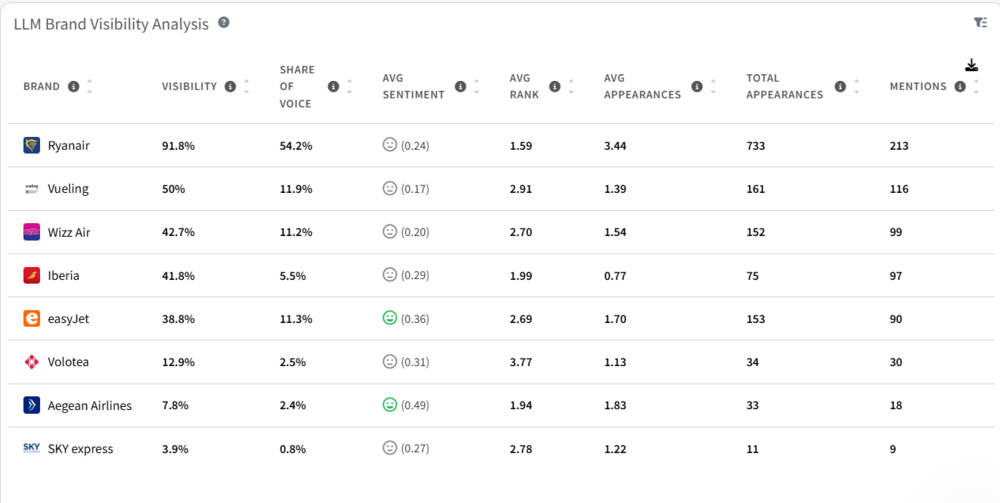
The goal of visibility tracking is not just to confirm who is winning. It is to understand where and why. A competitor may dominate informational prompts because of an extensive educational library, while another wins transactional prompts through reviews and comparison content.
Is Prompt Tracking a Reliable AI Visibility Metric?
Prompt tracking is a useful method for brand and reputation monitoring because it lets you repeatedly test the questions that customers, journalists, prospects, and other stakeholders may ask about your brand.
It can reveal:
- Whether AI platforms recommend your brand
- Which topics and use cases they associate it with
- How they describe your products or services
- Whether the information they provide is accurate
- Which competitors they recommend instead
- Whether negative narratives appear for sensitive questions
- How answers change across AI platforms and over time
With prompt tracking, you decide which prompts you want to track, and you should primarily opt for a mix of informational, comparative, and transactional prompts, because you want to show up there regardless of your industry or niche.
But we have to add that prompt tracking should not be treated as a complete measurement of content performance. Unlike traditional keyword rank tracking, there is no fixed, universally visible set of AI prompts. People phrase questions conversationally, add follow-ups, provide personal context, and receive answers influenced by platform, model, location, freshness, and other variables.
Your tracked prompts are therefore a representative sample, not a census of everything users ask AI.
For that reason, use prompt tracking to monitor strategic questions, brand associations, competitive positioning, and reputation risks. To measure overall content performance, combine it with organic traffic, conversions, referrals from AI platforms, citations, backlinks, engagement, and business outcomes.
How to Create an AI Visibility Report with Mentionlytics
Mentionlytics uses a modular Report Builder, allowing you to choose which AI visibility insights to include and how to present them. This helps you create different reports for executives, clients, PR teams, or SEO specialists without placing the entire dashboard into one very ambitious PDF.
Step 1: Open Your AI Visibility Report
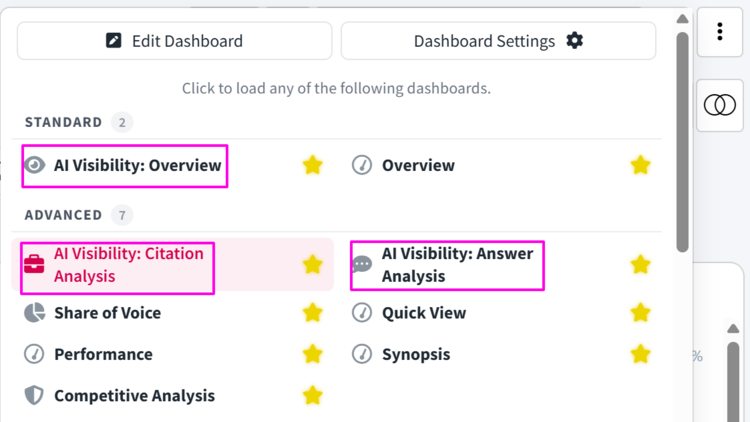
Click on the three dots to select one of the three AI Visibility dashboards.
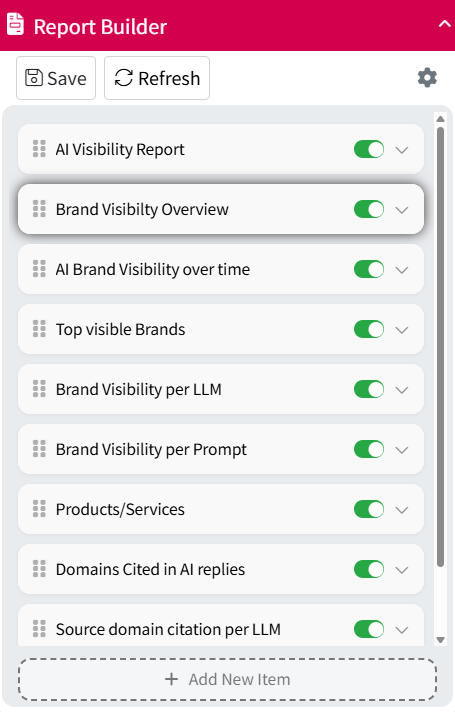
Once you do that, click the Report icon on the left-side menu. The dashboard will automatically switch to the report view, with the Report Builder appearing on the right side of the page.
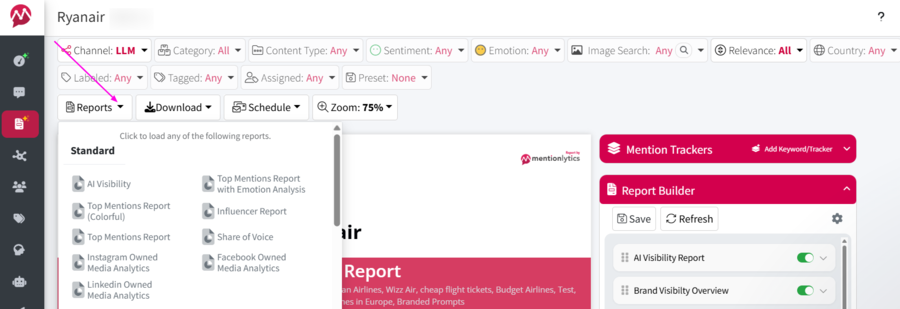
Also you may access the AI Visibility report from the drop-down menu of Reports in the corresponding feature.
The first page of the AI Visibility Report can be customized with your brand name, preferred colors, and reporting period.
Step 2: Choose the Right Report Elements
The Report Builder lets you choose the elements that match the report’s purpose and audience.
| Report element | What it shows | Most useful for |
| AI Visibility | Your visibility score and competitor scores | Executives, clients, and brand teams |
| AI Visibility Over Time | Changes in your brand’s and competitors’ appearances | Leadership and marketing teams |
| Domains Cited in AI Replies and Top URLs for Citations | Domains most frequently cited in AI answers | SEO, GEO, content, and PR teams |
| Brand Visibility per Prompt | Strong and weak prompts for your brand and competitors | SEO, content, and product marketing |
| Brand Visibility per LLM | Your brand’s and competitors’ visibility across individual AI platforms | SEO, GEO, brand, and competitive intelligence teams |
| Top Visible Brands | Brands appearing most frequently in tracked AI answers | Executives, brand, and competitive intelligence teams |
| Product/Services | Products and services most frequently mentioned in AI answers | Product, marketing, sales, content, and brand teams |
| AI Visibility Overview | Appearances, overall sentiment, and mention timeline | General and PR reporting |
| Sentiment Share | Positive, negative, and neutral AI mentions | PR, brand, and reputation teams |
AI Visibility Over Time can cover a day, week, month, quarter, or year. Use it to identify AI visibility trends and investigate sudden changes rather than treating every daily fluctuation as an emergency meeting.
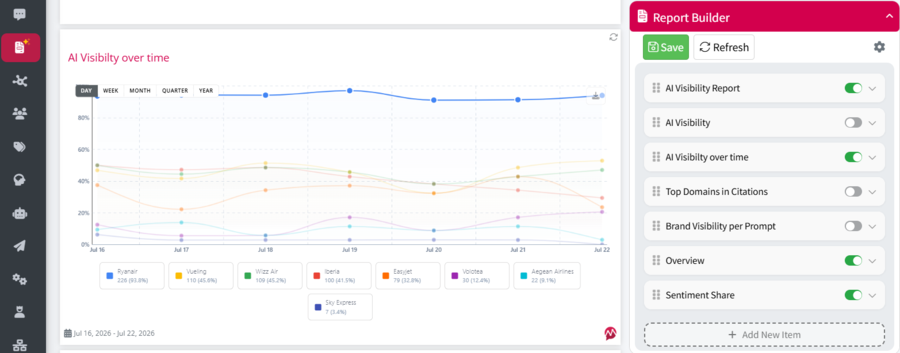
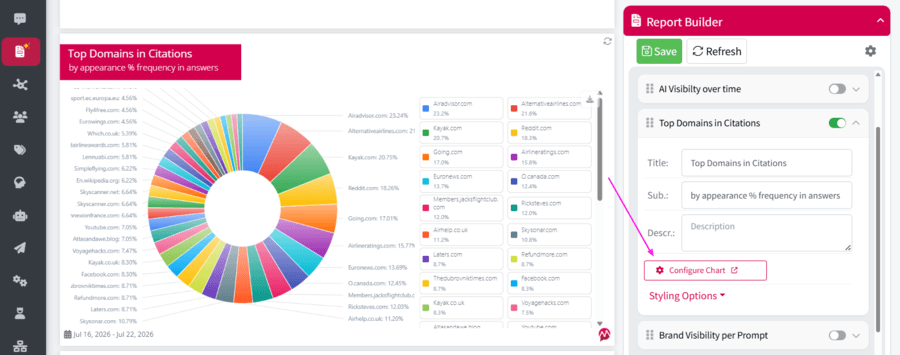
Top Domains in Citations helps identify which sources may influence brand visibility. Once you know which publications, websites, or discussions regularly appear in AI answers, you can investigate opportunities to earn coverage, correct outdated information, or strengthen your presence on those sources.
Brand Visibility per Prompt highlights the specific questions your brand dominates and those where competitors are mentioned more often. It is one of the most actionable elements for identifying AI visibility gaps.
Brand Visibility per LLM compares how frequently your brand and its competitors appear across individual AI platforms, such as ChatGPT, Gemini, Perplexity, Copilot, Google AI Mode, and AI Overviews. It helps you identify where your brand performs stronger and where it remains underrepresented so you can check the sources, content formats, and brand mentions influencing each platform.
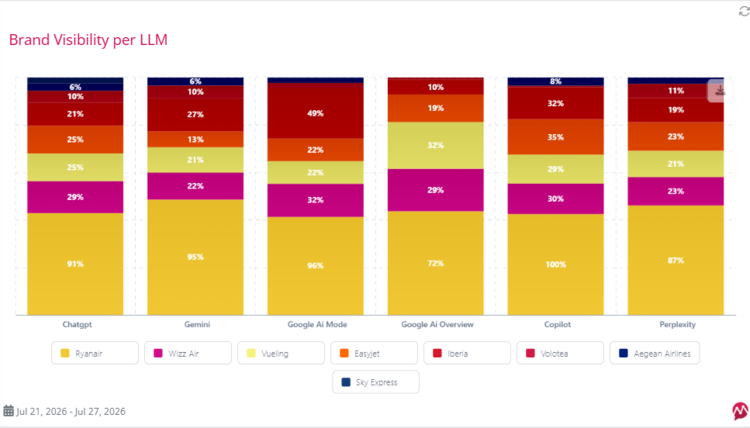
This analysis is very important since, according to a Vogue Business survey, 63% of survey participants use ChatGPT for fashion and beauty advice and product discovery, while only 10% opt for Perplexity. That means, if you’re in the fashion industry, it would be most significant for you to have high visibility in ChatGPT and Gemini (38%).
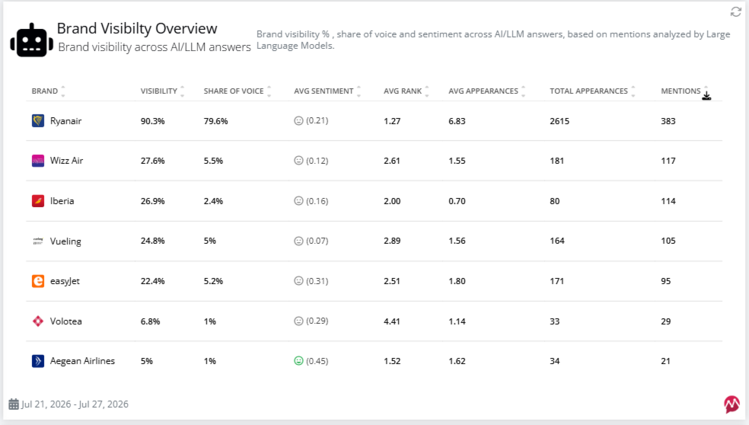
The AI Visibility Overview brings together appearances, sentiment, and changes over time. This is particularly useful for PR teams monitoring important brand or competitor benchmarking questions. If your brand suddenly disappears from a strategic answer, the next step is to examine which sources and competitors replaced it.
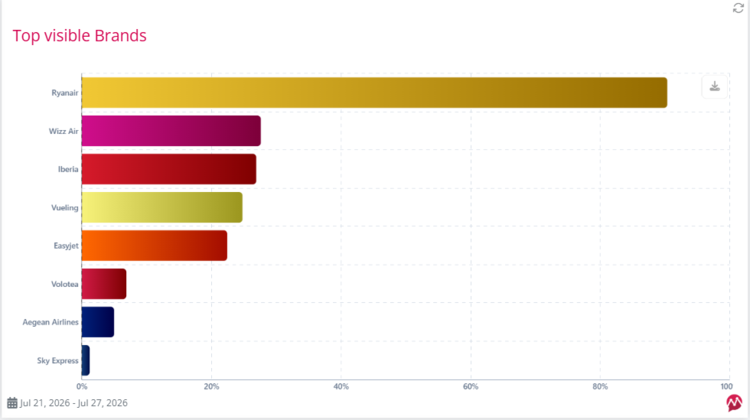
Top Visible Brands shows you the percentage of mentions in AI-generated responses for the most mentioned brands.
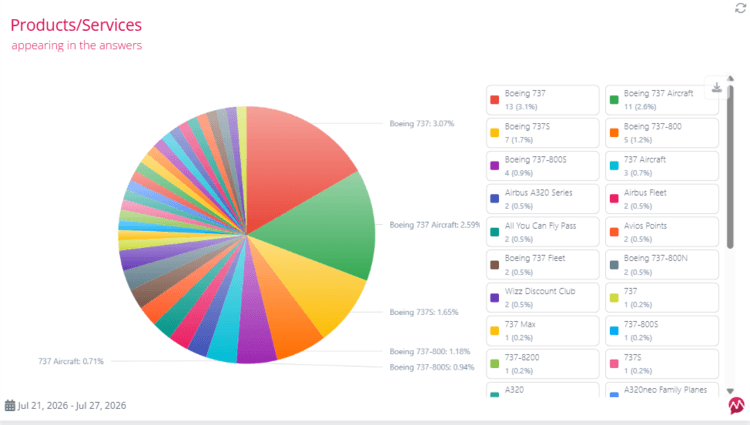
Product/Service reveals which products, services, features, and use cases AI platforms frequently associate with your brand and its competitors. You present these valuable insights to the product team, marketing, content, and sales team.
Sentiment Share displays the percentage or number of positive, negative, and neutral mentions. Depending on how you want to present the results, it can be shown as a doughnut or bar chart.
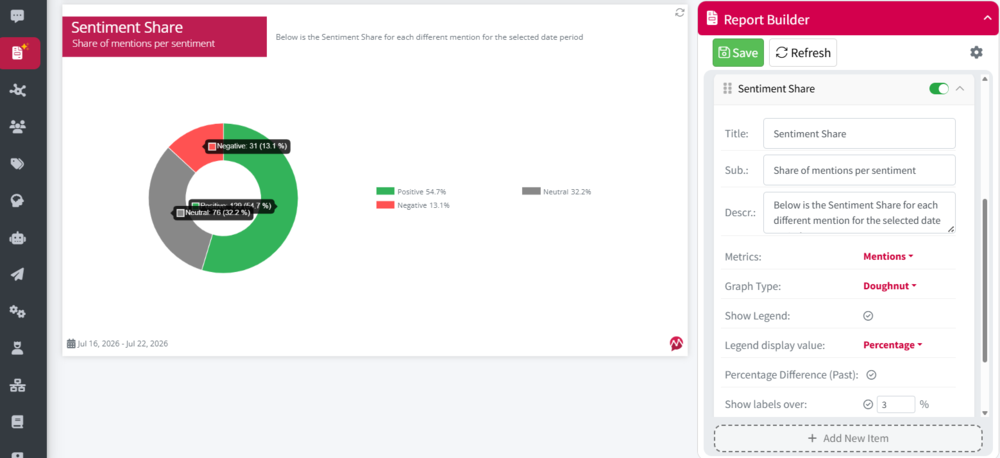
It can be displayed as a doughnut chart, but you can choose a bar chart instead, and it can contain percentages, actual numbers, or both.
Step 3: Customize and Export the Report
Mentionlytics lets you change the title, subtitle, and description of individual elements so that the report explains the significance of the data instead of merely displaying it.
Through Configure Chart, you can adjust:
- Layout
- Chart type
- Appearance
- Axes
- Data presentation
- Table or metric-card display
Available customization depends on the selected element. Overview, Sentiment Share, and the report’s first page have their own display options.
If you need a specific chart or answer from an individual AI platform, charts from the AI Visibility dashboard can also be downloaded separately.
You can use Add New Item at the bottom of the Report Builder to include relevant social listening insights in the same report.
For example, you could combine declining sentiment in AI-generated answers with traditional online brand mentions to determine whether the same reputation issue is appearing across both environments.
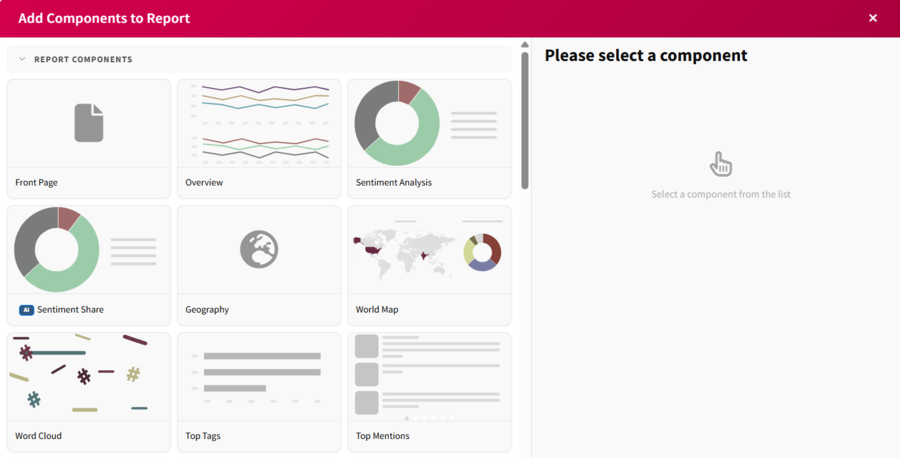
Once your elements are in place, review the report as its intended recipient would. Keep the main findings visible, move diagnostic details into supporting sections, and finish with clear recommendations.
What KPIs Matter for Executive AI Visibility Reporting?
Executive AI visibility reporting should focus on business impact, competitive position, reputation risk, and progress. Leadership rarely needs every tracked prompt or citation URL. It needs answers to four questions:
- Are we visible?
- Are we gaining ground?
- How are we being presented?
- What should we do next?
The following KPIs provide that overview:
| Executive question | KPI | Why it matters |
| Are we visible? | Brand Visibility | Shows how consistently the brand appears for relevant prompts |
| Are we competitive? | AI Share of Voice | Benchmarks the brand’s presence against its closest competitors |
| Are we improving? | Visibility Change Over Time | Reveals sustained progress, decline, or market movement |
| Are we being recommended? | Average Rank | Distinguishes appearing in an answer from being prominently recommended |
| Is our reputation protected? | Sentiment and material inaccuracies | Surfaces risks that visibility scores alone can hide |
| Where are the gaps? | Priority LLM and prompt coverage | Identifies missing platforms, audiences, categories, and use cases |
These KPIs should be presented with the previous reporting period, a competitive benchmark, and a brief explanation of any significant movement.
For example, saying that AI Share of Voice increased from 18% to 26% is useful. Explaining that the increase followed new industry coverage and occurred primarily across high-intent recommendation prompts makes it meaningful.
Individual citations, prompts, and AI answers remain essential, but they belong in the diagnostic layer of the report. SEO, content, and PR teams need those details to determine how to improve performance. Leadership needs the conclusion.
Turn AI Visibility Data Into Recommended Actions
An executive report should finish with decisions rather than a decorative collection of numbers. Turn the main findings into recommended actions, owners, and expected outcomes.
| Executive finding | Recommended action |
| AI Share of Voice declined against the market leader | Analyze the competitor’s strongest prompts, topics, and supporting sources |
| Visibility is stable, but Average Rank is falling | Strengthen product differentiation and comparison content |
| Negative sentiment increased | Investigate the answers driving the change and address the underlying narrative |
| Visibility is weak on a priority AI platform | Analyze its preferred sources and content formats |
| AI answers repeat inaccurate product information | Audit owned content and correct influential third-party sources |
| The brand is absent from high-intent prompts | Improve relevant product pages, use-case content, reviews, and third-party coverage |
Create Your AI Brand Visibility Report Now
AI-generated answers are already influencing how people discover, compare, and judge brands. If they are becoming part of your customers’ research process, AI visibility should also become part of your monthly reporting.
You can create an AI brand visibility report manually, but automated monitoring makes it easier to track changes across prompts, competitors, and AI platforms over time. The goal isn’t to squeeze every available metric into one report. Choose the insights that matter to your audience, whether that means AI Share of Voice for leadership, sentiment for PR, or prompts and citation sources for SEO and content teams.
Discover where your brand appears in AI-generated answers, how it compares with competitors, and which opportunities or reputation risks deserve your attention next, with Mentionlytics.
FAQ
What are the KPI for AI performance?
The main KPIs for measuring AI search performance include: AI Share of Voice, Brand Visibility, Average Rank, total brand appearances, sentiment, visibility growth, strategic prompt coverage, and performance across individual AI platforms. The right KPIs depend on your goal. Leadership may prioritize competitive position and visibility growth, while SEO, content, and PR teams need detailed data about prompts, citations, sources, and reputation risks.
How to report AI search visibility to clients of a marketing agency?
Marketing agencies should report AI search visibility by combining a concise performance overview with clear explanations and recommended actions. The report should cover the client’s AI Share of Voice, Brand Visibility, Average Rank, sentiment, competitor performance, and changes since the previous reporting period. Individual prompts, AI answers, and citation sources can then be used to explain why performance changed. Instead of simply delivering numbers, agencies should connect each finding with a content, SEO, PR, or reputation management opportunity.
Where to find AI visibility reports with sentiment analysis?
You can create AI visibility reports with sentiment analysis using Mentionlytics. The platform monitors how brands appear across ChatGPT, Gemini, Perplexity, Copilot, Google AI Mode, and AI Overviews while analyzing the sentiment of AI-generated brand mentions.
How to report AI search visibility to leadership?
Report AI search visibility to leadership using a short executive summary focused on business impact, competitive position, reputation risks, and progress over time. Prioritize KPIs such as AI Share of Voice, overall Brand Visibility, visibility growth, Average Rank, sentiment, and major inaccuracies found in AI answers. Avoid overwhelming executives with every tracked prompt or citation. Summarize what changed, why it matters, what may have caused it, and which actions or decisions are required next.
Which team owns AI brand visibility reporting for a large organization?
AI brand visibility reporting is usually shared across SEO, content, PR, brand, and digital marketing teams. Ownership may sit with the SEO or brand intelligence team, but the most effective approach is cross-functional because AI answers are influenced by owned content, third-party media, online reputation, reviews, and competitor activity. One team should manage monitoring and reporting, while relevant specialists investigate and act on the findings. Leadership should receive the executive view; SEO, content, and PR teams should receive the delightfully messy details needed to improve it.
