

When social listening tools are so similar, like comparing Brandwatch vs Hootsuite, or Mentionlytics vs Brandwatch, choosing can be hard. That’s why we put these three tools side by side, compare them in detail, and show what works best and what still has room for improvement.
In this article, you’ll find a detailed comparison of features, pricing, free trials, and quality of customer support, so that you can see what’s working for you, what’s not, and which tool best fits into your workflow.
Table of Contents
Brandwatch vs Hootsuite vs Mentionlytics Overall Comparison Table
| Brandwatch | Hootsuite | Mentionlytics | |
| Social listening | ✅ | ✅ | ✅ |
| Media Monitoring | ✅ | ✅ | ✅ |
| News Monitoring | ✅ | ✅ | ✅ |
| Reddit Monitoring | ✅ | ✅ | ✅ |
| Podcast Monitoring | ✅ | ✅ | ✅ |
| AI-Powered Insights | ✅Iris AI | ✅ Lumen intelligence engine, Wisdom, and AI Agent | ✅ Social Intelligence Advisor (SIA) |
| MCP Support | ❌ | ✅ (Through Wisdom) | ✅ |
| Multi-language sentiment analysis | ✅44 officially supported languages | ✅Analytics documentation lists 18 languages, and via Lumen, 186 | ✅All languages |
| Image Recognition | ✅ | ✅ | ✅ |
| Video Recognition | ✅ | ✅ | ✅ |
| Automated Reports | ✅ | ✅ | ✅ |
| Custom Dashboards | ✅ | ✅ | ✅ |
| API Access | ✅ | ✅ | ✅ |
| AI Visibility and LLM Monitoring | ✅ | ✅ | ✅ |
| Historical Data | Depends on the social network, plan, and module, and spans from 15 days to 3 years. And Consumer Research has access to the archive from 2008. | 7 days to 13 months for Quick Search (depending on the plan) | 12 months as an add-on |
| Archive | 27 months for private or owned channels; for public, it’s unlimited, though historical query data results will be summarized after 24 months. | 30 days to 13 months | 18 months (might extend upon request) |
| Ease of Use | Complex | Moderate | Easy |
| Best Fit For | Enterprise brands | Social Media Management Teams and Agencies | Agencies and enterprises |
| Free Trial | ❌ | 14 Days | 14 Days |
| Starting Price | Custom | From $99/month per user | From $69/month |
| Advantages |
|
|
|
| Disadvantages |
|
|
|
Features Comparison
To find out whether Brandwatch, Hootsuite or Mentionlytics is the right option for you, check the features you need the most, how well they perform, and then compare it with the overall price you would pay for a tool.
Social listening capabilities
Brandwatch and Mentionlytics are built primarily for social listening, while Hootsuite is well known for social media management, with basic brand monitoring features in lower-tier plans.
Brandwatch: Has strong social listening features that go beyond the basic mention count. It combines social media monitoring with sentiment analysis, recurring topics, trends, and competitor insights to deliver consumer intelligence.
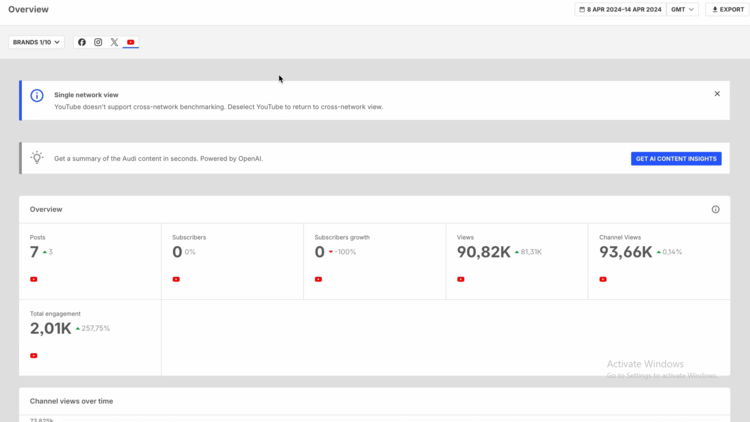
Hootsuite: The Standard plan includes basic features such as post engagement, account performance, template reports, and benchmarking against up to five competitors, plus searches for brand, competitor, topic, and hashtag mentions from the past seven days, with sentiment analysis and AI summaries. For more advanced social listening, such as 90-day trend forecasting that predicts mention and engagement volume for conversations and topics, you’ll need to opt for an additional package. An interesting thing is that Lumen Lite (as a light version of social listening) supports only basic sources for social listening, such as blogs, news websites, newsletters, Facebook, X, Bluesky, YouTube, Quora, and podcasts, but if you want Instagram or Reddit, for example, you need to jump to the highest-tier plan.

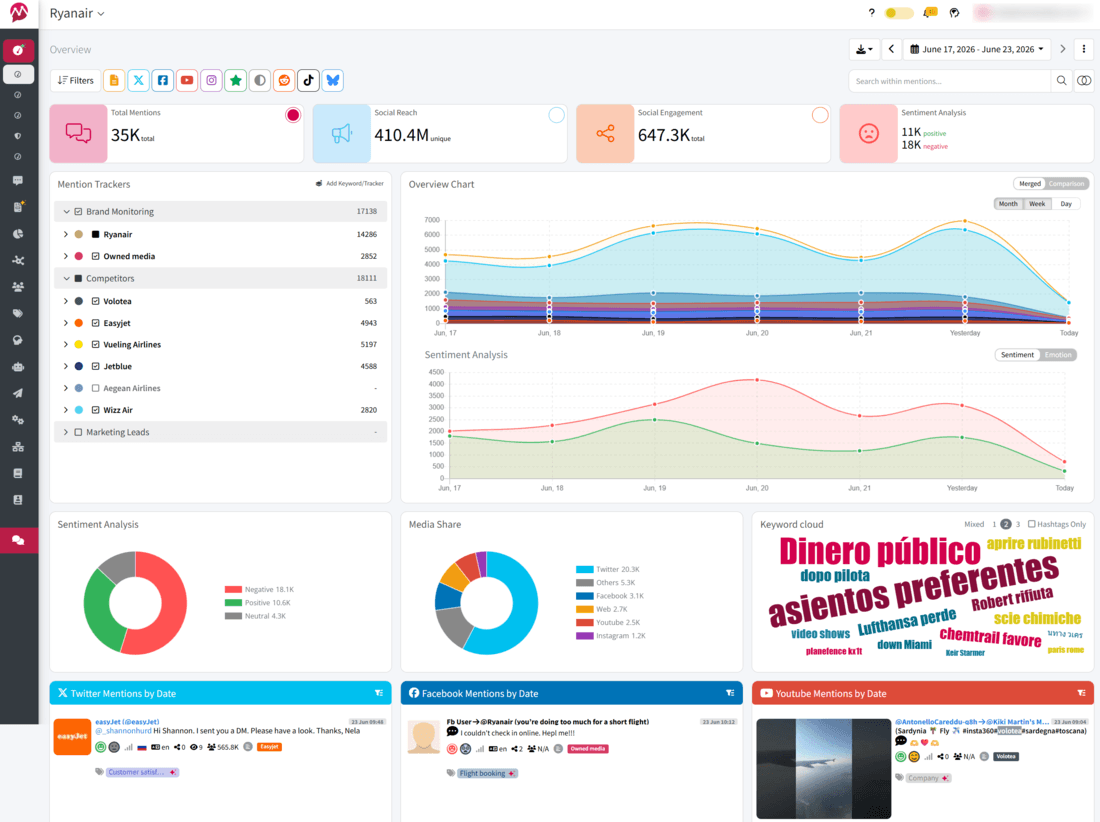
Mentionlytics: Listens to a wide range of channels, including social media networks like X, Instagram, Facebook, TikTok, YouTube, blogs, forums, and news. AI-powered sentiment analysis with 96% accuracy in all languages, according to user feedback, mention clustering, and competitive analysis make it easy to translate raw social listening data into actionable insights. On top of that, you can see which voices influence your brand, competitors, and industry-related topics; which influencers have the highest engagement; and which podcasts mention your brand.
AI features
All three tools have strong AI features, with one powerful AI assistant.
Brandwatch: Its AI-powered features span its different products, but Iris AI is the core. For example, Ask Iris answers questions about your listening data in plain language, generating summaries, charts, and topic breakdowns, while AI query building helps you build and improve Boolean queries. It also has Summaries that summarize themes and explain changes or spikes in conversations.
Hootsuite: Its core AI, Wisdom, combined with Lumen, answers questions about social performance, competitors, and trends, and recommends next steps; combined with Perch, it drafts social posts, campaign ideas, content briefs, and publishing recommendations.
Mentionlytics: Social Intelligence Assistant (SIA) is the main AI engine with strong analytics capabilities that helps you interpret raw social data and saves time digging through all mentions. Its AI Anomaly Detection alerts notify you when unusual activity occurs, something outside common audience behavior.

Custom reporting
Agencies need custom reporting most when presenting brand monitoring and social listening results to clients. All three tools offer white-label reports within their higher-tier plans, but for Brandwatch it will depend on what product you use.
Brandwatch: White-label options and customizable client-facing dashboards are available, but they depend on the plan and module you use. For example, native white labeling is included in the Enterprise plan, but you can add it to Pro and above. For dashboard customization, if you use the Social Media Management module, you get pre-built dashboards and can create your own by choosing the metrics that matter most to you. Consumer Intelligence doesn’t offer that flexibility, but it lets you create tags, rules, and categories to isolate share-of-voice, sentiment trends, and competitive benchmarking data. But if the price is over your budget, then you should definitely check some Brandwatch alternatives.
Hootsuite: It offers a high level of dashboard customization. Users can build custom analytics views and dashboards to track specific organic, paid, or social listening metrics, and pin modular widgets to track cross-channel performance, engagement rates, and competitive benchmarks. Adding your logo and images to the reports is also available for Advanced and above plans.
Mentionlytics: Higher-tier plans allow you to remove all Mentionlytics marks and present fully white-labeled reports to your clients. All users have access to standard dashboards (templates), while Pro and above plan users have the option to fully customize the dashboard with charts and AI insights. You can customize layouts, metrics, data filters, and custom charts through Dynamic Component.
Automation capabilities
With a high volume of mentions, automated collection and sorting can help. When your tool is able to sort the mentions, flag, notify, and automatically build a report and send it to your email or Slack, that’s half of the job already done.
Brandwatch: Focuses on automating research and data organization. Its Rules can automatically tag and categorize both existing and incoming mentions based on criteria you define. Automated reports, threshold alerts, and Signals also help teams spot changes without spending hours on the dashboard.
Hootsuite: Puts more emphasis on publishing and customer care workflows. Alongside scheduled publishing, higher plans add automated replies, DM workflows, conversation tagging, and scheduled performance reports. Depending on your plan, you can add message assignment and skill-based routing to help customer questions reach the right team. Listening alerts are also automated, and you can schedule listening reports.
Mentionlytics: Automates mention organization, monitoring, mention translation, alerts, and reporting. From tagging rules with AI Tags for labeling mentions based on their context to SIA catching sentiment shifts and sending Anomaly Detection Alerts. You also have Mention Clustering to group mentions under one topic, plus a daily summary. Reports can also be scheduled, but the level of automation will depend on the plan.
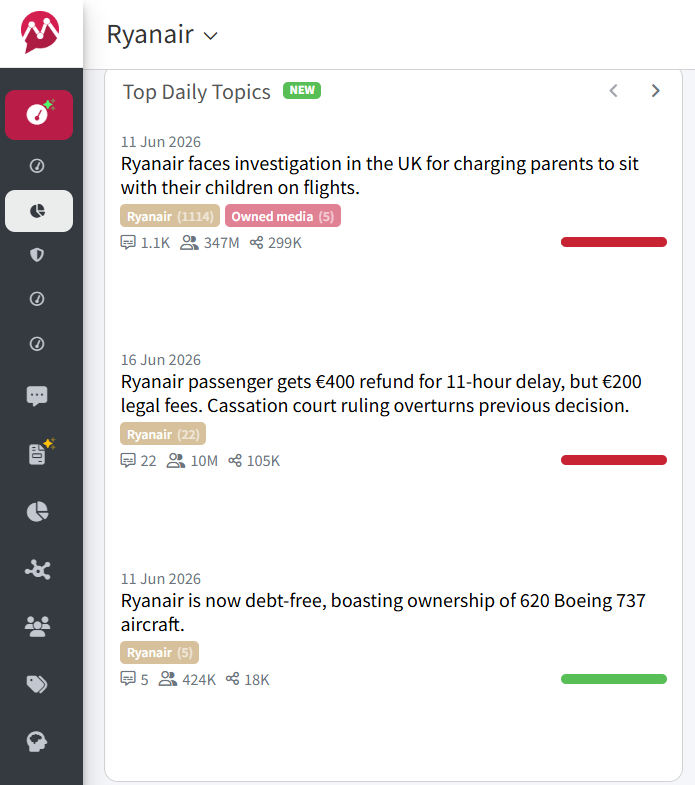
Multiple clients? Do you know who’s saying what about each?
Track their mentions, sentiment, competitors, and reputation with Mentionlytics!
AI visibility tracking
When it comes to checking whether AI answers mention, recommend, or cite your brand, all three tools offer AI visibility tracking, but their methods and available LLMs may differ.
Brandwatch: It enables you to track ChatGPT, Gemini, Claude, Perplexity, DeepSeek, Mistral, Grok, Google AI Overviews, Google AI Mode, Doubao, and Qwen through Trajaan, but the number of available AI models will depend on your plan and the market. It’s a prompt-based tracker, and you can run it daily using AI-suggested queries and prompts based on a topic. As a result, you can see brand representation, competitors, tone, and sources.
Hootsuite: Its LLM Insights allow users to create custom prompts or to use AI-suggested ones, and track changes over time. As a result, you can see mention rate, visibility, position, share of voice, sentiment, and citations. You can track four AI Models: ChatGPT, Gemini, Claude, and Perplexity. LLM Insights is available as an add-on for plans that don’t include Lumen by Talkwalker, while the Enterprise plan includes it.
Mentionlytics: It has four dashboards dedicated to AI visibility — AI visibility overview, AI answers analysis, AI citations analysis, and Deep citation analysis. LLM tracking is prompt-based and gives you the option to choose your own prompts or use AI suggestions based on your niche, industry, brand, and competitors. You can track six AI Models: ChatGPT, Perplexity, Gemini, Copilot, Google AI Overviews, and AI Mode.
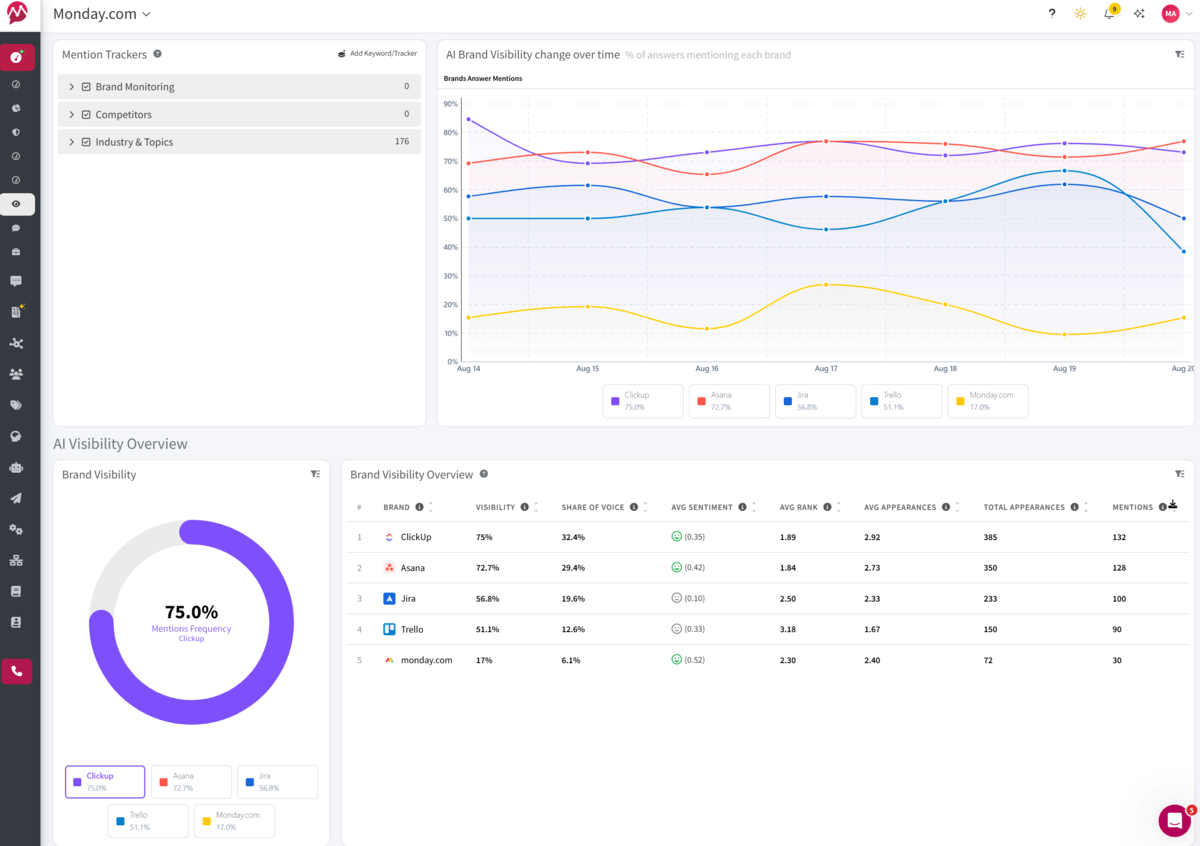
An interesting thing is that you can choose to run your prompts one to four times a day, or weekly, or monthly. All prompt runs are human-like (not through an API), and you can choose the country you want your prompts run in. Insights span from most used domains and citations for specific prompts and LLMs, AI visibility score, mention rate, people and products mentioned alongside your brand, and sentiment, to raw answers. Mentionlytics’ AI visibility tool is available as an add-on for Pro plans and above.
Brandwatch Pricing vs Hootsuite vs Mentionlytics
Pricing comparison, an important part of deciding which tool to choose, might be the trickiest part too, because Brandwatch offers custom pricing, Hootsuite charges per user, and Mentionlytics has transparent pricing. So, when you’re choosing a tool, you’ll probably need to go a step further and put side-by-side social listening capabilities, sources, data insights, accuracy, and whatever your team considers most important, then weigh them against the prices.
Brandwatch: Uses custom quotes with no publicly available subscription rates, but in February 2026, Dawid Jozwiak published a LinkedIn article with prices ranging from $9,600 to $150,000+ per year.
Hootsuite: Starts at $99 per user/month for Standard, followed by Professional at $199 and Advanced at $399, billed annually. Hootsuite offers both monthly and annual subscriptions, but monthly subscriptions cost a bit more. Enterprise pricing is custom. The per-user model matters: three people on Professional cost $597/month, and advanced social listening requires Enterprise access.
Mentionlytics: Starts at $69/month for Basic, followed by Essential at $169, Advanced at $299, Pro at $499, Business at $749, and Enterprise from $1,299, billed monthly. Plans scale by volume and features, with unlimited users from Advanced. And if you opt for an annual subscription, you get two months off.
How much does Hootsuite cost per month?
Hootsuite’s cost depends largely on the number of users and whether you choose month-to-month or annual billing. If you opt for the lowest-tier plan and your team has 3 members, all planning to use the tool, your price will go up from $99 to $297/month, billed annually. If you opt for a monthly subscription, it could go even higher.
Is Hootsuite worth the money?
If you’re managing multiple social media accounts and you’re focused on social media management, then yes, it’s definitely worth the money. But if you are more interested in social listening and AI visibility, Hootsuite alternatives may be a better fit.
How much does Brandwatch cost per month?
Brandwatch doesn’t display its prices publicly, so billing terms depend on the product and contract. While a monthly subscription for Brandwatch’s Social Media Management Essential package is possible, they don’t offer that option for Consumer Intelligence. However, the estimated price for the lowest-tier plan is around $800/month on an annual contract.
Is Brandwatch worth it?
If your team needs detailed consumer research, advanced segmentation, and historical analysis, then yes, Brandwatch can justify the investment. And if you’re more into tracking PR campaigns, or finding journalists, you might want to compare Brandwatch vs Meltwater first. But if you mainly need to track mentions, catch influencer posts and user complaints, send client reports, or have alerts for sentiment shifts, then you may be paying for research capabilities you rarely use.

How much does Mentionlytics cost per month?
Mentionlytics starts at $69 a month, but a yearly subscription is $59 per month, billed annually.
Is Mentionlytics worth it?
If social listening, reputation monitoring, competitor analysis, and AI visibility are your main priorities, Mentionlytics offers a practical balance of features and cost. Unlimited users from the Advanced plan make it particularly useful when several teammates need access, while agencies can get custom reports and separate customer accounts. But if your priority is complex publishing and customer service workflows, you might check other options before deciding.
Free Trial Availability
If you want to compare Mentionlytics vs Hootsuite vs Brandwatch with a self-service trial, you can try only Mentionlytics and Hootsuite for 14 days, since Brandwatch doesn’t offer that option.
Customer Support Comparison
Support quality becomes much more important when a tracker stops collecting mentions or a client’s report is due in an hour. G2 reviews show differences in both response speed and the level of help provided.
Brandwatch: Support is available Monday to Friday and typically responds within 4-24 hours, depending on the package. It offers: support request form, in-app chat, Help Center, Academy courses, and community forum. On review platforms, Brandwatch’s support gets positive feedback for being helpful and responsive, especially from Consumer Intelligence users who need help with sources or integration. However, onboarding isn’t consistently smooth, and users feel the initial demo isn’t enough for setting up the tool.
Hootsuite: Offers in-app chat, support tickets, a Help Center, and support via X/Facebook; their support team is available during weekday business hours across several regions in English, French, and Spanish. But if you check user feedback on review platforms, you’ll see mixed feelings, not directly about the support team, but about how long it takes to resolve an issue.
Mentionlytics: Expert support team is available 24/5 (Monday–Friday) via live chat, phone, or email, with response times under 3 minutes and typical resolution in just 15 minutes. There is also an info-rich Help Center with up-to-date articles about everything on the platform. A dedicated account manager is available for support, depending on the plan you have. Mentionlytics receives particularly positive feedback for responsive, hands-on assistance. Recent G2 reviewers praise helpful account managers, smooth onboarding, and a team willing to join a call when needed.
Which Tool Wins: Brandwatch, Hootsuite or Mentionlytics?
A generic feature list can’t help you choose between Mentionlytics, Hootsuite, and Brandwatch. The best way is to try the tool and see how it fits your needs, but as a starting point, you can take the strongest aspects.
Choose Brandwatch if you need to dig deep into consumer behavior. Its advanced segmentation, flexible queries, and historical archive make it a strong fit for research teams investigating markets, audiences, and long-term trends. Just allow room in your budget and your calendar (for setup and training).
Choose Hootsuite if managing social accounts takes up most of your day. Publishing, approvals, inbox management, and customer care workflows are its strongest reasons to buy. If you also need advanced listening or AI visibility, check the full package price before committing.
Choose Mentionlytics if you’re running an agency or expanding to a new market. It brings reputation monitoring, competitor analysis, AI-powered insights, and reporting together, with accurate sentiment analysis for all languages (even less common ones), which is ideal for market research; unlimited users, white-label reporting, and separate multiple client accounts on higher-tier plans make it a very tempting option for agencies.
