


Here’s a thought: What if finding high-quality backlinks for your clients or website required half the time you’re spending on it now? What if we could show you an easy way to find new backlink opportunities without putting too much effort or using SEO tools?
When you’re just starting out, and you have a brand new website, you’re probably wondering how to find backlinks. No matter how hard you work on link building, the results are not as expected.
On the other hand, we bet your inbox is full of proposals for backlinking if your website has a stronger domain authority (DA). But here’s the catch: they rarely are the ones you’re searching for, and they tend to have a very short life span.
One way or another, the question “How to find new backlinks without spending a fortune” is probably on every SEO and digital marketer’s mind.
And guess what? Backlinks still matter! Yes, they are not as powerful as they used to be, but they are still a ranking factor, providing you with the credibility the AI and Google search engines like.
So, we took “the road not taken” (poetry lovers 😉), and we’re going to show you how to find backlinks using web monitoring!
Table of Contents
What is a Backlink in SEO?
Backlinks are links from other websites to yours. They act like digital “votes of confidence” that tell search engines your content is credible and worth ranking higher in search results.
So, backlinks confirm that your website and your content have value because other websites point to your pages.
For a long time, backlinks were the backbone of SEO. It didn’t matter much where these links were coming from as long as they were numerous and “do-follow”. Yes, “no-follow” links didn’t do any good to your ranking. PageRank would just completely block the flow (link juice) from one website to another.
In 2019 Google updated how it treats nofollow links, making them a “hint” rather than a strict directive. This means Google might still consider the link for ranking purposes if it finds it valuable. This rule still stands.
As for the number of backlinks, that changed as well (announced in 2012 and integrated in 2016), as Google realized it was not the best strategy since a bunch of websites with low-quality content had taken over the first page of search due to numerous links from link-farm websites.
So, with the Penguin update, Google devalued unnatural, spammy backlinks and even penalized websites for manipulative link building. These unnatural links were classified as toxic backlinks. And that was the beginning of the changes we experienced over the years.
While the SEO rules have changed since AI search engines came to the scene, they are still important. AI search optimization is revolutionizing traditional SEO practices, but a strong backlink profile, credible backlinks, and natural anchor text still play an important role in ranking.
Turn Your Unlinked Mentions into Backlinks
Unlinked mentions are a great start for gaining backlinks. Spot yours EVERYWHERE online with Mentionlytics!
What is the Difference Between a Citation and a Backlink?
There’s a thin line between citations and backlinks, but yet crucial.

Backlinks are hyperlinks from another website pointing to yours that directly impact domain authority and organic rankings. Some of the main backlink characteristics are that:
- Backlinks are always a clickable link leading to your site.
- They can be found in blog posts, news articles, forums, and directories.
- They pass SEO value (“link juice”), helping improve your site’s ranking.
- Quality matters — a backlink from an authoritative site is more valuable.
On the other hand, a citation is a mention of your business’s name, address, and phone number (NAP) on the web without necessarily linking back to your website. Citations are mainly used in local SEO.
Some of their main characteristics are:
- Citations can exist without a hyperlink (just a text mention).
- They can be found on business directories, social media profiles, and local listings (e.g., Google Business Profile, Yelp, Yellow Pages).
- They are important for local SEO because Google uses them to verify business legitimacy.
- Citations help improve local search rankings in Google Maps and local packs.
An interesting fact about citations is that they can become your backlinks if you reach out to those who posted non-linked citations and ask them to link them to your website.
✔️ If you’re focused on local SEO, citations help your business appear in Google Maps and local search results.
✔️ If you’re looking for higher rankings in organic search, backlinks are essential.
Do Backlinks Matter Anymore?
And we’re back to every marketer’s question: Is the juice worth a squeeze? Do backlinks matter anymore?
Perhaps it seems the whole traditional SEO strategy is crumbling under the pressure of generative search engines, but you shouldn’t forget that backlinks are still a part of this new approach through the validation they provide.
It is not just for Google ranking; all other search engines rely on these backlinks as references that your content is worthy. While Google still holds the biggest share (around 90%), ChatGPT search appears to have reached 1% in just a few months since its feature launch.
There are 8.5 billion searches daily on Google worldwide, and we know that it’s not the only search engine, which means that more than 85 million daily searches go through ChatGPT. The principle with backlinks and AI search engines is almost the same.
High-quality and relevant backlinks are a ranking factor for generative search engines like ChatGPT; they signal that your content is worth mentioning and recommending.
With all that said, it’s time to learn how to find new backlinks, especially if you’re a beginner.
How to Find Relevant Backlink Opportunities with a Web Monitoring Tool
Backlink opportunities are everywhere — if you know where to look. Instead of following the same old methods, why not explore a smarter, unconventional approach that’s easier and more budget-friendly?
Finding backlinks opportunities is not rocket science. To make this work, you’ll need a web monitoring tool with the right features to help you track brand mentions and uncover backlink prospects.
Let’s take Mentionlytics as an example to see how this strategy works in action.
Monitor Unlinked Brand Mentions & Turn Them Into Backlinks
Here’s the thing — people are talking about your brand, and you might not even know it. These mentions aren’t backlinks (yet), but they could be.
So, how do you find them and turn them into high-quality backlinks?
Let’s break it down.
Step 1: Pick Your Brand Keywords
To track brand mentions, start by choosing the right keywords — this could be your brand name, CEO’s name, product, campaign, or anything closely associated with your brand.
Adding keywords is quick and easy, and you’ll be guided through a simple seven-step setup. Once complete, you’re ready to see your brand mentions in action.
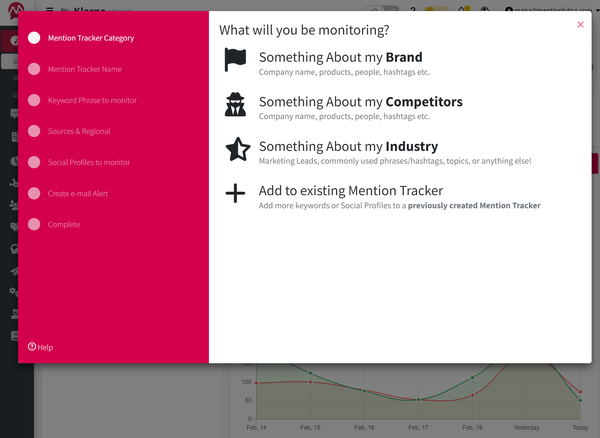
Step 2: Get Results in Seconds
When we say real-time tracking, we mean it. The moment you insert your keywords, results start appearing within seconds.
Your dashboard will display:
- Brand mentions from various sources (blogs, news sites, forums, social networks, etc.)
- Sentiment analysis (are they positive, negative, or neutral?)
- SEO insights – Keyword cloud (what keywords do people associate with your brand?)
- World map (where your mentions come from)
- Emotion analysis (are your mentioners expressing joy, anger, fear, sadness, or even sarcasm?)
and more…
Don’t worry when the screen fills with data — filters let you refine everything in just a few clicks.
Focus on web mentions, blog posts, news articles, and forums to uncover new backlink opportunities.
Step 3: Narrow Down Your Focus
You’ll find the Mentions section on the sidebar of your dashboard. Click on it, then select Web Mentions from the drop-down menu.
Why this matters:
- Your dashboard will now show all your web mentions.
- You can assess their sentiment (positive mentions are your best backlink opportunities).
- You can reach out to authors or publishers and request a backlink to your site.
This allows you to uncover unlinked brand mentions you may not have even known existed — and turn them into high-quality backlinks.
Identify Relevant Brands & Influencers to Pitch Content Collabs
Is your link-building strategy based on content collaborations? If so, you need to find the right brands and influencers to work with! Whether they’re already mentioning your brand — or haven’t discovered it yet — you can use a social listening tool to identify and connect with them.
Mentionlytics is more than just a web monitoring tool — it’s a powerful social listening platform that helps you discover potential brand advocates and collaboration partners.
Let us show you how to do that.
Step 1: Add Industry Keywords
Remember the part where you added relevant keywords (brand name, CEO name, etc.) in the platform in the previous step? Now, you go to Add Keyword again but you insert industry-related keywords, only in a part that says, “Something About my Industry.”
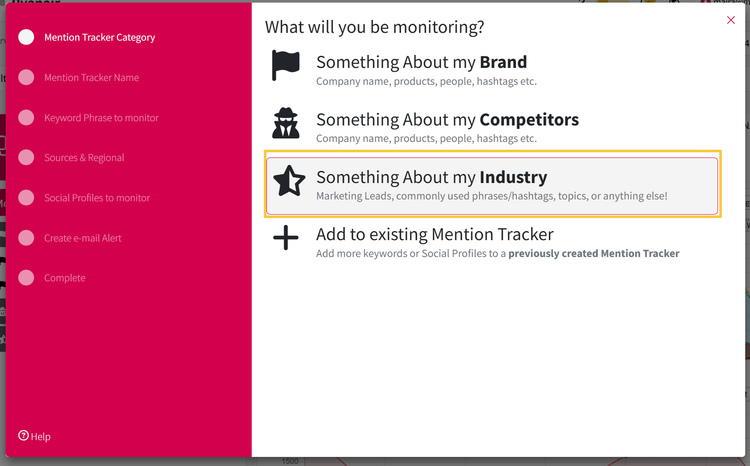
These keywords are important for your industry, as they are repetitive words related to your niche product or service. Remember, it’s not about classic SEO keyword search; you want to find people who are experts in your niche with a strong influence on their followers.
For example, if you work for a cosmetic brand, you can focus on:
- General industry keywords (such as skincare trends, clean beauty, anti-aging treatments, etc.)
- Product-specific keywords (hyaluronic acid moisturizer, organic lipstick, vitamin C serum, etc., depending on your product or campaign)
- Expert and influencer mentions (makeup artist tips, influencer skincare routine, dermatologist-approved skincare, etc.)
- Ethical and sustainability trends (Sustainable beauty brands, plastic-free beauty products, zero-waste packaging in cosmetics, etc.)
Step 2: Explore Top Mentioners
So, once you add your industry keywords, you can see the most relevant and influential people and brands talking about them (or your brand) by using the Top Mentioners feature.
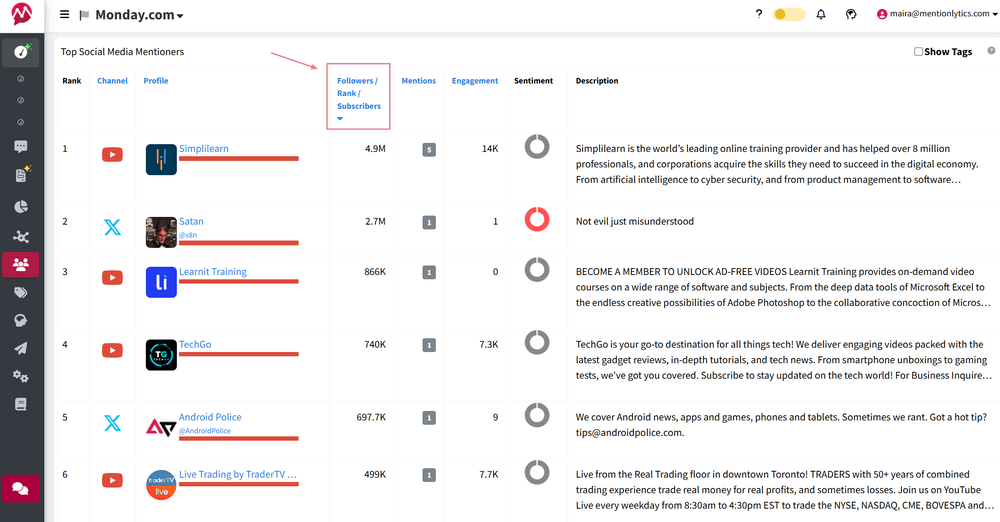
Example of a list of Top Mentioners for Monday.com in Mentionlytics sorted by follower count
You can also see the number of mentions they have created and whether they talk positively or negatively about the topics (or your brand).
But the most important part is that you can filter the results to be sorted by the number of followers. That’s how you don’t have to waste time searching through the whole list — all you have to do is to click on the Followers/Rank/Subscribers column, and they will be sorted by the number of followers from the highest to the lowest.
Not sure if someone is a brand advocate, influencer, or journalist?
- Click on the link with their profile from the provided list
- See how they’ve engaged with your industry
- Check all their relevant mentions in the pop-up window
This way, you can quickly spot potential advocates and collaboration opportunities without spending hours digging through data.
By narrowing your focus to high-impact mentioners, you can identify influencers, potential brand advocates, and collaboration opportunities more effectively.
Step 3: Use AI Mention Clustering
Another way to discover new backlink opportunities is by using Mentionlytics’ AI Mention Clustering — a powerful feature that summarizes all your mentions for your chosen timeframe.
To access it, go to the left-side menu and select AI Mention Clustering.

Example of discussions about Monday.com in Mentionlytics’ AI Mention Clustering
Just like with Top Mentioners, you can refine your results:
- Sort by Engagement, Reach, or Number of Mentions to prioritize high-impact conversations.
- Filter by specific channels if you’re interested in mentions from certain platforms.
- Check the Trackers column to see which keyword is associated with each mention and how many times it appears.
By using AI Mention Clustering, you get a complete overview of your brand’s online presence — helping you spot backlink opportunities faster and reach the right people for collaborations.
For example, you can check which are the hot (but at the same time positively discussed) topics around your brand and industry and then click each cluster to discover the most reputable websites to ask for a backlink.
How Do Beginners Get Backlinks?
Starting from scratch can feel overwhelming, especially when it seems like every established brand already has a head start. But here’s the truth — everyone started somewhere. And while it might feel like you’ll never land a single high-quality backlink, here are a few smart (and budget-friendly) ways to get them.
Spot Already Existing Brand Mentions
Use the unconventional method — use brand monitoring tools and turn those unlinked mentions into your new strong backlinks. Your competitors might use expensive SEO tools to get new links, but this way, you might even get better results (not to mention you’ll save your budget for some other marketing activities).
Don’t forget to check the referring domain, their traffic, and whether they are a good fit for you. Sometimes, a strong DA doesn’t work in the backlinking world if the website comes from a totally different industry.
Write for Other Industry Blogs
If no one knows about your brand, then perhaps the best way to introduce yourself to the world is to create content for other websites from your industry, popularly known as guest blogging.
Now, before you do that, you need to be aware that apart from the good sides, guest blogging also has its less popular side.
Pros of Guest Blogging
- Boosts SEO & Authority – Earns high-quality free backlinks that improve search rankings and credibility.
- Expands Audience & Brand Awareness – Reaches new readers, increasing exposure and potential customers.
- Builds Networking & Thought Leadership – Establishes relationships with industry experts and strengthens brand trust.
Cons of Guest Blogging
- Time-Consuming – Requires research, pitching, writing, and revisions, which can be resource-intensive.
- Risk of Low-Quality Sites – Posting on spammy sites can harm SEO instead of helping it. Make sure to check every website before you reach out for blog posting and outreach only to authoritative websites.
- Limited Control Over Content – Once published, you can’t easily update, repurpose, or remove the content. That’s why you need to use a backlink checker to track whether your links are still in place.
Create High-Quality Content
Yes, it takes time — but content is still king when it comes to earning backlinks.
Not only will Google favor your content and rank it higher in search results (bringing in more organic traffic), but other websites will be more likely to quote, share, and link back to your articles. The more valuable and well-researched your content is, the more backlinks you’ll naturally attract.
Find New Backlink Opportunities with Mentionlytics
There’s no magic shortcut to backlinks — but there is a smarter, more beginner-friendly way to find them. Instead of chasing links the hard way, let the backlinks come to you by discovering where your brand is already being mentioned online.
Your brand is being talked about right now. But are you getting the backlinks you deserve?
With Mentionlytics, you can track every unlinked mention and turn it into a powerful backlink — effortlessly. No extra cost, no wasted opportunities. And the best part? You can try it for free, no strings attached!
Let’s get those backlinks!

