


This is the first-hand experience from our customers on how they, as real brands, use social listening to improve their reputation, positioning, sales, and marketing strategies. We collected the feedback and built a list of the best social listening examples that you could find inspiring.
Sneak peek: One brand increased social engagement by 728% after using social listening to measure brand awareness. Another broke into a market dominated by industry giants before being acquired by Adobe. A third discovered that 90% of conversations about its clients were happening outside their own social media channels.
These aren’t hypothetical success stories.
In this article, we’ll show you real examples of how companies use social listening to solve completely different business challenges, how they did it, and what you can learn from each one.
Table of Contents
- Social Listening Example #1: ContentCal – David vs Goliath Marketing Strategy
- Social Listening Example #2: Videojet – Global Brand, Local Battles
- Social Media Listening Example #3: famille – The Biggest Insight Came from the People Who Weren’t Complaining
- Social Listening Example #4: Impact & Emotions – The 90% Conversation Brands Were Missing
- Social Listening Example #5: Electra Hotels – Brand Reputation Management, Five-Stars, One Unified Dashboard
- Social Media Listening Example #6: Aristotle University of Thessaloniki – Teaching the Next Generation to Read the Internet
- Social Listening Example #7: Customers.ai – From Brand Awareness to 728% More Social Engagement
- Get Started with Social Listening Today
Social Listening Example #1: ContentCal – David vs Goliath Marketing Strategy
What happens when nobody is talking about your brand? ContentCal used social listening to battle this challenge, build trust, increase its Share of Voice, and compete against some of the biggest names in the industry.
ContentCal Example in a Nutshell
About the Company: ContentCal entered the social media management market in 2016, competing against established brands with far larger marketing budgets. Within a year, the company had grown revenue by 300%, before eventually being acquired by Adobe in 2021.
The Challenge: Breaking into a market where the biggest competitors already dominated conversations, media coverage, and customer trust.
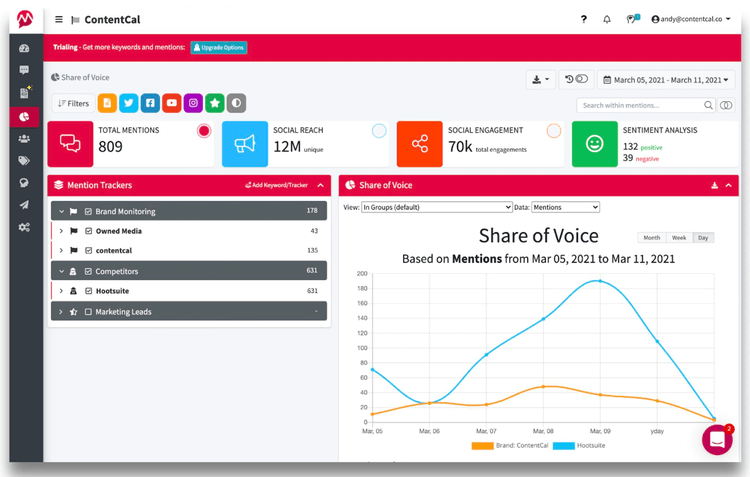
Social Listening Strategy: Using Mentionlytics’ Top Mentioners feature to detect powerful voices within the industry, close influencer partnerships, and establish Share of Voice as a way to measure whether their organic content and influencer partnerships were actually increasing brand visibility, which is one of the most common social listening strategy examples.
The Outcome: By focusing on organic social and content marketing, ContentCal increased brand awareness and captured a significant Share of Voice, helping establish the brand as a serious player in the industry before its acquisition by Adobe.
The Whole Story of ContentCal’s Social Listening Journey
When you run a small business in a niche dominated by industry giants, it’s easy to think you’ve already lost. But ContentCal Director of Growth & Founding Team member, Andy Lambert, saw things differently.
The moment ContentCal started using Mentionlytics as their social listening tool, their first Share of Voice report revealed an uncomfortable truth: almost nobody was talking about ContentCal. The social media conversations belonged to the industry’s biggest players.
And no one trusts the new kid on the block. No one talks about them, and Andy had a vision to change that by increasing the number of mentions.
Andy Lambert, ContentCal Director of Growth & Founding Team member
As part of the strategy, the team used the Top Mentioners feature to detect the most credible influencers in their industry and approach them to form partnerships and boost the brand’s presence across social media channels, which is one of the best examples of social listening strategies.
The strategy worked. As online conversations around ContentCal grew, so did its credibility. Share of Voice became a simple way to measure whether organic marketing was actually creating momentum. By 2021, the company had built a brand strong enough for Adobe to say, “We feel like we know you.” That’s the power of turning conversations into trust.
Social Listening Example #2: Videojet – Global Brand, Local Battles
Managing a global brand is more complex than winning one market; it’s about understanding hundreds of local ones. Videojet used Mentionlytics for social listening to uncover where its marketing efforts were making the biggest impact.
Videojet Example in a Nutshell
About the Company: Videojet Technologies is a global leader in industrial coding and marking solutions, operating in more than 135 countries across 20 industries. In 2024, the company established a dedicated Content & Brand Team to strengthen its global and regional brand performance.
The Challenge: Measuring brand performance across dozens of countries where every market has different competitors, customer behaviors, and levels of brand awareness.
Social Listening Strategy: Using Share of Voice to benchmark Videojet against local and global competitors, monitor brand mentions country by country, and identify where marketing efforts should be increased or adjusted.
The Outcome: Share of Voice became the team’s performance compass, helping prioritize regional marketing activities, inspire localized content, and demonstrate the impact of marketing initiatives to leadership.
The Whole Story of Videojet’s Social Listening Journey
Most brands measure their overall visibility. Videojet wanted something much more specific: How are we performing in Germany compared to Brazil? What about France? Or Southeast Asia?
For Global Brand Manager Melis Celebi, looking only at global numbers would hide local opportunities. That’s why they took a different approach to social listening data. The team created separate competitive landscapes for each country, comparing Videojet against regional competitors while also tracking its global position. Every month, they reviewed Share of Voice by market to identify where the brand was leading, and where it needed more attention.
The insights went far beyond reporting. The team discovered that markets responded differently to their messaging, so they invested more in localized content and targeted marketing activities, from SEO initiatives to regional trade shows. Instead of making sweeping global changes, they focused on small, data-backed improvements that produced measurable results. And that’s the best example of effective social listening.
“So, every month we go through Mentionlytics and select each country. We are reporting the number of mentions versus the number of our competitors’ mentions. And we are tracking our Share of Voice monthly compared to our global Share of Voice.”
Melis Celebi, Global Content and Brand Strategy Manager at Videojet
Social Media Listening Example #3: famille – The Biggest Insight Came from the People Who Weren’t Complaining
The loudest voices don’t always represent the majority. famille used social listening to uncover genuine community concerns and replace assumptions with real evidence.
famille Example in a Nutshell
About the Company: famille is a UK-based sustainable marketing and communications agency that helps charities, councils, master developers, and placemaking organizations develop communication strategies grounded in what communities actually think, not what brands assume they think.
The Challenge: New developments often generate loud negative sentiment on social media, making it difficult to distinguish genuine community concerns from the opinions of a vocal minority.
Social Listening Strategy: Using Mentionlytics, famille mapped conversations across social media, news, forums, and online communities, and got real-time alerts whenever the sentiment suddenly shifts. Besides sentiment, they focused on emotion analysis to fine-tune what the community is truly feeling (anger, joy, fear, etc.) and to address those feelings, as well as the questions, concerns, and voices hidden beneath the noise. For the competitive landscape, they used Share of Voice and Keyword Cloud, and to tie sentiment and emotion analysis to specific locations, they used available geographic data on a world map.
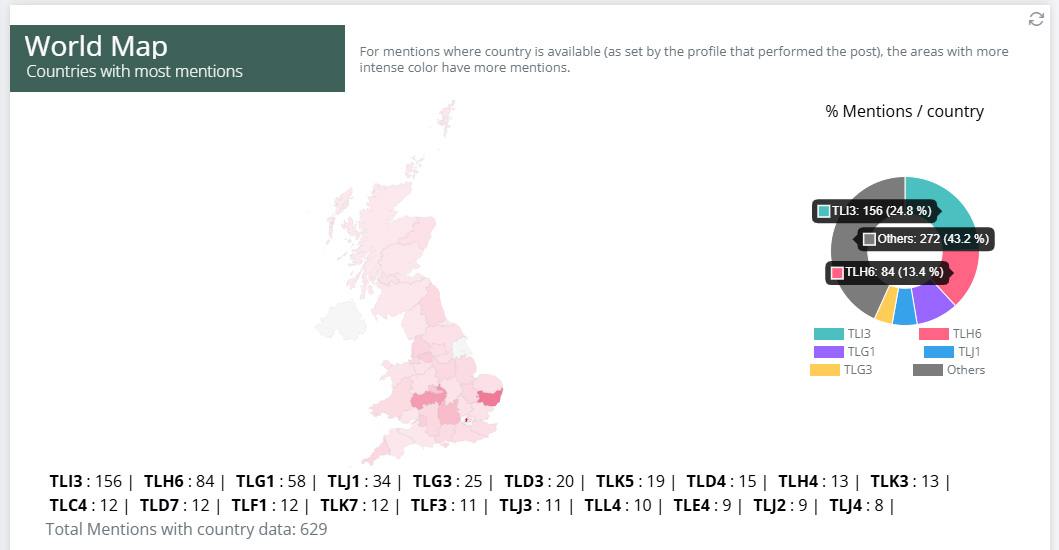
The Outcome: famille transformed these insights into a brand-new consultancy service called Community Listening, helping clients build evidence-based communication strategies and improve sentiment by answering communities’ questions without using too many technical terms, instead tailoring to the target audience.
The Whole Story of famille’s Social Listening Journey
When developers prepare for a new project, they often believe they already know what the community thinks. The loudest social media comments usually dominate meetings, headlines, and decision-making.
But famille discovered something surprising about these social conversations. Behind the negative posts was a much larger group of people who weren’t angry at all. They were simply curious. People had genuine questions about the project, but nobody was answering them, and when they were, the language was too technical.
So, what agencies would typically do is build a communications strategy around silencing criticism, but not famille. The team realized that it’s better to build a strategy around answering the questions the group of neutral voices asked, in a way that engages them and shifts their sentiment toward positivity.
The insight proved so valuable that Community Listening became the first step of every new client engagement, replacing assumptions with real conversations and actionable evidence.
“With Mentionlytics, you don’t have to wait for someone to come to you with a complaint. You can already see what’s forming, and you can shape your strategy around it before it becomes a crisis.”
Debbie Larrad, Founder of famille
Social Listening Example #4: Impact & Emotions – The 90% Conversation Brands Were Missing
Most brands focus on conversations happening on their own social media pages. Impact & Emotions discovered through Mentionlytics that the vast majority were happening somewhere else.
Impact & Emotions Example in a Nutshell
About the Company: Impact & Emotions is a German communications agency specializing in sports sponsorships, helping clubs, athletes, and sponsors understand how fans perceive their partnerships across the web.
The Challenge: Sponsors could measure likes and comments on their own social media pages, but they had no visibility into conversations happening elsewhere when using only Facebook’s official analytics. That meant missing reputation risks, campaign opportunities, and the true impact of sponsorships.
Social Listening Strategy: Using Mentionlytics for deep Facebook monitoring, Keyword Tracking with reduced noise, accurate Sentiment Analysis, Custom Alerts, World Map, and Excel Reports to monitor conversations beyond owned channels, detect potential crises in real time, analyze public perception, and quantify sponsorship performance.
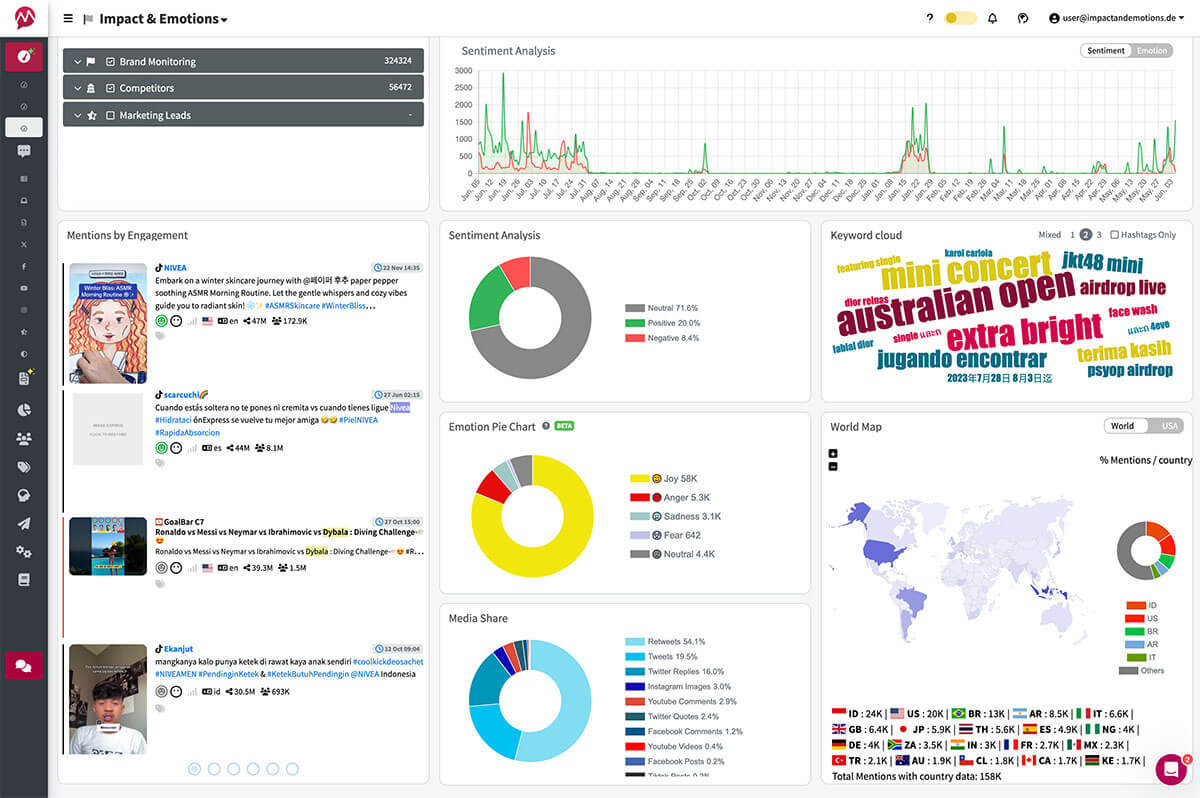
The Outcome: Impact & Emotions transformed social media monitoring into a strategic consulting service, helping clients understand not only what people were saying but why campaigns succeeded, where reputation risks were emerging, and how sponsorships influenced fan engagement.
The Whole Story of Impact & Emotions’ Social Listening Journey
When a football player scores a winning goal, fans celebrate. When the same player becomes involved in a controversy, the sponsor’s logo is suddenly part of the conversation too.
That’s exactly the challenge Pierre Hatje and his team solve every day.
Their clients already knew what was happening on their own Facebook, Instagram, and X accounts. But as Pierre puts it, that was only “the tip of the iceberg.” Most conversations about clubs, athletes, and sponsors were taking place on public Facebook pages, news sites, and across the web, far beyond channels brands controlled.
One of the biggest eye-openers came from the data itself. Up to 90% of all posts and around 80% of total engagement originated from external users rather than the brands’ own social media accounts. In other words, earned media, not owned media, was shaping public perception.
That completely changed how the agency advised its clients. Instead of reporting vanity metrics, they provided valuable social listening insights, such as identifying emerging reputation risks, measuring the real impact of sponsorships, and uncovering opportunities hidden in conversations brands never knew existed.
“Mentionlytics completely changed how we monitor Facebook. We can now create custom panels, easily track keywords, and get great Excel reports. It’s made our job way easier and helps us impress clients with our insights!”
Pierre Hatje, Founder and Marketing Director of Impact & Emotions
Social Listening Example #5: Electra Hotels – Brand Reputation Management, Five-Stars, One Unified Dashboard
When your reputation lives across multiple hotels, review sites, and social platforms, keeping everything under control becomes a challenge. Electra Hotels turned scattered conversations into one unified workflow.
Electra Hotels Example in a Nutshell
About the Company: Electra Hotels & Resorts has been welcoming guests since 1965 and operates multiple luxury properties across Greece. As the brand expanded its digital presence, maintaining the same high standard of customer experience online became just as important as delivering it in person.
The Challenge: Monitoring conversations across multiple hotel properties, social media accounts, review platforms, and competitor brands while ensuring every customer inquiry and reputation issue reached the right team member.
Social Listening Strategy: Using Review Monitoring to collect guest feedback across multiple platforms, Competitor Monitoring and Share of Voice to benchmark market performance, and Task Assignment to ensure every conversation reached the right team member.
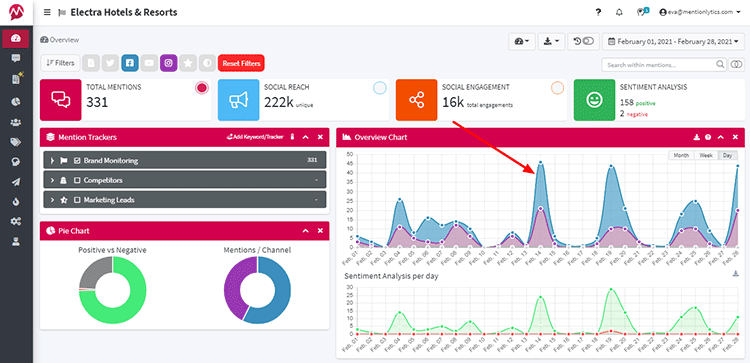
The Outcome: Electra Hotels increased total brand mentions by 57.9%, improved internal collaboration, reduced response times, measured campaign performance more effectively, and strengthened its online reputation across multiple digital channels.
The Whole Story of Electra Hotels’ Social Listening Journey
For Electra Hotels, the challenge wasn’t simply monitoring one hotel. It was keeping track of conversations surrounding multiple properties, hundreds of guest reviews, social media accounts, and competitors, all at the same time.
Before adopting Mentionlytics, the marketing team struggled to consolidate conversations from different platforms into a single workflow. Valuable customer feedback was scattered across review sites, social media, blogs, and forums, making it difficult to respond quickly or identify emerging industry trends.
Once everything was centralized with Mentionlytics, the Electra Hotels’ team could finally see the complete picture. They monitored competitor campaigns to discover which hashtags and topics generated the most engagement, tracked their own Share of Voice to measure market position, and collaborated directly inside the platform by assigning conversations to the appropriate team members.
When unusual spikes in mentions appeared, SIA alerted them before small issues had the chance to become reputation crises.
The impact became especially visible during a Valentine’s Day campaign. By analyzing engagement, reach, and sentiment in a single dashboard, the team discovered that positive sentiment increased by 46.3% and overall engagement grew by 22.4%, providing clear evidence that the campaign resonated with guests.
Keep an Eye on Your Customers’ Reviews
…through multiple channels with Mentionlytics, to maintain a good score and attract more guests.
Social Media Listening Example #6: Aristotle University of Thessaloniki – Teaching the Next Generation to Read the Internet
Today’s marketers need more than theory; they need real data. Aristotle University brought social listening into the classroom to prepare students for the realities of modern marketing.
Aristotle University of Thessaloniki Example in a Nutshell
About the University: The MSc in Strategic Marketing program at the Aristotle University of Thessaloniki (AUTH) is designed to bridge the gap between academic theory and the practical skills today’s marketing professionals need.
The Challenge: Teaching students how to collect, analyze, and interpret large volumes of social media and web data without spending weeks manually gathering information or writing code.
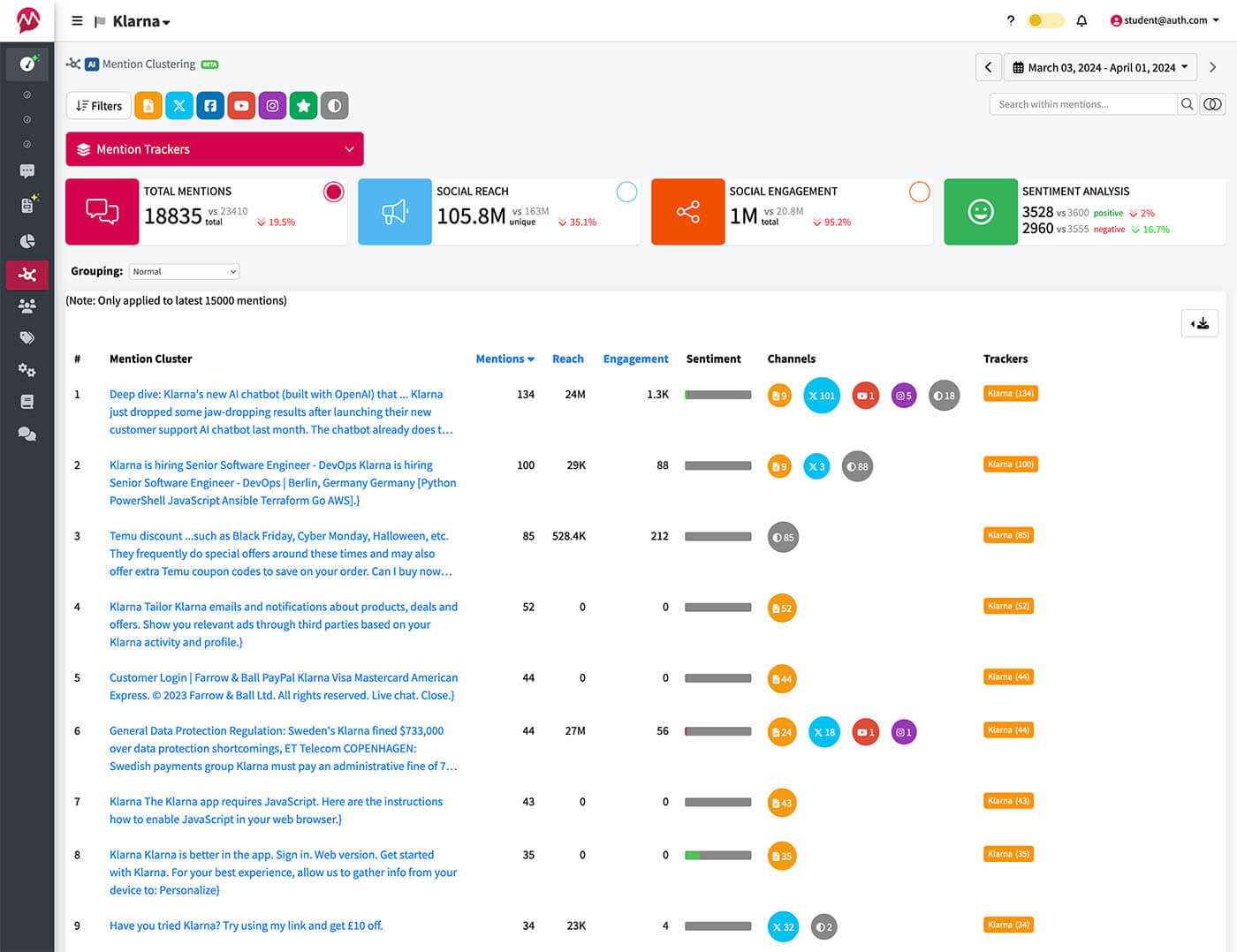
Social Listening Strategy: Using Keyword Monitoring to collect real-world social media data, Sentiment Analysis to help students interpret public opinion, and AI-powered dashboards to transform thousands of online conversations into practical marketing insights.
The Outcome: Students gain hands-on experience with professional social listening software, working with real-world data and developing practical analytical skills that prepare them for careers in digital marketing.
The Whole Story of Aristotle University of Thessaloniki’s Social Listening Journey
Marketing students often spend countless hours collecting data before they can even begin analyzing it. Spreadsheets pile up, social media posts have to be copied manually, and more advanced projects require coding skills that many students haven’t learned yet.
Professor Tsadiras wanted to change that.
Instead of teaching social media analytics through theory alone, Professor Tsadiras introduced Mentionlytics into the MSc curriculum so students could work with the same type of data and tools used by marketing teams and agencies.
Rather than wasting time collecting thousands of mentions, they immediately begin asking the questions that matter: What does this data tell us? Why did sentiment change? Which campaign performed better? What business decision would you make next?
“Without Mentionlytics, students would need to manually collect data from social media or the web… Thanks to Mentionlytics, the data is already gathered and analyzed, which saves them time to focus on more important tasks.”
Dr. Tsadiras Athanasios, Professor of Artificial Intelligence Applications in Business & Economics, Aristotle University of Thessaloniki
It’s a reminder that social listening isn’t just a marketing tool; it’s a marketing skill. And for the next generation of marketers, learning how to turn online conversations into business insights is becoming just as essential as learning SEO, paid advertising, or analytics.
Social Listening Example #7: Customers.ai – From Brand Awareness to 728% More Social Engagement
Brand awareness is easy to talk about but difficult to measure. Customers.ai used social listening to prove that its campaigns were generating real conversations and remarkable results.
Customers.ai Example in a Nutshell
About the Company: Customers.ai is a Boston-based B2B marketing platform that helps businesses identify, engage, and convert anonymous website visitors. As a growing startup, the company invested heavily in webinars, industry events, and thought leadership to establish itself as a recognizable brand.
The Challenge: After launching major initiatives like the Ad Universe Summit, the marketing team needed a reliable way to answer one simple question: Did all this effort actually increase brand awareness? Traditional campaign metrics couldn’t measure conversations happening beyond their own channels.
Social Listening Strategy: Using Brand Mention Monitoring, Sentiment Analysis, Social Reach & Engagement Analytics, Media Share, Share of Voice, Top Influencers, and Mention Trends to track campaign performance, benchmark competitors, identify the highest-performing channels, and uncover unexpected earned media opportunities.
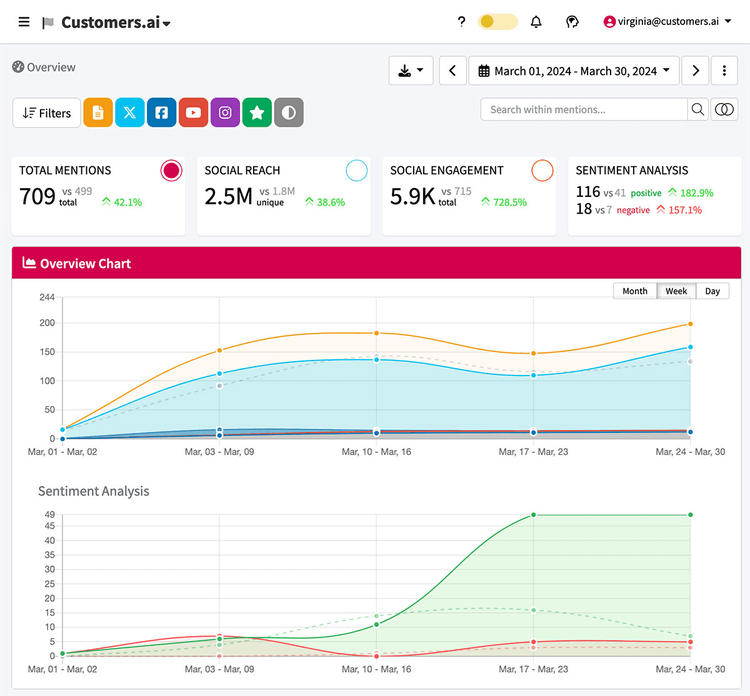
The Outcome: Customers.ai recorded a 42% increase in brand mentions, 38% higher social reach, and an impressive 728% increase in social engagement, while also discovering influencer collaborations and earned media opportunities they would have otherwise missed.
The Whole Story of Customers.ai’s Social Listening Journey
Every startup can confirm that the most challenging step is getting people to notice you and start online conversations about your brand. Customers.ai went a step further, wanting to become a recognized name in the marketing industry.
To get there, the team organized large-scale events featuring more than 20 advertising experts, hoping the discussions would naturally spread across LinkedIn, YouTube, Facebook, and other platforms. But once the event ended, a familiar challenge appeared: How do we measure brand awareness when most conversations happen outside our own social media accounts?
Marketing VP Virginia Nussey turned to Mentionlytics after finding other monitoring tools either out of their budget or too limited.
Instead of manually searching every platform, Virginia could instantly see where people were talking about Customers.ai, which channels generated the most buzz, and how audiences reacted to the campaign. Even mentions where attendees forgot to tag the company were automatically captured, giving the team a much more complete picture of their campaign’s impact.
The biggest surprise came after the campaign had already finished. While reviewing the results across social media platforms, Virginia discovered industry influencers mentioning Customers.ai organically, valuable earned media that could easily have gone unnoticed.
Those conversations opened the door to new relationships and future collaborations, proving that the success of a campaign isn’t just measured by the attention you plan for, but also by the opportunities you didn’t expect.
“We found a YouTube channel that featured us as a top chatbot tool, and the video already had over 3,000 views! It was great to see our brand recognition, but Mentionlytics also revealed a gap in awareness. While our product offers much more than chatbot functionality now, the video only mentioned that aspect. This is a perfect chance to connect with the influencer and share our full range of features. They might be interested in creating an updated video that reflects our current capabilities!”
Virginia Nussey, Customers.ai’s Marketing VP
Get Started with Social Listening Today
What are the key takeaways from this article? First, no two brands use social listening the same way. The social listening examples above are just seven success stories from our customers. Your challenge will probably be different, and that’s exactly why social listening is so powerful. It’s flexible enough to solve problems we haven’t even thought of yet.
In fact, many of our best features exist because our customers challenged us to build them. Their ideas continue to shape how Mentionlytics helps brands discover, understand, and act on online conversations about their brand.
Whether you want to track and analyze customer conversations, measure marketing campaigns, discover user-generated content, monitor competitors, or simply understand where your brand stands in the market, we’d love to help.
Every brand starts with a different question. ContentCal wanted people to start talking. Videojet wanted to win market by market. Electra Hotels wanted to protect its reputation. Customers.ai wanted to prove brand awareness was working.
What’s your question? Start your free trial and let’s find the answer together.
