


AI Share of Voice (AI SoV) measures how often your brand appears in AI-generated recommendations, answers, and citations compared to competitors. It shows how visible your business is inside the AI search engines people increasingly use to research products, compare brands, and make purchase decisions.
In this article, you will learn how to measure your AI Share of Voice accurately, which methods work best, what data you can use in an AI Share of Voice tool, and how to improve your visibility across major AI search platforms.
Table of Contents
- Why AI Share of Voice is Among Essential Marketing Metrics in 2026
- How to Measure AI Share of Voice with Mentionlytics
- 3 Main AI Share of Voice Measurement Methods & Which One to Pick
- How to Improve Your AI Share of Voice Quickly: 10 Expert Tips We Tried
- Track Your Share of Voice on AI Answers Today with Mentionlytics
- FAQ
Why AI Share of Voice is Among Essential Marketing Metrics in 2026
A few years ago, winning online meant ranking first on Google, outperforming competitors in the SERPs, and tracking clicks, traffic, likes, and saves. Those metrics still matter, but many customer journeys now begin somewhere else. Instead of opening a search engine, people ask ChatGPT or Gemini what to buy, where to eat, and which software to choose.
The shift happened almost overnight. If your brand doesn’t show up in AI-generated answers while they repeatedly recommend competitors, potential customers may never discover you. That is where AI Share of Voice comes in.
The concept is similar to traditional Share of Voice, but the battlefield has changed. Instead of measuring visibility across search results, social media, advertising, or online conversations, AI Share of Voice tracks your brand mentions in AI-generated responses.
In May 2026, Google announced that AI Mode had surpassed 1 billion users, with usage doubling every quarter. Instead of acting like a traditional search page, AI Mode reads multiple sources, compares information, summarizes findings, and continues the conversation through follow-up questions.
The search journey is shifting from finding links to receiving recommendations.
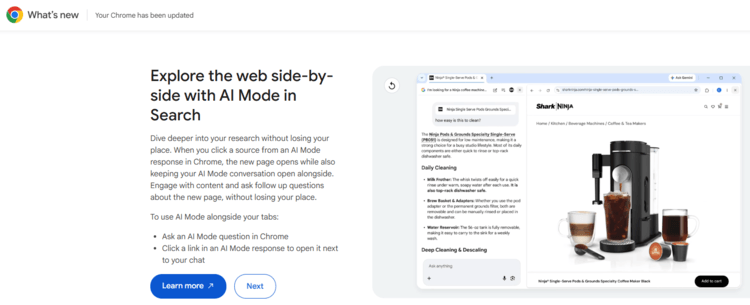
With agentic AI, that journey may become even more hands-off. AI assistants can increasingly research products, compare reviews, evaluate brands, and complete multi-step tasks on a user’s behalf. If your brand is not recognized as a credible option, users may never reach your website or traditional search results.
Around 60% of Google searches already end without a click, as users increasingly find what they need directly on the results page. At the same time, the stats show that brands that are cited in AI Overviews tend to earn 35% more organic clicks because they become part of the recommendation before users decide where to go next.
That is why AI Share of Voice is becoming a critical marketing metric and AI visibility software an important ally for teams to measure success.
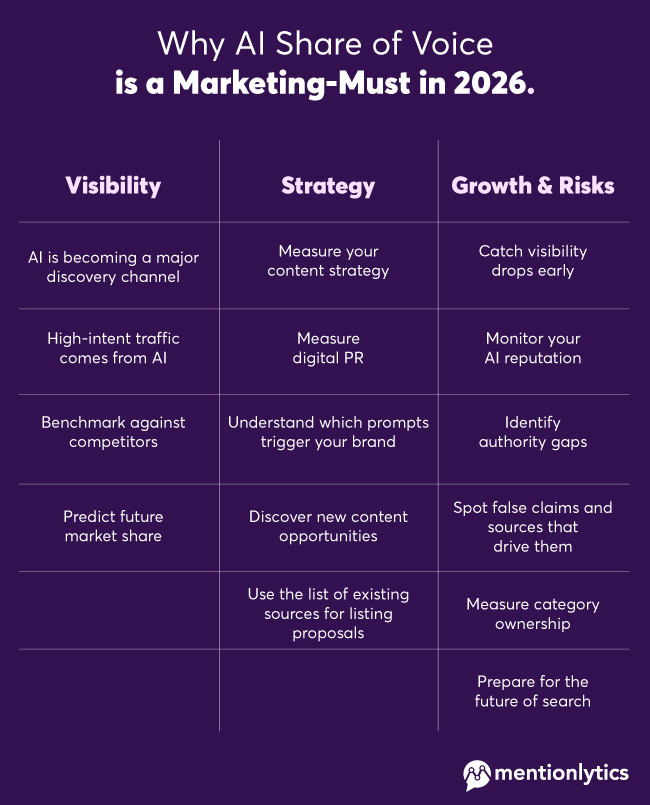
Since AI Share of Voice reveals whether AI platforms consider your brand relevant, trustworthy, and worth recommending, or whether they send customers elsewhere, it can help you:
- Benchmark competitors: See which brands own the largest share of AI-generated recommendations in your category, and find out the percentage of your AI brand mentions for a specific source.
- Find high-value prompts where your brand dominates: Identify the questions and buying intents where your brand appears, and where competitors dominate.
- Measure content and PR impact: Track whether articles, product pages, research, interviews, reviews, and media coverage improve your visibility.
- Spot authority gaps: Discover topics where AI recommends competitors despite your expertise.
- Crisis detection: Spot harmful or even false AI narratives around the prompts and find the content feeding them before it spreads.
- Catch visibility changes early: Detect declines before they become obvious in traffic, leads, or revenue.
- Find content opportunities: Turn weak prompts into new articles, comparison pages, FAQs, product documentation, or campaigns.
- Increase your AI brand visibility: By finding domains, articles, reviews, or Reddit posts that are already used as sources in LLMs and reaching out to them.
- Prepare for the future of search: Rankings still matter, but recommendations and citations increasingly influence brand discovery.
AI Share of Voice does not replace SEO, digital PR, social listening, or brand monitoring. It adds another layer: whether AI understands your brand well enough to include it in the answer.
What is a Good AI SoV Score or Benchmark?
Unlike traditional SEO, there isn’t an industry-wide benchmark for a “good” AI Share of Voice score yet. AI visibility varies by industry, competitors, prompt selection, and even the AI model being measured, making direct comparisons difficult. Research also shows that AI-generated recommendations can vary significantly across platforms and repeated queries.
Instead of aiming for a specific percentage, use AI Share of Voice as a competitive benchmark. Compare your visibility against competitors of a similar size and market position.
Recent research found that during the first scan, household brands achieved an average AI visibility of 73%, while small or niche brands averaged just 11%, highlighting how strongly brand maturity influences AI-generated recommendations.
Track your results over time and focus on increasing your Share of Voice for the prompts that matter most to your business.
How to Measure AI Share of Voice with Mentionlytics
Measuring AI Share of Voice is not as simple as asking ChatGPT one question and counting the brands it mentions. AI-generated answers change by platform, country, prompt wording, and time. The same query may produce different recommendations and citations on another day.
For reliable results, you need a fixed set of prompts, repeated scans, competitor monitoring, and enough data to reveal patterns.
Mentionlytics automates that process by monitoring selected prompts across AI platforms and showing the context behind your AI Share of Voice percentage.
Step 1: Set Up Your AI Visibility Project
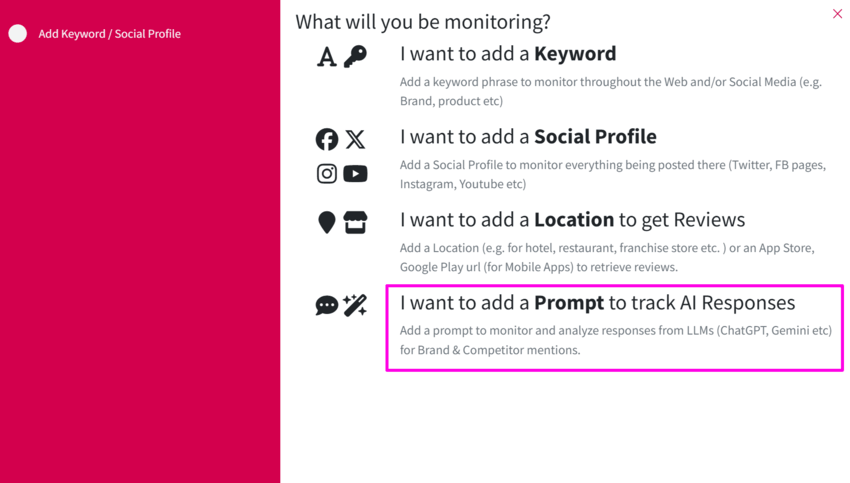
Create an AI Visibility tracker and define:
- your brand, competitors, and industry keywords
- the country you want to generate answers from
- prompt types such as informational, transactional, comparative, and instructional
- custom prompts or prompts generated with the built-in AI Prompt Generator
- AI platforms, including ChatGPT, Perplexity, Gemini, Copilot, Google AI Mode, and Google AI Overviews
- scan frequency: once, twice, or four times daily
Step 2: Let Mentionlytics Collect Enough Data
AI answers are dynamic. One response may include your brand, while the next may change the order, wording, citations, or recommendations.
That is why a single scan is not enough. Mentionlytics repeatedly checks your prompts and builds a larger dataset over time. We don’t use an API; we use prompts to get the most possible human query results, and we do it again and again, which is not a common AI visibility tool approach.
Give the platform several days before drawing conclusions. The more scans you collect, the more reliable your AI Share of Voice, Brand Visibility, Average Rank, sentiment, and prompt-level metrics become.
To view the results in your AI visibility dashboards, select the prompts you want to include, and compare performance after Mentionlytics has run your prompts enough times and collected AI answers.
The AI Share of Voice percentage is only the starting point. Additional metrics explain why your brand is (or is not) winning.
Step 3: Check Your AI Visibility Dashboards in Mentionlytics
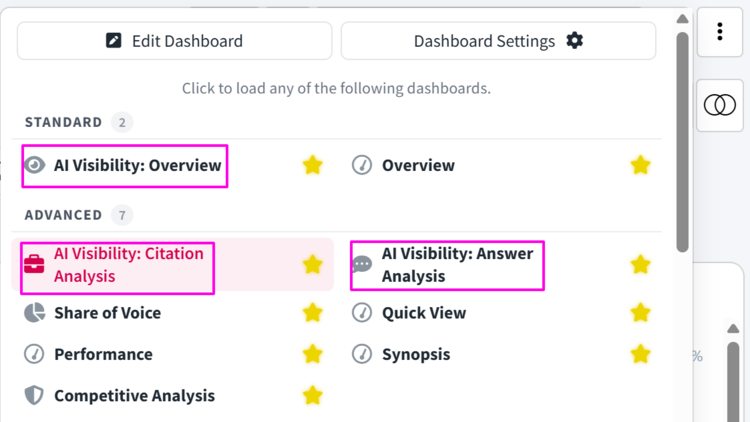
After Mentionlytics gathers the necessary data, it will analyze your AI presence and show you the results through various metrics across three AI visibility dashboards:
- AI Visibility Overview that gives you insights about AI Brand Visibility change over time, AI Share of Voice, Brand Visibility Overview, Brand Visibility per LLM and per Prompt, Domains used as sources for AI answers, and Top URLS for Citation.
- AI Visibility Citations Analysis that shows you Domains used as sources for AI replies, Top Citation domains per Prompt, Brand Visibility per LLM, Source domain citation per LLM, Top URLS for Citation, and Top Citation Domains over time.
- AI Visibility Answer Analysis that shows Brands’ Percentage of Visibility in the AI answers, Brand Visibility per Prompt, Products/Services appearing in answers, People appearing in answers, Companies appearing in answers, and Top Domains Cited in Answers.
Below we analyze the metrics that are most valuable to measuring your Share of Voice in AI search across all three dashboards.
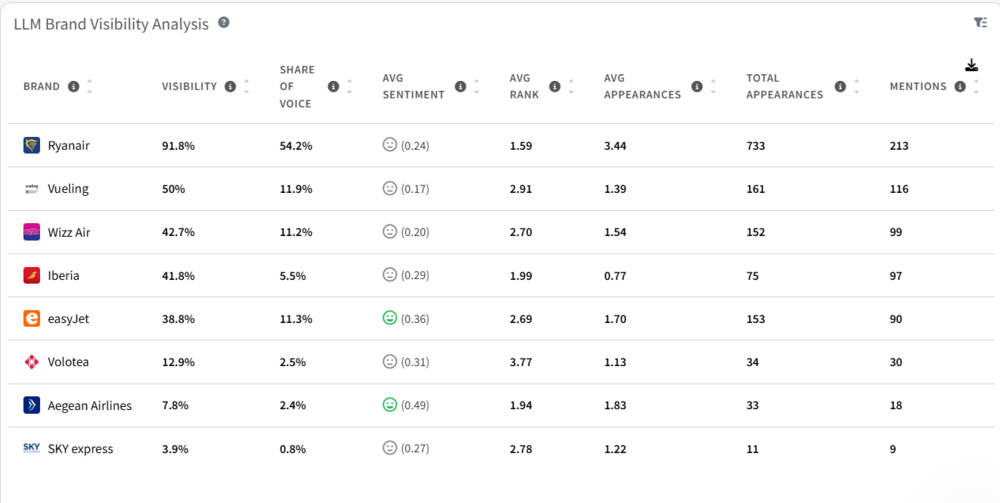
AI Share of Voice
AI Share of Voice shows the percentage of competitive AI visibility your brand owns.
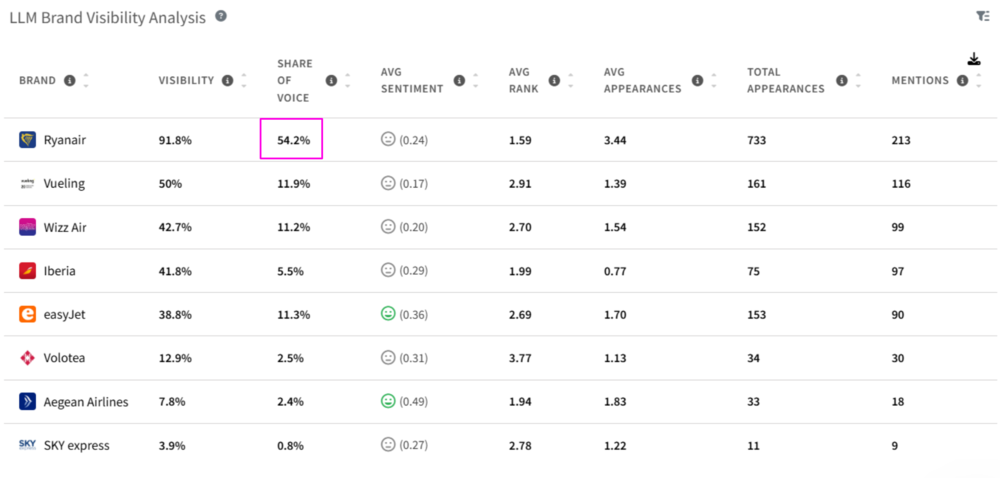
For example, Ryanair has a 54.2% AI Share of Voice in the European airline industry. That is a strong benchmark, but it does not explain how consistently the airline appears.
Brand Visibility
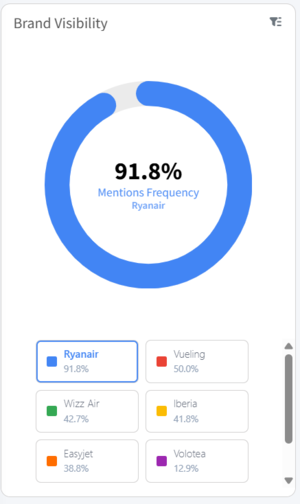
Brand Visibility measures how often your brand is mentioned across all tracked responses. Ryanair appears in 91.8% of relevant AI-generated answers, meaning it is present in nearly every monitored conversation.
Brand Visibility Change Over Time
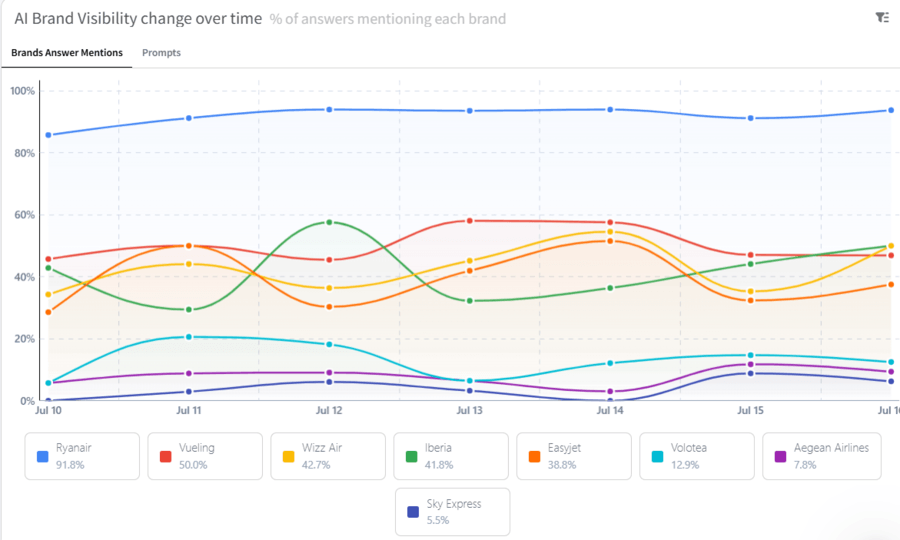
Brand Visibility Change Over Time chart shows whether that presence is rising, falling, or remaining stable. This makes it easier to separate a temporary fluctuation from a meaningful trend.
Average Sentiment
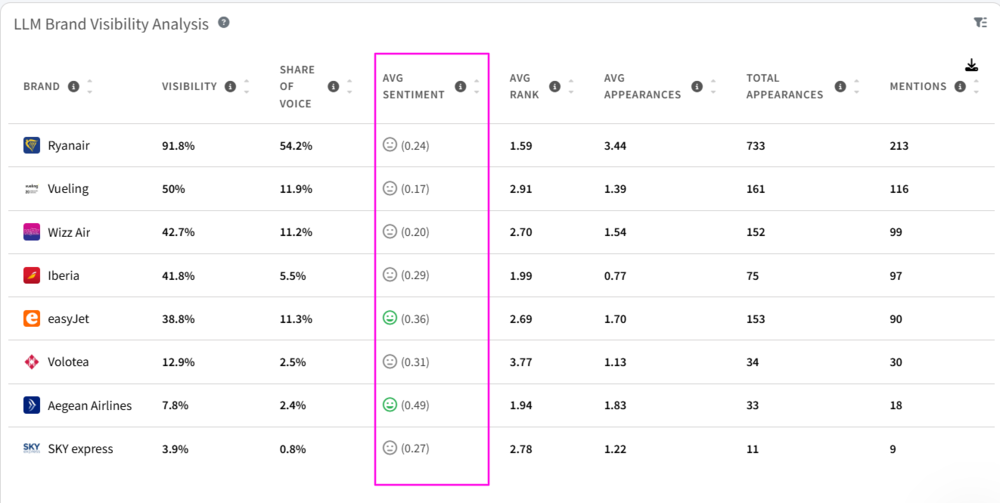
Average Sentiment in Mentionlytics measures the overall tone AI uses when describing your brand on a scale from -1 to +1. In the airline example, Ryanair maintains a largely neutral sentiment, while Aegean Airlines and easyJet achieve the highest positive scores, while Vueling has the lowest (0.17).
Average Rank
Average Rank shows where your brand appears inside AI-generated answers. The lower the score, the earlier the recommendation.
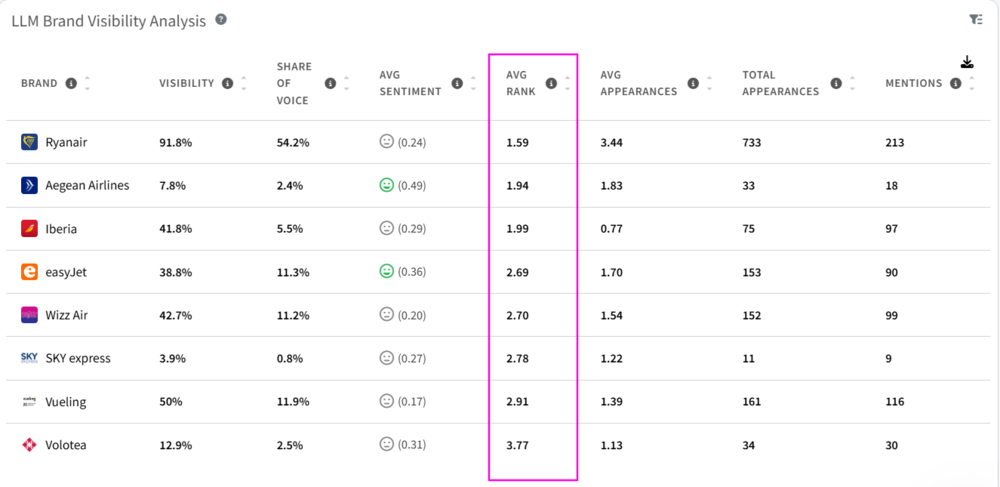
Ryanair achieves an Average Rank of 1.59, meaning it usually appears near the top of the answer, followed by Aegean Airlines and Iberia.
Mentions, Total Appearances, and Average Appearance
You can check the total number of responses where your brand is mentioned (Mentions), how many times your brand is mentioned in total (Total Appearances), and what the average mention of your brand is within one response (Average Appearance).
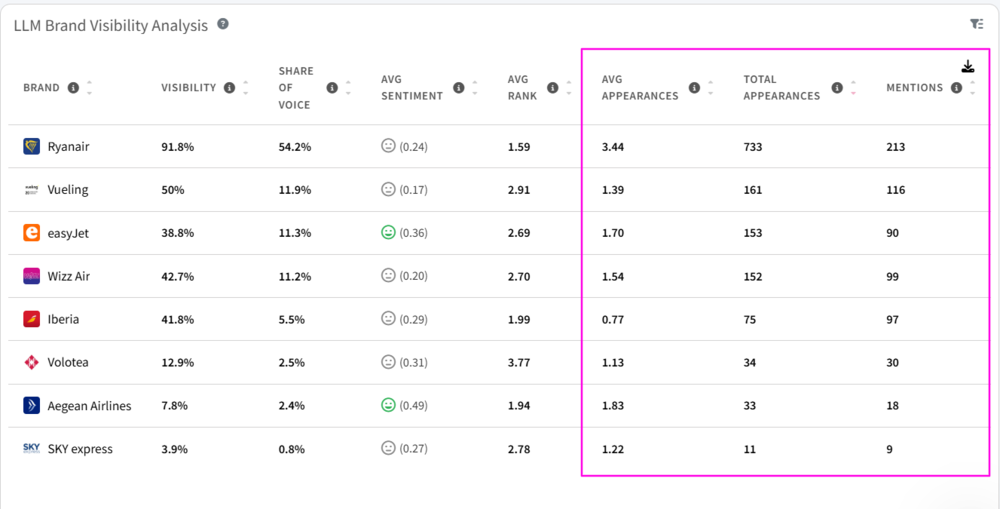
Ryanair averages 3.44 appearances per response, ahead of Aegean Airlines and easyJet. This shows not only whether the brand appears, but how strongly it is represented within each answer.
Brand Visibility per LLM
ChatGPT, Gemini, Perplexity, Copilot, Google AI Mode, and AI Overviews do not always recommend the same brands or use the same sources.
The Brand Visibility per LLM chart reveals where your brand performs best.
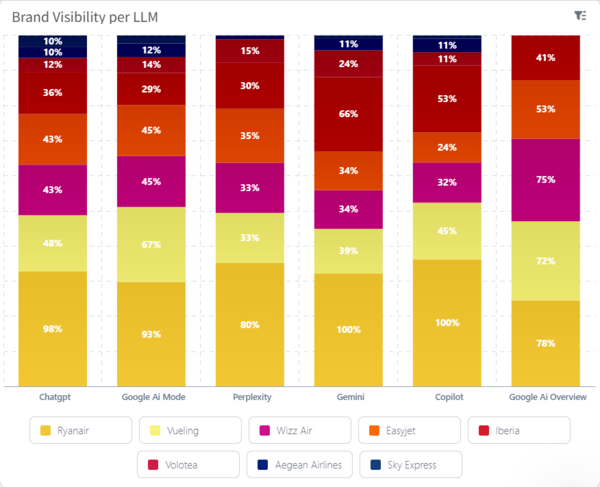
In our example, Ryanair dominates Gemini and Copilot but has its lowest visibility in Google AI Overviews. Sky Express has minimal visibility in Google AI Mode, Perplexity, and AI Overviews.
Wizz Air and Vueling, however, perform almost as well as Ryanair in AI Overviews, with visibility scores of 75% and 72% compared with Ryanair’s 78%.
These differences matter because you should prioritize the platforms your audience actually uses. If ChatGPT, Gemini, and Copilot dominate your market, strong brand performance there may be more valuable than visibility on a less-used model.
Brand Visibility per Prompt
Brand Visibility per Prompt shows how often your brand appears for each monitored question.
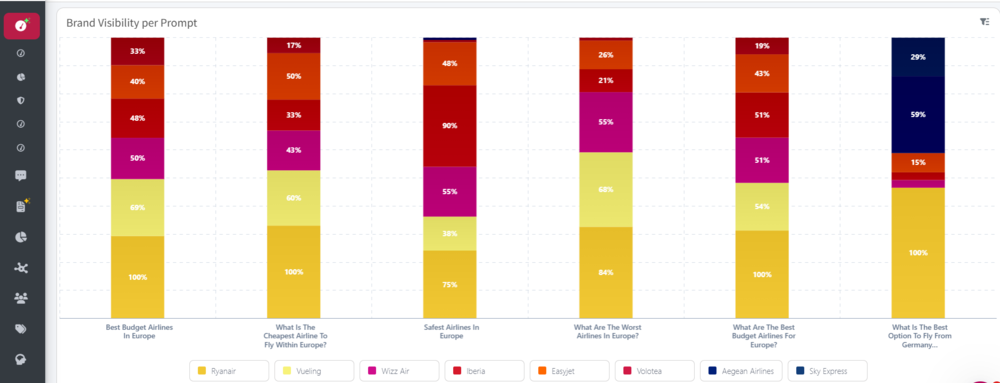
Strong prompts can inspire blog posts, landing pages, campaigns, and product messaging. Weak prompts reveal gaps where competitors have stronger authority.
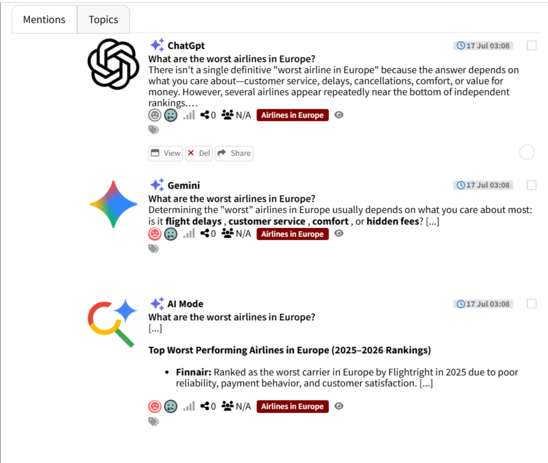
Not every high-visibility prompt is worth celebrating. Ryanair appears in 84% of responses to “What are the worst airline companies in Europe?” The supporting sources include Reddit, review platforms, and YouTube.
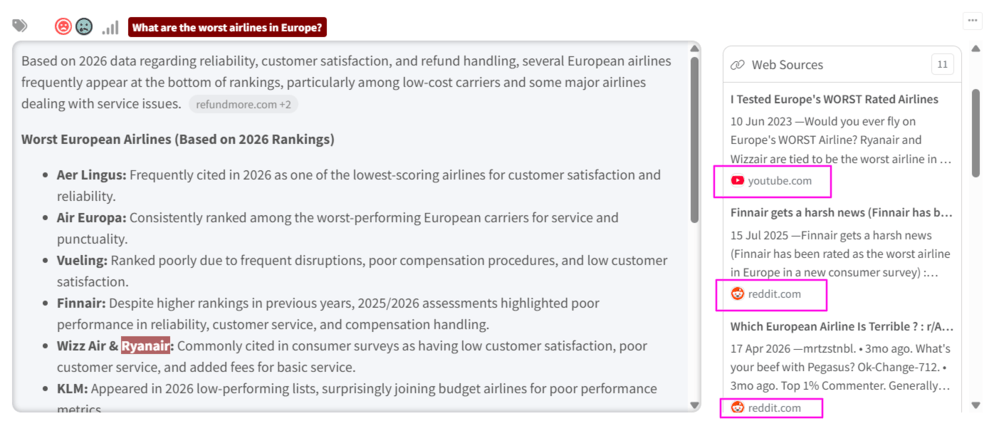
That result is strategically useful, but not flattering. Prompt-level tracking helps you distinguish between visibility you want to grow and visibility you need to manage.
Get Access to Your AI Visibility Insights
Book a quick demo with the Mentionlytics team to see where your brand appears across AI platforms, how it is presented, and where your biggest opportunities lie.
3 Main AI Share of Voice Measurement Methods & Which One to Pick
There is no universal AI Share of Voice standard yet. Some tools count answers containing only a brand name. Others count every appearance, citation, or position. More advanced methods may connect visibility with traffic, conversions, or revenue.
The right approach depends on what you need to learn.
Method 1: Manually Check a Fixed Set of Prompts
The simplest method is to create a relevant prompt list, run each question across several AI platforms, and record the brands that appear.
Use prompts that reflect real customer journeys:
- Informational prompts: “How can brands monitor customer sentiment online?”
- Instructional prompts: “How do I set up social listening for a product launch?”
- Comparative prompts: “What are the best social listening tools for agencies?”
- Transactional prompts: “Which affordable social listening platform should I choose?”
For each answer, record whether your brand appears, which competitors appear, their positions, sentiment, citations, and supporting third-party sources.
A basic calculation is:
AI Share of Voice = Your brand mentions ÷ Total mentions of all tracked brands × 100
If your brand receives 18 mentions and all monitored brands receive 60, your brand’s AI SoV score is 30%.
Manual tracking of brand mentions across platforms gives you valuable qualitative context because you read every answer yourself. However, it is slow, difficult to repeat, and vulnerable to personalization, location, account history, and prompt variation.
Pick manual measurement when:
- You are conducting your first AI visibility audit.
- You have a small number of prompts and competitors.
- You need a quick, low-cost benchmark.
- You want to test which prompts are worth monitoring before paying for a tool.
- You need qualitative examples of how AI describes your brand.
Best for: First audits, small prompt sets, startups, and marketers defining what they want to monitor.
Method 2: Automatically Track Prompts and Competitors Over Time
Automated prompt tracking is the most reliable option for recurring reporting. An AI visibility platform repeatedly runs a controlled prompt set across supported AI platforms, records brand appearances, and compares your results with competitors.
Beyond AI Share of Voice, stronger tools can measure:
- brand visibility in AI models
- average rank or position
- brand sentiment in AI responses
- appearances per answer
- performance by LLM
- visibility by prompt
- citation sources
- competitor changes
- trends over time
This context prevents misleading conclusions. Two brands may have similar AI Share of Voice, but one might appear in nearly every answer at position four, while another appears less often but usually ranks first.
Repeated scans also reduce the influence of one unusually positive or negative response.
Mentionlytics uses this method to monitor prompts across several AI platforms and connect Share of Voice with Brand Visibility, rank, sentiment, appearances, prompt performance, and citation sources.
Pick automated prompt tracking when:
- AI Share of Voice is becoming a recurring KPI.
- You report results monthly, weekly, or after campaigns.
- You monitor several competitors, markets, or product categories.
- You need to compare performance across different LLMs.
- You want to see whether content, PR, review management, or GEO best practices applied actually improve visibility in AI search and AI-generated responses.
- When you don’t have that large team to do AI share of voice analysis manually.
- Your team needs repeatable data rather than interesting screenshots from one ChatGPT session.
Best for: Marketing teams, PR departments, agencies, GEO specialists, and brands that need repeatable competitive data.
Method 3: Connect AI Visibility with Business Outcomes
The most advanced approach connects AI Share of Voice with traffic, leads, conversions, or revenue.
This may involve tracking referral traffic from AI platforms, monitoring branded search growth, adding “How did you hear about us?” fields, comparing visibility changes with pipeline performance, or using controlled landing pages and campaigns.
Attribution remains imperfect because many AI-assisted journeys do not produce a direct, trackable click. Someone may discover your brand in ChatGPT, search for it later, and convert through another channel.
Still, combining AI visibility data with business metrics helps answer the question executives care about most: Does increased AI visibility contribute to growth?
Best for: Established teams with mature analytics, meaningful AI traffic, and the resources to connect visibility with commercial results.
For most businesses, automated tracking should be the foundation. Manual checks provide useful context, while business attribution adds depth once enough data exists.
AI Share of Voice Tracking Tools
You can track AI Share of Voice manually, but spreadsheets become painful once you monitor dozens of prompts, competitors, countries, and AI platforms. Here are several prominent approaches available in 2026:
- Mentionlytics combines automated prompt tracking with broader brand intelligence. It tracks AI SoV and analyzes visibility, rank, sentiment, appearances, individual prompts, LLM performance, competitors, and the sources influencing AI answers. Mentionlytics is particularly relevant for teams that want to connect AI visibility with advanced social listening services, media monitoring, reputation, and competitive intelligence rather than manage AI search as an isolated channel.
- Ahrefs Brand Radar is a strong fit for SEO teams that want AI visibility connected with a large search-backed prompt database. Ahrefs’ Brand Radar tracks hundreds of millions of prompts and supports competitive Share of Voice, cited-page research, historical trends, and custom prompt tracking.
- OtterlyAI focuses on prompt monitoring, brand mentions, website citations, Share of Voice, competitor visibility, and GEO audits. It is suited to SEO and content teams that want a dedicated AI search tracker with citation-level analysis.
- Peec AI measures visibility, average position, sentiment, and Share of Voice across AI answers. Its focused reporting makes it a practical option for marketing teams primarily interested in tracking how often and how prominently brands appear.
- Free AI visibility graders from platforms such as HubSpot and Ahrefs can provide a one-time snapshot. They are useful for initial exploration, but they do not replace continuous monitoring, historical trend analysis, and a carefully controlled set of prompts.
When comparing platforms, check how they calculate Share of Voice in AI answers, which models they support, whether you can control country and scan frequency, and whether they include prompt-level data, sentiment, rankings, citations, historical trends, and exports.
Two tools may return different percentages because they measure different things or have different prompt-running frequencies. The best tool is the one that clearly explains what it tracks and turns the result into something actionable.
Get the Complete Analysis of Your AI Share of Voice
Increase your AI visibility and stay on track with Mentionlytics’ accurate analysis. Become the brand LLMs talk about and recommend.
How to Improve Your AI Share of Voice Quickly: 10 Expert Tips We Tried
After months of testing GEO trends and strategies, one thing became clear: many popular “AI optimization” tips sound sensible but produce little measurable impact.
The ten tactics below earned their place because they consistently improved visibility or revealed practical opportunities.
Expert Tip #1: Hit the Prompts, not the Keywords
AI models often cite Reddit threads, low-authority blogs, and pages that do not rank on Google’s first page. What those sources have in common is relevance: they answer the exact question.
Example: Instead of optimizing only for “PR agency New York,” create content around prompts such as:
- Which PR agency is best for SaaS startups?
- What are the top PR agencies for fintech companies?
- Which PR agencies specialize in crisis management?
- Should I hire a boutique PR agency or a large PR firm?
- What PR agencies have experience with B2B technology brands?
These are the prompts AI assistants receive every day, and they’re far closer to buying intent than a short keyword.
Earned wisdom: One article can rank for hundreds of keywords, but AI answers are generated from questions.
Expert Tip #2: Publish Original Data Because it Beats 10,000 Words
The same websites often appear repeatedly in AI citations even when they are not the largest or highest-authority brands. The common factor is usually original information.
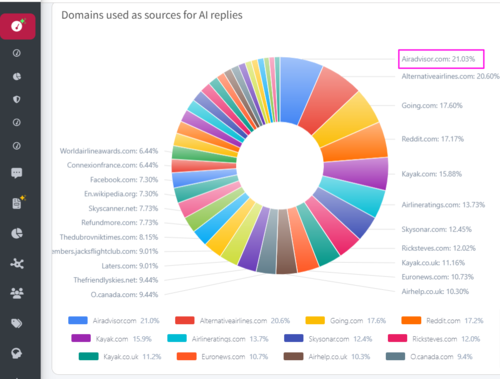
Example: In the Ryanair case, AirAdvisor is the most-cited source at 21.03%. Its domain authority is 56, yet its original research on Europe’s cheapest airlines made it highly useful to AI models.
Earned wisdom: AI can summarize existing information. It still needs someone to create the facts.
Expert Tip #3: Check the Sources – Every AI Model Has Its Own Trusted Sources
When we first began analyzing the sources behind AI-generated answers, we expected to find a single universal pattern. Instead, every AI model seemed to build trust differently.
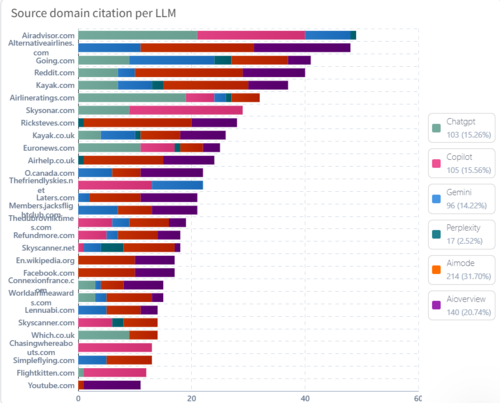
Example: In our airline example, specialized websites such as AirAdvisor, Alternative Airlines, Going, AirlineRatings, Kayak, and Skyscanner appeared frequently, but the source mix changed across ChatGPT, Gemini, Copilot, Perplexity, AI Mode, and AI Overviews.
If ChatGPT matters most to your audience, study the domains it cites and prioritize those publications, directories, communities, and review sites.
Earned wisdom: Do not optimize for “AI” in general. Optimize for the source ecosystem trusted by the AI platforms your audience uses.
Expert #4: Publish Comparison Pages, They Are AI Magnets
People rarely ask AI to define a product category anymore. Instead, they ask it to help them make a decision.
Should I choose A or B? Is there a better alternative? What’s the difference? Which one offers better value? In fact, 53% of users say they use AI for comparing products they’re already considering. These are exactly the kinds of questions LLMs are built to answer.
Example: Very few people open ChatGPT and type: “Email marketing software.”
Instead, they ask questions like:
- Mailchimp vs Klaviyo
- Best Mailchimp alternatives
- Which email marketing platform is best for ecommerce?
- Is Mailchimp worth the price?
- ConvertKit or Mailchimp for creators?
Comparison and alternative pages naturally match this intent. They also give AI structured information about pricing, features, strengths, weaknesses, and ideal use cases.
Earned wisdom: When you’re writing comparison pages, make sure you do the research, try the tools (if possible), and write it as first-hand experience.
Expert Tip #5: Stop Sending Mixed Signals
Keep your positioning consistent across your website, product pages, social profiles, directories, reviews, and media coverage.
AI struggles when a brand describes itself differently everywhere.
Example: Imagine a company whose homepage calls it an all-in-one business platform, LinkedIn describes it as an AI workflow tool, G2 lists it as an integration platform, and press releases position it as enterprise data software.
When someone asks for the best Shopify integration platform, which description should AI trust?
Earned wisdom: If people can’t consistently describe your brand in one sentence, AI probably can’t either.
Expert Tip #6: Get Featured Where AI Is Already Looking
One of the biggest advantages of tracking AI Share of Voice and a brand’s visibility in AI-generated responses is that you no longer have to guess where to invest your PR or content efforts. Your dashboard already tells you.
The Top URLs for Citation report reveals the exact pages AI models repeatedly use when answering questions about your industry.
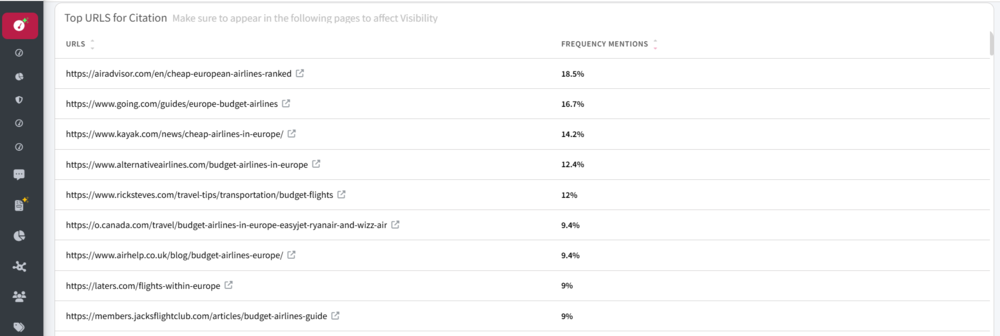
Example: Suppose you run a B2B SaaS marketing agency and want to appear when users ask for the best agencies for SaaS startups. Instead of guessing which websites deserve outreach, review the URLs AI already cites.
That may lead to expert contributions, agency directories, original research, interviews, or relationships with journalists covering your category.
Earned wisdom: Don’t build authority in places that might influence AI. Start with the places that already do.
Expert Tip #7: Check Social Media for Your Brand Mentions, It Isn’t Just for Engagement Anymore
Our citation reports repeatedly surfaced YouTube, Reddit, and Facebook alongside blogs, reviews, and editorial publications.
Example: A financial advisor’s website may explain retirement planning, but AI could also use a YouTube tutorial, a Reddit AMA, or a useful Facebook discussion when answering investment questions.
Not every social post will influence AI. However, useful conversations, expert explanations, and active communities expand the digital footprint AI can use to understand your brand.
Earned wisdom: Social content can become a source, not merely an engagement asset.
Expert Tip #8: Get Your Brand on Wikipedia
In our experience, Wikipedia citations came from Google AI Mode and AI Overviews, with nearly 60% coming from AI Mode and the rest from AI Overviews.
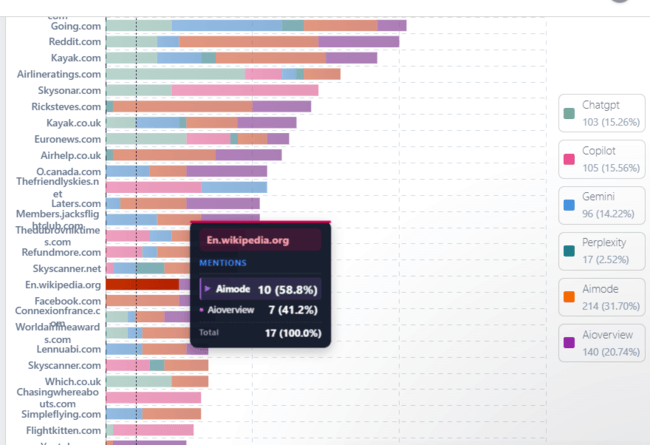
Example: For established companies that meet Wikipedia’s notability requirements, an accurate and neutral page can help Google’s AI systems understand the company’s history, products, and industry relevance.
This is not an invitation to create a promotional page. Businesses need independent coverage and genuine notability.
Earned wisdom: If established news outlets don’t talk about you, the chances of getting your page on Wikipedia are slim.
Expert Tip #9: Refresh the Content AI Already Knows
Pages do not remain accurate forever. Pricing changes, products evolve, competitors add features, and statistics become outdated.
Example: An HR software guide published in 2024 may still earn links and AI citations in 2026, but incorrect pricing and obsolete comparisons weaken its value.
Before publishing another similar article, update the existing page with current data, screenshots, products, and conclusions.
Earned wisdom: The pages that performed best over time weren’t necessarily the newest. They were the ones that stayed accurate.
Expert Tip #10: Don’t Forget Your Product Pages
AI-generated recommendations can bring visitors to your website, but your product pages still need to support the promise made in the answer.
We did not frequently see product pages among the citation sources in our dataset. Their role comes later: users arrive looking for the feature, use case, price, or capability the AI model described.
If that information is buried, outdated, or difficult to verify, the recommendation may generate a visit without generating confidence.
Create a clear page for each product, feature, or solution, and make sure users can quickly confirm what the product does.
Earned wisdom: AI may introduce the customer. Your product page still has to close the gap between recommendation and reality.
Why This Works: Factors With the Highest Influence on AI Share of Voice
Although AI companies don’t disclose exactly how their ranking systems work, testing and industry research point to several factors that consistently influence whether a brand appears in AI-generated answers.
Together, they determine how visible your brand becomes across platforms like ChatGPT, Google AI Mode, Gemini, Copilot, and Perplexity:
- Content relevance: AI prioritizes pages that directly answer user questions and match search intent rather than simply targeting keywords.
- Authority and trust: Strong backlinks, digital PR, expert content, reputable citations, and positive brand reputation help AI recognize trustworthy sources.
- Original information: First-hand research, case studies, proprietary data, and unique insights give AI a reason to cite your content over competitors’.
- Citation ecosystem: Mentions across trusted websites, review platforms, Reddit, YouTube, news outlets, forums, and directories strengthen your brand’s credibility.
- Brand clarity: Consistent messaging about who you are, what you offer, and who you serve makes it easier for AI to understand and recommend your business.
- Freshness: Updated statistics, pricing, product information, and refreshed content improve the likelihood of remaining relevant in AI-generated answers.
- Brand reputation: Consistent recognition and positive mentions across the web reinforce your authority and increase your chances of appearing in AI recommendations.
The exact weighting varies between AI models, but brands that perform well across these seven areas are generally more likely to increase both their AI Visibility and AI Share of Voice.
If I had to summarize AI visibility into one framework, it would look like this:
| Pillar | What AI is asking |
| Relevance | Does this answer the question? |
| Authority | Can I trust this source? |
| Originality | Does it add something new? |
| Citation Ecosystem | Do other trusted sources reference it? |
| Brand Clarity | Do I understand what this company does? |
| Freshness | Is the information still accurate? |
| Reputation | Is this brand consistently recognized across the web? |
Track Your Share of Voice on AI Answers Today with Mentionlytics
Still wondering where the organic traffic disappeared?
Your competitors are probably already appearing in AI-generated answers. The question is whether your brand is there with them. Take a leap of faith and check it.
Track the prompts, platforms, competitors, rankings, sentiment, and sources shaping your AI visibility and your Share of Voice in AI search with Mentionlytics and use every competitive advantage. Talk to our team today.
FAQ
What is AI share of voice?
AI Share of Voice measures how often your brand appears in AI-generated answers compared to competitors. Instead of tracking only traditional search rankings, it measures visibility across platforms such as ChatGPT, Gemini, Copilot, Perplexity, Google AI Mode, and AI Overviews.
How to track AI share of voice?
You can track AI Share of Voice manually by running a fixed prompt set and recording brand mentions, positions, sentiment, and citations. A dedicated AI visibility tool is more reliable because it repeatedly monitors prompts across several AI models and compares results over time.
What are some GEO tools for tracking AI share of voice?
Popular GEO and AI visibility tools include Mentionlytics, Ahrefs Brand Radar, Semrush AI Visibility Toolkit, OtterlyAI, and Peec AI. They differ in supported models, AI Share of Voice calculations, prompt controls, citation analysis, historical tracking, and competitor reporting.
