

Marketing in the entertainment industry today is a massive vehicle. Your favorite streamer, your favorite video game, and your favorite guilty pleasure show on an Over-the-Top (OTT) platform (*subtle nod to You*) — these are all cogs in what is a fast-evolving, revenue-oriented landscape.
In fact, the entertainment ecosystem has an annual growth rate of 10.64% and is expected to hit a whopping US$53.13 bn. by the year 2027.
In a world that’s so easily changeable, connecting with the audience is the best competitive advantage you can have. And what better way to leverage this advantage than through a carefully crafted marketing strategy?
In this article, we explore the relevance of marketing within the entertainment business and how you can stay ahead of the game with 5 must-know tips.
Table of Contents
How is marketing used in the entertainment industry?
Are you familiar with British Vogue’s ‘In the Bag’ series?
For the uninitiated, these are 5-10 minute long videos featuring a celebrity giving the audience a sneak peek into what they carry inside their bags. They are immensely popular and generate over a million views within hours of posting.

Source: YouTube
Marketing is used in the entertainment industry in various ways. The core of a good marketing initiative is to create content the audience can engage with, which then creates a launchpad for driving conversions.
Just like with the ‘In the Bag’ series, a good marketing initiative will transform a viewing experience into an immersive journey, allowing the viewer to experience emotions such as anticipation and emotional resonance.
Think behind-the-scenes (BTS) content of your favorite movies, cannily edited teaser campaigns, and BuzzFeed’s puppy interviews. The magic of marketing!
Why entertainment brands need strong marketing strategies
Entertainment brands, specifically, are often defined by how they are perceived. The need for a strong marketing strategy can be laid out through a few key factors.
To stand out in a crowded market
The entertainment industry has always been, shall we say, a bit crowded.
With the advent and exponential rise of OTT and live-stream platforms, the sea has turned into an ocean. An ocean of options to choose from. Naturally, this also intensifies the competition.
Not only do you need to effectively capture the attention of a viewer, but your marketing strategy should also lay out why you’re a viable choice.
Take Marvel Studios, for instance. A leading film and television company, it has produced 4 of the top 10 highest-grossing films of all time and broke many box-office records with Avengers: Infinity War (2018) and Avengers: Endgame (2019).
However, consistently maintaining success is a tricky task. MCU’s legions of fans complained, in fact, of the excessive content being pushed out by the studio.
With an enterprise that has a seemingly endless number of fictional (and beloved) characters under their banners, how to choose which ones to focus on?
The answer lies in tracking audience sentiment to get to the root of what your audience is feeling and give them what they want. That’s exactly what Marvel did and made their strategy one of the finest examples of actionable social listening.
Meeting audience expectations can sometimes be a gamble but social listening allows you to get to the crux of the issue from a marketing perspective.
Discover What Your Audience Really Wants
Start with social listening with Mentionlytics today and discover what content truly resonates with your audience!
To generate buzz and anticipation
Sometimes the lead-up to an experience works to elevate the experience. The buzz around an upcoming release has always been a canny sales tool. It generates excitement and anticipation that, in turn, drives ticket sales, album purchases, and general viewership.
The lead-up has been transformed in the last few years — transitioning into a full-blown community experience that is as relevant in pop culture history as the main experience itself.
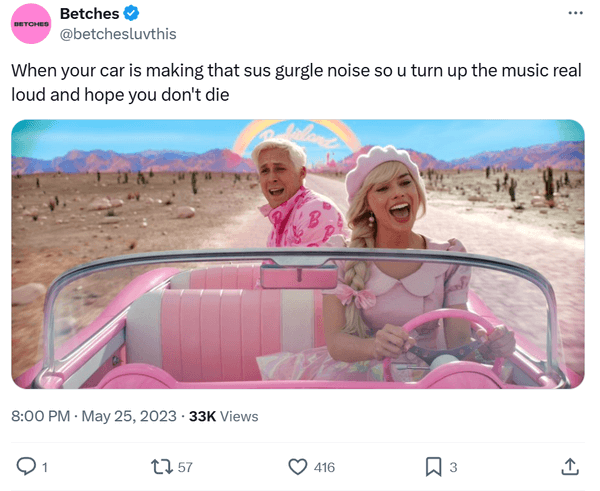
Let’s throw it back to the marketing campaign for the Barbie movie last year.
The powder pink synonymous with Barbie was everywhere, the Barbie Beach House could be rented out on Airbnb, and ‘Barbie-core’ had well and truly taken over the world of fashion.
A classic use of the breadcrumb strategy, the makers used little bits of the film to draw the audience in.
End results? A box-office collection of $155M on opening weekend alone, an army of viewers arrayed in pink, and an unforgettable time in film history. More than just a meme, eh?
Source: Bored Panda
To drive revenue
Just like with the Barbie campaign, good returns are mandatory for an effective marketing strategy. A well-executed strategy can have a long-term impact, such as on a brand’s bottom line through more subscriptions and sales.
Do you know which entertainment brand does great marketing? Netflix, of course!
Netflix uses a customer-centric, data-oriented strategy to market its original content and drive revenue. This involves a combination of hype signals, paid, owned, and earned media, user-generated content (UGC), partnerships, and omnichannel marketing.
Wednesday, Stranger Things, Emily in Paris — all financial successes and brilliant case studies for audience engagement. The marketing campaigns of all three shows were elaborate and meticulously thought out.
The marketing team behind Wednesday implemented shock marketing successfully. The team of Stranger Things has zeroed in on retro-inspired merch to invoke nostalgia. Emily in Paris focused heavily on influencer marketing to echo the show’s central theme.
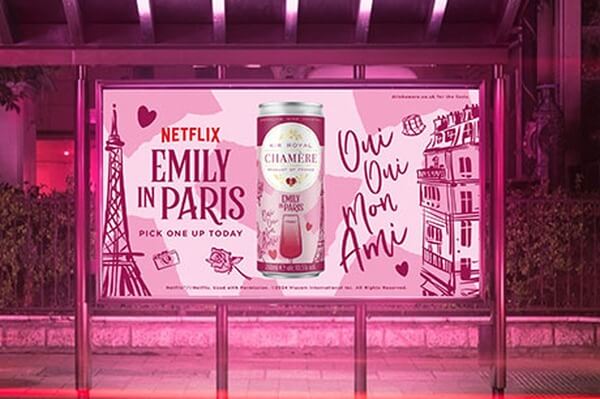
From leveraging influencer marketing to lucrative brand partnerships, Emily in Paris uses a robust marketing strategy to generate audience interest and engagement. A show-inspired cocktail, for example, allows fans to engage with the world of Emily more tangibly.
To be specific, the producers of Emily in Paris partnered with Quintessential Brands to bring to life Chamere, a Kir Royal cocktail featured on the show. What a clever way to bolster emotional connection!
Source: TRBusiness
All the featured examples draw from the theme of the show to create marketing strategies that are unique and audience-focused.
This is exactly where social listening comes in to help you tie in audience preferences with creative direction to build a memorable experience.
In fact, social listening can not only uncover what your audience truly likes but also help you discover trends and other insights to improve your marketing campaigns.
We’ve got some tips on that below.
5 social listening tips for compelling marketing in the entertainment industry
What makes a strategy compelling? The simplest and most effective answer: It has the ability to form a connection with the target audience.
That is exactly what social listening is designed for. To get to the pulse of what an audience group is feeling, ideating, and talking about. Once you’ve tapped into that, you can design communication that addresses their pain points.
Let’s see what you can do with social listening for your entertainment brand.
1. Understand your target audience’s content preferences
Conversations are revelatory. Social listening capitalizes on that and uses audience interactions as a foundational metric.
The sentiment around a particular piece of content is reflective of whether the audience resonates with it. If the sentiment is positive, you can hone in and replicate this content to keep the interest alive!
Good content, structurally, should have the ability to address user pain points and add some value to every stage in the customer’s decision-making journey. Social listening will get you to the finish line faster.
Let’s say you want to analyze and track the audience’s perception of your latest BTS video.
With a social listening tool like Mentionlytics, you can have a sentiment analysis chart ready in seconds to see which sentiment prevails: positive or negative.
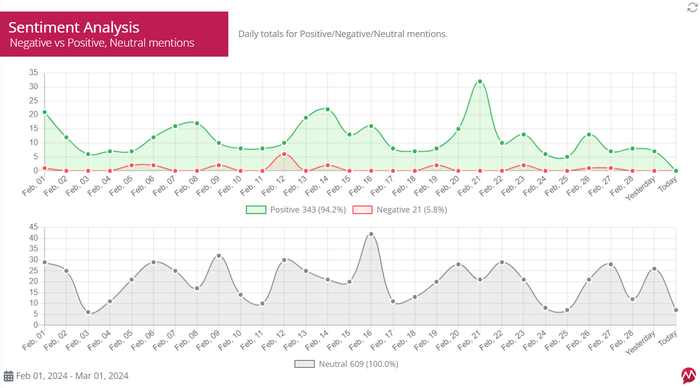
You can easily assess if you have a hit on your hands or if you need to try a different approach next time.
2. Keep up with trends in your niche
Keeping up with the Kardashians. A show we’re all familiar with in some quantity is an exercise in relevance. Can a family continue to be relevant despite the passage of time? The answer seems to be yes.
There are many reasons that can be ascribed to the show’s longevity. Our favorite is that it deftly capitalized on (nearly all) trends, leveraging popular culture for — you got it — popularity!
So except for discovering your audience’s sentiment, you can use social listening tools to research and track trends.
For entertainment marketers, like you, this is especially useful. You can use hashtag tracking to stay abreast of the latest in pop culture — inserting it within your strategies as you deem fit.

A culturally relevant post has the potential to make headway in a previously untapped audience segment. Once you’ve drawn a fresh audience in, you can use company-driven content to drive the value proposition of your brand home.
For example, you can tap into memes and gifs! Leveraging humor is a great trick for establishing common ground, and using it to drive further connection with your audience.
3. Engage in online conversations
One of the key facets of building a satisfactory end-user experience is community creation.
Not only is it essential for laying a foundation for gradual customer loyalty and trust, but it also serves as a good vantage point for studying customer behavior, user pain points, and frequently asked questions.
As a brand of the 21st century, you want to be visible and accessible to your users. A simple but effective way of going about is through consistent online engagement. Respond to online mentions, and help out in community discussions where possible.
Social listening tools make that happen seamlessly. Sharpening your social media marketing strategy is the need of the hour, and engaging meaningfully is one of the best places to start.
4. Keep an eye on competitors
Keeping an eye on the competition is beneficial in more ways than one. Competitor analysis is a good way of familiarizing yourself with the market — nuances, high points, commonly encountered obstacles.
There are a number of different approaches to analyzing the competition.
From a social listening PoV, the primary approach is close monitoring to understand successes and failures. What works? Did they face any social media backlash? How did they sidestep a campaign that failed to take off?
That way you can stay updated with what your competitors do at all times and plan your own actions and content.
But make sure you have a listening tool that covers a lot of online sources. For instance, Mentionlytics tracks all major social channels.
When it comes to analyzing your competitors and generating actionable insights, you can track their mentions as if they’re your own brand — and measure relative key metrics accurately such as engagement, reach, and sentiment!
5. Measure the success of your social media efforts
Measuring and tracking the success of an initiative is actually one of the chief contributors to maintaining success (overall) over time. It acts as a yardstick and works to further the understanding of how you can achieve a data-driven win and thereby, replicate it.
If you’re working for a brand that runs organic social media campaigns, you know how crucial certain metrics are to evaluating performance.
Share of Voice (SoV) is one such KPI. SoV reflects who dominates the market — your competitors or you. By measuring your SoV, you can have conclusive proof that your efforts are paying off!

Calculate Share of Voice in Seconds!
Forget about complicating formulas and counting mentions. You can do it all automatically with Mentionlytics!
Craft better marketing tactics for your entertainment brand
A solid marketing strategy does more than just get the word out there. In an industry that’s all about making connections, social listening-enhanced marketing lets you observe consumer behavior, get valuable insights, and develop lasting bonds with your audience.
And a comprehensive understanding of your audience is pivotal to making a mark in the long term. It allows you to adopt a future-proof entertainment marketing strategy, while also catering to specific short-term goals.
Are you interested in boosting your marketing with some social listening magic? Sign up for a 14-day trial of Mentionlytics at no cost, to get to know what your audience really, truly wants!

