

Everywhere you look, there’s a new Generative Engine Optimization (GEO) tip lurking around the corner. And if you’re a beginner in all this AI optimization stuff, you’ll probably feel overwhelmed.
If only you could find simple ways to tweak your GEO strategy without breaking your existing SEO work…
No, you don’t need a team of 10 people, and you don’t have to buy tons of expensive tools, and it doesn’t even drain your time too much (you need to invest some time in it, though). It’s easy, understandable, and most importantly, it brings results.
In this article, we give you six generative engine optimization tips for beginners, an explanation on how GEO works, what the first steps are, how to adjust your content, and what is the easiest way to drive LLM visibility without too much effort.
Table of Contents
- How Does Generative Engine Optimization (GEO) Work?
- How to Get Started with Generative Engine Optimization?
- 6 Generative Engine Optimization Tips All Beginners Need to Know
- Bonus Generative Engine Optimization Tips for Content Creation
- Get More Mentions and Drive LLM Visibility Without Too Much Effort
- FAQ
How Does Generative Engine Optimization (GEO) Work?
GEO affects how AI models (AI search engines and LLMs) see your brand when they cite, summarize, or recommend based on the users’ queries. GEO techniques include: adjusting content to GEO principles, structuring your website data differently, and increasing your online brand presence.
While with traditional SEO, you put effort into showing up on the first page of Google Search, with generative engine optimization, you’re not optimizing for rankings. Your goal here is to become a brand AI wants to talk about (in a positive manner) and recommend.
ChatGPT, Gemini, Perplexity, Claude, AI Overviews, Microsoft Copilot, these are all AI models that, according to a 2026 study, 37% of consumers use for initial search. Due to their simplicity, AI-generated answers are becoming increasingly popular, especially among younger generations.
In contrast to traditional search engines, where you had to go through a long list of suggested pages and read them all to get the insights from different angles, Large Language Models (LLMs) do the job for you. LLMs use their trained knowledge, real-time web search, and inputs you give them, and based on all of that, they provide a synthesized answer in conversational form.
So, you should start optimizing for AI search with GEO to increase the chances of showing up in these AI answers, and that’s a bit different from what you’ve done for SEO so far.
Traditional SEO relies on keywords, backlinks, and ranking signals to improve visibility on search engine results pages, while GEO is all about entity clarity, contextual authority, and structuring content so that AI models can extract, summarize, or cite it in a generated answer.
How to Get Started with Generative Engine Optimization (GEO)?
Seems like GEO is even more complex than SEO, so the logical question is, where to start? Your starting point should be your website. To make sure it’s AI-friendly, you could check:
- Entity identity: Clearly define who you are, what you do, what services or products you offer, and which category you belong to. That should all be stated in one paragraph on your home page (the more to the top, the better).
- Topical authority: You need to strengthen topical authority because it’s the strongest signal to AI crawlers that you’re credible to talk about a specific topic. Create deep, clear content clusters around your core themes to improve your visibility in AI search around these topics.
- Add structured, extractable sections: You can easily achieve this by adding FAQs, definitions, comparisons, tables, and short answer blocks. AI just loves that.
- Optimize for semantic clarity: Keywords are not enough. You need to write in a natural language, using phrases that fit into the context but without constant repetition.
- Content formatting: Keep your H2s and H3s clear, use bullet points, short paragraphs, and clear explanations. No digressions, no fluff, no small talk.
- Show credibility signals: Use credible data and link to reliable sources; that’s how credibility can transfer from other sources to your brand.
- Update outdated content: Most AI models feature fresh content. So, if you have old blog posts on your website, it’s time to audit them and edit them with some fresh data.
Maira Volitaki, Content Manager at Mentionlytics
Technical GEO Starting Points
Now, from the technical point of view, you’ll have to:
- Use semantic HTML: That means one clear H1 per page, no random bold text pretending it’s H4, clear structure that goes from H1 to H2 to H3, and so on.
- Use schema markup: This schema helps AIs to understand your entity and page intent.
- Make your “about” signals unmissable: Visible company name, what you do, location (if relevant), contact info, author boxes for content (who wrote it, why they’re credible), “About Us” page.
- Improve crawlability: Clean robots.txt, make sure you don’t have “noidex” pages, and that your XML sitemap is submitted.
- Performance and accessibility: Yes, speed still matters, so make sure your website loads fast, add a proper alt text for images, and anchor text is descriptive.
- Create AI-friendly tables: Like key takeaways, definitions, comparisons, or “best for” / “not for.”
6 Generative Engine Optimization Tips All Beginners Need to Know
After you fix the obvious things, it’s time to dig a bit deeper into generative engine optimization. Here are six GEO visibility tips that you could implement without extensive knowledge.
GEO Tip #1: Add a Quote-Ready Paragraph After Every Major Section
After each H2 or H3, content writers should create one paragraph that describes the essence of the chapter, and could be a standalone answer if copied alone.
If you want to show up more often when AI is answering user queries, you have to adjust your content to be as easy to read for AI models as possible.
You can do that by simply making small corrections in the first paragraph after the H2:
- First sentence has to provide a direct answer: The goal here is to provide a summarized answer to the question “What is it?” or “How to…” No fluff, no long intro, no assumptions, jokes, or ambiguous statements (that don’t work with AI).
- The second sentence answers the “why” question: Explain shortly why it matters, why it is so, and why you should or should not do something.
- The third sentence should be a supporting explanation: The third sentence supports your first and second statements with statistics or research papers and backs them all up with some good links. For every stat you use, you should include a valid source.
And that’s it for the first paragraph. After that, you could use real-life examples to make your blog post unique and give additional value. The best option is to combine empirical statements with how it’s been implemented in practice. Case studies are also very welcome.
This modular content is very AI-friendly, meaning AI can easily understand and extract any paragraph, use it as the answer, cite it, or synthesize it.
| Templates for the quote-ready paragraphs | |
|---|---|
| Use Case | Template |
| Best for general informative sections | [Topic Name] is [Direct Definition/Action]. This approach is essential because it [The “Why”/Primary Benefit], ensuring that [The Outcome]. According to [Source/Link], this method results in a [XX%] increase in [Metric]. |
| Best for sections that address a specific pain point | [Solution Name] solves the challenge of [Specific Problem] by [How it works]. Implementing this is critical because it prevents [Negative Outcome], which affects [XX%] of [Target Audience] according to [Research Source]. |
| Best for “How-to” or tactical sections | [Step/Action] involves [Clear Technical Description] to optimize for [Goal]. This step matters because it provides the [Data/Context] that AI models require to [Specific AI Function, e.g., Cite the source]. Internal testing shows that this specific adjustment improves [Metric] by [XX%]. |
GEO Tip #2: Replace Vague Claims With In-Depth Explanations
Vague claims like “more people experienced…“, “a large amount of…“, or even “all our customers…”, are not something AI search engines and LLMs appreciate. AI models are focused on facts, and therefore, you need to support your claims with data.
So, instead of using ambiguous sentences, it’s always better to use sentences with precise numbers, data, and sources. And it applies to both blog posts and website landing pages.
For clarity and reliability, rephrase to “According to xx research, 25% of people experienced…”, “Study shows that 2/3 of…”, or “Our customer XX…”, and link the study, research, numbers, percentages, or profiles (25%, 2/3, the customer’s LinkedIn profile) to the source.
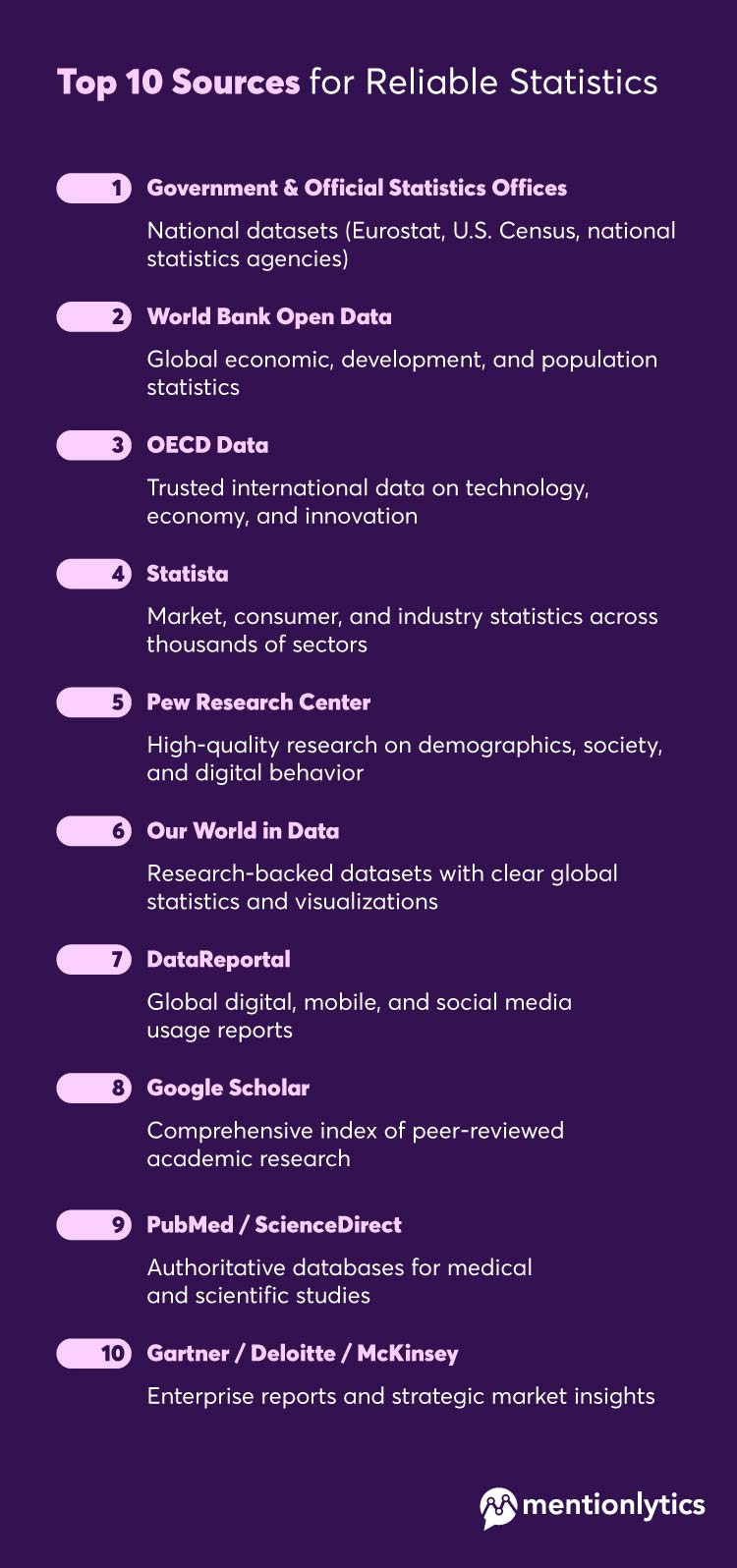
And remember, a number without a valid source is still just vague information. You need to back it up with trustworthy sources. Why? Because when you use a specific study name or a percentage, AI recognizes them as “Entities,” making it easier to connect users’ queries to your content.
Expand Your List of Credible Report Sources
With Mentionlytics, you can easily track industry keywords and be the first one to jump on a train with fresh data once published. AI will appreciate it! 🤓
GEO Tip #3: Add a Summary Section to High-Value Pages
A short, TL;DR paragraph at the beginning of the article is very useful for AI engines and LLMs, like ChatGPT or Gemini. It’s a summary of what your blog post or page talks about, and you don’t have to put “TL;DR” per se. AI will recognize it by the structure.
For example, Andy Crestodina, the well-known digital marketing and SEO expert, has an interesting structure for Orbit Media’s blog. Take this blog post as an example, where, at the very beginning, AI can understand which questions the blog post answers.
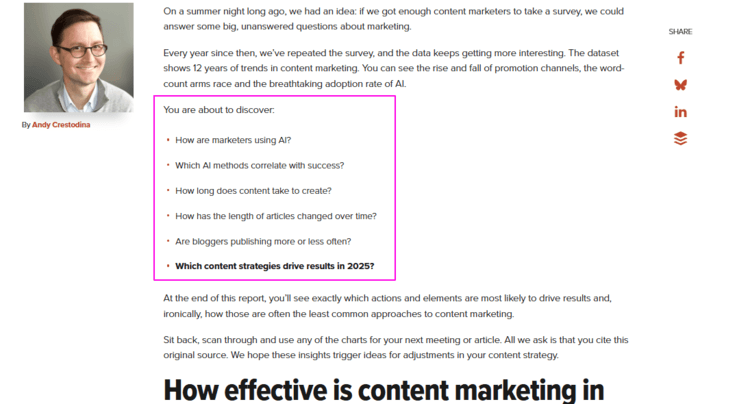
Now, there are several reasons why this method helps you show up in AI responses.
- Since LLMs are essentially trained on academic research and journalism, they seek the most important facts up front. Think of it as an abstract.
- The second important reason is the computation cost. TL;DR lowers the cost and enables LLMs to understand a 2,000-word article with only 100 tokens.
- Summary is the first place AI search engines will land in a search for the answer. If it fits the query perfectly, your content will be clipped and used as the answer.
A recent study showed that almost 50% of ChatGPT citations are from the first 30% of the content. That means that if you clearly and briefly explain what your blog post or webpage is about at the beginning, you have increased your chances of being considered for citation.
GEO Tip #4: Add Explicit Author & Credential Markup
Who is writing your blog posts? Is there a credible name behind it? Credibility can be conveyed through job title, expertise area, and experience, and it can strengthen entity authority signals.
So, choose the authors who can increase your credibility, sign the blog posts, and link your author’s LinkedIn profile, as proof that they are eligible to talk about a specific subject.
Now, don’t forget that you write blog posts for humans, but AI might perceive this information on a different level (in your code). Yes, we’re talking about Schema Markup again, because in this case, it acts like a “passport” for your content.
A schema is a block of code that sits in your backend and has a specific purpose to make your author credentials readable and easily checkable by AI. It translates your “About the author” into language LLMs understand and can make a quick checkup.
To implement this technically, ensure your developer uses the “sameAs“ property within the Person Schema. This specific line of code acts as the glue that binds your on-site bio to your external, verified profiles, telling AI, “Yes, these two digital identities are the same person“.
GEO Tip #5: Understand SEO Basics
You should know that optimizing content for AI search results starts with good traditional SEO, and if you’re not familiar with the essential SEO rules, you won’t be able to grasp generative engine optimization.
A recent Ahrefs study shows that 38% of AI Overview citations are related to the top 10 SERP results. So, as you can see, SEO and GEO intertwine, and whenever you are tempted to break an SEO rule to the advantage of GEO, the long-run results won’t be as expected.
The thing is that search engine optimization (SEO) lies within E-E-A-T, and good structure, with trust being the main pillar. Based on Google’s official SEO guide, you should first pay attention to site organization through:
- Descriptive URLs, grouping similar topics into one directory, and reducing duplicate content
- Making your content valuable: Is your content unique? Do you have structured data on your page? Is your content up-to-date? Is your content human-first?
- Making your content credible by using credible sources, established authors, or authors with authority on the niche topic, and make sure you create appropriate anchor text.
- Creating a meta description that corresponds with the content on the page
- Adding images, but make sure they are high quality and have alt text
- Adding videos, but make sure they don’t slow down your speed (best way is to embed them)
- Promoting your page on social media: The more people talk about you, the more Google finds your content valuable
GEO Tip #6: Invest in Third-Party Brand Mentions
Look at brand mentions as external confirmation that AI uses to verify your brand’s entity authority.
Yes, even traditional SEO reputation management admits that brand mentions help in visibility, but with AI models, especially LLMs, mentions go even higher on the trust scale.
You have to know that AI has become very skeptical about your owned content, and always wants to fact-check your website in third-party sources, like Reddit, for example.
And the beauty is that an unlinked mention on forums or online news outlets is as powerful as backlinks are for SEO. The only advancement is that LLMs will pay attention more to the sentiment of the statement than to the number of mentions.
Since there are more channels where your brand could be mentioned, it’s not possible to track everything without a social listening tool, and what you cannot track, you cannot optimize.
With Mentionlytics, you monitor your mentions with:
- Accuracy (so that you don’t get overwhelmed with data)
- Wide coverage (you might be surprised how often your audience uses channels that are not on your list)
- User-friendly dashboards (because at the beginning, all that data might seem a bit intimidating)
That way, you can have a clue of how AI models perceive your brand through the available information about it online.
Start Smart GEO
By tracking what people say and how they feel about your brand across the web. Mentionlytics gives you valuable insights with 96% accuracy in sentiment.
Bonus Generative Engine Optimization Tips for Content Creation
If you’re a content writer, you might want to pay attention to these two generative engine optimization tips as well, because they might make or break you showing up in generative search or LLMs responses.
Kill Ambiguous Terms
If you want to increase visibility in AI models, you need to make your content easy to understand, without using vague or technical terms, unless you explain them first.
AI search optimization is all about clarity, and your content should not leave AI platforms in doubt. The moment a model “doubts” your meaning, it will skip your text in favor of a source that is more definite.
So, here’s what you should do, without killing the spirit of your content:
- Cut off jargon: If you use a term like “synergy“, “leverage“, or other jargon words, an AI might interpret it in ten different ways. Instead, use specific verbs like “collaborate” or “increase.“
- The first-mention rule: Always define a technical acronym or niche term the first time it appears in your text. This provides the contextual grounding that the AI needs to index that section correctly.
- Literal over literary: Here’s the most painful one for all content writers who love metaphors. The sad truth is that metaphors are great for humans, but AI prefers literal descriptions. So, instead of saying your product is “a bridge to success“, say it “helps career growth through skill tracking.“
Reduce Pronoun Ambiguity Sitewide
Pronounces like it, this, that, and they are the ghosts of your content that haunt AI models. So remember this whenever you ask yourself, “Oh, what would be GEO best practices for our new article, that we could instantly implement?” It doesn’t require any preparation, tracking, or anything like that. Just pay attention to your writing style.

AI systems, especially those using Retrieval-Augmented Generation (RAG), often chunk your content into small snippets. If a snippet says “It is the best way to save money”, but the noun (for example, “automated savings”) was in the previous paragraph, the AI won’t know what “it” refers to.
If you want to test your content, ask yourself whether every paragraph could be a stand-alone answer. In other words, if you delete everything else from the page, would a reader (in this case, AI) still know exactly what you are talking about?
Don’t be afraid to repeat nouns. Yes, we all grew up on literature, which doesn’t like repetition, but AI will appreciate it if you use “This GEO strategy helps users…” instead of “This helps users…”
Get More Mentions and Drive LLM Visibility Without Too Much Effort
The era of tricking search engines with keywords is over, and the winners are the brands that are clear, consistent, and cited.
By using structured data as your passport, treating your authors as experts, and monitoring your mentions as trust signals, you are building your digital reputation that AI models read as The Trust.
So, are you ready to see your brand through the eyes of AI?
Start your experiment with Mentionlytics, and turn every online mention into a powerful signal for the next generation of search.
FAQ
How to start with GEO?
The best way to start with GEO is with a visibility audit. Ask AI platforms like ChatGPT, Gemini, and Perplexity questions related to your niche to see if your brand will come up in answers. Once you have the insights, you can start reforming your most important pages by paying attention to your content structure, adding direct-answer paragraphs (no more than 60 words) under your H2 headings, and making structural and organizational changes to make your site machine-readable.
What are some GEO tips for marketers?
The most important GEO tips for marketers would be to focus on citable facts and entity authority. Instead of broad marketing fluff, include specific statistics, original research, and expert quotes that an AI can easily take and attribute to you. A step further would be securing mentions on high-authority third-party sites like Reddit, industry forums, and reputable news outlets, to create a digital consensus around your brand.
Are there any Generative Engine Optimization (GEO) courses and certifications?
Yes, several major platforms now offer GEO-specific trainings, such as GSDC or Coursera.

