

Answer Engine Optimization (AEO) is the thin line that connects content writing and SEO, and it all started with Google enriching result pages with featured snippets in 2014, long before AI Mode even existed. Within the last six months, we’ve seen some changes on Google, and it seems that featured snippets have gone into history, since AI Overviews have taken the Zero Box completely.
But the trick is that AEO still counts, because it forces you to pack your content to be concise and answer the right questions. Okay, snippets are gone, but there are AI overviews, People Also Ask, voice search, and smart assistants such as Siri or Alexa, Knowledge Graph, and Local Pack. Not to mention LLMs, equally eager for short answer-first content.
In this article, we’re going to showcase five answer engine optimization best practices that have a high impact on showing up in AI summaries, explain how AEO differs from traditional SEO, and share our experience with optimization strategies that worked like clockwork.
Article Summary (TL;DR)
Answer Engine Optimization (AEO) focuses on structuring content so AI systems and search engines can extract clear answers directly from your page. Unlike traditional SEO, which aims to rank pages and drive clicks, AEO aims to make your content the source of the answer in AI Overviews, voice search, and AI assistants.
5 AEO best practices:
- Add a citation-ready paragraph after H2s and H3s
- Structure content for easy extraction (H1-H2s-H3s, lists, short paragraphs)
- Avoid unclear pronouns and keep references explicit
- Include FAQs with schema markup
- Be literal and avoid vague metaphors
Bonus AI optimization strategies according to our experience:
- Increase positive brand mentions across the web
- Monitor and fix negative brand sentiment in reviews and directories
Table of Contents
What is Answer Engine Optimization (AEO)?
Answer engine optimization (AEO) is a way of structuring content so that search engines, AI assistants, and AI answer engines and Large Language Models (LLMs) can extract clear, concise responses directly from your page.
It all started when featured snippets were reintroduced in 2018, and their main purpose was to provide a direct answer to the user’s query as fast as possible. No need for clicking or scrolling through the Google search result pages (SERPs); the answer was right there in front of users’ eyes with one source.
Unlike traditional SEO, where the goal is mainly to rank pages in search results, AEO focuses on becoming the source of the answer itself rather than competing for clicks alone. Content optimized with AEO best practices aims to appear in:
- AI Overviews
- Voice search responses
- People Also Ask boxes
- Smart assistants like Siri or Alexa
- Knowledge panels and instant answers
- AI chatbots such as ChatGPT, Gemini, Perplexity
The main idea behind AEO is simple: make it easy for machines to quote you.
The concept gained traction when Google introduced featured snippets, but the roots of AEO thinking go further back. The term “Answer Engine Optimization” was coined in 2018 by Jason Barnard, the digital marketing expert who has been actively promoting the concept of optimizing content for answer engines and knowledge panels, emphasizing that search engines increasingly prioritize entities, context, and structured answers over simple keyword matching.
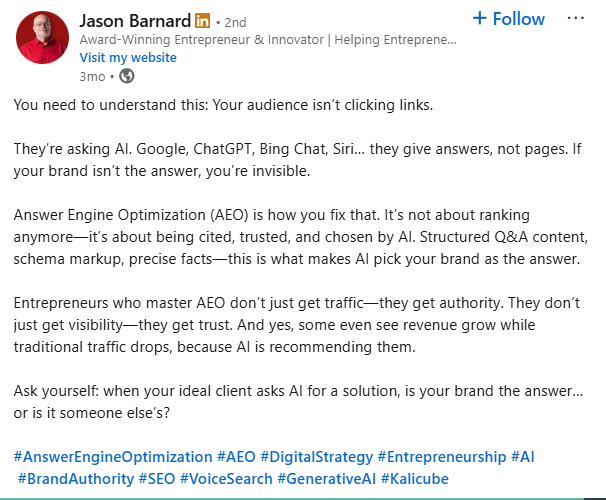
If we look back, we’ll see that AEO was, in fact, the intro for generative engine optimization (GEO), which showed up in 2023, with LLMs. At the same time, answer engine optimization was a soft transition from traditional Google and Bing results pages to AI-powered search engines.
Answer Engine Optimization (AEO) vs Traditional SEO
Traditional SEO and AEO share the same ultimate goal: visibility, but their approaches differ. While SEO focuses on ranking web pages, AEO focuses on delivering the answer itself.
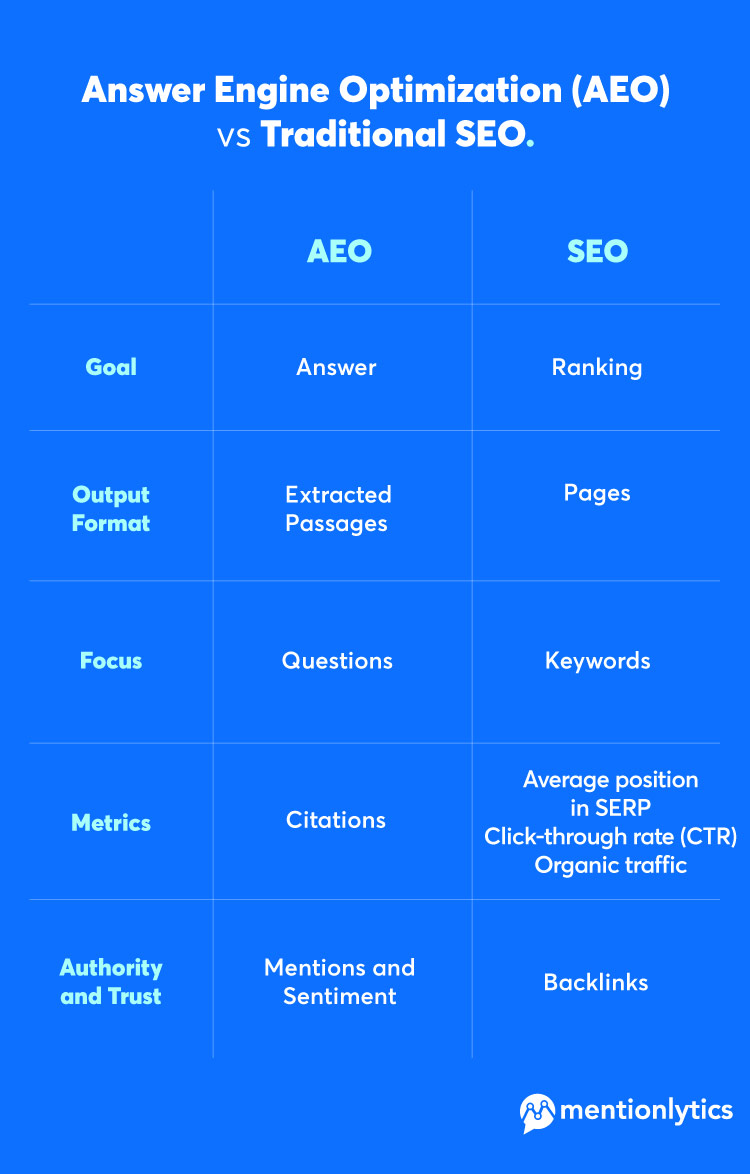
Furthermore, we measure the success of SEO through organic traffic, click-through rate (CTR), and ranking position on SERPs, while with AEO, we aim to adjust content to be cited by LLMs and answer engines.
And while we were all chasing backlinks for higher domain authority (DA) for years, today we witness that a simple unlinked brand mention in niche forums can have the same effect for AI.
Now, SEOs and marketers (like yourself) might wonder what your brand actually gains from being cited, especially when AI answers don’t always show a visible source or link. Well, the goal is to enter what we could call the “AI circle of trust“.
Yes, it might not bring you immediate clicks, but appearing in answers gradually builds an association between your brand and a specific topic. Over time, AI systems begin to recognize your brand as a trustworthy source with topical authority. That increases the likelihood that your company will be recommended when users ask about the product or service you offer.
And when those recommendations happen, the users arriving from AI tools or generative search engines are often high-intent leads at the very bottom of the funnel.
So, with answer engine optimization strategies, you’ll need patience, because the results won’t just pop up in a month or two.
That’s why AEO often overlaps with practices used in Generative Engine Optimization (GEO), and they do have a lot in common. When comparing AEO vs GEO, you can see that everything comes down to helping AI-powered search engines and LLMs understand the content clearly and trust the source behind it (your brand).
5 Best Practices For Answer Engine Optimization You Can Implement Right Away
AEO is a long process, but there are some tweaks you can implement right away and see results very soon. Here are five easy-to-implement best practices for answer engine optimization.
Best Practice #1: Add a Citation-Ready Paragraph After H2s & H3s
One of the easiest ways to improve your chances of appearing in AI-generated answers is to include a short, self-contained explanation immediately after a heading.
Search engines and AI models often extract the first clear definition or explanation that follows a heading. If that paragraph answers the query directly, it becomes a perfect candidate for citation.
And the clearer you are regarding your answers from the very beginning of the article, the greater the chance you have. A recent study showed that 74.8% of citations in AI Mode and Gemini come from the first half of the page, and ChatGPT follows with 44% cited from the first 30% of the page.
Here’s how to make a good citation-ready paragraph:
- Make it around 40-60 words, not more.
- The first sentence gives a direct answer to the question regarding the heading.
- The second sentence explains “Why“ it matters.
- The third sentence contains supporting sources (statistics, data, research, case studies).
- Avoid unnecessary content (fluff).
- Test if the paragraph can stand alone without needing the rest of the article.
If you did everything “by the book”, you’re good to go.
Best Practice #2: Structure Content for Easy Extraction
If your practice was to write without a clear structure, it’s time to change that habit. Your content should follow a logical structure and the right heading hierarchy (H1 → H2 → H3).
This allows answer engines to understand the relationships between sections and identify where the relevant answer is located.
Additionally, you can tidy up the content using:
- bullet lists
- numbering steps
- short paragraphs
- clearly labeled sections
- descriptive headings
In practice, this means breaking complex topics into small, clearly labeled sections instead of long walls of text.
Best Practice #3: Make Pronoun References Clear in Your Articles
This, that, it, they, those, these… these pronouns have no place within your paragraphs anymore. While humans could read several times or connect the dots in their head, AI engines are not willing to play a guessing game.
When a paragraph contains phrases like “It improves visibility” or “this strategy works well”, AI tools sometimes struggle to determine what “it” or “this” actually refers to.
To avoid ambiguity, it’s better to repeat the main noun in continuous sentences than to use a pronoun. And though it might sound a bit off to us humans, machines love clarity, and it’s perfectly crafted for AI digestion. Remember, avoiding ambiguity is a GEO tip most beginners can implement in the blink of an eye.
Best Practice #4: Include FAQs with Schema Markup
Having FAQs with schema markup is like having a cheat sheet for AIs. Frequently asked questions are among the most effective formats for AEO because they mirror how people actually search.
Users often phrase their queries as questions, and AI systems frequently extract answers directly from question-and-answer sections.
Adding an FAQ section at the end of your article can help capture queries such as:
- definitions
- comparisons
- implementation questions
- practical use cases
When possible, pair your FAQ section with FAQ schema markup for better AI search optimization so AI tools can clearly understand the question-and-answer format. That’s how you create structured data that makes it easier for AI models to find the right answer that corresponds with the user intent.
Best Practice #5: Be Literal and Avoid Vague Metaphors
Creative writing is great for storytelling, but not for improving your visibility in AI answers. Answer engines prefer clarity over cleverness. Metaphors, idioms, and abstract phrasing can make content harder for machines to interpret.
How many times have you seen in previous years, “SEO is a marathon, not a sprint”? We all understand what it means; we like it (even I have used it), but for LLMs and AI-driven search engines, this statement mixes marketing and sport, is totally disconnected from logic, and provides no valid information for AI.
So, for all of us who enjoy idioms, we don’t have to give up on metaphor; all we need to do is keep them out of the core explanations, which need to be direct.
With the right dose of idioms, humor, and clear statements regarding the core topic, you can make blog posts understandable for machines and enjoyable for humans at the same time.
Bonus: 2 AI Optimization Strategies We’ve Seen Results From
We’re at the forefront of changes, and we’ve tried everything. Now, what we noticed firsthand is that third-party brand mentions and their sentiment carry an impact on how LLMs perceive your brand.
Here’s what we’ve learned from our experience.
Increase Your Brand Mentions Instead of New Backlinks
Backlinks have long been the backbone of SEO, but AI-driven search systems increasingly evaluate brand presence across the web, not just link authority.
Back in the day of traditional search, if you wanted to show up in SERP, you needed backlinks. Without them, you were simply invisible. But now, mentions act like backlinks, and even the unlinked mentions count.
When AI models encounter the same brand name mentioned across multiple credible sources, forums, reviews, and media outlets, they begin to associate that brand with specific topics and expertise.
In other words, mentions build entity trust.
If you’re investing all of your time and budget building the perfect website that says you’re the best, the greatest, the ultimate… it all doesn’t mean anything if people on review platforms scream your product has flaws, your customer service is terrible, or that the user experience in general is not satisfying.
And we’re not saying that because we’ve read somewhere it’s functioning, but because we’ve seen the results.
Our marketing team is using the Mentionlytics platform to track interesting conversations across the Internet, and to see who mentions our brand, in what context, and what the sentiment is, to multiply our brand mentions in sources that AI search engines draw data from.
Claude seems to appreciate our efforts, as you can see below.
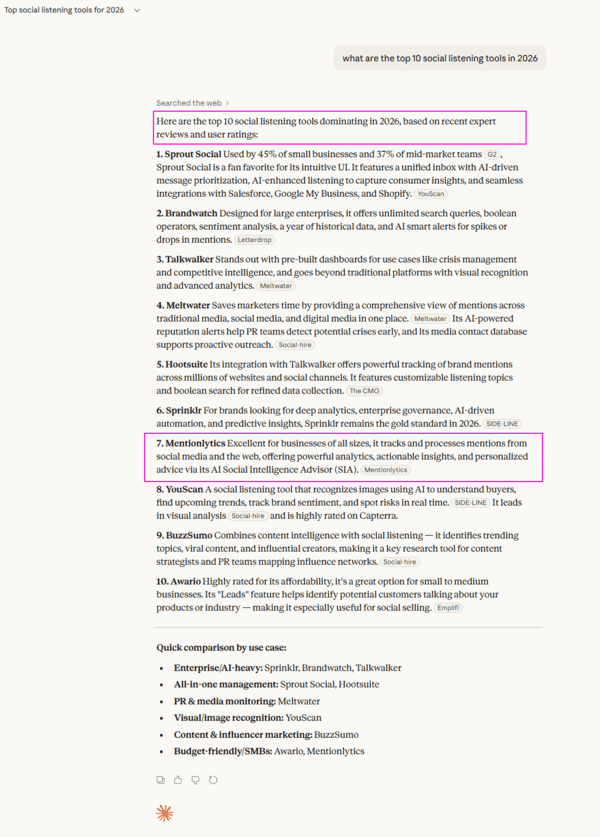
The same tactic works well for ChatGPT as well.
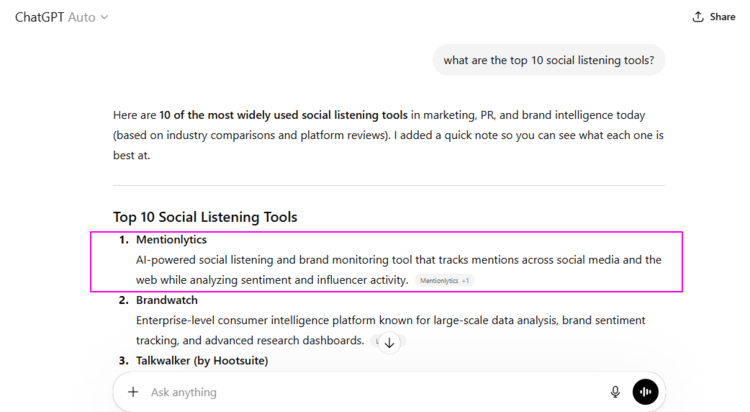
From our experience, one of the best practices for optimizing brand presence in AI answer engines is to increase the number of positive mentions in:
- industry discussions
- expert roundups
- podcasts
- social media conversations
- Reddit threads
- YouTube commentary
- review platforms
And you can track all the sources AI models consider the most with Mentionlytics, just like we do. You can easily track the relevant ones for a specific LLM and see if your brand starts showing up on the web (comparison articles, reviews, etc.), because, aside from forum platforms (such as Reddit), AI tools tend to skip other socials.
Start Your AEO Journey the Right Way!
Find your partners and discussions that matter with Mentionlytics!
Fix Negative Brand Sentiment in Review Platforms and Directories
We compared mentions with backlinks, but the truth is that positive mentions act like backlinks with high authority, while negative ones act like toxic links.
Besides the number of mentions online, AI systems evaluate how people talk about your brand. If review platforms, directories, or forums contain a large number of unresolved negative comments, these signals can influence how AI models interpret a company’s reputation.
That’s why brand reputation monitoring has become an important part of getting your brand mentioned by LLMs. And you mustn’t neglect it.
You should regularly track platforms, forums, marketplaces, review websites, directories, and social networks, and basically every corner of the internet where your users can drop a review. Because your potential users are not the only ones peeking at your reviews, Google’s AI Overviews can do that as well, for them.
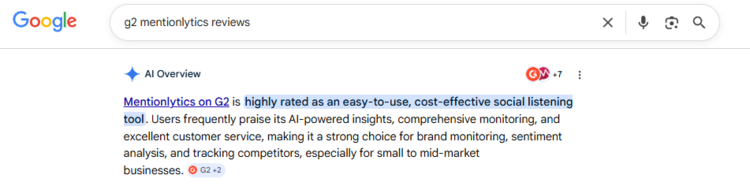
When negative feedback appears, you want to be the first to spot it, before it becomes viral or just contagious, bringing ten more negative reviews on the same platform.
Mentionlytics helps you track mentions and reviews and keep them clean, clear, and accurate, without missing any negative comments. And the best part is that when you use Mentionlytics, you receive alerts that notify you (or your PR team) whenever something requires your attention.

This allows PR, marketing, or customer support teams to respond before negative sentiment spreads or becomes a dominant narrative online.
Be Faster Than AI!
Spot a wave of negative mentions before AI lays its eyes on it, and turn them into your advantage with Mentionlytics!
By maintaining a healthy brand reputation online, you ensure that LLMs and AI search engines receive balanced and trustworthy signals about your brand.
Couple GEO with AEO for Best Results
Answer engine optimization (AEO) and Generative engine optimization (GEO) shouldn’t be treated as separate strategies. In practice, they work as two sides of the same coin. AEO helps AI models extract your answer, while GEO helps them trust the brand behind that answer.
You can write the most perfectly structured, citation-ready paragraph in the world, but if your brand barely exists outside your own website, AI engines may simply choose another source that looks more credible in the broader ecosystem.
This is why successful AI visibility doesn’t come from content structure alone. It comes from combining clear answers with strong external signals. When AEO and GEO work together, your entity becomes much stronger and serves as the source that generative AI trusts.
It’s time to close the gap between GEO and AEO! Track mentions, engage in discussions that count, and find the right partners for your brand with Mentionlytics’ 14-day free trial.
Strengthen your position while adjusting your content strategy, and the results will be visible.
FAQ
Is answer engine optimization and generative engine optimization the same?
No, answer engine optimization and generative engine optimization are not the same thing, but they both influence AI visibility. AEO focuses on structuring content so search engines and AI assistants can extract clear answers, while GEO focuses on increasing a brand’s presence and credibility across the sources AI models analyze.
What’s the role of internal links in answer engine optimization?
Internal links help AI models understand relationships between topics on a website. They also guide both users and search engines toward deeper explanations that support the extracted answer.
What are some strategies for implementing answer engine optimization?
Best strategies to optimize content for answer engines include:
- Adding citation-ready paragraphs under headings
- Structuring content clearly
- Using the FAQs section
- Writing direct answers to common questions
- Avoiding ambiguous language
Is answer engine optimization worth it?
Yes, AEO is worth it because AI-powered search continues to expand, and optimizing content for answer extraction helps brands appear in AI summaries, voice search results, and instant answers across search engines and AI tools.

