


Back in the days when TV and radio ruled political communication, public opinion moved slowly, and was measured even more slowly. Polls, focus groups, and press coverage were enough. Now, that world no longer exists, and public opinion monitoring operates in a completely different dimension.
Public opinion is no longer shaped slowly and steadily over the whole election cycle. It can detour within a day, triggered by a viral moment, a breaking headline, a misunderstood statement, or a sudden shift of sentiment. One moment, your candidate is a favorite in the eyes of voters. A few moments later, the candidate becomes a meme.
Political conversations now unfold openly and continuously across social media, news, websites, forums, and messaging platforms. Support, backlash, misinformation, and emerging narratives appear in real time, often way before they reach polls or traditional media.
For political comms teams, institutions, and analysts, the challenge is no longer whether public opinion has changed, but how quickly they can detect it, understand it, and respond before the narrative takes hold.
In this article, we explain the difference between public opinion and public sentiment, their mutual influence, and the best, proven ways to monitor both during political campaigns.
Table of Contents
What is Public Opinion Monitoring?
Public opinion monitoring is the ongoing process of understanding what large groups of people think and say about political issues, candidates, policies, and events. At its core, it’s about listening and tracking attitudes, reactions, and shifts in sentiment as they happen.
Traditionally, this meant relying on tools like polls, surveys, focus groups, and post-election analysis. While these methods still have value, they have a major limitation: they capture opinion at a single point in time and from a very small sample of the audience, which is not necessarily representative of the target audience. Additionally, phone polling responses have declined from 36% in 1997 to only 6% in 2018. Imagine what the numbers would be now in 2026, when Millennials and Gen Z seem allergic to phone calls.
By the time results are collected, analyzed, and published, public sentiment may already have shifted, if it was correct at the beginning.
Modern public opinion monitoring goes far beyond asking people questions. It focuses on observing real conversations as they naturally unfold across social media, online news, forums, blogs, and comment sections. Massive audience and real-time data collection make it irreplaceable.
The scale of this modern approach is staggering compared to traditional focus groups. For example, a 2020 study with over 17.5 million data points processed across X (still Twitter back then) and YouTube showed that analyzing large-scale digital conversations provides a highly accurate roadmap of how voters intend to behave.
That’s why, without social listening and media monitoring, public sentiment analysis is nearly impossible. Instead of waiting for scheduled research cycles, political PR teams can see what people are reacting to right now, what’s gaining traction, what’s triggering backlash, and which narratives are forming or fading.
The key difference here is timing and depth. Traditional methods explain why people think a certain way, after the fact. Modern monitoring shows what people are saying and how they feel in real time. Together, they paint a more complete picture. However, since today everything changes within a second, a real-time insight is what allows teams to act before sentiment hardens into public perception.
Public Opinion vs Public Sentiment
Public opinion and public sentiment are often used as synonyms, but in politics, they represent two different ends of the same stick.
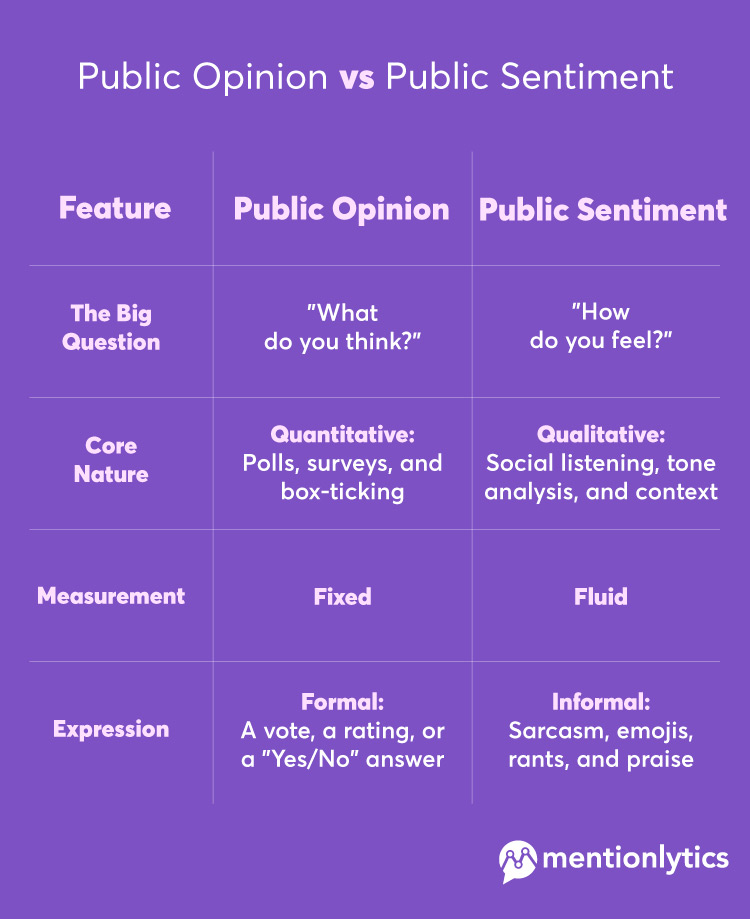
First, public opinion refers to what people think. It reflects positions, beliefs, and initial preferences for the political candidate.
Traditionally, it is measured through polls, focus groups, surveys, and voting-intention studies. It gives you answers to some of these questions:
- Do people support these policies?
- Which candidate do they prefer?
- How likely are they to vote?
Public opinion is largely fixed, with only slight chances of changing it quickly once a choice is made public.
Public sentiment, on the other hand, captures how people feel. It reflects emotional tone (anger, frustration, trust, enthusiasm) and the intensity behind the opinion. Sentiment is analyzed by how people express themselves, especially in online conversations across social media, news comment sections, forums, and blogs.
It provides answers to questions like:
- How do people feel about the XX topic, the candidate, or the policy?
- Is support passive or passionate?
- Is criticism mild or explosive?
Unlike public opinion, sentiment is more fluid, changing within seconds based on a headline or a trend.
Why Does the Difference Matter in Political Campaigns?
A political campaign might look strong on paper while quietly losing emotional ground. You might have a favorable public opinion in polls, but if public sentiment is turning negative, with sarcasm and frustration appearing more often online, that’s an early warning sign.
If the opposite candidate gets more positive attention from the audience, that’s also not a very good sign for the outcome.
Perhaps the most drastic example of this is the 2024 Indian general elections. Traditional exit polls almost universally predicted a “supermajority” (350-380 seats out of 543) for the ruling BJP-led alliance.
However, while public opinion in these polls suggested a stable preference for the status quo, real-time sentiment analysis on platforms like X and YouTube told a more complex story. A study found that sophisticated sentiment analysis of X data can achieve predictive accuracy of 86%-89%.
Analysts noted that unemployment, inflation, social injustice, and the language and hashtags used on X for the campaigns resulted in 234 seats in the Lok Sabha (India’s lower house of parliament), not enough for the majority (272 seats).
That’s why, even though your candidate might have 52% support after announcing a new policy, sentiment may tell a different story. And this is how it might look:
- Public opinion: Majority support looks solid.
- Online sentiment: Online conversations show rising anger, mockery, and distrust, even among supporters.
What’s happening? People may agree with the policy in principle, but emotionally, something feels off. That emotional friction can quickly turn into declining support, viral backlash, or voter apathy if ignored.
Find Out How Your Voters Truly Feel!
Mentionlytics’ sentiment analysis, with 96% accuracy, provides your campaign with insights that can help turn it in the winning direction.
How is Public Sentiment Measured?
Public sentiment is measured by analyzing how people express themselves: tone, language, emotion, and context all matter. If we add that, in the digital space, opinions are shared instantly and often without filters due to anonymous accounts, the importance of tracking sentiment becomes even greater.
In practice, this means examining conversations across social media, online news, forums, blogs, and comment sections. Every post, comment, headline, or reply carries signals that help indicate whether public reaction is positive, negative, or neutral, and how strongly people feel about a topic, policy, or political figure.
Social media sentiment analysis has become one of the most powerful and scalable ways to measure public sentiment today. It uses AI and natural language processing to process massive volumes of public posts in real time, identify emotional tone, and detect shifts in mood as they happen.
This allows political marketing teams to spot emerging approval, frustration, polarization, or backlash long before traditional indicators appear.
But let’s not forget that sentiment analysis works best when it’s part of a broader political campaign monitoring ecosystem. On its own, social data can sometimes feel too loud, messy, and even misleading. When combined with media monitoring, historical trends, polling data, and qualitative analysis, it provides context and balance, which transitions raw data into valuable insights.
Why Do I Need Real-Time Public Opinion Monitoring in the 2026 Mid-Term Elections?
In a presidential year, the goal of monitoring is often persuasion, while in a midterm, the goal shifts to mobilization. Because midterm turnout is historically 8-20% lower than general elections, success is less about who is “liked” and more about whose base is “on fire”.
While presidential races are national “vibes”, midterms are a collection of hyper-local fires. Without real-time sentiment analysis, a campaign is essentially trying to manage 435 separate mini-elections using a single national map.
But if we set aside these facts, here are five main reasons you need to monitor public opinion in the 2026 midterm election.
News Cycles and Voter Reactions Move in Real Time
Traditional polls are more like a post-game report. They tell you what happened last week. In midterms, a single local scandal or policy shock can flip a district in 48 hours.
We can see that in the Graham Plater case. He entered the 2026 U.S. Senate race in Maine with significant anti-establishment momentum. However, he immediately faced a dual crisis: a wave of resurfaced Reddit comments from 2010-2021 and a backlash on a chest tattoo resembling the Totenkopf, a Nazi-era symbol.
Rather than waiting for a traditional polling cycle to quantify the damage, Platner bypassed the usual “wait-and-see” approach and addressed the digital echoes immediately, explaining that the tattoo was an intoxicated mistake from 2007 (since covered) and that the comments reflected a period of intense PTSD and social alienation following his military service.
Graham Platner talks about his reddit comments
byu/Old-School8916 inMilitary
Early Sentiment Shifts Signal Emerging Political Risk
Sentiment is a lead indicator, where often a shift in the tone of online conversation, such as rising sarcasm, frustration, or a sudden drop in engagement, or any other shift that could potentially end up with crisis management, leads to a drop in polling numbers.
Monitoring early spikes in negative sentiment allows regional candidates to “decouple” their branding before the wave hits. And that’s exactly what Platner did.
We wanted to examine his case by ourselves to see what’s going on with Maine’s voters and how these crises affected their sentiment toward him. By tracking the audience’s sentiment in real time through Mentionlytics, we observed the effectiveness of his response as it unfolded and how it reflected on him and other candidates.
Our data showed that instead of a total collapse, Platner’s raw, authentic explanation actually fostered a “forgiveness narrative” among his base.
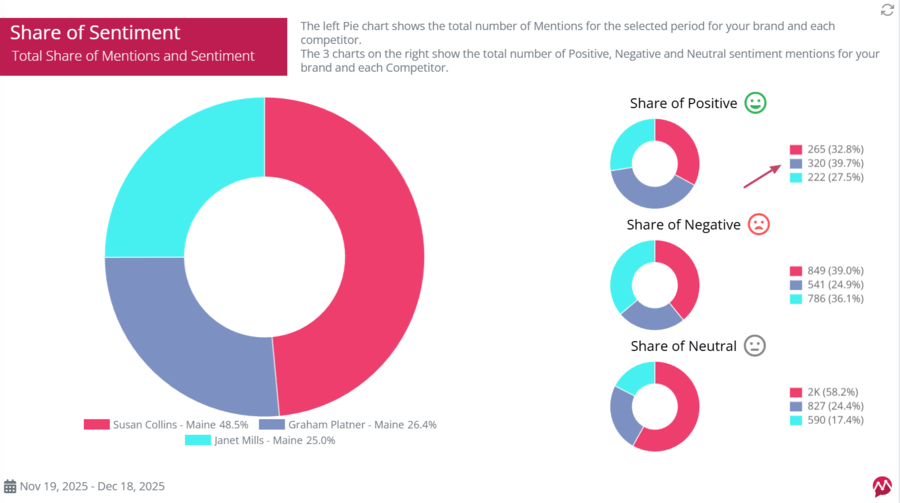
Platner’s social media sentiment share – Mentionlytics ‘ data November-December 2025
Monitoring revealed that his radical transparency was working while the controversy was still peaking, and as a result, he has maintained the largest positive share of sentiment among his rivals, proving that real-time tracking is essential for surviving the short-fused scandals of the midterm cycle.
Misinformation and Negative Narratives Spread Faster Than Ever
Midterms are a breeding ground for micro-disinformation, false claims tailored to specific local demographics. And they spread throughout channels in the blink of an eye.
Remember the 2022 Florida midterm Spanish-language WhatsApp crisis? In the lead-up to the 2022 midterms, a highly effective disinformation campaign targeted Latino voters in South Florida through encrypted messaging apps like WhatsApp.
Anonymous messages and viral audio clips falsely claimed that the Democratic Party was being endorsed by authoritarian regimes like Nicolas Maduro’s in Venezuela. Other “micro-narratives” suggested that voting for certain local candidates would result in the seizure of private property, mimicking the trauma of those who fled populist dictatorships.
This highlights the need for niche monitoring. If you aren’t tracking regional-language sentiment or community-specific forums, you are missing the primary source of political risk for those demographics.
Does Your Monitoring Tool Speak Other Languages?
Mentionlytics does! It translates and summarizes key topics, so no one can talk behind your back without you knowing.
Messaging Must Be Adjusted While the Conversation Is Still Active
Public opinion monitoring allows for A/B testing in the wild. If a candidate releases a video and the comment section is filled with “passive” support, but the opponent’s video triggers “passionate” engagement, you know your message lacks the “fuel” needed for midterm turnout.
With real-time monitoring, campaigns can gauge public sentiment and adjust communication strategies. Fit the language, tone, and priorities while the audience is still engaged, not after the moment has passed and attention has moved elsewhere.
In the 2022 Pennsylvania Senate race, Republican candidate Mehmet Oz released a video at a grocery store meant to highlight inflation. He used the word “crudité” to describe a vegetable platter.
While traditional polling couldn’t possibly capture the nuance of a single word choice, real-time internal monitoring showed an immediate explosion of “class-outsider” sentiment and sarcasm in the comment sections. The engagement wasn’t just negative; it was passionate and viral.
Seeing this “fuel” in the audience’s reaction, the John Fetterman campaign didn’t wait. They pivoted their entire messaging strategy for the week to focus on the “outsider/elitist” narrative. They even released a “Let Them Eat Crudité” sticker that raised over $500,000 in 24 hours.
Monitoring allowed the campaign to identify the exact language that resonated with the working-class “midterm base” and double down on it while the audience was still engaged.
@johnfettermanEat your veggies 🥦🥦♬ original sound – John Fetterman
Polling Alone Cannot Keep Pace With Modern Elections
The “snapshot” problem is fatal in midterms. Because the electorate is so small and specific, polling “likely voters” is notoriously difficult.
If we add that voters often hide their intentions from pollsters (a phenomenon called Social Desirability Bias), but express their raw emotions, such as anger, excitement, or fear, freely in online forums. Monitoring captures the intent that polls miss.
Polling still has a role, but it’s slow, periodic, and retrospective by design. It tells you where voters are at a given moment. It doesn’t tell you how fast they’re moving, or in which emotional direction.
That’s why the internet public opinion monitoring isn’t a replacement for polls. It’s what keeps you from being blindsided between them.
The Best Way to Do Public Opinion Monitoring in Real-Time
Public opinion monitoring in 2026 is way beyond just counting mentions. To decode intent and build a predictive system, you should move through these seven strategic steps.
Step 1: Use Social Listening to Capture Real-Time Public Conversations
Social listening is a “live stream.” Use a social listening tool to scan millions of sources, from X and TikTok to local Facebook groups and Reddit threads, to see what voters are saying when they think no one is “polling” them.
Step 2: Combine Social Listening With AI Sentiment Analysis
If you don’t filter raw data, you’ll be overwhelmed. AI sentiment analysis processes thousands of mentions instantly, detecting emotional tone, intensity, and emerging narratives that no human team could track manually.
Not to mention that emotional responses are difficult to predict. You never know which side sentiment will turn on. For example, who would have guessed that your own campaign could bring more popularity to the opposite candidate than to you? That’s exactly what happened in the Georgia midterm campaign of Mike Collins.
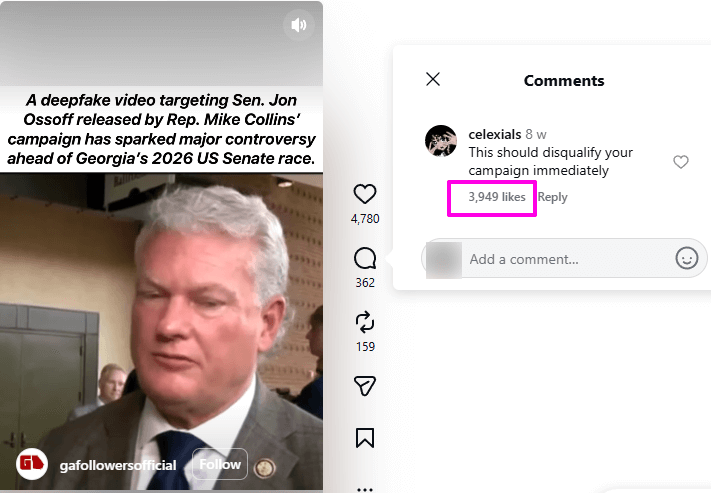
Georgia Sen. Jon Ossoff is ready for the 2026 midterm election, and so is his opponent, Republican candidate Mike Collins, who launched a deepfake video showing Ossoff mocking rural Georgia voters.
View this post on Instagram
This move backfired, and voters reacted negatively to the use of AI deception.
Mentionlytics’ data show that the deepfake video had no negative influence on Jon Ossoff’s campaign. On the contrary. The video was released at the beginning of November 2025 and became headline news around November 21st.
Although voters were initially angry, emotion analysis shows that just a few days later, Ossoff experienced a significant spike in positive mentions, driven by the deepfake video scam that was revealed.
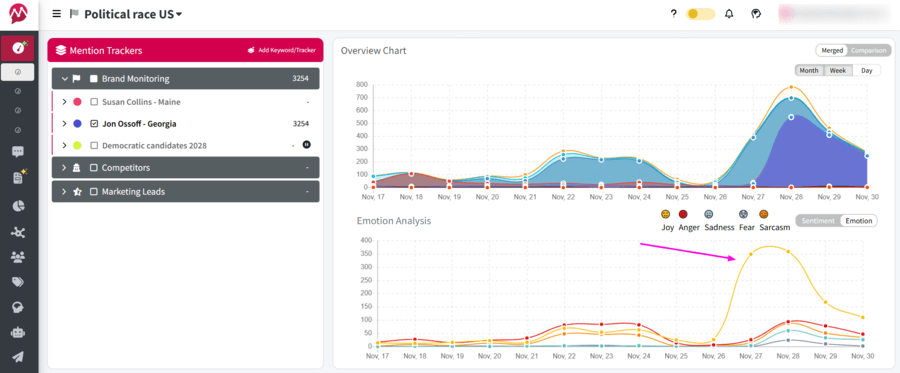
And if we take a look at the emotional analysis chart, we’ll see that there’s a spike of positive emotion (joy) around that date.
Step 3: Monitor Topics and Narratives – Not Just Candidate’s Mentions
By monitoring topics, you gain insights into your voters’ major pain points. Then you can create campaigns that target that spot and trigger an emotional response.
Voters don’t always talk about candidates; they talk about problems. If you only track your candidate’s name, you will miss the “silent” issues that are actually moving the needle.
Step 4: Track Sentiment Shifts Over Time to Identify Momentum or Risk
Midterm elections are all about timing. If you spot the right moment and the right topic, you’ll capture your voters’ attention. And that’s one of the easiest ways to influence public sentiment.
Real-time dashboards reveal trends, spikes, and sudden drops in sentiment. These shifts often signal backlash, growing support, or narrative turning points as they happen, not after the damage or momentum is already locked in.
Step 5: Segment Public Opinion by Geography and Audience
National sentiment is useful. Local sentiment wins elections. With Mentionlytics, conversations can be broken down by region, audience type, language, or interest group, making insights actionable at the district, state, or issue level instead of vague and generalized.
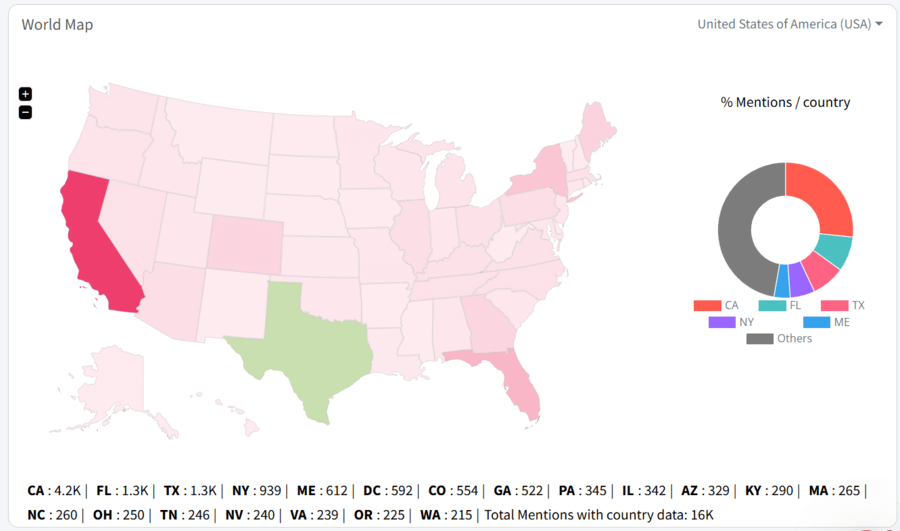
Real-time segmentation ensures your messaging is “context-aware,” preventing a rural strategy from clashing with an urban one.
Step 6: Set Alerts to Respond Before Narratives Take Hold
No team wants 200 alerts a day. That’s where anomaly detection matters. Instead of constant noise, automated alerts flag meaningful changes, sharp sentiment drops, and unusual volume spikes, so teams can respond while the story is still forming.
By receiving automated anomaly detection alerts for any out-of-pattern spike in negative sentiment within a specific district, your crisis management team can intervene while the conversation is still manageable.
Stop Being Drowned in the Flood of Alerts
Mentionlytics notifies you only when it truly matters. Stay sharp. Stay focused. And win.
Step 7: Pair Technology With Human Analysis for Strategic Context
AI tells you what’s happening. Humans explain why it matters. Social listening and sentiment analysis surface the signals, but political judgment, context, and nuance still require human interpretation to guide messaging and decisions.
Use AI for the “What” and human analysts for the “Why.” While AI is undoubtedly capable of processing millions of posts, it can not make a political decision instead of you.
Try a Trusted Public Opinion Monitoring System Now
In the 2026 midterms, the difference between a victory speech and a concession is often just 60 minutes of data. Polls tell you where the finish line was yesterday; Mentionlytics tells you where the race is moving right now.
While your opponents are busy analyzing the past, you could be decoding your district’s emotional engine, intercepting deepfakes before they go viral, and adjusting your message while voters are still listening.
In politics, the silent majority is only silent if you aren’t listening.
Feel the pulse of your voters. Turn your monitoring into your greatest strategic advantage and win the online conversation before the first ballot is even cast.
Ready to see the truth? Let Mentionlytics be your public opinion monitoring tool for the midterm elections this year. Start your free trial today.
FAQ
What is public opinion analysis?
Public opinion analysis is the systematic process of finding out what a specific population thinks about issues, policies, or candidates. In 2026, this analysis moves beyond simple surveys to include AI-driven insights into why those opinions are forming.
What is a POR survey?
A Public Opinion Research (POR) survey is a structured tool used by campaigns to establish a baseline of voter attitudes. It helps identify a candidate’s strengths and weaknesses early in the cycle, providing a benchmark for all future strategic moves.
What are the main sources of public opinion?
Public opinion is primarily shaped by mass media framing, social media interactions, and personal “social desirability,” which is the tendency to align with one’s peer group. Today, digital platforms have surpassed traditional news as the fastest driver of these shifts.
What is an example of public opinion?
A current example is the 2026 shift in voter sentiment regarding affordability in the US. While national approval of the economy might be low, public opinion specifically targets the cost of living as the primary grievance in local districts.
What is public sentiment?
Unlike public opinion (what people say they think), sentiment is the emotional heat or intensity behind those thoughts. While an opinion might be “I disagree with this policy,” the sentiment reveals whether that disagreement is passive or an explosive feeling of betrayal.
Why do some people criticize public opinion polls?
Critics argue that polls are often “snapshots” that miss last-minute shifts and suffer from Social Desirability Bias, where voters hide their true intentions (the “Shy Voter” effect). This happens most often when there are two polarities, strongly divided supporters on both sides, who don’t feel comfortable sharing their opinions. In these situations, voters will likely agree publicly with the general public opinion rather than express their own beliefs, which may not align with it.

