


Have you ever wondered how to use social media market research to craft the best marketing strategies for your clients or your business? You can pull so much data out of social media channels to get actionable insights for your 2025 planning.
To start, you can feel the market’s pulse, checking trends and customer preferences that point out product improvements needed to increase customer satisfaction.
Also, market research should include valuable competitor intelligence. What are your competitors doing, and how are they doing? Do they have better social media engagement? What triggers your target audience to react to their social media posts and not yours?
These are all pieces of information you can get from social media data. That’s why it should be the starting point when creating a marketing strategy for the following year.
In this article, you’ll find the best ways to use social media data in your market research as well as an example that’ll persuade you to start right away!
Table of Contents
What is Social Media Market Research?
Social media market research is the process of gathering and analyzing data from social media platforms to understand trends, consumer behavior, and public opinion.
It involves reviewing mentions, comments, industry conversations, and more to identify the most relevant and valuable insights to inform your strategic decisions.
You cannot do that just by pulling out raw social data — there is too much of it, and you’ll probably get lost.
Companies can see the bigger picture by carefully analyzing the most meaningful insights and patterns. Thus, they can better understand their audience’s preferences, market gaps, and emerging trends.
This type of research helps businesses make informed decisions and adapt their strategies. It is the right way to connect more effectively with customers.
Methods you can use social media for market research
Analyzing Comments & Reviews
The truth is in comments and reviews. Statistics say that 75% of people read reviews before purchasing. So that should be your starting point.
Surveys
You can create surveys with questions that help you understand what people think about your product or service.
Forums
Online forums, like Reddit, are a great starting point. People discuss various topics in what looks like a big group chat.
Social Media Listening
It’s like having ears everywhere, listening to tweets, posts, and comments to understand what people like or don’t like.
Sentiment Analysis
You can feel the pulls of the audience. How do people feel about your product or service? Are the comments positive, negative, or neutral or they have mixed feelings?
Polls & Quizzes
You can use social media platforms like Instagram or X to create quick polls or quizzes. These are fun, easy ways for people to share their opinions, like choosing between two snacks or answering which product they’d prefer.
Native social media analytics tools can provide statistics about gender, age, location, and other demographic data about your audience.
Analyzing Hashtags
By following hashtags (#) on platforms like X, you can track trends and see what’s popular at the moment. This helps you spot trends and see popular topics, like #SpotifyWrapped or #Bitcoin.

Tracking Competitors Activity
You can check out what similar businesses are doing on social networks. By seeing which posts are getting a lot of engagement, you can learn what people like about competitors’ products and services.
Influencer Insights
It’s very similar to tracking competitors. You get insights on what posts have a high engagement rate and try to replicate it.
As you can see, there are so many methods that you can use social media in your research. Seeing the big picture from all these fragmented data could also be challenging.
That’s why you will need a market research tool that can analyze and provide you with only valuable data for your research.
Combining Social Media and Market Research: Pros & Cons
Yes, everyone uses social media! And if we ignore that segment, we’re missing a huge portion of data, sitting there and waiting to be picked up. So, when doing market research today, we can’t diminish the importance of social media platforms.

Of course, like every method, social media has its own downsides when used in market research. Let’s examine the pros and cons of combining social media and market research.
Advantages
- Real-Time Insights: Social media provides instant feedback. That allows companies to understand trends and consumer reactions as they happen.
- Wide Audience Reach: There are 5.52 billion internet users worldwide. This allows companies to access a diverse pool of opinions and insights.
- Unfiltered Feedback: Social media users share their honest opinions without prompting. That gives businesses genuine insights into what their audience really thinks.
Disadvantages
- Data Overload: The amount of data on social media can be overwhelming. It’s very difficult to filter out the noise and focus on what’s truly important without tools.
- Misinterpretation Risk: Social media posts are often brief and casual. It’s easy to misunderstand sarcasm or take things out of context. That might lead to incorrect conclusions.
- Bias and Representativeness: Though the majority uses social media, it’s not the whole population. And those social media users might not represent the entire target market. Consider this when researching to avoid biased conclusions.
5 Ways to Use Social Media Data in Your Market Research
Now that we have reviewed all the advantages and disadvantages, let’s see how to get the most out of your social media data for market research.
1. Gather Customer Feedback With Social Media Monitoring
Social media monitoring can enhance traditional market research by providing insights into social mentions and reviews. You can use these social insights to adjust the product or service to the audience’s preferences.
It can be a starting point for your social media research. But, of course, you can’t do this process manually. It would be time-consuming, and you couldn’t get all the mentions and reviews. That’s where the analytics tools come in handy.
With social media monitoring tools, such as Mentionlytics, you can track every mention of your brand or the keywords you’re interested in. Oh, and one more important thing: Don’t forget to check as many resources as possible.
For example, just because you don’t use Pinterest that doesn’t mean your potential buyers don’t use it too. So, be careful when choosing your tool. Make sure it has a wide range of social channels you can track or at least the major ones.
Monitor ALL Major Social Channels for Feedback
With Mentionlytics, you can keep track of all customer feedback and brand mentions everywhere online, e.g. from X and TikTok to YouTube and review websites, automatically!
2. Monitor Trends In And Out of Your Niche
No business is immune to trends — they impact everyone. If you don’t track the trends in your industry, you risk being run over by competitors who keep their eyes and ears on what’s trendy.
Monitor industry conversations and analyze them. Try to spot the patterns and to foresee which topic has the potential to impact your industry in the future.
You need to dig a bit deeper here — not just relying on viral posts. Even if many people are talking about something, and their reach isn’t very high, there’s still potential.
And not just the trends from your niche. Perhaps one of the best examples is the latest AI developments, which have impacted almost all industries.
Take Spotify, for example. It introduced an AI-generated podcast feature as part of its 2024 “Spotify Wrapped” campaign. This innovative addition uses generative AI to create personalized podcasts. Spotify enriched the user experience and set a new standard in the music streaming industry.
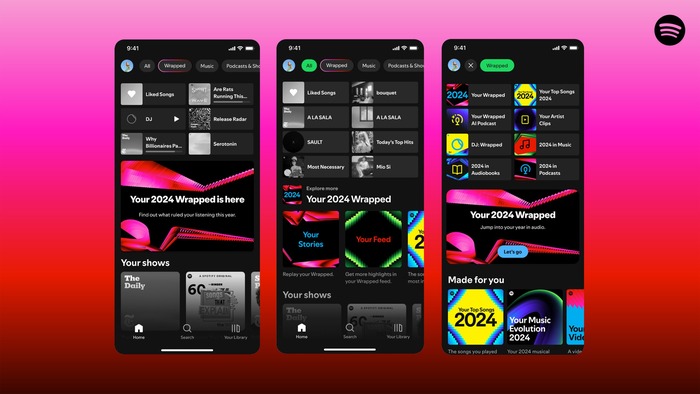
Source: Spotify Newsroom
This strategic move allowed Spotify to differentiate its brand from competitors.
3. Get an Inside View of Your Rivals With Competitor Analysis
Competitor analysis has always been a part of every business or marketing strategy. But social media data and insights are pretty new. Nevertheless, the insights about your rivals you can get from there can be a game changer.
Check the competitors’ social and find out how successful they truly are. When you conduct competitor analysis, you need to check what and how they are doing on different social media. That way, you can see where they are better than you and where you have the advantage.
Tired of creating competitor analysis reports from scratch? Grab our downloadable template with all the insights you need to benchmark against the competition and just add the data!
With social media monitoring tools, you can check their marketing campaigns as well. You can see their overall performance and reputation. You can even check whether people talk more about your brand product on social media than your competitors’ brands with Share of Voice analysis.

But what about those newcomers? We live in an era where rivals are popping up like mushrooms after the rain, no matter what industry you’re in. You need to pay special attention to them.
Why? Because they’re new, they come with big dreams, fresh ideas, and a hunger for success. Chances are, they’ve done their homework on you and already know your weak spots before stepping into the arena.
With monitoring tools, you can track their progress. Are they doing something differently? Are their new tactics gaining traction? Staying ahead means understanding your established competitors and those new players eager to carve out their space.
4. Analyze Sentiment and Emotion to Uncover Hidden Customer Needs
Social media analytics doesn’t just provide numbers; it also reveals sentiments and emotions. And we all know how important this is.
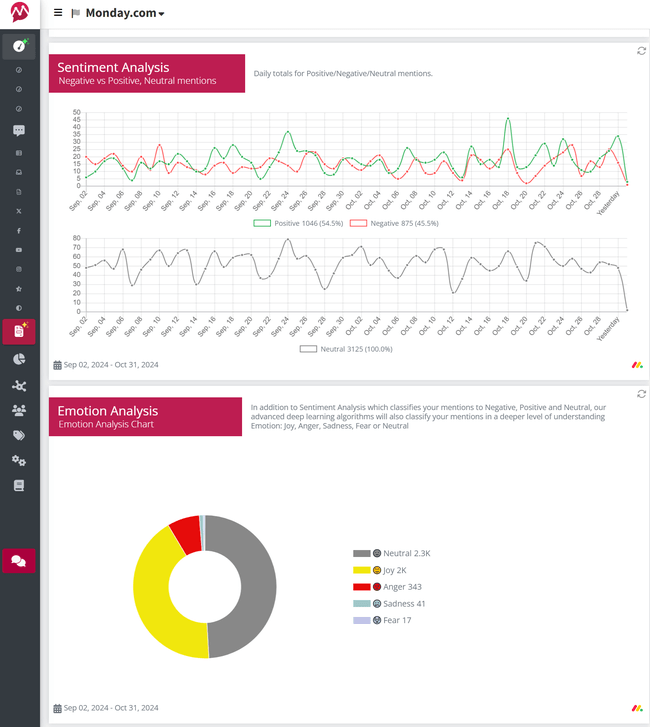
Spotting subtle differences between emotions and digging deep into negative ones can identify where your company or campaign might be falling short. What is disappointing for your audience, and why?
You might miss the real issue if you only scratch the surface of negative reviews. Digging deeper allows you to fix problems, enhance your product, or even change the direction of your campaign.
These insights can be some of the most valuable you gain from social media because they reveal the true needs and pain points of your customers.
The best part? You don’t have to do all of this manually. Tools with AI capabilities, like Mentionlytics, can handle it for you with AI-driven emotion analysis. These tools sift through social media platforms and analyze emotions, helping you detect even the fine distinctions that make all the difference.
5. Discover untapped markets
Who knows — maybe there’s a tiny corner of the world eager for your product or service, and you don’t even realize it. Missing out on these opportunities can be a big mistake.
Social media listening tools can provide valuable insights into this. If you notice that many mentions of your brand come from a country where your product isn’t yet available, it could indicate potential demand. That market might just be the perfect place for your next expansion. It’s all about recognizing where there’s interest and taking action before your competitors do.
You can also analyze markets where your competitors aren’t present or aren’t as successful as they’d like. Social listening will reveal these opportunities in no time. It can give you the chance to establish a strong foothold before others catch on.
Example: How Social Media Market Research Helped ContentCal Succeed
Perhaps the best example of how social media market research can lead to unexpected opportunities is ContentCal. Founded in 2016, ContentCal entered a highly competitive market. Already established content marketing and social media management tools, such as Hootsuite and Buffer, were the biggest competitors.
ContentCal initially struggled with visibility and trust as a new tool — customers were hesitant, and no one was talking about it. Andy Lambert, Director of Growth and a founding team member realized they needed to create a buzz.
Growth would remain out of reach without making people talk about them on social media and driving organic impact. Therefore, Andy focused on building trust and brand awareness. He knew that the more people talked about the tool, the more credibility and trust it would gain.
To achieve this, Andy used Mentionlytics’ Share of Voice feature to track and measure online word-of-mouth. He monitored mentions and conversations across social media and saw how ContentCal was performing compared to competitors. He adjusted strategies to boost its organic social media reach and presence.
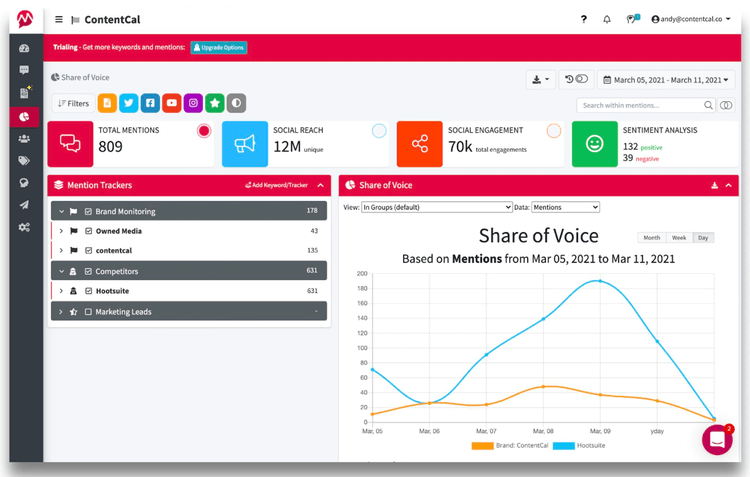
These efforts paid off. Within just five years, ContentCal achieved significant growth, establishing itself as a leader in its niche.
This success culminated in its acquisition by Adobe in 2021. ContentCal’s strong online presence and reputation made it an ideal fit for Adobe’s suite of tools. They demonstrated how strategic social media market research can position a company for incredible opportunities.
Get Accurate Social Media Data for Your Market Research Reports
So, next time you doubt the benefits of using social media for your market research, remember this: with the right tools and strategies, social data can provide insights that drive growth, uncover untapped markets, and even position your business for game-changing opportunities.
Ready to take your market research to the next level? Try Mentionlytics for free and start uncovering actionable market insights to stay ahead of the competition!


