

Political marketing may be a relatively new term in political science, but it’s not a new strategy that political candidates employ in their campaigns. In reality, political digital marketing tactics are being blended into the campaigning strategies of most politicians to reach voters online and promote their messages.
Whether commenting on current events via tweets or running Facebook ads to spread the campaign messaging, political candidates leverage the power of digital channels to win votes and influence voter turnout.
So, as a campaign manager, getting to understand how to implement digital marketing in politics can help your candidates get elected and establish a strong bond with their constituents.
In this article, we’re explaining the basics of political marketing in 2026, with strategies and real-world examples of recent elections to get inspiration and lessons learned for your campaign.
Article Summary (TL;DR)
- Long-form podcasts now build more voter trust than polished 30-second ads.
- Campaigns must optimize for AI search (ChatGPT, Gemini, Perplexity), not just Google rankings.
- Real-time social listening has replaced traditional polling as the fastest way to read voter sentiment.
- Niche “comfort creators” drive more persuasion than Hollywood celebrity endorsements.
- Lo-fi, phone-shot videos consistently outperform studio productions.
- The “For You Page” is the new press office; campaigns that bypass traditional media and go direct to creators win visibility.
- The strongest campaigns in 2026 sync digital momentum with physical field operations. Viral attention alone doesn’t win elections.
Table of Contents
What Is Political Marketing?
Political marketing is an applied method of political communication involving creating and promoting political messages (through various channels) by politicians and parties to influence public opinion and voter behavior. Essentially, political marketing is the strategy of using tools developed for business marketing for political purposes, from winning elections to improving the image of the government.
Some indicative political marketing strategies are political advertising, personal branding, online campaigning, mobile phone canvassing, and celebrity endorsements.
Unlike what you might think, business marketing doesn’t differ that much from political marketing.
The main difference is that in the former you promote products and services while in the latter you push ideas and policies. Apart from that, digital marketing for politicians involves the same tactics as in business marketing.
For example, political candidates can create videos on YouTube, do social media monitoring for political reasons, be featured in online media articles, run digital advertising, and forge influencer collaborations to reach different segments of the electorate with tailored messages and ensure their votes.
Eventually, the objective is to connect politicians with potential voters and create a favorable image of them in the minds of their target audience.
Is Marketing Appropriate for Political Candidates?
Yes, marketing is appropriate and necessary for political candidates as the political landscape is more competitive now than ever.
As the competition is getting stronger, all politicians need to be able to distribute and share their views, party ideology, and programs with the electorate. Thus, they have an equal opportunity to be considered as a good choice by the voters.
Political campaign marketing helps candidates reach a broader audience and simultaneously address the specific needs of certain communities. No matter if they want to appeal to the masses with generic political messaging or speak to the hearts of a very specific group of citizens, campaigns can do it through their digital strategy by using different channels.
Ethically used, marketing can enhance democratic processes by multiplying the information sources that are available to the people.
On the other hand, there is some criticism around political marketing and whether it harms democracy. That’s because it can create echo chambers where extreme ideas can be more easily propagated. Intentionally or not, a falsehood spread can negatively affect the voters’ minds, thus damaging the democratic process.
Therefore, ensuring truth in political campaigns should be one of the utmost priorities of campaign managers like you, to preserve democracy.
Why Is Political Marketing Important?
There are numerous reasons why political marketing is essential for anyone actively involved in politics, either at a local or a national level. Below, we analyze the main ones.
To Bridge the Gap Between Candidates and Voters
For a political candidate, connecting with their voters on a personal level is of paramount importance. So, political marketing strategies allows for two-way communication between the candidate and their voter base.
Especially through social media and other digital campaigns that facilitate interaction. It’s exactly that dialogue that fosters a sense of real connection and builds trust.
Furthermore, by targeting specific demographics with their digital marketing campaigns, candidates can address the concerns of different voter groups. That way they can speak to their very hearts and show understanding, in particular to minority groups.
To Influence Public Opinion and Behavior
There’s no better way to sway public opinion to favor your candidates than running a digital political marketing campaign. Through persuasive messaging, it can influence voters’ preferences and decisions.
Marketing strategies employ emotional appeals and storytelling to resonate with your target audiences. With consistent messaging and repetitive actions, you can reinforce the key campaign topics in the minds of constituents.
Ultimately, effective marketing can determine the outcome of political contests and shape the course of governance.
To Control Crisis and Manage Reputation Effectively
Political marketing plays a significant role in managing PR crises and preserving a candidate’s reputation. It helps control narratives during turbulent times.
It’s a toolkit that campaign staff can rely on to address scandals, controversies, or unexpected setbacks. With the right messaging and strategy, your team can directly tackle issues, shape perceptions, and restore public trust in your candidate.
Moreover, with the right online reputation management, your team can turn every crisis into an opportunity for growth.
To Enhance Voter Engagement and Participation
Implementing marketing tactics into political campaigns can boost voters’ participation as it informs them about candidates and educates them about the issues that matter.
In fact, creative campaigns captivate the electorate’s attention and inspire involvement.
Also, interactive strategies encourage dialogue and feedback. Thus, politics become more accessible and relatable which motivates people to get involved.
To Maximize Campaign Resources Efficiently
With effective marketing strategies, political campaigns can achieve more with less. These strategies help allocate funds strategically by focusing on key demographics. Targeted messages make sure that your resources don’t go to waste.
Moreover, analyzing marketing data can help campaigns minimize the cost of digital platforms by not overspending on channels that don’t work and reduce traditional advertising costs, which can be enormous!
7 Online Marketing Strategies for Political Campaigns
Now, a lot has changed in the past six years, and some strategies that were effective only a decade ago can no longer bring voters in or influence public opinion. New media and online channels has been slowly taking over, and, as a result, new strategies have emerged, and we can see that the campaigns are starting to look very different.
The 2026 Online Marketing Strategies for Political Campaigns
| # | Strategy | What to Do |
| 1 | Human Media | 3-hour podcasts build trust that 30-second ads can’t. |
| 2 | GEO (AI Search) | Winning the “answer” that ChatGPT gives the voter. |
| 3 | Social Listening | Using real-time sentiment data to “mind-read” voter pain points. |
| 4 | Comfort Creators | Niche influencers are more trusted than Hollywood stars. |
| 5 | Lo-Fi Aesthetic | If it looks polished, it looks like a lie. iPhone > Studio. |
| 6 | Creator Access | Making the “FYP” your official, unfiltered press office. |
| 7 | Unified Front | Turning digital likes into physical votes through O2O sync. |
Human Media: Podcasts Becoming More Powerful Than Political Ads
For decades, political campaigns were built around short television appearances, polished interviews, established media outlets, and expensive 30-second ads. But the 2024 and 2025 election cycles showed something very different: voters increasingly trust long-form conversations more than traditional campaign messaging.
The clearest example was Donald Trump’s appearance on “The Joe Rogan Experience” in October 2024. The interview lasted nearly three hours and generated more than 26 million YouTube views within a single day, outperforming the opening game of the World Series.
At the same time, Kamala Harris pursued a completely different podcast strategy. Instead of targeting Rogan’s heavily male audience, her campaign appeared on shows like Call Her Daddy and The Breakfast Club, attempting to connect with women and younger black voters through personality-driven conversations rather than press conferences.
This was not accidental. Podcasts allow voters to spend hours with candidates, hear their reactions in real time, and evaluate personality, confidence, humor, and emotional tone without heavy editing. In other words, campaigns discovered that trust is increasingly built through exposure rather than slogans.
Honestly, it makes sense. A 30-second ad can communicate a message. Three hours of conversation can create familiarity.
But there’s another important statistic related to podcasts. According to YouGov, 39% of the regular weekly podcast listeners vote in primary elections, meaning they are more politically active. And if we add to that the fact that 54% of Trump’s voters aged 18 to 34 said the podcast influenced their choice, we can surely see the impact this new channel has on political campaigns.
GEO (AI Search): Campaigns Now Compete for AI Visibility
Political SEO used to mean ranking high on Google. Now campaigns also compete to become the answer generated by AI systems like ChatGPT, Gemini, and Perplexity.
This shift is happening quietly, but it is already changing how social media affect elections. Increasingly, voters no longer search: “candidate website.” Instead, they ask:
- “Who won the debate?”
- “What does this politician stand for?”
- “Why are people criticizing this candidate?”
- “Which candidate supports rent freezes?”
AI systems generate those answers by synthesizing information from various sources:
- news outlets
- podcasts
- social media discussions
- Wikipedia
- creator videos
- interviews
That means campaigns with stronger digital footprints increasingly dominate AI visibility.
This was particularly visible during the 2025 New York City mayoral election.
Zohran Mamdani consistently appeared in affordability discussions across media outlets, podcasts, TikTok clips, YouTube videos, and online commentary. His platform around rent freezes, free buses, childcare, and grocery costs became highly searchable and highly quotable online.
And that matters because AI tools do not only summarize official websites anymore. They summarize the internet’s understanding of a candidate.
Social Listening: The “Vibe” Radar
One of the biggest political marketing shifts of the past few years is that campaigns have stopped relying only on polls and begun monitoring online conversations in real time instead. Because by the time a poll is published, the internet has already moved on to three new conversations, two outrage cycles, and one completely different emotional climate.
Political campaigns now rely on predictive social listening instead: tracking online conversations in real time to identify emotional shifts before they become mainstream political narratives.
So, besides traditional media outlets, 2026 political campaigns should also monitor:
- TikTok comments
- Reddit threads
- YouTube reactions
- Facebook groups
- podcast discussions
- local X/Twitter conversations
Not just to measure popularity, but to identify recurring frustrations, emotional language, economic anxiety, anger spikes, trust collapse, or emerging local issues.
One of the clearest examples came from the UK general election campaign in 2024.
Labour’s digital operation reacted almost instantly after the Conservatives proposed mandatory national service for 18-year-olds. Labour’s TikTok team posted a meme-style video using an old Cilla Black clip with the caption:
“POV: Rishi Sunak turns up at your 18th birthday to send you to war.”
@uklabour Surprise surprise #generalelection #toriesout #ukelection #ukpolitics ♬ original sound – UKLabour
The video generated 4.5 million views and nearly 700,000 likes almost immediately, massively outperforming Conservative TikTok engagement at the time. The results of the elections were approximately the same: the Labour Party won, with 412 seats in the Parliament.
Now, the important part here was not the meme itself. It was the speed of adaptation.
The Labour campaign recognized almost immediately that younger voters online were emotionally reacting to the national service proposal with sarcasm, disbelief, anxiety, mockery… and they amplified that emotional current before traditional political coverage fully caught up.
That is exactly where public opinion monitoring is heading. Campaigns increasingly monitor the internet the same way traders monitor financial markets:
- emotional spikes
- narrative shifts
- engagement acceleration
- creator amplification
- emerging frustrations
- cultural momentum
This is also why political campaign media monitoring has evolved far beyond simply tracking mentions in newspapers and television. Campaigns now monitor creators, the meme ecosystem, repost culture, reaction videos, algorithmic momentum, and shifts in audience sentiment.
That’s because, the internet tells campaigns what voters will care about before voters fully articulate it publicly.
Get a glimpse into the minds of the voters
Monitor internet and social media trends with Mentionlytics and stop the endless scrolling!
Comfort Creators & Niche Micro-Influencers
The era of the giant Hollywood political endorsement is slowly fading away. In 2026, voters are far more likely to trust the creator they watch every morning while drinking coffee, going to the gym, or scrolling TikTok in bed at midnight.
Celebrity endorsements often feel distant, polished, and transactional, while comfort creators feel familiar.
Audiences spend hundreds of hours with them through podcasts, livestreams, YouTube videos, Discord communities, and Instagram Stories. Over time, those creators stop feeling like “media personalities” and start feeling more like digital friends.
Modern political campaigns noticed that shift very quickly. Instead of relying primarily on actors, musicians, and television appearances, campaigns increasingly entered creator ecosystems where audiences already had strong emotional trust. The goal became to appear naturally inside trusted digital communities.
The clearest example came during the 2024 US presidential election, when Donald Trump’s campaign aggressively targeted young male audiences through creators and streamers that had almost nothing to do with traditional political media. Trump appeared with:
These appearances were not accidental media stunts. They were part of a broader strategy to reach younger men who had largely disconnected from traditional news consumption.
According to post-election research cited by CNN and Pew Research, nearly 40% of young voters were already getting news from influencers and online creators rather than mainstream media outlets.
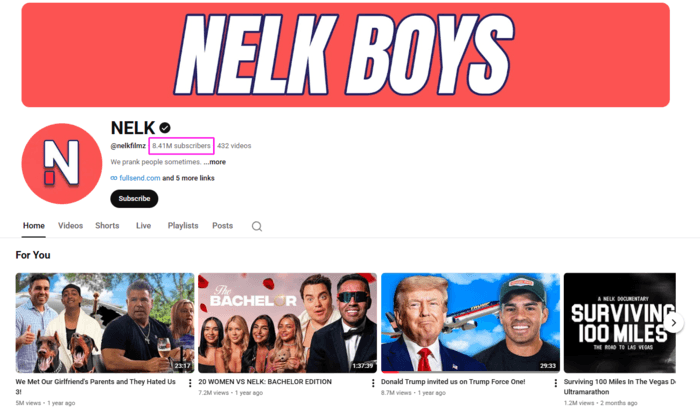
The numbers behind those creator ecosystems were massive. The Nelk Boys alone had more than 8 million YouTube subscribers by late 2025, while Trump’s appearance on their Full Send podcast became one of the platform’s most viral political interviews.
This strategy became so influential that political analysts began referring to it as “bro whispering”: campaigns strategically entering male creator ecosystems centered on comedy, sports, fitness, UFC culture, and internet personalities.
What made these appearances effective was not direct political persuasion. In many cases, politics was barely discussed formally at all. Conversations revolved around sports, masculinity, money, lifestyle, confidence, culture, and everyday frustrations.
That dramatically lowered the audience’s psychological defenses. The creators were “vibe-checking” politicians in front of millions of followers.
And that may be one of the biggest changes in modern political communications. Campaigns increasingly realized that audiences trust emotional familiarity more than institutional authority.
The new political battlefield is not only television anymore. It’s creator ecosystems, podcast networks, livestream communities, and algorithm-driven digital tribes.
So the goal of this strategy is to partner with niche influencers (local foodies, “mom-bloggers,” or hobbyist YouTubers) who have high-trust relationships with their followers. These creators don’t “endorse” the politician; they “vibe-check” them.
Mentionlytics can help you identify podcasts and niche creators’ shows that might be fitting for your candidates to participate.
The Lo-Fi Aesthetic (Authenticity as a Weapon)
One of the strangest political marketing shifts of the past few years is that high production quality increasingly creates distrust online. For decades, campaigns operated under the assumption that the more polished a video looked, the more professional and trustworthy the candidate appeared.
But TikTok, Instagram Reels, YouTube Shorts, livestream culture, and creator ecosystems completely changed that logic.
In 2026, overly polished political content often signals the exact opposite of authenticity. If a campaign video looks like it was scripted by consultants, filmed in a studio, color-graded for television, and edited like a corporate commercial, many voters instinctively assume they are being manipulated.
High production value increasingly became associated with “The Establishment,” while imperfect content started feeling emotionally believable.
This was especially visible during the 2025 New York City mayoral race. Zohran Mamdani’s campaign videos frequently looked like they were filmed casually by a friend walking next to him on the street.
Many of the clips were recorded in neighborhoods, on subways, during canvassing, or while speaking directly to the camera in one take. The visual language mattered because it made him feel less like a distant politician and more like an actual New Yorker dealing with the same problems as everyone else.
And this shift is not anecdotal anymore. Researchers analyzing more than 25,000 TikTok videos posted by politicians during the 2025 German federal election found that engagement increasingly favored emotionally direct and platform-native content over traditional institutional political communication.
Videos that looked conversational, reactive, and informal consistently outperformed highly polished campaign messaging.
The same pattern appeared repeatedly throughout the 2024 US presidential election. Campaigns across both parties shifted toward:
- vertical phone-shot videos
- podcast clips
- livestream reactions
- selfie-style commentary
- spontaneous backstage moments
- and lower-production creator collaborations
Not because they suddenly lost production budgets, but because audiences trained by social media associate imperfection with honesty.
This also became an important part of online reputation management for politicians. Traditional political communication was built around control: controlled interviews, controlled lighting, controlled messaging, controlled emotional tone.
But modern audiences consume thousands of hours of creator content every month and instinctively recognize when someone sounds rehearsed, over-trained, or emotionally artificial.
The “lo-fi” strategy is therefore not simply “film badly on purpose.” It is about removing the visual and emotional signals audiences associate with manipulation.
The internet trained audiences to trust humans more than productions. Which explains why some of the most effective political videos of the past two years looked like they were filmed in under three minutes on a phone.
Creator Credentials – The FYP as the New Press Office
For decades, political campaigns depended on a relatively small ecosystem of television anchors, newspaper reporters, and political journalists to shape public perception. If a campaign wanted visibility, it needed traditional media access.
That model is breaking down very quickly. According to Gallup, trust in the news media has dropped drastically since 1970, when it ranged from 68% to 72%. Today, that percentage is way below, and the 2025 poll says news media have only 28% trust of the American audience.
In 2026, campaigns increasingly bypass journalists entirely and communicate directly through creators, streamers, podcasters, TikTok personalities, YouTubers, meme-page admins, and online communities. The “For You Page” became the new press office, and the people controlling access to audiences are no longer only editors and producers, but creators with highly loyal digital communities.
Discover content creators that fit your campaign
Use Mentionlytics to identify creators and thought leaders that match your campaign messaging and energy to boost your candidate’s positions.
The clearest institutional example came during the 2024 Democratic National Convention, which became the first major US political convention to formally credential influencers and content creators at scale.
More than 200 creators received access traditionally reserved for journalists, including backstage areas, livestream positions, creator lounges, interview access, and dedicated “influencer platforms” specifically designed for streaming content directly to their audiences.
The main difference here is that traditional journalism filters political events through editorial priorities, newsroom framing, production schedules, and institutional narratives, while creators operate immediately, emotionally, personally, conversational, and algorithmically native.
So instead of watching a polished CNN package about the convention six hours later, audiences watched creators filming backstage, interviewing delegates, reacting live, posting outfit breakdowns, livestreaming speeches, and arguing in hallways. That’s real life, with no masks on.
Voters (especially younger generations) want creator translation: a political event interpreted through familiar internet personalities that audiences already emotionally trust.
Research published after the election found that social media creators often influenced political attitudes more effectively than traditional campaign outreach or partisan media. Interestingly, creators who mixed political and non-political content were often perceived as more trustworthy than explicitly political commentators.
The Unified Front (Mixed Online & Field)
Some ten years ago, political campaigns treated digital marketing and field operations like two completely separate departments. One team handled ads, social media, email campaigns, and online messaging, while another handled canvassing, rallies, volunteers, and voter outreach on the ground.
In 2026, that line is starting to blur. The strongest campaigns now operate like synchronized ecosystems where digital momentum and physical organizing constantly reinforce each other, and create a circle.
A voter sees the candidate on TikTok in the morning, receives a targeted Instagram ad during lunch, watches a podcast clip in the afternoon, and then opens the door in the evening to meet a volunteer talking about the exact same issue.
And this completely changes political persuasion because repetition across environments creates familiarity much faster than isolated campaign moments do. Because voters are present on multiple channels, TikTok clips, podcasts, group chats, forums, livestreams, local conversations, and face-to-face interactions, but if your candidate stays in the “online zone,” they might miss the connection point.
This integration matters because modern political behavior is fragmented across platforms, devices, and environments. Voters no longer experience campaigns in one place.
The campaigns performing best today understand that digital visibility alone is not enough. Online attention must eventually become physical participation (donations, voting, volunteering).
And this is where many purely “viral” campaigns still fail. Internet momentum can create enormous visibility without translating into real-world infrastructure. The strongest modern campaigns bridge that gap by treating the internet not as a separate campaign layer, but as the engine constantly feeding real-world organization.
Best Political Marketing Campaign Examples
According to statistics, around 40 countries will have elections on a national level in 2026. Some of them have already played out, and some yet are to be. But we mustn’t forget that besides these elections on the highest level, there are hundreds of thousands elections on local, municipality, or regional level worldwide.
The USA, for example, besides the Congress elections will have governors elections in 36 courtiers and 3 territories, legislative chamber elections in 46 countries, and thousands of races for mayors, city councils, and judges, and each one of them has its own political marketing strategy.
Some of them were very successful in the past, and some of them were a miss. So let’s see a few good examples from the recent period.
Zohran Mamdani: New York City Mayoral Election Plot Twist
On November 4th, 2025, Zohran Mamdani, a candidate who had a 1% chance of winning in the Democratic primary, at the beginning of the race for the New York City Mayor position, ended up winning with 50.8% of the vote.
Mamdani’s strategic story has two linked elections:
- In the Democratic primary on 24 June 2025, he beat a crowded field that included Andrew Cuomo, Brad Lander, Adrienne Adams, Scott Stringer, Zellnor Myrie, Michael Blake, Jessica Ramos, Whitney Tilson, Paperboy Love Prince, and Selma K. Bartholomew. He won more than 545,000 votes, the most any Democratic primary candidate has received in the past 36 years.
- Then, in the 4 November 2025 general election, Mamdani defeated the former governor, Andrew Cuomo (who ran as an independent candidate after the Democratic primary defeat), and Curtis A. Sliwa.
Mamdani won 1,114,184 votes across his Democratic and Working Families ballot lines, or 50.8%, against 906,614 for the former governor, Como (41.3%), and 153,749 for the Republican nominee Curtis A. Sliwa (7.0%).
Now, these elections were not the typical tight races from beginning to end. In fact, everything started really slowly. While Andrew Cuomo entered the race with almost universal name recognition, institutional support, massive media attention, and years of political infrastructure behind him, Mamdani entered as a relatively unknown progressive assemblyman with limited resources and almost no serious expectations around his candidacy.
But then… the campaign slowly began to spread online and offline simultaneously. And not in the “traditional political campaign” way.
So how did he manage to go from zero to hero? What was his winning strategy?
View this post on Instagram
Mamdani’s team understood something many political strategists still struggle to accept: modern voters, especially younger ones, no longer experience politics primarily through debates, TV appearances, or newspaper endorsements. They experience it through feeds, clips, reposts, group chats, creators, and short videos consumed while lying in bed at 1 AM pretending they’ll “just scroll for five more minutes.”
And instead of fighting that reality, the campaign fully embraced it.
Political Marketing Strategy #1: Vertical videos that looked like creator content, not political ads
One of the biggest strengths of the campaign was its video strategy. The content was designed for TikTok, Instagram Reels, and YouTube Shorts from the beginning. They were not adapted later or repurposed from TV appearances; they were built vertically-first.
The videos were:
- fast-paced
- subtitled
- conversational
- casual
- emotionally direct
- filmed on streets, subways, neighborhoods, rallies, and sidewalks
Most importantly, they didn’t feel like campaign advertisements. They felt like someone explaining why New York became impossible to afford, and that’s what made them stand out.
Political Marketing Strategy #2: They targeted disappointed Democrats and politically exhausted non-voters
Most campaigns spend enormous energy trying to persuade people from the opposite political side. Mamdani’s team focused somewhere else entirely.
They targeted:
- Democrats frustrated with establishment politics
- renters exhausted by rising costs
- younger voters who stopped believing elections change anything
- politically disengaged people who simply gave up
And instead of blaming those voters for disengaging, the campaign validated their frustration. That was very important psychologically, and that changed the entire tone of communication, especially in New York, where affordability became less of a political issue and more of a daily survival conversation.
According to the CBS News Voter Poll, 15% of voters who didn’t support Kamala Harris the year before the presidential elections were voting for Mamdani.
View this post on Instagram
Political Marketing Strategy #3: The online campaign and field operations worked together
This is probably one of the smartest things the campaign did. Most political campaigns still separate digital marketing and field organizing into two completely different worlds. Mamdani’s campaign connected them.
The online content generated emotional momentum and visibility, while volunteers converted that momentum into actual turnout through:
- canvassing
- local organizing
- phone banking
- neighborhood conversations
- community events
And then the field informed the content again. Volunteers heard the same frustrations repeatedly: rent, groceries, childcare, transportation, burnout, and cost of living.
And those exact concerns kept reappearing in videos and speeches. That created consistency between the online version of the campaign and its real-life counterpart. The internet campaign didn’t feel detached from reality because it was constantly fed by real conversations happening on the ground.
Political Marketing Strategy #4: The messaging stayed consistent everywhere
This sounds simple, but it’s actually very difficult to pull off. Most campaigns eventually fracture into five different personalities:
- social media voice
- debate voice
- interview voice
- volunteer scripts
- fundraising language
Mamdani sounded almost identical everywhere. Whether he appeared in interviews, podcasts, short-form videos, during rallies, while talking to voters on the street, his tone stayed the same: calm, conversational, explanatory, emotionally grounding, hopeful, and non-judgmental.
There were no dramatic pivots depending on the audience. And that consistency slowly built credibility.
Political Marketing Strategy #5: The campaign addressed real pain points instead of abstract politics
This was probably the emotional core of the entire campaign. Instead of focusing heavily on ideology, the messaging focused on lived experience, like rent prices, childcare costs, grocery bills, transportation, and financial exhaustion.
That way, the campaign translated politics into everyday language, with a simple question: “Can you still afford to live in this city?” That’s a huge difference. Because people don’t experience politics as policy documents. They experience it when they open the fridge, pay rent, or check their bank account three days before payday.
And honestly, the campaign understood that better than most establishment candidates.
Political Marketing Strategy #6: The campaign was built around Mamdani’s natural strengths
This may have been the single most important strategic decision. A lot of political campaigns try to force candidates into a “presidential” mold, which is most often polished, over-rehearsed, overly disciplined, and emotionally distant.
Mamdani’s team did almost the opposite. They leaned into:
- his natural communication style
- calm explanations
- humor
- cultural fluency
- comfort in front of a camera
- intellectual but accessible conversations
The campaign never tried to transform him into a traditional political figure. Instead, it optimized the strategy around who he already was. And audiences notice that immediately.
The audience can sense when someone is performing a personality instead of speaking naturally. Especially online, where audiences consume thousands of hours of creator content and instantly recognize forced behavior.
Political Marketing Strategy #7: No slogans. No repetitive political catchphrases.
This was extremely unusual. Modern political campaigns are normally obsessed with:
- slogans
- chants
- repeated one-liners
- consultant-tested “go-to phrases”
Mamdani’s campaign largely avoided that style of communication. The content often felt more educational than promotional. Instead of hammering audiences with branding, the campaign focused on explaining, listening, inspiring, and encouraging.
@zohran_k_mamdani I’m freezing…your rent as the next mayor of New York City. Let’s plunge into the details. #newyears #coneyisland #polarbear #nyc #Brooklyn #mayor #zohranmamdani #bk #bronx #queens #manhattan #statenisland ♬ original sound – Zohran Mamdani
Ironically, the absence of over-engineered branding made the campaign more memorable. People didn’t focus on one perfect slogan, but they remembered the feeling of the campaign itself.
Political Marketing Strategy #8: Traditional media largely rejected him… so the campaign went around them
This is another extremely important part of the story. Mamdani was actually very open to interviews and media appearances throughout the campaign. The problem wasn’t access. The problem was that many major outlets and political commentators never treated him as a serious candidate until it was already too late.
Some openly positioned themselves against him. The New York Times editorial board advised voters not to rank him in the Democratic primary.
The New York Post was consistently hostile toward his campaign and messaging. Large parts of the traditional political media ecosystem framed him as unrealistic, inexperienced, too progressive, or simply unelectable.
Now normally, that kind of media environment destroys campaigns, especially local campaigns. Because, historically, if major newspapers, political insiders, donors, and institutional voices collectively decided you were “not viable,” that usually became reality.
But this election exposed something bigger: traditional media no longer fully control political momentum. Social media changed the equation.
Instead of depending on newspaper endorsements, TV appearances, or political gatekeepers, Mamdani’s campaign built direct distribution channels through:
- TikTok
- Instagram Reels
- YouTube Shorts
- podcasts
- creators
- repost culture
- community pages
- volunteer-driven content
And once that machine started moving, traditional media lost its ability to fully contain the campaign narrative. In fact, in some cases, negative media coverage probably helped him.
Because younger audiences increasingly interpret establishment hostility as proof that a candidate is disrupting something real.
And that created one of the most interesting dynamics of the entire race: the more traditional political media dismissed him, the more internet-native audiences paid attention to him. And it was the perfect example of how social media affects elections and campaigns.
@nycmayorThere is no NYC without unions. A people united and organized cannot be defeated. Together, we’re showing the world what solidarity means.♬ original sound – Mayor Zohran Kwame Mamdani
Vivek Ramaswamy: The Campaign That Turned Podcast Clips Into Political Power
In early 2023, Vivek Ramaswamy entered the Republican primary with 0% name recognition. He was a biotech entrepreneur with no political background, facing off against a former President and a field of established governors. Most political insiders laughed him off as a “vanity project.”
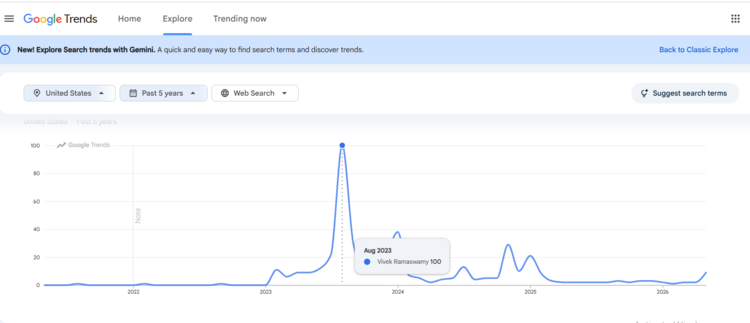
But by the first GOP debate in August 2023, he had a huge spike in search on Google, and was at 6.1% in the RealClearPolitics (while only two months prior, he was at 2.2%).
Despite eventually suspending his campaign in January 2024 to endorse Trump, he achieved a different kind of victory: he transformed from an unknown businessman into a national political figure with a massive, loyal digital following.
That helped him win the Republican primary for the Ohio gubernatorial election in May 2026, where he defeated Casey Putsch with 82,5% of the vote (673,902 votes) compared to Putsch’s 17.5%.
And Casey was not just another candidate Ramaswamy needed to pass. We’re talking about Casey the Car Guy, who has a YouTube channel with more than 352K subscribers, and an Instagram account with more than 30K followers.
To be honest, that’s what makes Vivek Ramaswamy such an interesting political marketing case study. Because technically, his presidential campaign failed. But strategically? It may have been one of the most successful political personal-branding campaigns of the past decade.
Most presidential candidates run to win an election. Ramaswamy also ran to build:
- recognition
- audience
- media gravity
- ideological positioning
- digital loyalty
- long-term political infrastructure
And that completely changed the trajectory of his political career.
By the time the presidential campaign ended, he had become a recognizable political media personality with millions of online views, nonstop podcast circulation, extremely high social media visibility, strong loyalty among younger conservative audiences, and massive name recognition compared to where he started.
Unlike many traditional politicians, he achieved most of that growth not through legacy political infrastructure, but through internet-native campaigning.
So how exactly did he pull that off? How did he manage to go from “Who?” to a household name in under a year? What was his winning strategy?
Political Marketing Strategy #1: He treated long-form podcasts like political infrastructure
While other candidates were fighting for 3-minute slots on Fox News, Vivek was doing 3-hour deep dives on podcasts. He became the “Podcast Candidate,” appearing on over 70 shows, including The Jordan B. Peterson Podcast, The Shawn Ryan Show, Lex Fridman Podcast, PBD Podcast, Flagrant, and various niche podcasts and YouTube channels.
He didn’t focus only on political podcasts. People could see (and listen) to Vivek on business and culture podcasts, comedy-adjacent shows, and libertarian platforms.
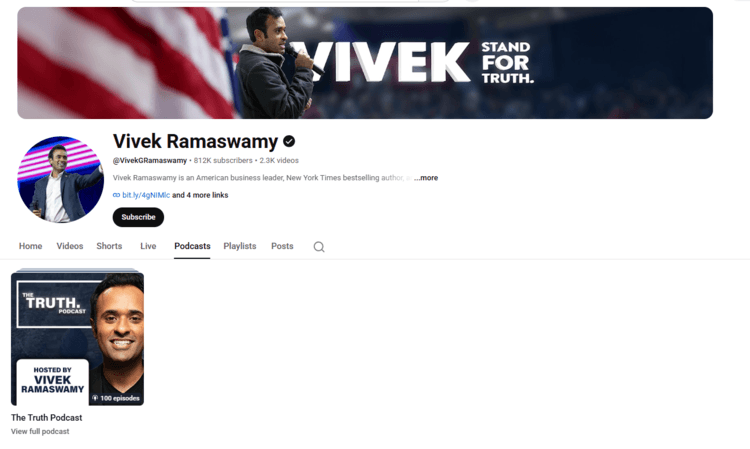
On top of that, in April 2023, he launched his own YouTube podcast channel, “The Truth Podcast,” which has more than 100 long-form episodes and gained over 800K followers.
Ramaswamy leaned on long-form video content, which his campaign used as raw material for his social media team to turn into vertical clips for TikTok, YouTube Shorts, Reels, and on X.
Political Marketing Strategy #2: Viral moments as political currency
If Mamdani had the “Subway videos,” Vivek had the “State Fair Rap.” His impromptu performance of Eminem’s “Lose Yourself” at the Iowa State Fair went mega-viral.
It was intentionally unpolished and “cringe” to some, but it did exactly what it was supposed to: it humanized him, broke the “boring politician” mold, and made him the center of the cultural conversation for an entire week.
Every time he did something his Google search volume spiked, allowing his policy ideas (like the “10 Truths”) to reach people who would never watch a political debate.
Political Marketing Strategy #3: The “10 Truths” simplified, meme-able policy
Modern political campaigns love 50-page policy white papers that nobody reads. Vivek did the opposite. He boiled his entire platform down into “10 Truths” (e.g., “God is real”, “There are two genders,” “Reverse racism is racism”, etc.) and earned 357K likes.
View this post on Instagram
The thing with this clip is that it is designed for sharing. Ideal short-form video that is meant to be screenshotted, shared in group chats, and used as “digital flags” for his supporters to rally around.
And one more important note: just like Mamdani, Vivek sounded the same on a podcast as he did on a debate stage. Whether you liked him or hated him, you knew exactly what he stood for because he repeated the same “truths” everywhere.
Political Marketing Strategy #4: Radical accessibility and the “unfiltered” town hall
Ramaswamy’s campaign held hundreds of “TRUTH” town halls, often in deep-blue areas or hostile environments. And what he did was implement the “logic-bro” appeal.
He welcomed hecklers and filmed his interactions with them. These “Vivek destroys a protester with logic” style videos became a genre of their own on YouTube, Instagram, and TikTok, appealing directly to a generation raised on debate culture.
By live-streaming everything, he made traditional journalists irrelevant. If a newspaper misquoted him, he simply posted the full, unedited clip to his millions of followers.
View this post on Instagram
Political Marketing Strategy #5: Traditional media hostility as a badge of honor
Just as the New York Times and New York Post were skeptical of Mamdani, the mainstream media (and the GOP establishment) were often hostile toward Vivek. Outlets like The New York Times, The Washington Post, The Hill, and CNN generally framed Ramaswamy as an aggressive, fast-talking provocateur pushing extreme ideas.
But every time a news anchor tried to “trap” him, his team edited the clip to show him “fighting back”.
For example, when The New York Times started investigating his business background, it didn’t go unanswered; Ramaswamy appeared on Jordan B. Peterson’s YouTube channel and talked back, which had 417K views.
So, whenever the establishment tried to ignore him or accuse Vivek of something, he went to TikTok, Instagram, or YouTube and gained millions of views by speaking directly to the “digitally native” voters who felt ignored by both parties.
Political Marketing Strategy #6: He leaned heavily into controversy and confrontation
Unlike many carefully disciplined Republican campaigns, Ramaswamy understood that online visibility often comes from friction. So instead of avoiding conflict, the campaign often accelerated into it.
He became known for:
- highly confrontational debate moments
- provocative statements
- direct attacks
- aggressive ideological positioning
- culture-war commentary
His statements about the government dismantling, raising the voting age to 25, abolishing the H-1B visa system, etc., put him at the center of attention. And whether audiences loved him or hated him, they shared the clips constantly. This made the campaign disproportionately visible compared to its polling numbers.
This became especially obvious during the first Republican debate in August 2023, where search interest around Ramaswamy exploded immediately afterward.
3 Digital Marketing Tips for Politicians
To wrap it up, here we’ve gathered our top 3 tips political marketing professionals should keep in mind to thrive in the digital marketing world.
Build a Strong Online Presence
If you crave increased visibility and high engagement with voters, you have to build an active online presence for your political candidates. This enables politicians to shape their public image and respond swiftly to negative comments, thus preserving their reputation.
Personalize Voter Communication
Tailoring messages based on demographics, interests, and concerns resonates more deeply with voters, fostering a sense of understanding. By addressing specific issues that matter to constituents, politicians demonstrate empathy and responsiveness.
Also, personalized communication encourages engagement and participation, as constituents feel valued and heard.
Leverage Social Media for Engagement
Social media platforms provide an opportunity to share updates, policies, and campaign messages, reaching a vast audience instantly. It’s a direct avenue to connect with constituents in real time to create dialogue and show transparency.
By actively engaging with followers through comments, direct messages, and live sessions, politicians can humanize their image and build trust.
Moreover, by using social media monitoring tools political candidates can gauge public sentiment, gather feedback, and address their voters’ concerns promptly.
Make Political Marketing Work For Your Candidates
To sum up, political marketing serves as the cornerstone of modern campaigns, shaping perceptions, mobilizing support, and driving electoral success. Effective marketing strategies can amplify a politician’s message and engage voters on a personal level.
To make sure your campaigns are effective and address issues promptly, keep an eye on your candidates reputation in real time with Mentionlytics.

