

Anyone who has worked on online reputation management for politicians knows it is unique. It’s a bit different from all the other ORM processes you’ve ever handled: more intense, more time-sensitive, and more … prone to erupting at 2 a.m. because someone misused an emoji.
Safeguarding a public figure whose every statement, eyebrow raise, or photo background plant is analyzed, screenshotted, and turned into discourse is not easy.
While voters demand transparency, journalists demand statements, and opponents demand blood pressure spikes, your job is to stay ahead of it all and report on time, without losing your weekends or developing a new caffeine dependency. It is definitely not a one-person show, but a team project.
And here’s the part most people outside the political bubble don’t realize: reporting seems just like another deliverable, but the truth is it’s the war room oxygen. It’s the thing that tells your team where the narrative is headed, what’s blowing up, what’s quietly brewing, and whether your candidate should prepare a statement or a fire extinguisher.
Strategists rely on it, comms teams move with it, and campaigns collapse without it. It’s no surprise that reporting is also one of the biggest challenges agencies face.
So in this article, we’re going to give an answer to one of the real questions: How do you cut your reporting time in half, stay proactive, and keep your candidate’s online reputation from spontaneously combusting without hiring more people?
Table of Contents
3 Common Political Reputation Management Challenges & Solutions
What slows political comms teams down the most? It’s usually not the strategy, not the messaging, and definitely not the talent. It’s the hidden operational blockers that drain your energy and hours before you even notice.
Let’s break down the three challenges that consistently stretch reporting time (and patience) to the limit, plus how to fix them fast.
Manual Reporting Takes More Time Than Your Team Can Afford
Anyone who’s ever been through the political morning briefs at least once knows the pain. Opening 12 tabs, checking all the PR clippings, mentions, and sentiment, taking screenshots, and then repeating the whole routine again at noon… and again if something “mysteriously” blows up at 6 p.m.
Multiply that by three candidates, and you’ve got a reporting schedule that eats half the day and half your sanity.
But it doesn’t have to be like that for your agency. You can use AI and automate half of that.
Solution: Ready-made, custom reports in your inbox
Did you know you could wake up to a full 24-hour recap of everything said about your candidate online, categorized by sentiment, channel, and topic clusters?
Add AI summaries for instant context, and you have a customized report with no manual sorting required, ready for your morning briefs.
Bots and Real Voters’ Lines Are Blurring
Political ORM teams today are navigating a confusing new landscape where real voters, organized opposition, and AI-driven bots blend to shape online conversations. If we add to that a relatively soft social media moderation, it becomes nearly impossible to separate authentic public opinion from manufactured buzz.
It would be great if you could eliminate these unfiltered distortions from creeping into reports, skewing sentiment analysis, and sending political marketing campaigns chasing the wrong problems.
Solution: SIA Troll Detector to flag bot-generated mentions
Mentionlytics’ SIA (Social Intelligence Advisor) automatically identifies suspicious or bot-like activity in your mention stream. You can exclude flagged mentions from your main report, move them into a separate “manipulated activity” brief, or keep them visible for strategic monitoring. Cleaner data enables you to gain a more accurate overview, make better decisions, and avoid unnecessary crisis meetings.

Crisis Management Takes Over Everything If You Let It
How many times did a PR crisis barge in, flip the table, and demand a statement right now? A single comment, a clipped video, or a misinterpreted quote can blow up into a crisis that causes you to lose the race.
Yes, every candidate gets negative comments (that’s the nature of politics), but the real danger lies in not knowing when normal opposition noise turns into a narrative you mustn’t ignore.
The main problem is that they are happening so fast, and if you don’t spot a spark, your candidate can say goodbye to a positive online reputation. While your team is piecing together who said what, journalists have already picked it up, opponents are framing it, and voters are forming opinions in real time.
And before you know it, crisis management becomes a full-time job, and instead of strengthening your candidate’s reputation, you’re just trying to contain the damage.
Solution: Real-Time Alerts Powered by AI Anomaly Detection
Effective online reputation management for politicians requires smart time management and a focus on what truly matters. This is where AI Anomaly Detection can be of great help.
Instead of pinging you every time someone tweets something mildly spicy, it learns your candidate’s normal mention patterns and alerts you only when something truly unusual happens, like a sudden negative spike, coordinated push, or narrative shift that doesn’t fit the usual rhythm.

You’re not glued to dashboards or guessing what’s urgent. You’re getting a ping only when the data says, “Hey, this is not normal.”
Pair those smart alerts with instant AI summaries that tell you why the spike occurred, where it started, and how fast it’s spreading, and your team gains back hours of reaction time.
Find Everything You Need for Your 2026 Mid-Term Election Campaigns in One Place!
SIA, AI Summaries, Anomaly Detection, and many more under the Mentionlytics umbrella, to help your candidates win the online game.
How to Reduce Reporting Time for Online Political Reputation Management without Hiring More Juniors
Online reputation management services for politicians typically require large teams. Even with numerous team members, the system may be disconnected, leading to an inaccurate overall view.
Let’s see how you can reduce reporting time without getting more people into this task or losing valuable data.
Automate Online Reporting for Your Political Candidates with Trusted AI
Can you trust AI to do the reporting for you? Yes, if the tool is trustworthy, accurate, and capable of multilingual sentiment analysis (because your voters definitely don’t limit their opinions to one language, and they rarely hold back when expressing them sarcastically on social media platforms).
And here’s the campaign truth nobody wants to admit out loud: Manual reporting slows down your entire war room.
Every minute spent copy-pasting mentions is a minute you’re not shaping narrative, preparing counter-messaging, or flagging early risks to your candidate. Speed matters. Accuracy matters more.
A battle-tested AI-powered tool like Mentionlytics can outperform even the most caffeinated junior on both:
- Instead of pulling screenshots, you get an organized feed.
- Instead of interpreting tone manually, you get sentiment that actually understands irony, sarcasm, and “oh no, they did NOT just say that.”
- Instead of assembling morning briefs from scratch, you wake up to a clean report your team can act on immediately.
Win Elections With Smart Insights
Cut reporting time and make reports stand out, point out, and call out action, with Mentionlytics.
This system won’t replace your team. It will free them from constantly manually monitoring political campaigns’ progress and their candidates’ online presence, and allow them to focus on actions that actually win elections.
Create White-Label Custom Dashboards without Online Noise
Imagine giving each of your candidates their own clean, real-time “social media pulse” dashboard, branded as your agency’s exclusive tool, fully embedded on your website page, closed to public view, with the candidate and their team having the password. It could look like something your in-house tech team built.
That’s the superpower of white-label reporting with Mentionlytics.
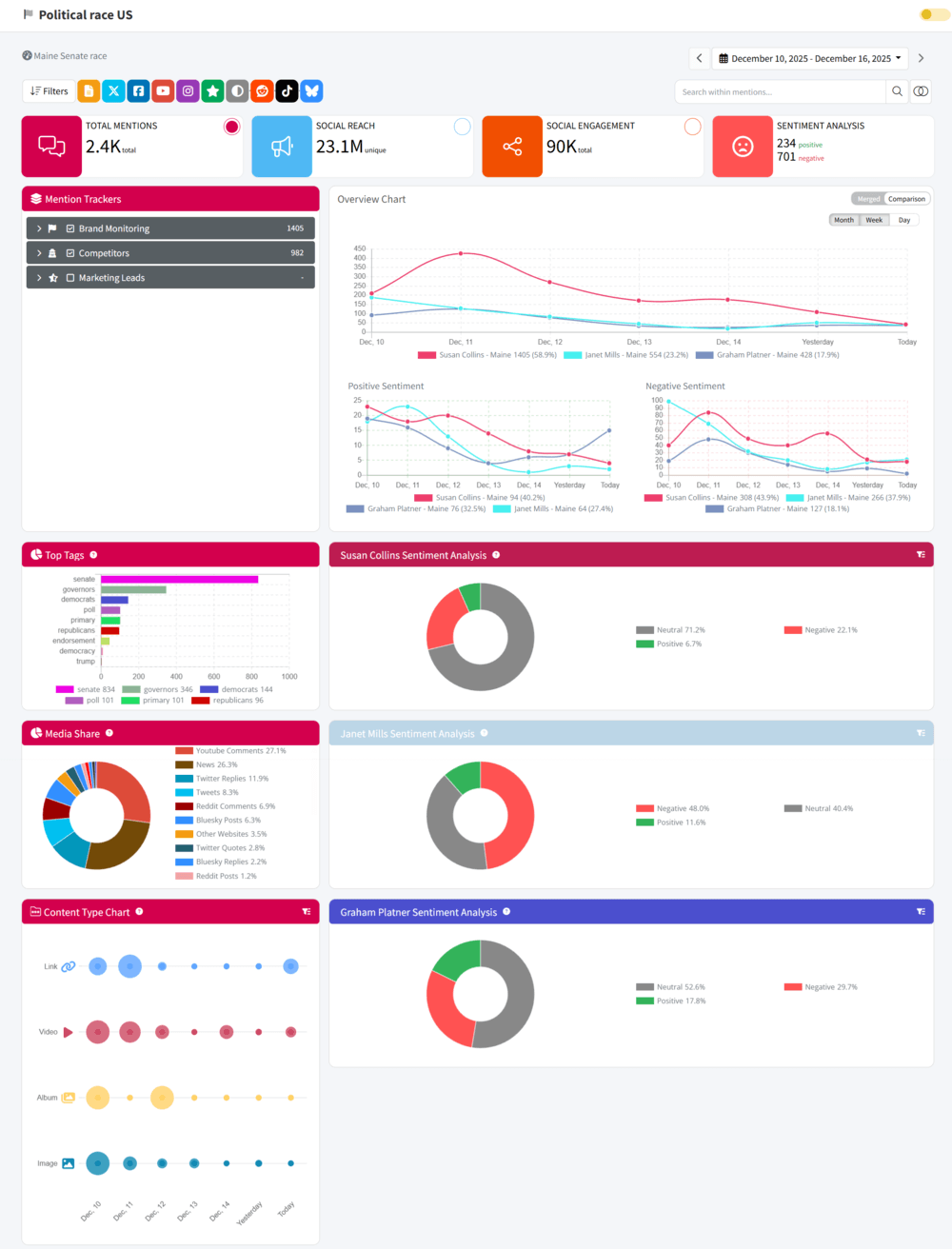
Instead of drowning clients in raw mentions, noise, and off-topic online content that can be confusing, you deliver a crisp dashboard that shows exactly what matters: shifts in sentiment, trending narratives, spikes in coverage, influential voices, and emerging risks. You can even include competitor analysis. And that’s how you get right on point and surprisingly insightful public perceptions packaged in your branding.
And guess what? It doesn’t just elevate your service, it elevates your pricing.
When your candidate or political client sees a polished “real-time reputation intelligence hub,” they see premium value… and yes, you can charge accordingly.
Get War Room Intelligence by Simply Asking Your Question(s)
In a political war room, speed is your best survival kit. Decisions get made in minutes, narratives shift in seconds, phones are ringing like crazy, and someone is always shouting, “Can we verify this?” while refreshing five tabs at once.
And all these adrenaline spikes can sometimes feel too much. It would be easier if you could get the answer directly from your software and address concerns immediately.
And we built one, specialized in these situations. The SIA Chatbot becomes your unofficial (but very effective) extra team member.
Forget digging through dashboards during a crisis meeting. Just ask your question:
“What’s driving negative sentiment today?”
“Did this spike start organically or from a coordinated push?”
“Which communities are talking about our candidate right now?”
“Who’s winning today based on sentiment?”
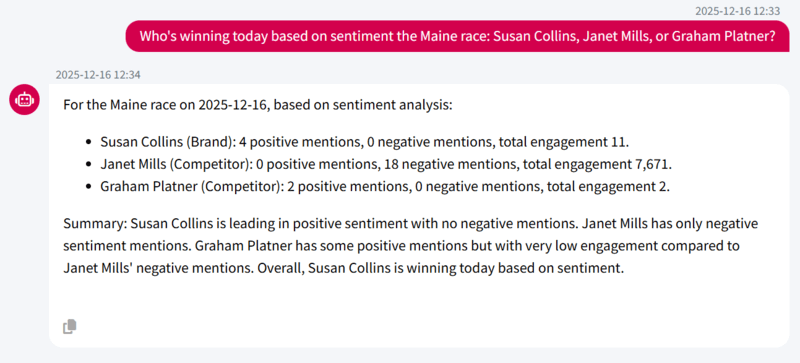
SIA’s AI chatbot pulls data from every mention, every sentiment score, every cluster, and every channel you’re monitoring, and gives you an instant, data-backed answer.
It’s like having an analyst in the room who never sleeps, never guesses, doesn’t need a sandwich break, and doesn’t have nervous breakdowns.
Get SIA Chatbot into Your War Room
Find competitive advantage for campaigns and make the high-pressure moments less stressful with Mentionlytics.
This is real-time political intelligence at your fingertips, built for the people making decisions when the clock is ticking loudest.
Create Special Graphs & Charts without Excel or Power BI
There’s a moment in every campaign when someone says, “Can we get a quick chart on this to include in a press release for news outlets?” And suddenly your entire team is knee-deep in Excel sheets, color palettes, and whispered prayers that the bar graph won’t randomly disappear before export.
Perhaps that was before, in your previous candidate’s run. However, you now have SIA Chatbot, and you don’t need to open Excel, Power BI, or summon your resident “data person” anymore.
With SIA Chatbot, you can generate custom graphs and visuals with a single prompt: sentiment trends, narrative spikes, top influencers, comparison charts, you name it. Whether you’re preparing a report, pitching a new idea to your candidate, or trying to show your team where a conversation started spiraling, you can produce clean, presentation-ready visuals instantly.
Just ask: “Show me a chart of negative sentiment spikes in the last 10 days.”
Or “Create a comparison graph between Candidate A and Candidate B on education-related mentions.”
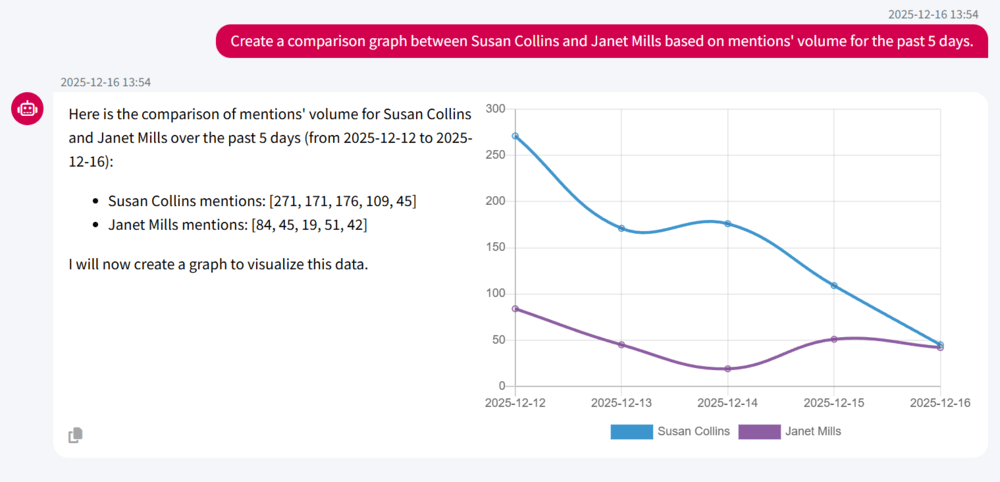
And boom! You get exactly what you need, perfectly formatted, ready for the war room, the boardroom, or the candidate who loves visuals more than words.
Find the Voices That Actually Move the Needle
If you want to cut reporting time in half, you need a shortcut for the part that always takes the longest: figuring out who actually drove the conversation and impacts the online image of political figures.
Treating every mention as having equal weight does not drive results. A random troll in the comments and a respected community figure criticizing your candidate are not the same problem, but manual reporting often conflates them.
And in local political campaigns, this becomes even more crucial. A single vocal teacher, business owner, journalist, or neighborhood-group admin can shift sentiment faster than a thousand anonymous accounts, and those are exactly the people your candidate wants to see. Not a wall of screenshots, but the loudest supporters, the sharpest critics, and the community voices that genuinely influence how voters talk and think.
But manually scanning mentions to find these voices? That’s an hour gone. Sometimes two. And if you’re reporting for multiple candidates… well, good luck.
You need a clean list of the online voices that moved the needle over the past 24 hours, the ones shaping sentiment, building momentum, or stirring the pot. And all of that with just one click in Mentionlytics! You can easily filter your mentioners list by sentiment (positive or negative) and include both lists in your report.
Find Your Advocates!
Without running a door-to-door campaign. Mentionlytics can find the most influential online supporters of your candidates in seconds.
Cut Reporting Time in Half with Mentionlytics
Political online reputation is a fragile thing, and you’re constantly on alert. Add daily (or hourly) reporting on top of that, and suddenly sleep becomes a luxury instead of a certainty.
You can keep doing everything manually, gathering mentions, filtering noise, and bloating reports with pages no one actually uses. Or you can produce sharp, insightful, action-ready briefs that guide strategy instead of exhausting your team.
Before the race heats up and every social platform turns into a mini battlefield, try Mentionlytics for free and get ahead of what’s coming.
Cut your reporting time in half, keep your insights strong, and help your candidate win the narrative, without burning out your entire comms team.
FAQ
What is political reputation management?
Political reputation management is the process of monitoring, shaping, and protecting a politician’s public image across online and offline channels. It involves tracking what voters, journalists, influencers, and opponents are saying; responding to emerging narratives; and guiding the candidate’s communication strategy to maintain trust and credibility.
It’s the behind-the-scenes work that keeps a campaign from being blindsided by a comment, a clip, or a rumor that suddenly takes on a life of its own.
What are examples of online reputation management services for politicians?
Online reputation management services for politicians include everything that helps campaigns stay informed and proactive, such as:
- Social media monitoring (tracking online mentions across platforms)
- Online reputation management strategies
- Sentiment and emotion analysis across multiple languages
- Crisis alerts and anomaly detection
- Daily or real-time reputation reporting
- Influencer and voice-impact analysis
- Competitive/opponent monitoring
- Media and news tracking
- AI-powered summaries and insights
These services help political teams understand what’s happening now, why it’s happening, and what actions to take next, without drowning in noise, reading every news article, sifting through search results, or wasting precious time during the campaign in any way.
How can social listening help in online reputation management for politicians?
Social listening helps political comms teams understand not just what people are saying about a candidate, but why they’re saying it. It captures conversations across social media, news sites, blogs, and online communities, giving campaigns a real-time view of public sentiment, emerging narratives, and potential crises.
It also helps identify the voices shaping the conversation, spot coordinated attacks or misinformation early, and track how supporters and critics respond to key messages. In short, social listening turns chaotic online chatter into clear, actionable insights that help politicians stay ahead, respond smarter, and communicate strategically.

