


Pinterest is the kingdom of visual content. The place where people go when they’re ready to dream, plan, and (quietly) shop. It’s where every visually driven business feels at home; from interior brands and fashion labels to skincare, travel, food, and anything that looks good on a mood board.
Here, users arrive with purpose: not to scroll, but to discover. Not to kill time, but to plan their next move. And because everything on Pinterest is searchable, saveable, and can be resurfaced for months, your content keeps working long after your other posts have retired.
A simple logo maker can help you create a clean, recognizable logo fast—no design background needed—so every pin looks polished and unmistakably yours. other words, Pinterest is less a social network, more a visual search engine for buyers in the making.
In this article, I’ll show you how to turn Pinterest from a pretty mood-board platform into a strategic, conversion-ready engine your brand can actually grow with. Here you’ll find the best Pinterest marketing strategy for your brand.
Table of Contents
- Is Pinterest Marketing Worth it?
- How are Marketers Incorporating Pinterest into their Marketing Plan?
- How to Use Pinterest as a Marketing Tool?
- Pinterest Marketing Strategy Example: IKEA
- How to Create a Pinterest Marketing Strategy?
- 3 Pinterest Marketing Strategies for Different Purposes
- 5 Tips for Using Pinterest for Business
- Kick Start Your Marketing Strategy for Pinterest Now
- FAQ
Is Pinterest Marketing Worth it?
Yes, Pinterest marketing is worth it, and let me tell you why. Let’s start with the fact that Pinterest has 600 million active users monthly. Statistics show that Pinterest is the only social network with a predominantly female audience (70%), and the largest global audience aged 25 to 34.

So, if this is your target audience, you already have a reason to consider a brand-new Pinterest marketing strategy for 2026.
Furthermore, it’s the platform for marketers who find Instagram too instant, TikTok too hyperactive, and the rest of social media… well, a bit too loud before coffee. Pinterest is the sanctuary for brands and consumers who prefer ideas over trends, inspiration over noise, and evergreen value over 48-hour algorithm drama.
But that’s not the end of the list. If we look the intent of the audience on Pinterest and the conversion rate, they are much higher than on other social media, starting with 90% of the Pinterest audience being on the platform for shopping and searching for products.
And it’s not just statistics. Marketers see positive effects on their ROI from Pinterest, as Reddit users mention.
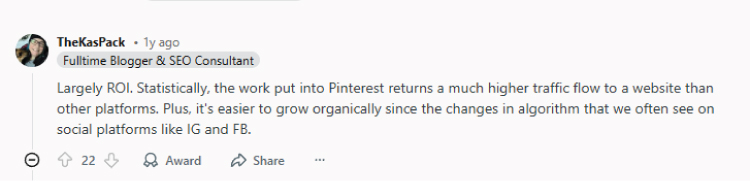
And lastly, your pins are here to stay. It’s not a fast-moving Instagram, where scroll-scroll-scroll and the algorithm pushes your post out. Pins stay and bring traffic to the website from the moment you pin till you delete it.
How are Marketers Incorporating Pinterest into their Marketing Plan?
So, how does Pinterest marketing work? Marketers figured out that this platform is the very start of the customer journey. So, most brands now use Pinterest as a visual social media search engine, optimizing pins the same way they’d optimize blog content: keywords, seasonal trends, and evergreen ideas that keep pulling traffic for months.
The good part: You can put as many links as you want, and it won’t downgrade your content.
Others pair Pinterest with email funnels or product drops, using boards to warm up audiences before launching something new.
And what eCommerce marketing strategies are implemented on Pinterest? eCommerce brands are loving shoppable pins and catalog syncs, turning casual inspiration seekers into ready-to-buy customers faster than you can say “add to cart.”
Why is Pinterest good for marketing?
Pinterest is a great place for marketing because people come there with the intention of finding ideas, products, and inspiration. And that’s a great starting point to present your product or service. “Renovate kitchen”, “Unique Christmas gifts”, “Plan vacation”, and many other queries are a paradise for marketers.
On top of that, you can always tap into Pinterest Trends to see what the audience searched for the most.
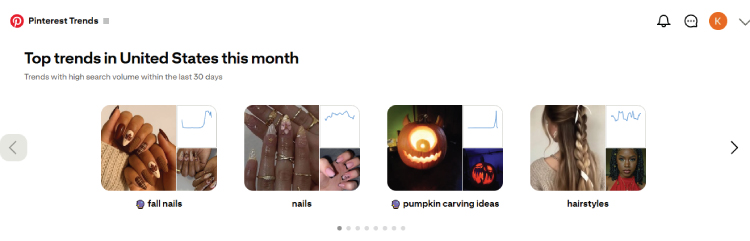
So if we summarize what’s there for marketers, we can say that these five facts make Pinterest a great place for marketing:
- High purchase intent: People come to Pinterest ready to plan and buy, not just browse. Your content meets users at their most conversion-friendly moment.
- Long content lifespan: Pins keep resurfacing for months (sometimes years), bringing steady traffic long after other platforms bury your posts.
- Organic reach to new audiences: Pinterest’s search-driven algorithm helps your content appear in front of people who weren’t following you… yet.
- Rich Pins, Idea Pins & shoppable features: Built-in shopping tools turn inspiration into transactions with fewer clicks.
- Early-stage customer journey power: Pinterest is where people start dreaming and researching, making it a perfect top-of-funnel engine.
How effective is Pinterest for marketing?
Despite that it’s been a bit pushed down by other, louder social media networks, Pinterest is surprisingly efficient, mostly because users come with goals, not boredom. A study shows that 35.4% of the audience visits Pinterest to research brands and products.
They’re planning purchases, comparing ideas, and saving options for later, which gives brands a built-in advantage before a single ad dollar is spent.
Pins act like long-living mini search results, driving traffic long after posting and often outperforming social content on Instagram or TikTok. Add Pinterest’s shoppable features, product tagging, and visual search, and you get a platform that turns inspiration into action quickly.
For brands with strong visuals, Pinterest becomes a quiet, steady conversion engine that keeps working even when everything else goes silent.
How to Use Pinterest as a Marketing Tool?
Okay, so we agreed by now that Pinterest is not like any other social media; no chatting, no stalking exes, no debating. People come to search for ideas. Anything: outfits, recipes, living room inspiration, book lists, tattoos, travel routes, hairstyles, gift ideas… literally everything, which makes it a perfect platform for B2C brands.
And before you start using Pinterest as a marketing tool, you need to know how typical users behave. So, here’s the basic flow:
- People search for something: They type “minimalist kitchen,” “winter outfits,” “branding color palettes,” or “best gifts for mom.” Pinterest shows them visual results.
- Pins = visual search results: A pin is just an image or short video with a title, description, and link. When people like it, they save it.

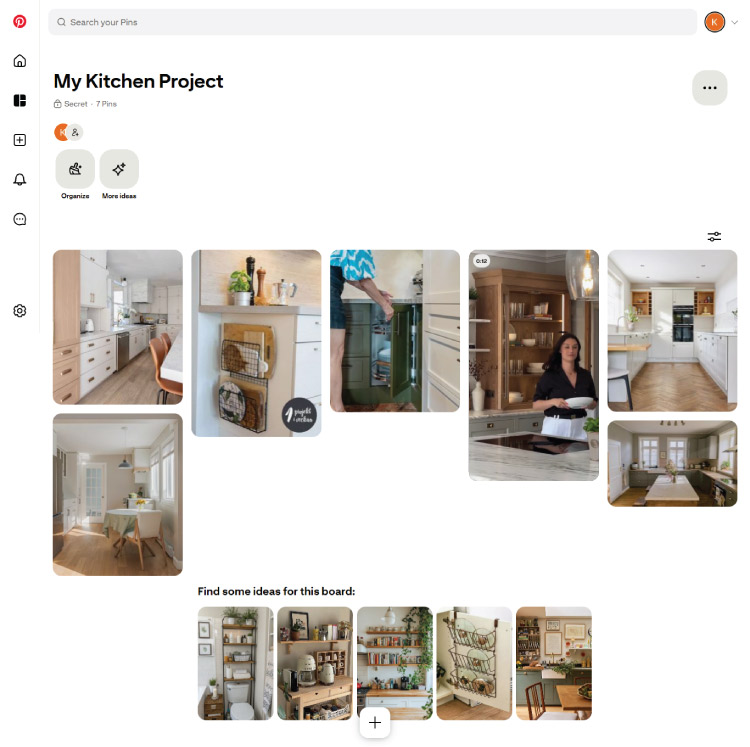
- Boards = organized collections: Users save pins into boards like “My Future Home,” “Skin Care,” “Marketing Ideas,” etc. Boards help Pinterest understand the user’s interests. I’m planning to renovate my kitchen, so here’s what one of my boards looks like.
- Your pins keep showing up long-term: When you publish a pin, it can appear in search for months or years. Pinterest is evergreen (the opposite of TikTok’s 24-hour fame).
- Most people end up clicking through: If your pin is interesting, they click to your website, product page, or blog. Pinterest is your traffic machine.
Based on everything said, here’s how to make Pinterest work for your brand:
- Treat pins like search results. Use keywords in your titles, descriptions, and pin text so Pinterest knows where to place you.
- Create beautiful, scroll-stopping visuals. Pinterest is all about aesthetics. If it looks good, it gets saved. If it’s useful, it gets clicked.
- Organize boards around topics your audience cares about. Think “Winter Outfits,” “Small Kitchen Ideas,” “Branding Tips,” depending on your niche. Boards help Pinterest understand what you’re about.
- Link every pin to something valuable. A blog post, a landing page, a product, a freebie, and make sure people can take the next step.
- Be consistent. Pinterest rewards steady pinning. A few pins each week is better than one heroic “50 pins in a panic” session.
- Use Idea Pins and shoppable features: These keep you visible in Home feeds and make it super easy for users to engage (or buy).
How do you market an event on Pinterest?
Pinterest is great for events because people literally go there to plan things; weddings, trips, home remodels, you name it. Events fit right into that mindset.
Start by creating event-specific boards (like “Marketing Summit 2026” or “Wellness Weekend Retreat”). Fill them with countdown graphics, teaser clips, speaker highlights, behind-the-scenes snaps, and visual reminders of what attendees will experience.
Then link each pin to your event registration page or landing page, as Pinterest users love a clear next step.
Target seasonal or industry keywords (“spring events,” “marketing workshops,” “summer retreats”) and interest-based terms your audience follows.
Example: Adobe MAX uses Pinterest to tease sessions, share design inspiration, and promote speakers, driving traffic to their registration page through a board dedicated to the event’s aesthetic and theme.

How to do influencer marketing on Pinterest?
Pinterest influencers (or creators) aren’t the loud, dancing-in-your-face type. They’re curators. Aesthetic magicians. People who make even a storage bin look inspirational.
Brands collaborate with Pinterest creators by sponsoring pins, co-creating boards, sharing Idea Pin tutorials, or sending products for visually driven reviews. The goal is to show how your product fits into the user’s life, not shout about it.
Find influencers based on niche, engagement, and visual style, not follower count. A micro-creator with killer taste can outperform a big account any day.
Example: IKEA is the master of this game. If you check Pinterest, you’ll see tons of pins showing how items fit into real homes or DIY videos featuring some of IKEA’s products. It’s creating a fast bridge from “inspiration” to “add to cart.”
How to use Pinterest for market research?
Start by exploring Pinterest Trends to see what people are searching for by season, niche, or aesthetic. This helps you plan content, product launches, and campaigns around actual demand. Pinterest is basically a giant, real-time focus group, only prettier and less awkward.
Next, study competitor boards and top-performing pins to see what formats work. Are people saving minimal designs? Bold colors? Check-pin collections? All clues.
Pay attention to saves, because this is Pinterest’s version of “Hey, I want this.” High save numbers indicate high future demand.
Lastly, analyze what your own audience is saving and searching for. Pinterest provides insights that can inspire new content, product lines, or packaging designs.
How to use Pinterest for product marketing?
Pinterest users love seeing products in action, not on sterile white backgrounds, so start with lifestyle photography. Think “this soap lives in a real bathroom,” not “this soap sits on a table.”
Example: A gift shop, Spa Routine, uses Pinterest as its marketing channel to showcase spa-related gifts and gets 127.3K monthly views! Impressive, huh?

Use Rich Pins to automatically pull pricing and product details, so users always see accurate info.
Create product-focused boards (“New Arrivals,” “Holiday Gifts,” “Skincare Favorites”) to visually organize your catalog.
And don’t sleep on video pins and Idea Pins: short tutorials, how-tos, or “before/after” transformations help people imagine your product in their own lives. Pinterest loves this format, and users save it like crazy.
Pinterest Marketing Strategy Example: IKEA
It’s time to review one highly successful brand and its Pinterest strategies to inspire you. I’ve chosen IKEA because they are doing a great job with Pinterest marketing, and the platform is well-suited to them.
Why Pinterest is the Perfect Choice for IKEA?
Out of all social media platforms, Pinterest ticks all the boxes for IKEA, and here’s why:
- Visual-first: IKEA sells furniture, home décor, interior design solutions, and Pinterest is all about visual inspiration. Users come there specifically to search for home ideas, décor moods, room makeovers, and lifestyle inspiration. That means IKEA’s catalog of living rooms, kitchens, storage hacks, small-space solutions, and cozy interiors aligns perfectly with the mindset of Pinterest’s audience.
- Long shelf-life for inspiration: For a furniture and home-living brand, evergreen content (room setups, design ideas, space-saving hacks) has a much longer shelf life than social media trends. Pinterest makes those ideas discoverable months or even years after posting, which matches home-renovation timelines more closely than Instagram or TikTok timelines ever could.
- A home for the DIY and hack community: Pinterest is overflowing with IKEA hacks, before/after transformations, clever assembly tweaks, small-space storage tricks, repurposed IKEA furniture, and hyper-aesthetic project boards. Users uplift IKEA for being affordable, modifiable, and friendly to creative upgrades, and this user-generated content ecosystem makes the brand even more discoverable. In fact, IKEA-related UGC consistently drives strong search traffic for terms like:
“IKEA hack,” “IKEA shelves DIY,” “PAX wardrobe organization,” “KALLAX ideas,” “IKEA small apartment solutions.”
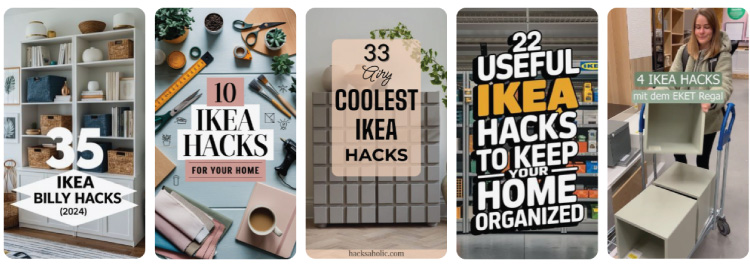
- Discovery over distraction: For a brand like IKEA, whose products often require thought, space planning, budgeting, and aesthetic alignment, that’s a much more fertile environment than the dopamine-rush browsing of other social networks.
Key Takeaway for Marketers
Before you build a Pinterest strategy, check your audience’s real interests online using a social listening tool. Search your brand, products, or category terms and look for user-generated content, DIY ideas, reviews, mood boards, or “hacks”, anywhere online.
If people are naturally sharing and repurposing your products, like they do with IKEA, Pinterest can become a powerhouse channel. Let the online world show you how users see your brand, then build a strategy that amplifies what’s already working.
Start Your Pinterest Expedition the Right Way!
With Mentionlytics’ analytics, every meaningful insight is in your report.
What IKEA Does on Pinterest: Their Strategy Playbook
If you take a peek at IKEA’s Pinterest presence, you’ll notice something immediately: IKEA USA alone has 772.8K followers and over 10 million monthly views as of December 2025. And that’s just one profile.
IKEA doesn’t operate a single global account. It runs multiple country- and region-specific ones (IKEA UK, IKEA Australia, etc.), each with content tailored to local styles, homes, and cultural aesthetics. Very on brand for a company that sells both tiny-apartment magic and giant-family-home dream setups.
As Shideh Hashemi, Country Marketing Manager, CMO, IKEA US, put it in their Pinterest case study:
“Pinterest is on the forefront of marketing to consumers in new ways. And since it’s the go-to destination for inspiration, it’s a natural environment to play in.”
IKEA openly treats Pinterest as a major growth channel. No surprise they moved their famous paper catalog to Pinterest in 2019, and fully retired print in 2020. Pinterest became their digital showroom, mood board, trend guide, and customer research tool all in one.
After digging into their approach, it’s clear that IKEA uses a mix of smart strategies, reinforced by a mountain of organic UGC. Here’s how they do it:
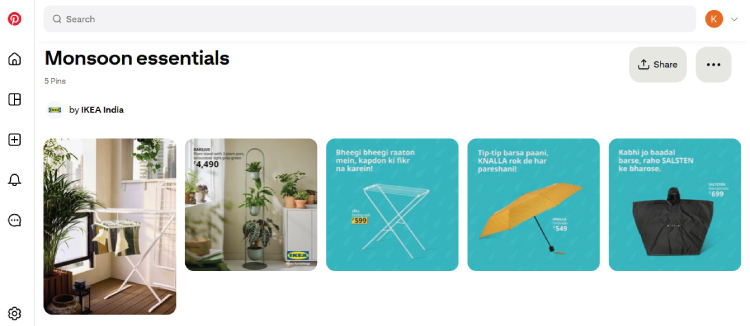
- Localized Pinterest Accounts
IKEA doesn’t rely on a single global profile; it runs region-specific accounts (US, UK, Australia, Germany, India…). Each one publishes content tailored to local homes, tastes, seasons, and lifestyles. And it’s not just about translation but cultural relevance.
- Lifestyle-First Visual Content
Instead of dropping sterile catalog photos, IKEA fills Pinterest with room setups, storage hacks, color palettes, and real-life scenes. They focus on showing how products live in a home, not just what they look like.

- Personalized Digital Catalogs & Style Quizzes
After retiring the paper catalog, IKEA turned Pinterest into a shoppable inspiration hub. Interactive quizzes generate custom boards for users, resulting in massive completion rates and strong engagement. - Search-Driven Pinterest SEO Strategy
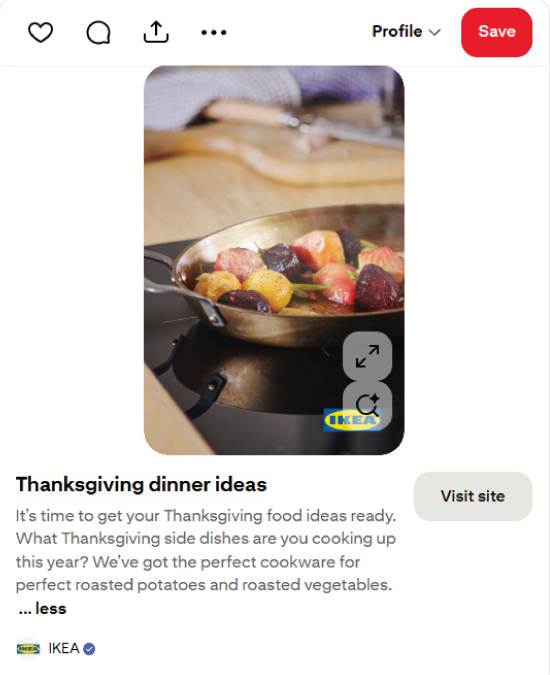
IKEA heavily targets high-intent search terms, such as Thanksgiving dinner ideas, through which they present their product: “perfect cookware for perfect roasted potatoes and roasted vegetables“. Their Pins are optimized like mini blog posts, and Pinterest rewards them with discoverability.
- Pinterest Ads & Promoted Pins
They invest in Promoted Pins during peak seasons like back-to-school, holiday décor, and home-office months. These campaigns repeatedly deliver high CTR and low CPC, proving Pinterest ads work when aligned with search intent. But it didn’t come out of nowhere. IKEA Canada did A/B testing to see which ads have better results. - DIY and Hack-Friendly Positioning
IKEA thrives in Pinterest’s DIY culture. Users constantly post IKEA hacks, assembly tweaks, renter-friendly upgrades, and before/after transformations. IKEA leans into this by highlighting flexible furniture, modular solutions, and small-space magic. - UGC as a Built-In Growth Engine
Pinterest users have created an entire subculture around IKEA products, from KALLAX hacks to PAX wardrobe makeovers. IKEA taps into this organic ecosystem by embracing, re-pinning, and mirroring the content users naturally love. - Seasonal and Trend-Based Boards
IKEA builds boards aligned with Pinterest Trends, such as cozy winter homes, Thanksgiving dinner, spring refresh ideas, minimalist bedrooms, holiday organization, tiny-home solutions, and more. They follow the platform’s seasonal rhythm, not just their own campaigns. - Influencer and Creator Collaborations
IKEA partners with interior, DIY, and lifestyle creators for room makeovers, tutorials, seasonal décor ideas, and Idea Pins. These collaborations introduce IKEA products in authentic, real-home contexts, something Pinterest users respond well to. For example, the new Stockholm 2025 collection launch was promoted in collaboration with Pinterest influencer Poppytalk (10.4 million followers). - Using Pinterest to Increase Website Traffic
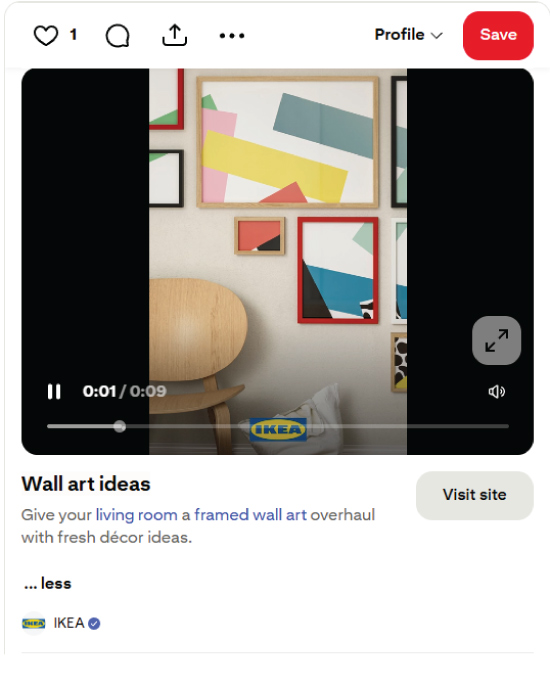
If you check IKEA’s profile, you’ll see that most pins have links. Some of the links will take you right to the catalog page on their website, but some will take you to their blog posts.
- Consistent Board Structure and Niche Segmentation
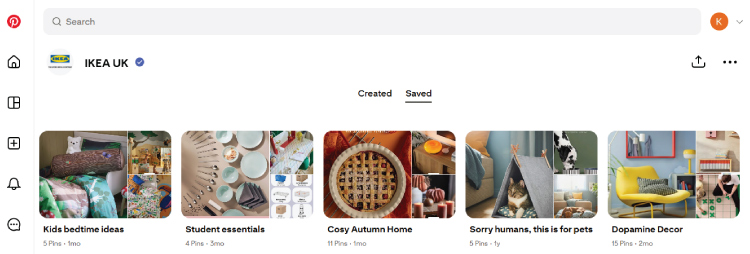
IKEA organizes boards by lifestyle needs: “student essential“, “kids bedtime ideas“, or even “sorry humans, this is for pets“. The result feels like walking through the store, but hyper-personalized to the user’s interests.
The IKEA case study proves one thing: Pinterest rewards brands that inspire, not interrupt. If your product solves real problems, sparks creativity, or fits into lifestyle storytelling, Pinterest can become your most quietly powerful channel, just like it did for IKEA.
How to Create a Pinterest Marketing Strategy?
I know what you think, “Easier said than done”, but it’s not actually. Here’s a short guide on how to create a Pinterest marketing strategy without spending too much time on it.
Step 1: Map Pinterest Content to the Full Customer Journey
Pinterest is a search engine with a built-in customer journey. That’s why your pins should match each stage:
- Awareness Stage: Lifestyle inspiration, mood boards, tutorials, “how to…” pins, seasonal trends, before/after visuals. This is where users discover you without knowing you exist yet.
- Consideration Stage: Step-by-step Idea Pins, guides, product comparisons, style breakdowns, bundling ideas (“5 ways to style…”). This is where users save, research, pin again, and evaluate options.
- Conversion Stage: Shoppable pins, Rich Pins with auto-updated pricing, product demos, “shop the look” pins. Pinterest users love a direct path to checkout, so make it easy.
When you map content like this, Pinterest becomes more than a gallery.
Step 2: Build a Keyword Ecosystem Instead of One-Off Keyword Lists
Pinterest loves keywords the way Google SEO functions: strategically, deeply, contextually. Look at keywords as a Pinterest authority builder.
Instead of stuffing one-off keywords, build keyword clusters around your core pillars. For example:
- “Small apartment ideas” cluster: “small entryway storage,” “tiny bathroom hacks,” “small living room layouts,” “renter-friendly ideas.”
- “Skincare tips” cluster: “AM routine,” “PM routine,” “dry skin solutions,” “glowy skin hacks.”
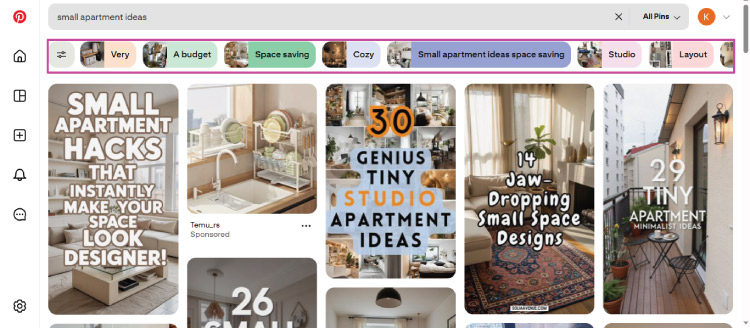
How to build your clusters:
- Search your main topic on Pinterest and check related searches.
- Scroll down and examine related keywords.
- Open top Pins and analyze the keyword-rich titles and descriptions.
Use these clusters to shape everything: boards, pin titles, copy, image text, and publishing cadence.
Step 3: Develop a Visual Identity System Specifically for Pinterest
Your Instagram aesthetic won’t always translate to Pinterest. If you want to be instantly recognized on this platform, you need to build a mini brand kit just for Pinterest. And just like any other brand kit, this one also needs to have:
- Color palette for pin backgrounds
- Fonts optimized for mobile readability
- Layout templates (tutorial layout, product layout, mood-board layout, quote layout…)
- Text box styles for consistency
- Branded corner tag for recognizability
When someone sees your pin and instantly knows it’s yours, you’ve made it on Pinterest!
Step 4: Create a Content-to-Pin Production Pipeline
This is where most brands fail. “Make pins consistently” is not a strategy; it’s a wish (that will hardly come true or be efficient).
Here’s the real system:
- Brainstorm: Pull topics from your keyword clusters and seasonal trends.
- Design: Create 5–10 pin variations per one blog post, product, or idea.
- Keywording: Add search-friendly titles, descriptions, and text overlays.
- Scheduling: Plan pins weekly/monthly.
- Review: Track what works and reuse winning structures.
- Scale: Project your monthly output based on your existing content calendar.
One blog – 10 pins.
One product – 7 angles.
One tutorial – 5 breakouts.
That’s how brands grow on Pinterest.
Step 5: Use Competitor & Trend Gap Analysis
You need a bit of Pinterest stalking for strategic purposes for this one. Here’s how to do it:
- Find top competitors and analyze their boards, best-performing pins, and most repinned visuals.
- Note formats that keep appearing (collages? checklists? aesthetic photos? bold text?).
- Spot gaps: topics they haven’t covered, trending aesthetics they ignore, or outdated visuals.
- Check Pinterest Trends for rising searches they haven’t jumped on yet.
- Reverse-engineer what works, but add your brand’s twist.
And remember, Pinterest rewards originality paired with trend alignment, so make sure not to copy and paste.
Step 6: Create a Long-Term Evergreen Content Plan
Pinterest is for the long-term game, not instant results. That’s why you need to be smart and post content that will keep spinning all year round. Apparently, the best evergreen content on Pinterest is the one that solves problems, inspires, or guides.
So, how does your brand fit into this? What does your target audience most often search for on Pinterest? What are their problems you could solve? These are the questions you need to answer before fitting your content into some of these forms:
- Tutorials
- Step-by-step visuals
- Product inspiration
- Checklists
- Simple how-tos
- Year-round aesthetics (minimalism, home office, morning routine, capsule wardrobe, etc.)
Once you find the format that suits you the most, don’t be afraid to refresh your top-performing pins from time to time with:
- Updated designs
- Trend-aligned visuals
- Seasonal twists
This extends their lifespan and keeps them relevant.
Step 7: Use Analytics to Build Feedback Loops
Analyze your content. See what’s working and what’s not (or less). Use it to build a repeatable system.
Track:
- Month-over-month growth
- Pin formats that consistently outperform
- Topics that drive saves vs. clicks
- Colors, layouts, and text styles that win
Create a “what works” library, literally a folder of your top-performing pin formats and topics. This becomes your blueprint for future design and content.
To have clear analytics just a click away, you can use Mentionlytics to monitor how your own Pins perform, which formats drive clicks, and which posts deserve scaling. And you can download or share it as a report. It helps you build your “winning formula” faster.
Step 8: Create a Sustainable Distribution Schedule
Pinterest rewards consistency, and there’s not too much time to create 30 fresh pins a week. That’s why you need to consider reusability.
Here’s how to structure a schedule you won’t burn out from:
- Mix fresh pins with repurposed ones.
- Refresh evergreen content every month.
- Set a realistic output based on your resources (e.g., 20–30 new pins per week).
- Allocate slots for seasonal and trend-driven content.
- Maintain steady publishing rather than sporadic uploads.
3 Pinterest Marketing Strategies for Different Purposes
Pinterest isn’t a one-size-fits-all platform, so every business will have a slightly different strategic approach. What works for IKEA or Etsy won’t look the same for a small jewelry brand or a blogger chasing traffic.
Here are three strategies, each designed for a different business goal.
Pinterest marketing strategy for eCommerce
If you run an online store, Pinterest is basically your silent salesperson. The one who doesn’t talk much but brings in conversions consistently. Here’s what to focus on.
Use Shoppable Pins
These turn your images into direct product listings. Users can tap “see the item” and “buy”. Zero friction, maximum impulse buying energy.
Enable Rich Pins & Catalog Integration
Rich Pins automatically sync product info (price, availability, descriptions) from your website. Your Pinterest catalog becomes a living, auto-updating storefront.
Use Product Lifestyle Photography
No boring white backgrounds. Pinterest wants:
- real rooms
- real outfits
- real people
- real use cases
Think: “Here’s how this looks in your life,” not “Here’s the SKU.”
Retarget with Pinterest Ads
Recommend products to people who’ve clicked your pins, visited your site, or saved your content. Think of Pinterest retargeting as “You liked that? Here are five more.”
Best Example: Etsy eCommerce Marketplace
Etsy uses Pinterest to showcase handmade products through lifestyle visuals, gift guides, seasonal boards, and shoppable pins, creating thousands of paths back to product pages. Their boards are designed both around themes and categories.

Pinterest strategies for a small business
Small businesses don’t need big ad budgets to grow on Pinterest; they just need the right formats and timing.
Leverage Idea Pins for Free Reach
Idea Pins currently get exceptional organic push. And you can use this best in:
- tutorials
- step-by-step guides
- checklists
- behind-the-scenes content
- styling demos
- transformations
Tap Into Seasonal Trends Early
Pinterest is full of planners. People start searching months ahead. Post 30–60 days before holidays, events, or seasonal changes. Create boards like:
- Fall Outfit Ideas
- Summer Recipes
- Holiday Gift Guides
- Back-to-School Essentials
Repurpose Everything
Small businesses rarely have time for brand-new content every week, and you don’t have to. Repurpose what you already have:
- Turn blog posts into Idea Pins.
- Turn product photos into “inspiration use case” pins.
- Break long content into step-by-step visuals.
- Convert customer reviews into visual pins.
The best thing is that it doesn’t have to be perfect, but it needs to be on schedule. Pinterest rewards consistency, not perfection. For marketers who struggle with planning and time management, a daily planner for ADHD can help organize content tasks and deadlines into a more manageable daily routine.
Pinterest marketing strategy to increase traffic
Big or small, your business needs traffic on your website. So, if this is your primary goal, or if it’s SEO boosts or newsletter sign-ups, Pinterest behaves like a second Google.
Write Keyword-Rich Pin Titles and Descriptions
Pinterest SEO is simple: the more relevant your keywords, the more searches you appear in. Include your main keyword in:
- title
- description
- on-image text
- board name
Pin Consistently (Not Randomly)
Pinterest loves patterns. Aim for a steady flow instead of bursts of activity.
Link to Blog Posts, Landing Pages, or Lead Magnets
Every pin should lead somewhere meaningful, a guide, a checklist, a blog post, or a free downloadable.
Create Multiple Pins for One URL
This is where traffic explodes. You can link one blog post to 5-10 different pins with different angles, colors, headlines, and images.
IKEA does this brilliantly: they link to the same lifestyle blog posts through many pins, each visually distinct, which keeps old content evergreen. Sometimes it will be static visual, and sometimes a short video.
5 Tips for Using Pinterest for Business
Pinterest audience doesn’t want cute pins; they search for solutions and ideas, so before you opt for the same visuals you use for Instagram carousels, I would advise you to think twice.
What you need here is pairing strong SEO with scroll-stopping creativity. These five tips help your brand actually grow on the platform instead of quietly floating around someone’s “maybe someday” board.
Use Pinterest SEO for every pin and board
Pinterest is a visual search engine wearing a social media costume. Treat it accordingly.
- Add targeted keywords to your pin titles, descriptions, and board names.
- Use long-tail keywords from Pinterest Trends and autocomplete (“minimalist kitchen ideas small apartment”).
- Match the image to the keyword intent; a “minimalist kitchen” pin should actually look minimalist.
Prioritize high-quality, branded vertical graphics
Vertical pins (2:3 ratio) dominate the feed, and Pinterest is ruthless about burying low-quality visuals.
- Use clean, bold, high-resolution images.
- Add readable text overlays where needed.
- Keep your branding consistent: colors, fonts, layout style, and logo placement.
A simple logo maker can help you create a clean, recognizable logo fast -no design background needed- so every pin looks polished and unmistakably yours.
You want users to recognize your pins at a glance, the Pinterest version of “Oh, this must be them again.”
Create content tailored to trends and seasonal patterns
Pinterest users are early planners. Some are already making Christmas boards in September and summer outfit boards while there’s snow outside.
- Publish seasonal content 30–60 days in advance.
- Use Pinterest Trends to identify rising searches.
- Tie your content or products to moments people actually plan for:
- spring cleaning tips
- back-to-school organization
- holiday gifting
- summer wardrobe refresh
Use Idea Pins to boost engagement and reach new audiences
Idea Pins are Pinterest’s favorite child right now, and Pinterest pushes them hard.
- Use Idea Pins for tutorials, tips, before/afters, styling ideas, and product demos.
- Even without links, they increase profile visits, follows, saves, and brand familiarity.
- Add CTAs like “Follow for more,” “Save for later,” or “See more ideas on our profile.”
Think of Idea Pins as your free brand awareness booster.
Track analytics and refine your strategy monthly
Pinterest Analytics gives you the roadmap; you just need to follow it.
- Track top-performing pins, boards, and keywords.
- Pay attention to impressions, saves, outbound clicks, and engaged audiences.
- Double down on pins that work, refresh designs that stagnate, and ditch formats that flop.
Track your analytics daily, and change your Pinterest marketing strategy on a monthly basis if necessary.
Kick Start Your Marketing Strategy for Pinterest Now
A Pinterest strategy only works when you know what’s actually moving the needle and what’s just sitting there looking pretty. When you start reading the platform’s signals: what people save, what they click, and what quietly takes off while you’re living your life, is when you’re able to craft the best Pinterest marketing strategy for your brand.
So, what are you waiting for? Find those insights and pull them into the report!
Start with a Mentionlytics free trial… just a few clicks for infinite clarity!
FAQ
Does Pinterest marketing work?
Yes, Pinterest marketing does work when you treat the platform like a search engine, not a social feed. Brands that use keyword-rich pins, lifestyle visuals, and consistent posting see steady traffic, saves, and conversions long after publishing.
How to learn Pinterest marketing?
Start by understanding how Pinterest search works: keywords, trends, and user intent. Then study top-performing pins in your niche and create your own strategy around what people actually search for, save, and click.
How to use Pinterest for social media marketing?
Use Pinterest to share visual guides, tutorials, product inspiration, seasonal content, and Idea Pins. Focus on discovery rather than engagement. The goal is to help people find you through search, not comments.
Is Pinterest a good marketing tool?
For visually driven brands, yes. It’s one of the strongest platforms for evergreen reach and long-term traffic. Pins can generate results for months or years, which is rare in other social platforms.
How did Pinterest change the marketing industry?
Pinterest shifted marketing toward intention-based discovery. Instead of chasing fleeting trends, brands now create content that solves real problems and fits naturally into user searches and life moments.
What is the best audience to market to on Pinterest?
Pinterest performs best with audiences interested in planning, organizing, designing, or improving something. Think home décor lovers, DIY fans, foodies, beauty seekers, fashion planners, travelers, and lifestyle shoppers. And don’t forget that the majority are women.
How to market on Pinterest?
Use keyword-rich pins, high-quality visuals, seasonal boards, Idea Pins, and shoppable features. Post consistently and build a board structure around topics people already search for.
How many followers do you need on Pinterest to start making money?
You don’t need many followers to make money on Pinterest. Pinterest is search-based, so even small accounts can drive clicks, traffic, and sales if their pins rank well. And that is the best value of this platform for small businesses that are just starting with Pinterest marketing.
What is the best Pinterest strategy?
The best Pinterest strategy is to combine keyword-rich content, strong visuals, seasonal timing, and consistent publishing. And always create multiple pins for each URL, that’s where the real growth happens.

