

You’ve surely thought of it… especially if your target audience is on this social media platform. Is it worth investing in Threads marketing, and how effective is it?
We all know Threads was a thing in 2024, but it kept growing, so the guess is the trend will continue. Lower brand saturation, especially if your target audience is Millennials and Gen Z, makes it a perfect addition to your marketing mix.
In this article, we’re going through how Meta Threads marketing actually works, where to focus for maximum efficiency, and five social media strategies that work best on this platform.
Table of Contents
What is Threads and How Does It Work?
Threads was launched in 2023 as an antidote to X, alongside Bluesky, Spill, and others. Meta built it as a text-first platform (because, yes, some of us still like words), but it’s tightly connected with your Instagram account. Which is good because there’s no need to build an audience from scratch; your IG followers can follow you with a single tap. Bless.
Threads is the major X competitor with over 400 million monthly active users, and continues to grow. And if your target audience is male, age 25-34, you should give it a try, since this is the biggest demographic group, according to Statista.
Threads works like this:
- You post short updates (up to 500 characters, basically a mini blog post similar to LinkedIn articles… or a rant).
- Add photos, videos, links, or GIFs to boost engagement because attention spans are allergic to pure text.
- Follow people you like, reply to conversations, and join threads where your brand can actually shine without battling an algorithmic labyrinth.
- And yes, your posts can now appear on Instagram as well. Two birds, one stone, zero extra effort.
The vibe? More conversational, less polished, and way more “let’s be real for a second.” Think X before the great identity crisis.
What is the Point of Threads?
At its core, Threads was created for one reason: to bring back lightweight, human conversation on Meta’s duo (Instagram and Facebook) without the algorithmic mood swings.
Meta built Threads as a space where people can:
- Talk casually
- Share quick thoughts
- Reply in real time
- And feel like they’re part of a living conversation instead of a performance.
While Instagram is polished, curated, and “look at my life” vibe, Threads is “look at my thoughts.”
There’s no doubt it’s Meta’s answer to the chaos surrounding X at the time, but it’s also the missing piece of the puzzle for Meta’s social media platform package.
Now, if you peeked at Threads, you might have noticed that it seems to have less outrage, virality obsession, and “my content must be perfect” vibe, and more dialogue. Interaction, and “meh, here’s a thought” without polishing.
Is Threads Part of Meta?
Yes. 100%. Fully-owned, fully-operated, deeply integrated with Instagram. Threads is a Meta product, developed by the Instagram team, and tightly tied into the company’s entire ecosystem.
How it fits into Meta’s universe:
- Login via Instagram: no new account creation headache.
- Follower migration: your IG followers can follow you on Threads with one tap.
- Shared safety tools: Muted words, blocked user lists, hidden replies, all synced from Instagram.
- Cross-platform visibility: Threads posts can appear directly on Instagram, making content distribution easier than ever.
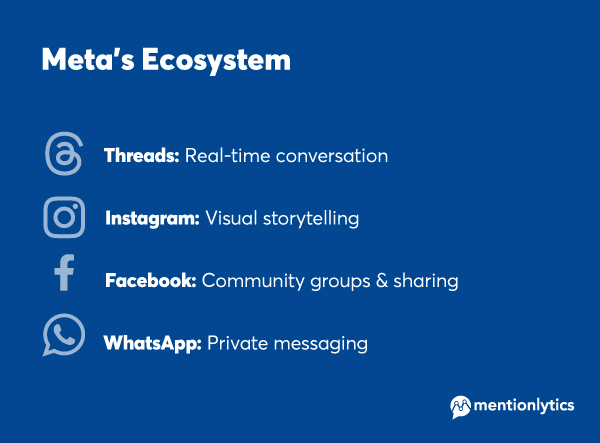
When it comes to Meta’s positioning, they did a great job creating their own mini ecosystem where words, images, groups, and private messaging are all packed together under Meta’s umbrella. So, whatever you need, whatever your preferences or needs are, Meta has something for you.
What Does Threads Look Like?
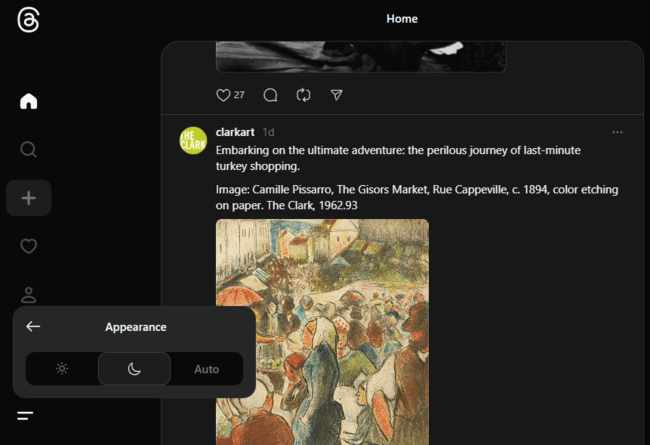
Threads intentionally looks minimal, airy, and distraction-free. Some would say way too similar to X, so if you have an X account, you’ll know intuitively how to walk through the platform.

But if you’re just stepping into the world of words, here’s what you’ll encounter:
- Feed: A clean vertical scroll of short text posts, replies, and conversation chains.
- Typography: Instagram-like, simple, and readable. No crazy, bold, or colored text.
- Appearance: You can choose between light and dark modes for your feed.
- Post structure: Replies come first, literally. Threads promotes conversations, not standalone posts. That means the more replies you get on your post, the more visible it becomes.
- Profiles: Connected to Instagram, with your IG username, bio, and verification carrying over automatically.
- Interactions: Like, reply, repost, quote, share to IG, share to Stories, all in one tap.
- Overall vibe: “Come as you are.” Fast, informal, and built for quick scrolling during coffee breaks.
Who Uses Threads?
Despite being the “new kid,” Threads has already built a surprisingly diverse user base.
Here’s who’s actually active on the platform:
1. Everyday Instagram Users
Because joining is so frictionless, millions of IG users created Threads accounts instantly. There’s no surprise that the largest age group (24-35 years old) on Threads is also the largest on Instagram. So the user groups on these two platforms are very similar (or the same).
You’re probably asking yourself why you would even bother developing a Threads marketing strategy when you already have the same audience… Well, the major difference between Instagram and Threads is the content format.
The Instagram audience, which is more inclined to short-form conversations and word-based content, will consume it more on Threads, while those who prefer visual content will lean towards Instagram.
2. Creators & Celebrities
It’s a low-pressure environment that every creator and influencer would love to have. Posts don’t need to be aesthetic; they just need to be real. That means you need less time to create (and polish) it.
Many influencers from other social media platforms joined Threads for hot takes, quick tips, and behind-the-scenes chatter.
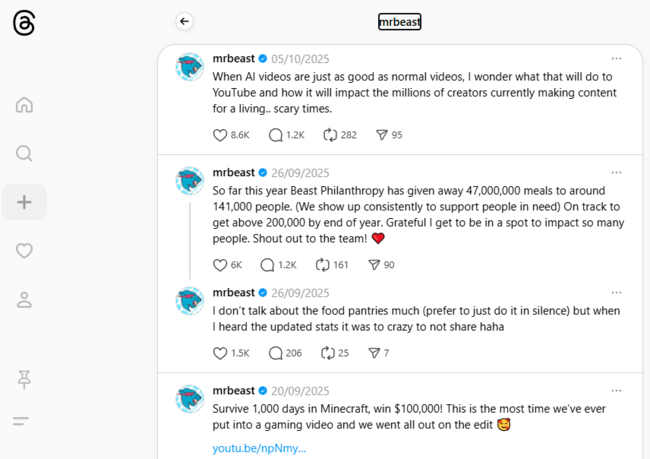
That’s why you can find MrBeast (a well-known YouTuber), Selena Gomez, Jennifer Lopez, and many niche influencers there.
3. Brands (especially ones with personality)
From Starbucks to Canva to Netflix, brands use Threads for:
- conversational marketing
- product teasers
- micro-stories
- fast feedback
- community engagement
The brands with humor or a distinct voice perform especially well, as do those whose narratives fit the Threads culture. Canva is a great example of a brand using multiple social media platforms simultaneously.
On Instagram, for example, it has more than 2 million followers, while on Threads, it has 436K. But if we look at their post from December 2023 (yes, apparently they were among the first who joined Threads), we’ll see it has more than 2K likes, 189 comments, and 96 reposts, which is an excellent engagement rate for those early days.

4. News Outlets & Journalists
You have to admit that real-time conversation is perfect for breaking news and commentary. And though it’s not everyone’s cup of tea, some news outlets, such as The Guardian, CNN, and the Financial Times, are very active on Threads.
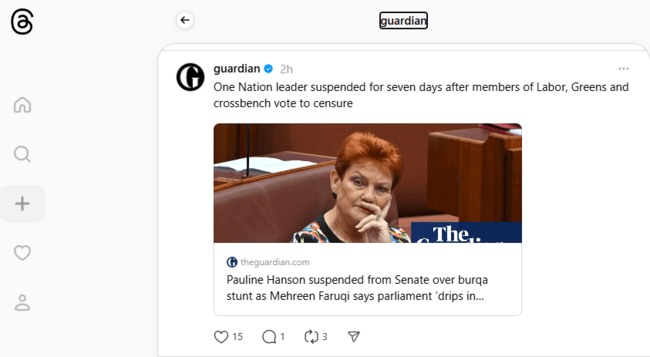
As I noticed, journalists were among the first adopters of the platform and were very active in the first year. After that, some of them gave up on Threads and probably moved to other platforms, but the majority stayed and kept playing.
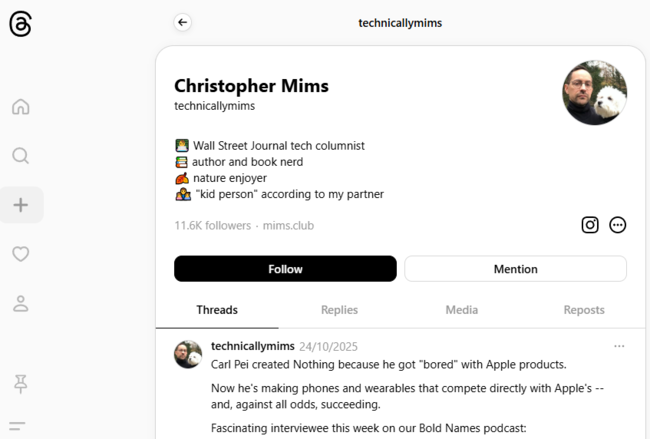
Christopher Mims, a Wall Street Journal tech columnist, is one of those active journalists on the Threads, though he’s been active on multiple platforms.
5. Community-focused users
People who enjoy group conversation, threads, debates, and casual talk. It’s basically social media’s “living room.”
Those who like to exchange opinions with others in a real-time forum-like style are often the most active users of Threads.
What are the Pros & Cons of Using Threads for Marketing?
Just like every platform that promises “opportunity,” Threads comes with its own perks and plot twists.
Pros (the things brands actually care about)
- It’s easier to grow than Instagram, especially if you already have an audience there.
You’re not starting from zero. And that’s the first benefit: no “start from scratch trauma”. Your IG followers automatically see the option to follow you on Threads, and even non-followers can see your Threads in their IG feed. This makes audience migration as easy and effortless as possible. - Engagement is high because the platform isn’t saturated with brands yet.
Marketers on Reddit keep saying the same thing: “Daily active users are neck-and-neck with X (and sometimes even beating it) according to Similarweb.” It’s not uncommon for B2C and even B2B brands to get 10x the engagement compared to X.
- Conversations matter more than polish: a win for brands with personality.
User feedback shows that text-only posts often outperform highly produced visuals. People on Threads reward authenticity. If your brand voice is fun, bold, sarcastic, or relatable, you’re basically winning the race. - It’s algorithmically chill.
Creators note that Threads doesn’t punish you for missing a day or for not posting “perfect” content. No shadowbans, no mysterious drops, no “post three Reels a day or perish” energy. It’s not about how often you post, but how much you comment and interact with others. - It’s incredibly friendly for quick customer insights.
Threads is amazing for test-marketing ideas. Want to see how people feel about your new packaging, slogan, product mockup, or pricing structure? Ask. You’ll get honest replies within minutes, sometimes brutally honest, but hey, free focus group.
Cons (the things marketers quietly complain about in Reddit comments)
- Discoverability can be messy, especially if you’re small.
The Threads search is still… let’s say “minimalistic.” No hashtags. No advanced search, meaning “good luck” with finding something with a keyword search. You can search for profiles by inserting a keyword (or a name), and it will show you the list, and if you press Enter, you will see posts related to that topic, but it’s still not 100% smooth or accurate as on Instagram, for example. So, discoverability is pretty challenging.
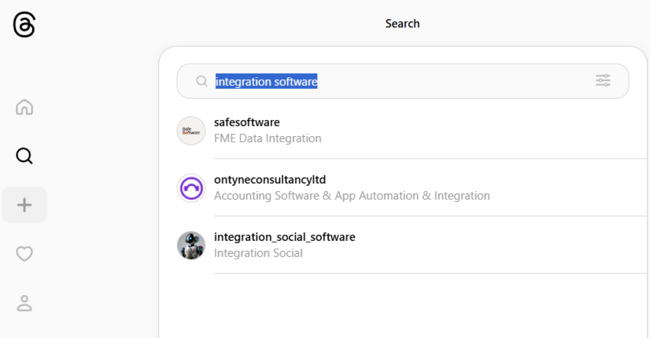
- There’s no deep analytics (and it annoys marketers).
With Threads analytics you get basic metrics, but nothing like Instagram Insights, X Analytics, or Meta Ads Manager. If you need detailed client reporting, you’ll be guessing more than you’d like without a social listening tool that includes Threads as a source and has great reporting options.
Want to Dive Deep Into Threads?
Let Mentionlytics pull the missing piece of the puzzle and show you analytics that move the needle.
3. Ads on Threads are still limited, and it’s not great for direct response.
Yes, Threads has ads (rolled out globally), but advertising on Threads is a bit different:
- Limited placements.
- Creatives must be subtle or conversational.
- CTR and conversions aren’t as strong as IG/FB.
- Third-party comment moderation is not supported for ads in Threads.
- It’s VERY easy to look out of place as a brand.
Brands that copy-paste content from Instagram or LinkedIn get ignored instantly. Threads users notice and roast you. You need a conversational tone, personality, and real-time engagement… or don’t bother. - You have to actually talk to people.
This isn’t a “post and walk away” platform. Brands that succeed reply to comments, jump into conversations, and treat it like group chat energy. If you don’t have someone on the team who enjoys this… it shows. - Cross-posting helps but can also backfire.
If your IG audience isn’t into your “text personality,” your Threads posts might flop on IG while doing great on Threads. - It’s a much smaller pool than TikTok or X.
Yes, 400 million users can’t compare with the numbers on other social platforms, like 3,070 million on Facebook, 2,500 million on YouTube, or 1,990 million on TikTok. - Trends don’t last long.
Threads trends move fast, like X, but are less predictable. If your approval process takes more than 2–3 hours… You missed it. But that’s not the biggest problem. The Trending Now feature is available only in the US. The rest of us will have to follow the hunch.

How to Use Threads for Marketing?
Marketing on Threads hits different. This isn’t Instagram, where you spend 45 minutes choosing between two nearly identical beige filters. And it’s not X where you shout into the void and hope someone cares. Threads lives and dies by conversation: replies, interactions, and fast back-and-forth energy.
And before you craft a single post, decide one thing: Are you going organic-only or mixing in ads?
This choice will shape your entire Threads strategy and how you show up on the platform.
Here’s how to actually use Threads for business and stop treating it like a side quest in your social media marketing mix:
- Optimize your profile for clarity (not vanity)
- Keep your bio short, human, and brand-voice friendly.
- Use the same profile photo as Instagram (instant recognition).
- Pin something useful: a welcome thread, a product teaser, or a brand intro.
- Post consistently, but focus on engagement: it beats aesthetics every time on Threads
This is the opposite of Instagram in the best way. No polished grids. No curated perfection. On Threads, conversation is the content. So, your hair might be messy, but if you have something important or interesting to say, the Threads’ audience will love it.
- Encourage replies through questions, prompts & hot takes
Your first job: get people talking. Brands that ask the right questions build communities, and this platform is all about that. Presence on Threads doesn’t mean anything if you’re not interacting with others.
- Reply like a real human (not a legal department)
Users love brands that react fast, reply with humor, and join conversations in real time. A huge part of Threads campaigns in 2025 was built on brand personality. So if you have a team member with a rich and chatty personality, there you go!
- Cross-promote with Instagram
I know they are a different pair of shoes, but you might reach a new audience that is both on Instagram and Threads, but don’t follow you. So, here’s what you should do:
- Share your Threads to IG feed or Stories.
- Let your existing audience warm up your Threads presence.
- Think of it as free traffic from the world’s most visual platform.
- Mix formats, but keep the tone conversational
Threads supports text, images, GIFs, and videos, but remember that text still dominates. Short, punchy thoughts and quick visuals are the winning digital marketing combo here.
Is Threads a Good Marketing Tool?
Yes, Threads is a strong marketing tool, especially for brands prioritizing community, fast engagement, and conversational social media marketing. It’s easier to grow here than on X, thanks to Instagram integration and algorithm-light distribution.
Threads works best for brands with personality: those willing to reply, ask questions, and show their human side. It’s less polished than Instagram and less chaotic (and saturated) than X, making it ideal for authentic digital marketing, micro-content, and real-time feedback. If your brand thrives on dialogue rather than aesthetics, Threads is absolutely worth the investment.
What to Post on Threads as a Brand?
From my research (plus snooping on brands that are actually doing well), most brands post things like:
- Quick thoughts (“We just dropped something new and we’re sweating.”)
- Hot takes or opinions (mildly spicy = big engagement)
- Questions and polls (“Which feature should we launch first?”)
- Behind-the-scenes snippets
- Soft updates (not full announcements)
- Micro tips (“One thing we learned today: never schedule launches on Mondays.”)
- Fun stuff (related to the industry or brand itself)
You can absolutely post:
- videos
- carousel-style image drops
- memes
- product teasers
- short tutorials
- staff moments
- reactive content (“We see your comments, yes, we’re adding dark mode… eventually.”)
For example, Ryanair’s memes show much more engagement than their other posts.

But the winner of originality for me is Netflix, with its “upside-down post“. Everything, starting with the description and the video, is upside down; it got 2K+ likes, so originality is the key to success.

What Content Performs Best on Threads?
Meta doesn’t publish deep analytics (we’re still in “vibes era”), but here’s what I do know from checking on 2024–2025 user reports, marketing case studies, and engagement patterns.
Top-performing content on Threads right now:
- Short, opinionated text posts
– Highest reply rates
– Most shared within Threads - Conversation starters
– Questions
– Comparisons
– “Tell me your unpopular opinion” posts - Humor and brand personality-driven content
– Especially when brands reply in real time - Behind-the-scenes content
– Teams, office chaos, product development moments
– Users LOVE real-life glimpses - Very short videos (≤10 seconds)
– Usually product demos, reactions, or playful clips
– Highest save + share rate among visuals
And one more important thing. Whatever content form you choose, remember to act just like a normal person who happens to have a business. That’s what Threads is asking of you.
If your content is promotional in any way and isn’t a Threads ad, your account might get shadowbanned. So, make sure to stay away from typical sales content on the Threads platform.
5 Strategies that Work on Instagram’s Threads for Brands & Real-Life Examples
So, you have a brand, and you want to test your luck with Threads. Here are five strategies you’re going to like. Choose the one that aligns best with your brand and the one you feel comfortable with.
Highjack Trends In & Out Your Industry
Threads moves at the speed of caffeine. One minute, everyone’s debating pineapple on pizza, the next, they’re arguing about whether AI has feelings. Brands that jump into these conversations early, and naturally, get the visibility everyone else pays for.
Trend hijacking on Threads isn’t like Instagram or X. There are no hashtags to chase, no SEO-friendly keywords to sprinkle around like parsley. So, here’s how to do that:
- Start with platform-native trends
Memes that started on Threads perform far better than anything recycled from TikTok or Instagram. Think: spontaneous debates, silly questions, Monday grief rituals. - Blend cultural + industry conversations
If you’re a coffee brand and everyone’s joking about 8 a.m. meetings, reply with something relatable.
If you’re in SaaS, jump into discussions about productivity, AI chaos, or “my boss made me join another meeting that could’ve been a PDF.” - Keep the tone loose
Trend hijacking on Threads only works when it doesn’t smell like a scheduled corporate post. Be funny. Be fast. Don’t overthink punctuation. Your legal team will survive.
Starbucks, for example, has a great tactic. It slides the trends and the holiday season. This is a post about a new holiday red cup that is more about holiday spirit than promotion, and it’s rewarded with a high engagement rate.
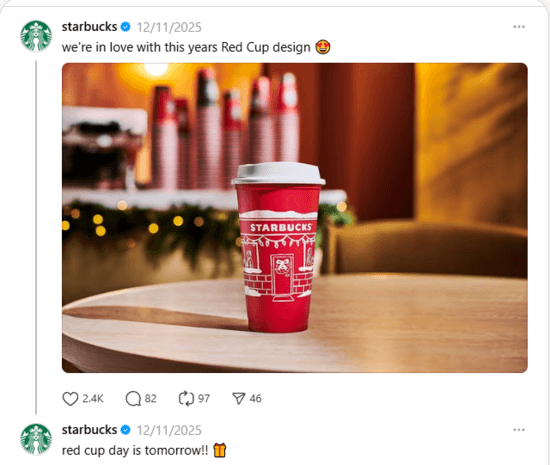
Remember, Threads pushes active conversations to the top of feeds. If you join a trend early, your replies can surface far beyond your follower list.
Now, the hard truth. As I mentioned before, the Trending Now feature is currently available only in the U.S. So, for the rest of us, we can either go by instinct or let Mentionlytics whisper, “Hey, something’s heating up! Jump in now.”
It’s a saver, because it can flag rising conversations, audience sentiment shifts, sudden spikes, and emerging topics across your niche, so you don’t have to scroll till your finger is numb.
Use Replies as Your Content
The sooner you realize that on Threads, replies aren’t just “extras” but that they are the content.
The platform treats replies like mini-posts with superpowers. Honestly, it’s the closest thing we’ve had to old-school Twitter (now X), where a clever reply could get more reach than a carefully crafted standalone post.
Brands that win on Threads don’t sit around polishing their own feed. They jump into conversations, reply to creators, banter with fans, and show up where people are already active.
Look how Ryanair does it smoothly on a topic that isn’t related to flights… but they made it.
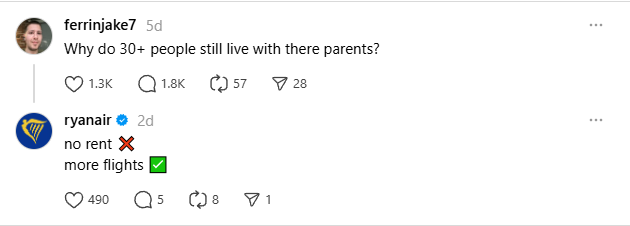
Think of it as conversational gravity: if the crowd is there, go for it. And you can find out the hot spots (posts with high engagement) with Mentionlytics.
It helps you notice conversations you’d otherwise miss: the rising topics, the industry keywords gaining traction, the posts where someone mentions your product without tagging you, or the questions begging for a smart brand reply.
Post “Thought Fragments” Instead of Polished Ideas
Threads is not the place for 600-word captions, perfectly drafted statements, or content that survived seven rounds of approvals. What works here are “thought fragments”: the quick takes, half-formed ideas, spicy opinions, random brand thoughts, and behind-the-scenes moments you’d normally keep in the notes app until you find time to turn them into something.
The beauty of Threads is that users don’t want polished, packaged content.
They want the human behind the brand, the spontaneous reactions, the “we’re testing something and it may explode,” the “here’s a weird thing that happened in the office today,” or the “question we argued about during lunch.” Short, punchy posts feel native to the platform because they match how users actually talk.
Brands that lean into this style feel instantly more approachable and in-the-moment. It signals, “Hey, we’re here with you, not broadcasting at you.” And the best part? These micro-updates often get far more engagement than your most curated content because they invite reply-first interaction.
Threads rewards immediacy, not polish, which is why the brands winning here aren’t the ones posting essays, but the ones dropping thoughts as they happen.
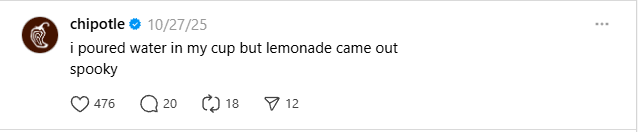
Now, the master of random thoughts without any polishing is Chipotle. If you check their Threads profile, you’ll notice it’s packed with short, random thoughts, with a picture here and there.
Create “Reply Bait” Posts
Threads is built on conversation, so posts that spark replies get pushed into more feeds, meaning your reach goes up without boosting, begging, or bribing anyone.
The trick is to keep it ethical and fun. No manipulation, no “reply for a surprise” or “comment “hot topics” to get the list” nonsense. It should be just genuine prompts that make people want to jump in.
Think:
- opinion polls (“Is Monday the worst day or the absolute worst day?”)
- friendly debates (“Tell us your most unhinged coffee order”)
- or classic hot-take invitations (“Unpopular opinion: meetings should never be longer than 20 minutes… go”).
These posts work because they feel native to the platform’s tone: casual, reactive, and human. People on Threads love sharing their thoughts (it’s the main reason they are here), especially when a brand opens the floor.
Ask the right question, and the comment section becomes its own mini-community. And once people start talking, Threads does the rest by distributing your post into fresh feeds, where new eyes (and potential followers) discover you.
If trend hijacking is about joining existing conversations, Reply Bait is about starting them and giving users a reason to stay in your orbit.
ClickUp, for example, does that from time to time. Asking random questions, not too much related to the project management topic, but a seasonal one.

Keep Your Brand Personality Consistent
Threads is absolutely a playground for experimentation: new tone, new formats, new ways to talk to people. But experimentation doesn’t mean becoming an entirely different species online.
You can’t be Superman on Instagram and suddenly show up as Batman on Threads just because the vibe is different. Pick your character, pick your tone, and stick to it across every platform.
Your audience follows you from Instagram to Threads, expecting the same energy: the same humor, the same values, the same “this feels like them” presence.
If your brand is warm and friendly on Instagram, don’t turn into a sarcastic gremlin on Threads. And if you’re bold and funny on TikTok, don’t suddenly go corporate here (totally no-go).
Threads gives you freedom to be more human, more spontaneous, and more conversational, but it shouldn’t rewrite your whole personality. Think of it as the casual Friday version of your brand voice, same person, same tone, just a little more relaxed.
Track Your Threads Marketing Journey with Precision
You know by now that Threads isn’t just another Meta platform; it’s a whole new ecosystem where speed, personality, and real-time conversations rule. You don’t survive here by shouting into the feed; you win by listening, reacting, and staying human.
If you’re ready to dive in (or at least dip a cautious toe), make sure you’re not going in blind.
Start by tracking your brand mentions, emerging trends, and rising conversations with Mentionlytics for free. It’s the easiest way to see what people are saying about you and your industry, and to shape a Threads strategy that actually matches the platform’s vibe.
Spontaneity is great.
Spontaneity with data? Even better.
FAQ
Is it worth advertising on Threads?
Yes, if your goal is brand awareness, community building, or conversational engagement. Threads ads are still new and evolving, but early results show they’re more effective for visibility than direct conversions. If you want personality-driven reach, it’s worth testing.
How do you promote on Threads?
Focus on conversations, not polished campaigns. Post short thoughts, react to trends, reply to creators, and cross-promote from Instagram. The more you participate, the more the algorithm rewards you.
How many followers do I need on Threads to make money?
There’s no magic number of followers you need to make money on Threads. Threads doesn’t have monetization tools yet, so earnings come indirectly, via product sales, partnerships, and brand visibility. Even small accounts can drive revenue if the engagement is strong.
How much does it cost to advertise on Threads?
Ads run through Meta Ads Manager. Pricing works like Instagram/Facebook: CPM-based, auction-driven, and varies by competition and audience. There’s no Threads-specific pricing; it’s bundled into Meta’s ecosystem.
Does Gen Z use Threads?
Yes, but not exclusively. Threads currently attracts Millennials and Gen Z, especially socially active users aged 18–34. The biggest demographic overall is still men 25–34, according to Statista.
What is the best content to post on Threads?
The best content to post on Threads is short text posts, quick opinions, questions, behind-the-scenes snippets, hot takes, and anything that sparks replies. Threads rewards conversation, not aesthetics.
How to get more audience on Threads?
If you want to get more audience on Threads, reply to active conversations, ask engaging questions, post consistently, cross-promote via Instagram, and show your brand personality. Visibility grows fastest when you interact with others, not just post.
Is there a downside to Threads?
Yes, there are downsides to Threads: discoverability is limited, Trending Now is U.S.-only, analytics are basic, and success requires active participation. Threads isn’t for brands that want set-and-forget posting.
How does Instagram’s Threads work?
Threads connects directly to your Instagram account, lets you share short text posts, reply in real time, and follow your Instagram audience with one tap. It’s built for informal, fast conversation, not curated content.
What is the purpose of Threads?
Threads was created to bring back lightweight, text-first social interactions. It’s designed for quick thoughts, real-time discussion, and a calmer, more conversational alternative to X.


