Email marketing remains one of the most effective digital channels in 2026. This has nothing to do with it being an up-and-coming channel — some marketers believe it should’ve “died” long ago. It’s because it delivers results.
Modern email marketing services have evolved far beyond simple newsletters.
Today’s top platforms offer AI-powered content recommendations, sophisticated automation workflows, advanced segmentation, and real-time analytics.
This article breaks down the 7 best email marketing services for 2026. Whether you’re a solo creator, small business, or fast-growing eCommerce brand, here you’ll find tools that match your goals.
Table of Contents
Why You Should Use Email Marketing Services
While social media platforms constantly shift their algorithms and ad costs continue to climb, email marketing offers direct access to your audience with a high ROI and full control over messaging.
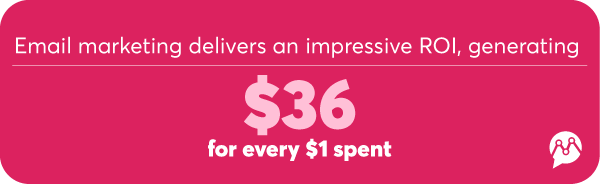
Source: Litmus.com
Smart businesses aren’t abandoning email in favor of other digital marketing trends; they’re doubling down with better tools.
Let’s see which are the best-performing email services you can use to drive growth and customer engagement.
7 Best Email Marketing Services Reviewed for 2026
1. Constant Contact
Best for: Small businesses, nonprofits, and users who want an easy, dependable email solution.
Pricing: Prices start at $12/month. Offers a free 30-day trial.
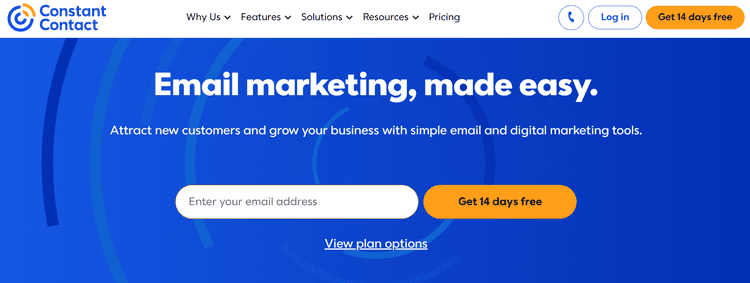
Constant Contact is one of the oldest email marketing services in the space, and it’s well-known for its simple interface and reliable, SMB-friendly features.
It’s especially well-suited for users who want to get campaigns up and running without a lot of friction.
The platform offers a no-code editor, a solid library of templates, and quick-start guides that make it easy for beginners to create polished emails.
But the email marketing service goes beyond email newsletters. Constant Contact also includes event marketing tools, like RSVP tracking that lets you run event campaigns without switching tools — all from one intuitive platform.
Constant Contact’s innovative features, like AI-generated subject line suggestions, optimal send-time prediction, and automatic resends, can improve open rates with minimal manual input.
At the same time, this email marketing service features some robust social media marketing options, like social scheduling and ad tools, and SMS marketing.
While the platform lacks complex custom automations, its basic automation workflows make it a great email marketing solution for small businesses, nonprofits, and entrepreneurs by giving them the tools they need to succeed without overcomplicating the process.
2. Moosend
Best For: Startups, small businesses, marketers who need a cost-effective, feature-rich solution.
Pricing: Prices start at $9/month. Offers a free 30-day trial that includes most features.
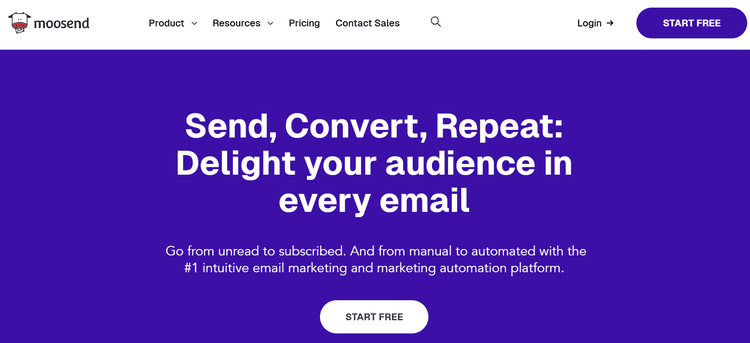
Moosend is an email marketing and marketing automation platform that offers robust features at an affordable price, earning a loyal following among SMBs and startups.
It’s designed to give you professional-grade tools without the hefty price tag, making it perfect for teams that need results on a budget.
Moosend’s standout feature is its drag-and-drop email builder, which is intuitive and flexible.
This, along with its extensive email template library, helps both seasoned and novice email marketers send professionally designed, responsive emails.
Moosend’s automation builder can help with setting up triggered campaigns by building automation workflows based on real user interactions.
From the most common — like cart abandonment, browse abandonment, or replenishment emails — to the most complicated or unusual — like transactional emails, or weather-based automations — the platform showcases a wide range of pre-made workflows in its automations’ library.
Of course, this doesn’t mean that marketers can’t create their own custom automations when needed.
At the same time, the detailed analytics allow marketers to make data-driven decisions.
The platform doesn’t cut corners when it comes to deliverability, either. It consistently lands emails in inboxes rather than spam with dedicated tools like its free DMARC checker, and functionalities that follow email marketing best practices like segmentation and list cleaning options.
On top of that, it offers useful features like real-time reporting and personalization options usually reserved for more expensive platforms.
On the downside, Moosend’s platform doesn’t offer a plethora of native integrations or options like SMS marketing.
3. SendPulse
Best For: Scaling businesses that want SMS marketing and multichannel reach, all with a genuinely free-forever tier.
Official Pricing: Paid plans start at $12/month for up to 500 subscribers. There’s also a Free Forever plan that covers up to 500 subscribers and 15,000 emails per month, a plan that stays free indefinitely rather than expiring after a 30-day trial as many competitors do.
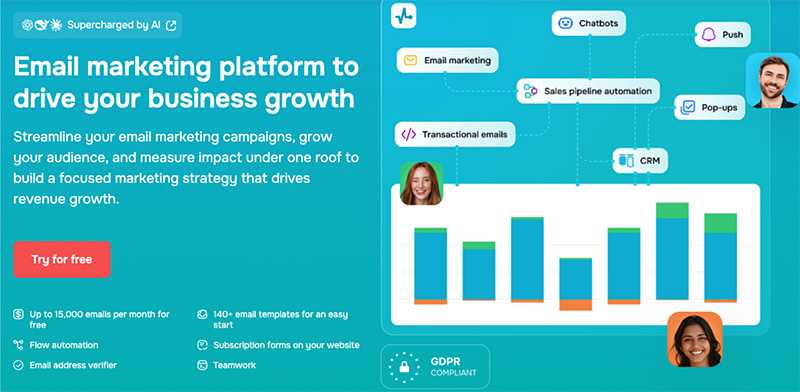
SendPulse is an AI-driven email marketing and chatbot platform that fills two gaps common among email tools: it includes native SMS marketing, which many platforms lack entirely, and supports more complex, multi-step custom automation than the basic workflows found in simpler tools.
Beyond that, SendPulse extends campaigns into WhatsApp, Instagram, and Telegram chatbot flows from the same Automation 360 builder, letting a single trigger fire an email, an SMS, and a chatbot message depending on which channel a subscriber actually uses, a level of channel reach few email-first platforms offer.
Its drag-and-drop builder and 140+ templates keep campaign creation approachable for beginners, and AI tools built into the editor can generate campaign copy, adjust tone, or translate content into other languages, and they work across the whole email body rather than just subject lines.
SendPulse also bundles a website and landing page builder, popup forms, and a built-in CRM, so growing teams get tools that would otherwise require separate subscriptions.
The downside is that the interface can feel a little busy for first-time users given how many tools live under one roof.
4. ActiveCampaign
Best For: Teams and businesses that need complex automations and sales CRM capabilities.
Pricing: Prices start at $15/month. Offers a free 14-day trial.
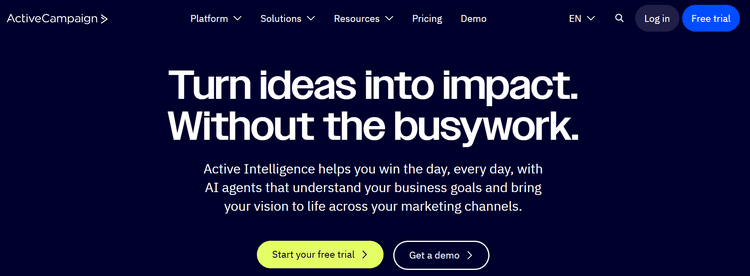
ActiveCampaign is the go-to platform for businesses that want advanced automation combined with a powerful CRM.
Unlike simpler email tools, it blends customer relationship management with sophisticated email marketing, making it ideal for organizations that need deeper personalization and smarter workflows.
One of its biggest strengths is its “Predictive” actions, which include predictive sending, predictive content, and predictive next steps.
These actions use machine learning to suggest next steps based on customer behavior, like when a lead is likely to buy or engage.
This, combined with dynamic content, lets you tailor every email to each recipient’s interests in real time, improving conversion rates.
ActiveCampaign also offers targeted segmentation and robust A/B testing, giving marketers the ability to refine campaigns with precision.
Its automation builder remains one of the most reliable on the market, allowing marketers to scale their efforts effectively.
One of the cons of this platform is that it has a steeper learning curve than basic email tools. Its pricing point can also get quite hefty, as the functionalities of the “Starter” plan are quite limited.
This makes ActiveCampaign an inefficient choice for companies like startups that are looking to save money.
5. Sender
Best For: Small businesses, growing brands, and marketers who want an affordable, feature-rich platform.
Pricing: Paid plans start at $7/month. There’s also a Free Forever plan that covers up to 2,500 subscribers and 15,000 emails per month.
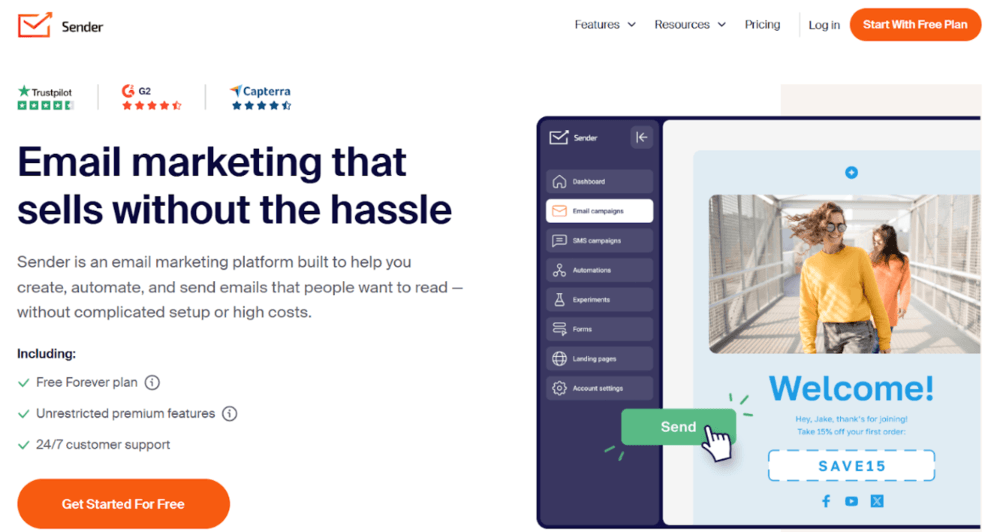
Sender is a feature-rich email marketing platform designed to help small and growing businesses run newsletters, bulk email campaigns, automations, and transactional emails from one dashboard. It’s especially appealing to teams that want strong functionality without the steep pricing that often comes with more complex tools.
One of Sender’s biggest strengths is that it combines marketing and transactional emails in a single platform. This makes it easier for businesses to manage promotional campaigns, automated sequences, and time-sensitive transactional messages without relying on separate tools. Its intuitive drag-and-drop builder, responsive templates, and segmentation features also make it simple for both beginners and experienced marketers to create targeted campaigns.
Sender also offers detailed analytics and e-commerce reporting (on the Standard plan and above), which gives marketers the insights they need to improve performance over time. The platform also provides 24/7 customer support even for free users, which is something many competitors reserve for higher-tier plans.
The downside is that emails in the free plan have Sender’s branding, and some advanced capabilities, like SMS campaigns and email A/B testing, are reserved for paid plans. Still, Sender remains a strong option for small businesses and growing teams that want a cost-effective platform with more depth than a basic newsletter tool.
6. Mailchimp
Best For: eCommerce brands, SMBs, non-profits looking to invest in a platform backed by a trusted name.
Pricing: Prices start at $13/month. There is also a free plan with very limited features that covers up to 500 contacts.
Mailchimp is one of the most recognizable names in email marketing, with experience in helping businesses build and engage their audiences. The platform is widely known and trusted by millions of businesses across the globe.
Some of its most innovative tools are its AI-powered campaign suggestions and customizable customer journeys.
A wide selection of professional email templates shows that the platform makes it easy for marketers to design, automate, and optimize campaigns. This holds true for users without technical expertise as well.
Users can build precise segments directly within Mailchimp, create personalized content based on subscriber behavior, and track performance through detailed analytics dashboards.
Its built-in eCommerce features — like abandoned cart reminders, product recommendations, and order notifications — allow marketers to segment customers based on purchase behavior, personalize product suggestions, and track sales generated from each campaign in detailed revenue reports.
This all-in-one approach helps online stores nurture leads, recover lost sales, and hit their eCommerce KPIs without needing third-party add-ons.
The downside to Mailchimp is its pricing point. It can get quite expensive quite fast. Meaning that a growing list can come with added costs, as some advanced features are locked behind higher-tier plans.
7. Kit (Formerly ConvertKit)
Best For: Bloggers, YouTubers, educators, and content creators who want to engage their audiences.
Pricing: Paid plans start at $29/month. There is a free plan that covers newsletter sends only.
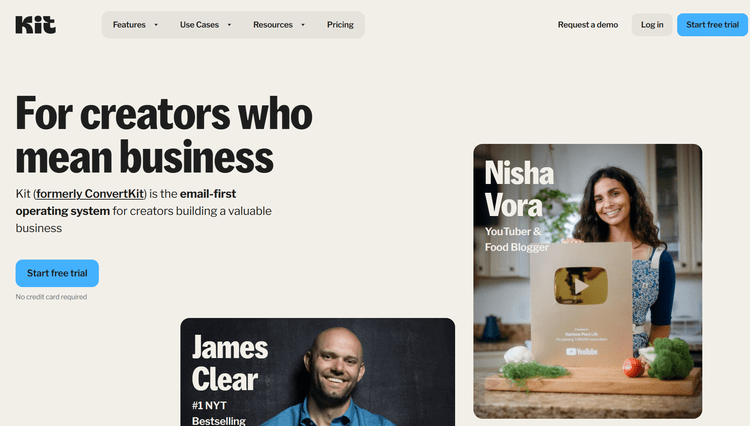
Kit (formerly ConvertKit) is a useful email marketing tool designed specifically for creators. Think bloggers, YouTubers, podcasters, coaches, and indie authors who need powerful yet easy-to-use tools for growing and nurturing an audience.
Kit specializes in creator-friendly features like customizable sign-up forms, content upgrades, automated welcome sequences, and beautifully simple email templates.
The platform features a clean, user-friendly interface that simplifies email marketing, even for those who aren’t tech-savvy.
One of its standout features is the powerful tagging system, which allows creators to segment their audience effectively and deliver highly personalized content.
Automation is a core strength of Kit, providing creators with tools to build automated email sequences, nurture subscriber relationships, and increase engagement without constant manual effort. Additionally, Kit supports monetization through paid newsletters and product sales, making it easier for creators to generate revenue directly within the platform.
Kit offers a free plan to help beginners get started, while its pricing scales based on subscriber growth, allowing users to pay as they expand their audience.
However, one limitation is that the platform’s design and features are very creator-focused. Kit is not the best when using emails as something more than a PR tool. Since it’s built for creators, it lacks some core eCommerce functionalities, making it difficult for users to monetize their content through an eCommerce store.
Choosing the Best Email Marketing Service for Your Business
When selecting an email marketing tool in 2026, the key is to match the platform to your specific needs and business type.
Testing different tools before committing is essential. What works for one user might not fit another’s workflow or growth plans. Here are some best practices to follow:
- Choose a platform that grows with your audience and business without forcing a costly switch.
- Focus on automation capabilities, ease of use, integration options, and customer support when evaluating email tools, and always check for email sending errors before launch.
- Prioritize features that align with your marketing strategy and audience needs.
- Regularly review performance metrics to optimize campaigns and drive consistent growth.
Lastly, test platforms with tools that align with your goals. Evaluate key features and consider your budget carefully.
The right email tool in 2026 will be the one that aligns with your needs, simplifies your marketing, and supports sustainable growth.