

Before social media managers, data dashboards, and “this post is underperforming” panic attacks, or studies on how social media affects elections and campaigns, elections were still won and lost the same way they are today: by public opinion.
Only back then, public opinion traveled slowly. Much slowly.
If you wanted to shape it, you relied on town squares, newspapers, radio broadcasts, party rallies, door-to-door canvassing, and the occasional dramatic speech delivered from a balcony (Hello, Evita Perón).
Campaign messages moved at the speed of printing presses and evening news schedules. If a candidate misspoke, there was a decent chance only a few thousand people noticed, and by next week, something else had taken over the headlines.
But make no mistake: public opinion is what makes you win or lose elections.
Long before the internet, political strategists tracked what people feared, hoped for, and were angry about, and then shaped speeches, slogans, and policies accordingly. The tools were analog, but the goal was identical: influence how people feel, talk, and ultimately vote.
Fast-forward to today, and the fundamentals haven’t changed. What has changed is the scale, speed, and visibility.
Instead of whispers in cafés and headlines in tomorrow’s paper, opinions now form and explode on timelines, comment sections, group chats, and viral videos. A single post can rally supporters, derail a campaign, or spark a global debate before breakfast.
Public opinion no longer waits politely to be measured; it broadcasts itself in real time, with emojis, sarcasm, and screenshots included. Social media didn’t invent political influence. It just put it on fast-forward and handed everyone a microphone.
In this article, we’re going to dig deep enough into research papers and discover why and how social media impacts elections, whether traditional news still counts, and how to prevent attacks on your candidate in the next election round.
Table of Contents
- How Does Social Media Affect Elections?
- Real-World Example: How Did Social Media Affect the 2024 Election in the US?
- Why Has Social Media Affected Political Campaigns?
- Does Social Media or Traditional News Affect Elections More?
- How is Social Media Affecting the Next Election?
- What is the Impact of Social Media on Elections?
- Protect Your Political Candidates from Social Media Attacks
- FAQ
How Does Social Media Affect Elections?
According to December 2025 statistics, there are 5.4 billion social media users worldwide, of whom 67% in the US use social media daily. Add to that the fact that social media usage is no longer politically neutral, and things get interesting fast.
Recent study by the Pew Research Center shows that Democrats and Democratic-leaning independents are significantly more active on platforms such as WhatsApp, Reddit, TikTok, Bluesky, and Threads, while Republicans lean towards X (which was actually Democrats’ favorite platform just a few years ago).
So, elections are no longer fought on a single public stage. There’s a whole fragmented digital ecosystem, and each platform has its own norms, narratives, and feedback loops, making influence more targeted, faster, and harder to control than ever before.
Monitor the Entire Digital Ecosystem Effortlessly
Track the whole social media sphere, from mainstream channels to niche platforms. Leave no blind spots with Mentionlytics.
Here are five ways in which social media impacts election outcomes as we see it.
Political Communication is now Algorithm-Driven
Political messaging used to be shaped by editors, broadcasters, and campaign managers some 20 years ago. But today, it’s shaped by algorithms optimized for engagement.
Instead of asking whether a message is accurate, balanced, or even useful, platforms quietly ask a simpler question: “Will people react to this?”
A 2025 academic research shows that strong emotional reactions and controversial political content are more likely to be amplified by algorithms than neutral information. Audits of social media ranking systems confirm that engagement-driven algorithms tend to push the content that provokes stronger reactions, even when it’s negative or hostile, because it keeps users engaged.
A systematic review from 2023 found clear evidence that increased digital engagement correlates with political polarization across multiple countries and platforms, confirming that algorithms don’t just distribute political messages; they actively shape how public opinion forms, hardens, and spreads.
Real-Life Story: 2022 Philippine Presidential Election and TikTok
In the 2022 Philippine presidential election, Ferdinand “Bongbong” Marcos Jr. and Leni Robredo ran very different digital campaigns, but only one fully adapted to how modern feeds work.
On TikTok, where political content is discovered almost entirely through algorithmic recommendations, Marcos-aligned videos consistently dominated users’ feeds. Short, emotionally engaging clips were rewarded with visibility, while more traditional political messaging struggled to surface.
A study by the University of the Philippines System showed that among 10 presidential candidates, Marcos was the most popular on TikTok. But what’s even more interesting is that the posts that got the most attention were basically user-generated content.
@barkada_tv22 bongbong marcos 2022#bongbongmarcos #tiktokphilippines #fyp ♬
Viral Spread of True or False Political Narratives
It’s true: sometimes a viral false political narrative wins. Social media has collapsed the time it takes for political narratives (accurate or not) to spread. So the only thing that really matters is whether a post evokes an emotion: anger, fear, outrage, pride, or the irresistible urge to hit “share” before checking a single source.
Unfortunately, a widely cited 2018 MIT study found that false political news spreads faster and reaches more people than truthful information, largely due to its novelty and emotional appeal.
But here’s the catch. If a false narrative gains attention and the audience discovers it’s false, those who spread it lose the election.
Real-Life Story – Slovakia 2023: Fake Audio and Presidential Elections
Just days before Slovakia’s 2023 parliamentary election, a fake audio recording appeared online. The recording seemed to capture a leader of the liberal party, Progressive Slovakia, discussing vote-buying.
By the time fact-checkers and journalists confirmed it was false, the clip had already spread widely across social media and messaging apps.
This fake audio didn’t have to convince anyone; it was enough to plant a doubt, and by the time the truth arrived, attention had already moved on.
Polls prior to this audio showed the liberal Progressive Slovakia (PS) party, led by Michal Šimečka, was in a tight race with Robert Fico’s Smer-SD party and, in some cases, leading in the polls. Still, the election results were different, and the Smer-SD candidate won.
Influencers and Communities are the New Political Gatekeepers
Once algorithms decide what people see, someone else decides what they believe. And increasingly, that role belongs to influencers and tightly knit online communities.
In modern political marketing campaigns, voters rarely encounter candidates’ messages directly. They encounter them filtered through creators, community leaders, group admins, subreddit moderators, Telegram channel owners, or TikTok personalities who already have their trust.
A 2025 research paper on human communication shows that people are more likely to accept political information when it comes from someone they perceive as “one of us,” rather than from official institutions or campaign channels. This means a creator explaining a policy in a 60-second video can have more influence than a full campaign manifesto because it feels familiar and socially validated.
This is where communities matter. Private groups, niche forums, and creator-led audiences act as modern gatekeeping layers. Once a narrative enters these spaces, it doesn’t compete with every other opinion on the internet; it competes only with the norms of that community.
If a message aligns with those norms, it spreads. If it doesn’t, it quietly dies, regardless of how important or factual it may be.
Before social media, this role belonged to unions, churches, local party organizations, and neighborhood leaders. Today, it belongs to people with usernames, comment sections, and followers. The function hasn’t changed. The scale has.
Public opinion still passes through gatekeepers. They just don’t work for media outlets, and they don’t need permission to shape the conversation.
Real-Life Story: Brazil 2018 Elections and WhatsApp
In Brazil’s 2018 presidential election, Jair Bolsonaro defeated Fernando Haddad in a campaign where traditional media exposure was limited, and algorithmic distribution filled the gap.
Bolsonaro had very little TV airtime, limited support from mainstream media, and a fragmented, grassroots digital presence. Yet he dominated the political conversation on WhatsApp, Facebook, and YouTube, where algorithmic and network-based amplification played a decisive role and won.
Let’s not forget that Brazil is one of WhatsApp’s largest markets, and political content spread through private groups, public groups, mass forwarding, emotionally charged memes and videos can have a great impact on elections.
Emotional Content Shapes Voter Attitudes
If facts decided elections, political campaigns would look very different. Fewer slogans. More spreadsheets. But elections aren’t decided in spreadsheets. They’re decided in the nervous system.
On social media, emotional content performs and sticks better. Posts that trigger anger, fear, hope, pride, or moral outrage are more likely to be remembered, shared, and discussed than neutral or purely informational messages. Over time, repeated emotional exposure shapes how voters feel about entire political groups.
Research in political psychology consistently shows that emotions act as shortcuts in decision-making.
- Anger increases political participation and sharpens attitudes.
- Fear makes voters more receptive to simple explanations and strong leadership signals.
- Positive emotions, like hope or nostalgia, can soften critical thinking and reinforce identity-based loyalty.
Before social media, emotional political messaging relied on speeches, posters, and television ads. Today, it lives in memes, short videos, comments, and reaction threads, repeated daily, personalized by feeds, and reinforced by social validation.
Pre-Internet example: Nixon’s “Law and Order” campaign (1968)
In 1968, the U.S. was emotionally exhausted by protests, assassinations, the Vietnam War, and civil unrest.
Richard Nixon didn’t win by out-arguing Hubert Humphrey on policy. He won by tapping into fear, anxiety, and a desire for stability. His campaign centered on a simple emotional message: “law and order.”
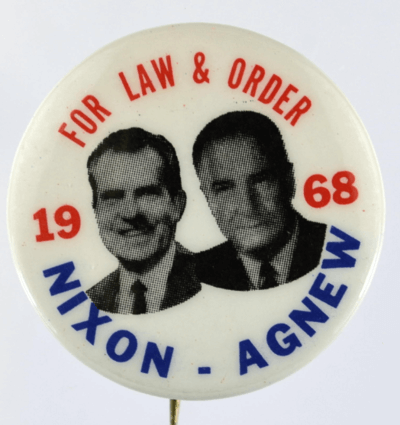
There was no data to back up this statement; it didn’t require detailed explanations and spoke directly to how people felt.
Misinformation, Disinformation, and Echo Chambers
Not all false information spreads by accident. Some of it is carefully planted, some casually shared, and some just happen to fit a story people already want to believe. Over time, misinformation turns into disinformation, and both feed into what psychology calls the illusory truth effect, the tendency to believe something is true simply because we’ve seen it often enough.
And this isn’t new.
The illusory truth effect was identified back in 1977, long before social media, proving that repetition alone can make false information feel credible. What is new is the environment in which that repetition now occurs.
Social media didn’t invent the effect. It perfected it, not by changing how people think, but by surrounding them with the same ideas again and again.
As political conversations shift to more personalized feeds and private spaces, voters increasingly encounter the same ideas repeated by the same voices within the same digital circles. Over time, certain narratives feel familiar.
This is how echo chambers quietly form: through repetition and social validation. The more often a claim appears in your feed, your group chat, or your favorite community, the less it feels like an opinion and the more it feels like common sense.
Once a false or misleading narrative settles into an echo chamber, correcting it becomes surprisingly difficult, and fact-checks have no chance to fix the broken trust.
Real-Life Story – Brexit Campaign Myth: “Bandy Banana” Regulation
The infamous “bendy banana” story shows how accurate information can become misleading once it’s framed the right way. The EU never banned curved bananas. It introduced a technical marketing standard, but it was pulled out of context and turned into a symbol of bureaucracy.
British tabloids ran with it. Headlines like “Now they’ve really gone bananas” helped cement the image of “bonkers Brussels” obsessing over nonsense. Pro-Brexit politicians, including Boris Johnson, repeated the claim often enough that it stuck, not because it was true in practice, but because it was simple, funny, and familiar.
A June 2016 poll found that 24% of people in the UK believed the EU had banned bendy bananas from import. The banana didn’t decide Brexit, but it helped normalize the idea of an EU that was out of touch, overbearing, and not to be trusted.
Real-World Example: How Did Social Media Affect the 2024 Election in the US?
The 2024 US presidential campaign was a rematch of familiar names. On one side was Donald Trump, running for re-election as the Republican nominee, while on the other was Kamala Harris, who entered the race as the Democratic candidate after President Joe Biden stepped aside earlier in the campaign.
The campaign began with a long, uneven buildup, months before election day, in an environment already shaped by social media users’ habits.
Early in the campaign, national polling consistently pointed to a tight race. By mid-summer 2024, multiple reputable surveys showed figures hovering around 48% to 47%. When elections are this close, small shifts in attention and sentiment can outweigh grand policy announcements.
Against that backdrop, post-election research and platform data point to four social-media-driven factors that consistently shaped how the 2024 election unfolded.
Influencers and creator-led political coverage
During the 2024 campaign, a Pew Research Center analysis of more than 150,000 posts from roughly 500 social media “news influencers” revealed distinct patterns in how these voices discussed the two major candidates.
Nearly 9/10 influencers mentioned Donald Trump, and 86% mentioned Kamala Harris at least once. But Trump was featured in twice as many posts as Harris overall.
Despite similar proportions of influencers being more critical than supportive of each candidate, posts about Harris were disproportionately critical, while coverage of Trump tended to be more balanced between critical and supportive tones.
Right-leaning influencers also posted more frequently than left-leaning ones, posting roughly 183 times per week compared with 72. And the majority of influencer discussion about both candidates took place on X, where nearly half of all election-related posts from influencers originated.
These patterns show how influencer ecosystems shaped the volume and tenor of candidate discussion on social platforms, contributing to differences in what users saw and engaged with during the campaign.
Toxic and Partisan Content Dominated Engagement on TikTok
One of the first studies on TikTok during the 2024 election analyzed 51,680 political videos from the presidential cycle and found a clear pattern: content that was explicitly partisan or toxic consistently attracted more engagement than neutral posts.
Out of all videos studied, about 77% were partisan, and partisan clips earned roughly 2.2 times more views and interactions than non-partisan ones. Toxic language, such as insults, hostility, or controversial framing, was linked to higher interaction rates, especially when they were tied to partisan content.
Republican-leaning videos tended to reach more viewers overall, while Democratic-leaning ones sparked slightly more likes, comments, and shares. Topics like immigration, racism, and election fraud, flashpoints in the campaign, drew the highest volumes of attention.
These findings show that political TikTok users responded more to emotional and aligned content than to neutral or informational material.
Gen Z Voters Awaken
One of the most surprising shifts in the 2024 election was the way younger voters, especially Gen Z (voters aged up to 27 years old then), voted totally differently than expected.
Research from the Harvard Kennedy School’s Ash Center shows that while Gen Z still favored Kamala Harris overall, the margin was dramatically smaller than in 2020. On the other hand, Trump’s share among young voters was the strongest that any Republican candidate had among that age group since 2008.
Analysts consider dissatisfaction with the economy and concerns about immigration as the main causes of this shift.
But these trends didn’t happen in a vacuum. They played out inside the digital space where youth spend their time: TikTok feeds, Instagram stories, YouTube shorts, and messaging groups full of memes, narratives, and peer-to-peer political cues.
The 2024 election proved that elections now happen inside social media long before ballots are cast.
Why Has Social Media Affected Political Campaigns?
There are three main reasons why social media affects political campaigns.
Reason 1: Because Influence Shifted From TV to Digital
Social media has affected political campaigns because we’re no longer living in an analog age. We’ve moved into the digital world, and social media has taken the place of TV, radio, and newspapers.
About 46% of Americans under 30 said social platforms were their most common source of election news, compared with about 10% who relied on TV. That means social platforms like TikTok, X, Facebook, and Instagram are where public attention naturally goes first, especially among younger and middle-aged voters who scroll multiple times a day rather than tuning in to an evening broadcast.
In short, people aren’t gathering around the TV like they used to. They’re scrolling down their feeds, and that’s where the new battleground for influence lives.
Reason 2: Because Social Media Is Cheaper, Faster, and More Targeted
Social media lets campaigns do in minutes what used to take months. Compared with traditional TV buys and print ads, political advertising on platforms like Facebook, Instagram, TikTok, and X is orders of magnitude cheaper and far more flexible.
You can now test campaigns with a small audience, see how they perform, and tweak them in real time, which was impossible with a TV commercial fixed to a broadcast schedule.
Research on digital campaign strategies shows that online ads enable precise micro-targeting of specific voter segments based on interests, behavior, and demographics, allowing campaigns to tailor messages to finely defined audiences rather than a broad, one-size-fits-all TV audience.
That combination of low cost, speed, and specificity has turned social platforms into must-have tactical tools in virtually every modern election cycle.
Reason 3: Because Voters Can Interact with Candidates
Social media is all about conversation. Voters can like, share, reply, tag a friend, or even DM a candidate’s post within minutes of seeing it. That two-way communication changes everything.
Instead of waiting for a staged TV town hall or an edited debate clip, voters now interact directly with candidates, sometimes in real time, sometimes through comments and replies that shape how others perceive the message.
This interactivity fundamentally changes who controls the conversation. People don’t just absorb political content anymore. They react to it, reinterpret it, remix it, and redistribute it.
That’s a key reason voters, especially younger voters, prefer engaging with campaigns on social platforms rather than sitting through staged TV interviews. And that’s exactly what makes online reputation management for politicians so complex. So many channels, and so many interactions.
Find Out Which Channel is Moving the Votes
Use Mentionlytics to see how conversations spread, who drives them, and where public opinion is formed, all in real time!
Does Social Media or Traditional News Affect Elections More?
When it comes to sheer reach and influence, research shows that both social and traditional media matter, but in different ways and for different audiences.
A 2025 UK media analysis found that 58% of those younger than 35 now get their news from social media rather than from TV, while 46% of the older generation (55+) consume news through TV.
That’s why traditional news outlets like TV networks, newspapers, and radio still shape narratives and legitimacy. They set agendas through investigative reporting, debates, and editorial framing that older voters especially trust and rely on. These outlets influence what most people consider important before social feeds start buzzing about that story.
In terms of reliability, the same study found that people trust traditional outlets, mostly podcast and radio, more (83%) than social media (53%).

How is Social Media Already Affecting the Next Election?
Elections and social media don’t suddenly meet during campaign season. They’re intertwined long before the first rally and long after the last vote is counted. From the moment political messaging begins circulating on X, TikTok, Instagram, and other platforms, public opinion forms, and it doesn’t disappear when the election ends.
What happens online after election day matters just as much. Ongoing conversations, unresolved debates, and lingering perceptions set the tone for the next campaign cycle before it officially begins.
AI Deepfake Videos & Images Distort Candidates’ Reputation
Generative AI has added a new layer of risk to political campaigns: content that looks and sounds real, but isn’t. Synthetic voices, manipulated videos, and AI-generated images can now be produced in hours and spread in minutes, often faster than fact-checks can keep up.
A clear warning sign appeared during the 2024 election cycle, when New Hampshire voters received an AI-generated robocall imitating President Joe Biden’s voice, falsely urging them not to vote in the Democratic primary.
The call was widely reported by major outlets, including The New York Times, BBC, The Guardian, The Washington Post, and many other media outlets, which sparked immediate investigations by the FCC and state authorities. Even though the fake was quickly exposed, the damage wasn’t just confusion; it was doubt.
Deepfakes don’t need to convince everyone. They only need to circulate long enough to erode trust, plant suspicion, or dominate a news cycle.
Stop Deepfakes on Time
Prevent them from spreading through social media and save your candidate’s reputation with Mentionlytics.
Increasing Regulation and Platform Enforcement Trends
As the risks grow, so does regulation. In the US, political advertising and election integrity are under closer observation than ever. The Federal Communications Commission (FCC) ruled in early 2024 that AI-generated robocalls are illegal, directly responding to election-related deepfake incidents.
Meanwhile, platforms like Meta, Google, and TikTok have expanded rules around political ad disclosures, AI-generated content labeling, and election misinformation.
For campaigns, the real challenge is that enforcement is messy. Every platform plays by different social media moderation rules, transparency isn’t always clear, and harmful content is usually removed only after it’s already done the rounds.
In other words, following the rules isn’t enough anymore. Campaigns have to be ready for constant scrutiny, instant backlash, and public accountability while juggling different platform policies.
Micro-Influencers in Political Persuasion
Big names still matter, but some of the most persuasive political voices today don’t have millions of followers. They have trust. Micro-influencers, especially on TikTok and YouTube, speak to tight, highly engaged communities that feel more personal than polished campaign channels.
During the 2024 election, multiple news outlets, including The New York Times, reported on how political creators with tens or hundreds of thousands of followers shaped conversations around issues like the economy, immigration, and foreign policy, often outperforming official campaign posts in engagement. Their strength isn’t reach; it’s relatability. Followers see them as peers, not spokespeople.
For campaigns, this shifts persuasion from broadcasting messages to participating in communities where opinions are already forming.
For example, Frank Serena (@Frank Dominic) has 137K followers and very high engagement on his TikTok posts, criticizing and expressing his opinion regarding the economy, politics, and social topics in Canada.
@frankdomenic Do you remember during the pandemic when Doug Ford gave $2.5 million to Facedrive, a company that was making COVID-19 tracking bracelets that ended up being a scam? Doug Ford gave that CEO more of your tax dollars recently. #ontario #onpoli #dougford #frankdomenic🍁 ♬ original sound – FrankDomenic
Growing Vulnerability of Candidate Reputations Online
Looking ahead to the next election cycle, reputational risk is no longer episodic; it’s constant. Coordinated attacks, misleading clips taken out of context, and targeted disinformation campaigns are becoming standard tactics, especially at the state and local level.
Even outside national races, candidates preparing for future elections are already dealing with viral pile-ons, manipulated screenshots, and rapid narrative shifts driven by anonymous accounts or coordinated networks. Once a damaging narrative gains traction, correcting it becomes harder than stopping it early.
Here’s an example. Graham Platner is an American oyster farmer, military veteran, and Democratic candidate for the U.S. Senate in Maine’s 2026 midterm elections.
Shortly after entering the race, past Reddit comments he made between 2010 and 2021 resurfaced, prompting public backlash. Platner addressed the issue in a video and interviews, apologizing and explaining that the comments came during a period marked by PTSD and social alienation after returning from military service.
But he again was put in the spotlight when attention turned to a chest tattoo resembling the Totenkopf, a skull-and-crossbones symbol historically used by Nazi concentration camp guards. Platner stated he got the tattoo in 2007 while intoxicated and said he was “appalled” to later learn of its resemblance to Nazi imagery. He has since covered the tattoo and emphasized that he is a lifelong anti-fascist, but the echo is still present online.
@cnnCNN’s Jake Tapper points out the similarities between Maine Senate candidate Graham Platner’s cover-up of his Nazi-linked chest tattoo and a meme from a British comedy show depicting a Nazi soldier realizing the badge on his cap is a symbol of evil.♬ original sound – CNN
The episode highlights how candidates’ past actions, especially those documented online, can resurface and shape public narratives long before an election campaign fully begins.
But as you can see, with Mentionlytics, you can feel the pulse of the audience in real time, day by day, week by week, month by month, and according to the audience’s sentiment, Platner’s explanation and efforts have been successful. He has the largest positive share of voice among the three candidates.
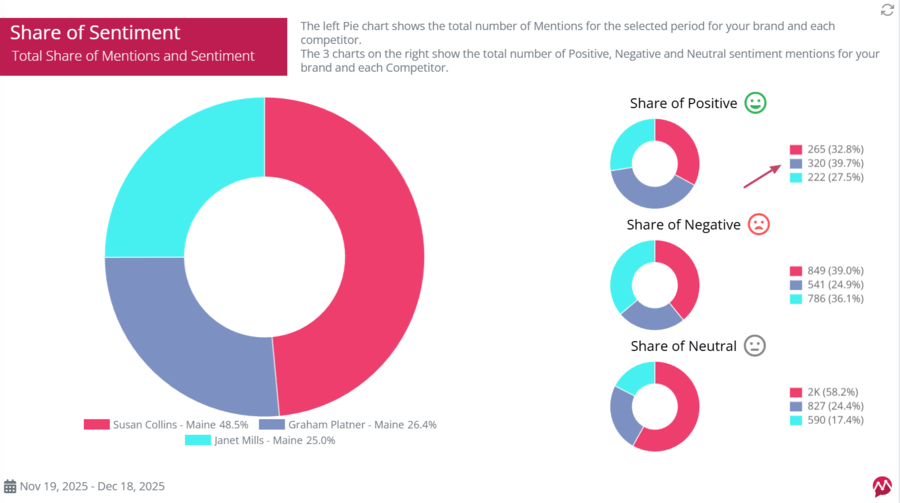
Platner’s social media Share of Sentiment – Mentionlytics’ data (November-December 2025)
What is the Impact of Social Media on Elections?
Social media has introduced new channels for political campaigns and reshaped how elections function at a structural level. Voter engagement no longer follows predictable patterns like debate nights or news cycles.
Instead, attention spikes around moments, a clip, a comment, a reaction, often driven by emotion rather than policy. People engage more frequently, but not always more deeply, and participation is shaped by what feels urgent, relatable, or shareable in the moment.
At the same time, campaigns have lost much of their control over the narrative. Messages are no longer delivered intact. They are quoted, clipped, reframed, and redistributed by audiences, influencers, and algorithms. Once a narrative takes off, campaigns often find themselves responding to it rather than steering it.
Visual and emotional content plays an outsized role in this environment. Short videos, images, and soundbites travel faster than long explanations, rewarding content that provokes reaction over reflection. As a result, the line between facts, opinions, satire, and manipulation has become increasingly blurred.
What feels familiar or widely shared can start to feel true, regardless of accuracy.
Elections became much faster and messier. Perception moves quicker than verification, and attention often matters more than intent.
Protect Your Political Candidates from Social Media Attacks
The impact of social media on political campaigns is no longer limited to election season. It stretches far beyond it, where a single viral post in the pre-election period can define a candidate before voters ever hear a policy position or see a debate stage.
Narratives now form early, spread fast, and linger long after the original moment has passed, often shaping public perception before a campaign has the chance to respond.
That’s why reputation management can’t be reactive anymore. Campaigns need visibility into what’s being said, where conversations are forming, and how sentiment shifts over time. Not to control the narrative, but to understand it early enough to act intelligently.
Turn On the Early-Warning System for Protecting Your Candidate’s Reputation
Not just during elections, but long before the race officially begins. Monitor emerging narratives with Mentionlytics, detect coordinated attacks, track sentiment changes, and respond before issues spiral out of control.
FAQ
How has social media affected elections and political discourse?
Social media has accelerated how political ideas spread and how public opinion forms. It has shifted political discourse from scheduled, editor-led spaces to real-time, algorithm-driven conversations where emotion, visibility, and repetition often matter more than formal statements or policy detail.
How does social media affect the presidential election?
Social media influences presidential elections by shaping visibility, engagement, and narrative momentum. Candidates are no longer judged only on debates or speeches, but on how their messages are interpreted, shared, and reacted to across platforms like TikTok, X, and Instagram.
What is the negative impact of social media on politics?
The negative impact of social media on politics is the rapid spread of misinformation, the rise of echo chambers, and increased emotional polarization. Viral content can damage reputations quickly, while false or misleading narratives often travel faster than corrections.
How does social media affect political campaigns?
Social media changes how political campaigns communicate, advertise, and respond. Social media allows faster, cheaper, and more targeted outreach, but it also reduces control over messaging, forcing campaigns to monitor conversations continuously rather than relying on one-way communication.
How does social media influence U.S. elections and politics?
In the U.S., social media shapes what issues gain attention, how voters engage with candidates, and how narratives evolve over time. It often sets the agenda that traditional media later amplify, especially among younger voters.
How has social media impacted politics?
Social media has made politics more participatory, more visible, and more volatile. It has lowered barriers to entry for political voices while increasing reputational risk, turning elections into ongoing public conversations rather than isolated events.


