The ultimate goal of public relations is to maintain a positive brand reputation. Every initiative and action works towards this objective. But that’s what makes PR measurement so challenging.
Reputation — not to mention awareness — is an abstract concept. So, because of the goal’s nature, it’s difficult to assess the Return on Investment (ROI) of your PR campaigns.
You need to provide some PR metrics to your clients, though, to prove that your efforts are fruitful. From the client’s point of view, measuring PR efforts helps you look credible and accountable. You ensure their budget doesn’t go to waste.
For your agency, that means you can make data-driven optimizations to your campaigns. Thus, you can deliver better results.
So, it’s time to dip your toes into PR KPIs. In this article, we’ll walk you through PR measurement and analyze 10 metrics to measure your campaign’s success.
Table of Contents
What is PR Μeasurement?
PR measurement is the process of tracking specific metrics to assess the impact of your public relations activities.
For example, you can track your brand mentions before and after a social media PR campaign to see how much your brand awareness has increased.
Nonetheless, it’s not easy to match public relations metrics with business objectives. That means you should choose KPIs mindfully. Avoid vanity metrics and select those you can measure accurately.
Measuring PR Before the Digital Age
So, before digital PR tools bloomed, PR agencies used to measure their strategies’ success with traditional metrics. For instance, circulation, the number of press clippings, or the notorious AVE PR metric.
The Advertising Value Equivalent (AVE) metric compares the size and placement of your earned media coverage, e.g., for a story or press release, to the cost of similar-sized ads.
To understand it, let’s take this as an example. You pitched a story about a new event for your clients. You get a full-page article in a magazine as earned coverage.
Then, AVE would look at what a full-page ad in that magazine costs. So, it can give your clients an idea of your campaign’s ROI.
But it’s actually a vanity metric because no ROI is secured. That’s why it has such a bad reputation in the industry.
That’s also why the International Association for the Measurement and Evaluation of Communication (AMEC) issued the Barcelona Principles of PR Measurement and came up with the Integrated Evaluation Framework to provide a modern theoretical model for measuring PR success, without AVEs and other outdated measurement practices.
PR Measurement: How It’s Done Today
Media monitoring is the descendant of press clipping. It’s the process of gathering all brand mentions from web and social media sources and analyzing their impact on a brand.
It can help you track your media coverage, evaluate the social media buzz you create with your campaigns, keep an eye on the influencers you collaborate with, and more.
There are a lot of merits of media monitoring for PR, but here we focus on measurement.
So, PR professionals turn to media monitoring tools to gauge the effectiveness of their efforts. These tools provide a lot of useful and reliable PR metrics to assess your campaign’s performance.
For example, in Mentionlytics, you can calculate the engagement rate of your campaigns and your Share of Voice automatically. But also, you can be aware of every mention in real time to safeguard your brand reputation. All from a single platform.
Now, you must be thinking about what kind of metrics you should include in your PR reports. We have the answer in the next section.
10 Reliable PR Metrics to Track
Here you’ll find the most accurate key performance indicators for various public relations activities.

1. Media Coverage
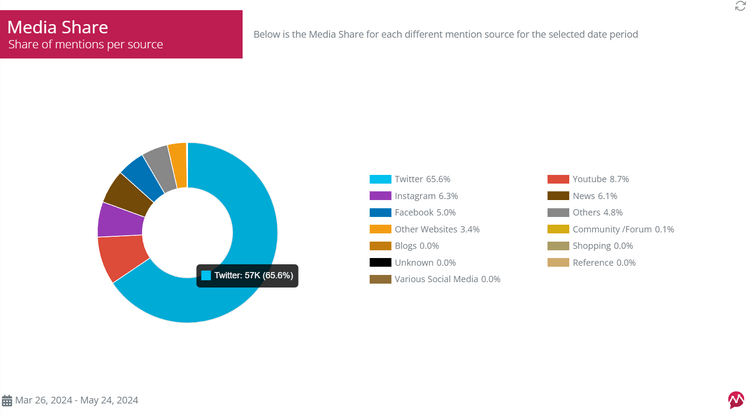
You can’t measure PR success unless you know if the media outlets are picking up on your story. That’s what makes PR teams and clients obsessed with media coverage.
You need to know what the media says about your campaigns. How many times has your story been mentioned in the news? Which media have published something related to your campaign? This is important to paint a general picture of your campaign’s reach.
A media monitoring report is all you need to track coverage and prove the hard work you did pitching journalists. You can generate one automatically by using the Mentionlytics Reports feature.
2. Share of Voice
Assessing how well your campaign performs against competitors is important for PR measurement. Is it reaching your target audience? Or is it drowning because of the competition?
Share of Voice (SoV) will give you the answer. Mentionlytics automatically calculates it by comparing the volume of brand and campaign mentions against your competitors.

Pro Tip: Measure your SoV before launching your new campaign. Then, keep track of it during and after your campaign to see how it evolves against your competition.
3. Brand Mentions
One of the best KPIs for public relations is the volume of your brand mentions on social media and the web.
The more coverage you get, the more people talk about your campaign on social channels. That translates to increased brand awareness, which is the desired outcome for most PR efforts.

Brand mentions as a PR success metric help you determine whether your campaign gets traction or if you need to make adjustments.
4. Reach
Reach is a metric mostly related to social media marketing. But it can be a strong indicator of PR success, too.
In a media monitoring tool, reach refers to the number of social accounts that have potentially seen your content. So, having this knowledge, you can evaluate other metrics, e.g., engagement, more accurately.
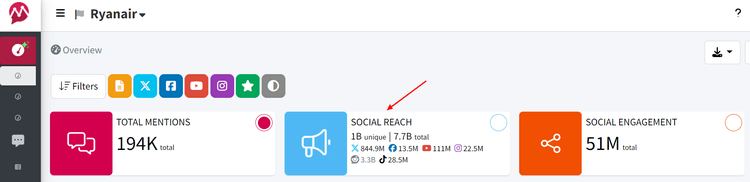
For instance, if your campaign reel on Instagram reaches 1K users but you get only 10 likes and 2 comments, that means your campaign isn’t performing well on this channel.
So, reach can’t really help you with PR value measurement. But comparing it to other metrics is insightful!
5. Mention Sentiment & Emotion
As we said, the volume of your campaign’s mentions on social media can tell you a lot. So, does their sentiment analysis.

Example of sentiment and emotion analysis for Ryanair in Mentionlytics.
Are people referring to your campaign positively? This shows a direct, positive impact on brand reputation, too.
But if users express negative feelings toward your campaigns, that is an early sign of a potential PR crisis. And you should act quickly to address their complaints before the situation escalates.
Understand Your Audience’s Real Emotions
Take a deep dive into your audience’s feelings with Mentionlytics AI Emotion Analysis that recognizes joy, fear, anger, sadness, and even sarcasm!
6. Social Media Engagement
Engagement on social media is one of the top PR metrics to track. It shows clearly if your campaign is interesting enough for your target audience.

A high number of likes, comments, and shares indicates an increase in awareness around your campaign.
Also, you should examine what kind of engagement it is. Are users praising your brand for a fascinating campaign? Then, you’ve made it!
But are people complaining about your brand, or worse, have they misunderstood your message? Then, it’s time for some damage control.
7. User-Generated Content
There are hundreds of examples when brands ask the audience to share their own content with a campaign hashtag.
It’s common to accompany your PR campaign with a dedicated hashtag so that when people talk about it on social media, all the conversations appear under that hashtag when a user searches for it.
That means tracking user-generated content is a great way for measurement in PR. The more users create reels and posts with your campaign hashtag, the more awareness and engagement they generate.
So, don’t forget to include the number of UGC pieces in your campaign report. It’s a direct reflection of whether your campaign talks to the hearts of your audience.
8. Website Traffic
The traffic on your website is another way to measure PR campaign success. If your website traffic is increasing when running your campaign, that means people have started getting interested in your brand.
Furthermore, in Google Analytics, you can see your metrics increase when your brand lands on a major news site. Or when an influencer mentions it in their posts.
This brings us to the next important metric.
9. Backlinks
Getting backlinks for your campaign on high domain authority (DA) websites is the ultimate success.
That’s because those quality backlinks help your website rank higher in search results. And they increase the overall website DA. This results in better awareness and reputation for your brand.
By tracking your backlinks, you get trustworthy performance data on the number of visitors to your website as a result of landing on specific news sites.
Through backlinks, you can also check the quality of the media coverage you get.
10. Email Metrics
Do you use email marketing to boost the reach of your campaign’s messages? Then, you should evaluate email performance metrics.
Email open rate and click-through rate (CTR) shouldn’t be missing from your campaign’s reporting.
Open rate shows you how many people got interested in reading your messaging. CTR is basically the engagement metric for emails. If you got people to interact with your email, then ta-da! You’ve made it.
This was our long list of must-have public relations KPIs. But if you aren’t convinced about their worth, keep reading.
Why Do PR KPIs Matter?
PR measurement and evaluation are of the essence for three main reasons.
To Prove Your Campaigns’ Impact
Today, leadership boards want to measure the ROI of every single penny they invest in different business endeavors.
Public relations measurement provides just that. We mean data and statistics proving the impact of campaigns on the overall brand performance.
With PR metrics at hand, you can offer your clients conclusive proof that your campaign increased brand awareness by 10%, for example.
Or you can give them a list of influencers who picked up on your story and are now interested in forging a collaboration.
To Benchmark Against Your Competitors
Tracking PR performance metrics can also help in benchmarking against the competition.
How? You monitor your latest campaign performance and do the same for your main competitors.
Then, you do a comparative analysis to see where you’re doing better and where you can improve. That way, you learn from your competitors’ mistakes and evaluate where you stand in the market.
To Come Up with Better Digital PR Strategies
Digital PR takes a lot of creativity and strategic thinking to work well. That means you have to assess your previous campaigns to discover hits and misses.
This is where measuring PR comes into play. By evaluating your performance metrics, you can see in which areas you can do better.
Only that way can you avoid the same pitfalls and apply battle-tested strategies to your next campaigns.
Measure Your Public Relations Metrics The Easy Way
To wrap it up, PR measurement isn’t a straightforward process. You should choose the right metrics and tools to help you prove the ROI of your PR efforts.
Luckily, you can have most of the metrics we discussed in this article automatically calculated by Mentionlytics. Start your free trial today.
FAQ
What is a KPI in PR?
A PR KPI can be:
- The engagement rate in your latest campaign’s social media post
- The number of UGC pieces using your campaign hashtag in their captions
- The number of new backlinks you generated from reputable news sites
- Audience sentiment toward your brand – shifted from negative to positive
- Media coverage
And other metrics, based on your campaign/strategy goals.
How Do You Measure PR Performance?
To measure your PR performance, you have to set specific objectives upfront and track meaningful metrics that directly impact those objectives. For example, if your objective is to increase brand awareness for a client’s brand, you can measure your PR performance by tracking how the brand’s Share of Voice grows compared to the competition in the market, increases in the volume of brand mentions monthly, media coverage, and more.
Is Media Coverage a KPI?
Media coverage is a good PR KPI as it shows whether news outlets and social media users have picked up on your latest campaign, press release, interview, and any PR activity you did.
Is PR Measurable?
PR is indeed measurable as there are a lot of metrics and KPIs, both quantitative and qualitative, that prove the results of your PR efforts. However, to measure PR results, you need a media monitoring tool to track mentions, media coverage, Share of Voice, sentiment shifts, UGC, and other data – proof of your success, without needing any manual work from your side.