
Social media PR strategies can’t be missing from any brand’s campaign planning anymore. Social media and public relations are interconnected. The proof: Every PR campaign now has its dedicated hashtag.
Brands used to rely on traditional media to reach people, but social media made this simple.
Brands are in contact with their audience 24/7. This allows them to nurture real relationships with customers. And also build a positive brand image in their minds.
Isn’t this the ultimate goal of PR anyway?
Not to mention that social media provides the best way to cultivate media relations by getting in touch with journalists without spamming their inboxes.
These are just a few reasons why combining PR and social media is a genius move.
In this article, you’ll learn how to leverage social media to score better results with your PR efforts.
Table of Contents
What is Social Media PR?
PR in social media means sharing content to cultivate a positive brand reputation, addressing online PR crises, and spreading the word of your latest campaigns.
Think about the all-time classic #ShareACoke campaign. Or the ever-lasting #ShotOniPhone UGC campaign, which still goes strong with fresh pieces!

Source: Instagram
Social media is an alternative to traditional media for getting your brand in front of your target audience. The main purpose is to build a favorable brand image and inspire trust and loyalty.
You don’t have to wait for media outlets to feature your story. You can publish it straight through social media, and the platforms will do the rest.
How is Social Media Affecting PR Strategies?
Social media has been revolutionizing the way brands communicate with their audiences. From building relationships with media to influencer marketing, social media is the best PR tool to achieve your goals.
Below, we analyze in which areas social media has changed public relations the most.
Direct communication
Social media helps brands interact with a wide audience directly, bypassing traditional media. As a result, there are more opportunities for two-way communication. For example, people can comment on your brand’s posts, sharing their thoughts.
Although this is great for cultivating a brand community, it also poses a threat. Some users can misinterpret your post and create a huge backlash, spreading across the internet quickly.
That’s why PR professionals need to handle negative comments promptly to address concerns and show respect. This brings us to the following point.
Next-level reputation management
Today, by monitoring social media, you can better control the narrative around your brand. Having a media monitoring process, you can catch potential issues early and resolve them.
That’s how you can improve your online reputation management and prevent damage to your brand integrity.
These issues can be customers complaining about your products in their tweets. Or a news website featuring a negative story about your brand.
However, media monitoring helps in collecting positive publicity too. Like PR clipping, only digital. In this way, you can celebrate user-generated content and prove your campaign’s impact.
Better media relations
Social media and PR go hand in hand in nurturing relationships with journalists. You no longer have to search for their email addresses or bug them on the phone whenever you have new press releases.
You can build real relationships by interacting with them on social media.
That way, you get to understand what topics they’re most interested in. And pick the right media outlets to pitch your brand stories.
What’s more, through a social DM you appear more approachable and genuine than with an email.
Quality Data Insights
Social media analytics provide concrete data on the performance of your PR campaigns. Especially, compared to the vanity metrics provided by media outlets.
The native analytics tools show you the reach and engagement of your content, which is gold. Plus, they show insights into your audience demographics and preferences to understand what’s resonating.
But in case you want to uncover the real impact of your PR strategy, you go social listening, which offers a holistic view of your brand’s performance.
How Can Social Media be Used for PR?
At this point, you’ve understood that public relations and social media are a powerful duet. So, let’s see together how you can take advantage of it.

1. Monitor brand mentions and online sentiment
Knowing what people say about your brand is key to effective reputation management. What’s a better way to do that than using a social listening tool to collect all your brand mentions?
In fact, 51% of PR pros believe that social listening is one of the most effective ways to assess reputation.
That’s because with social listening, you learn how many users talk about you and uncover their feelings.
For example, with Mentionlytics, you can collect all your mentions into a neat dashboard to measure your reach and engagement.

At the same time, you can automatically perform sentiment analysis of your mentions.
So, you see if the audience perceives your PR activities positively or negatively. That way, you know which strategies work best and where you should pivot.
2. Build relationships with journalists and media
Social media is the best place to cultivate media relations.
Journalists love X (formerly Twitter) the most due to its frequent updates and concise nature, helping them stay informed about what’s going on.
Through dedicated hashtags — like the #journorequest example you see below — they can also find sources for their latest stories.

Source: X (Twitter)
So, here’s what you should do:
- Follow your key journalists and keep up with what they post.
- Analyze their interests and what their media channel is all about.
- Reply to their posts and engage in meaningful conversations with them.
When it’s time for your pitch, make sure you share the gist of your story. Also, explain why this may be interesting to the journalist. Provide extra resources and be helpful.
Make sure you treat journalists with respect. Don’t just pitch them your latest brand stories, but create a real connection.
3. Respond to comments and messages promptly
Answering your audience’s comments and messages should be your top priority. Whether it’s replying to a customer query or dealing with a bad in-store experience, responding to all your mentions is necessary to show you care.
Thank users who celebrate your brand. But don’t be afraid to respond to bad feedback, too.
That’s how you resolve issues and deal with a crisis right at its beginning. For example, see below how Sephora is handling customer queries.

Source: X (Twitter)
Make your social channels a safe place for your audience to share thoughts and experiences.
4. Leverage hashtags strategically
Creating a dedicated hashtag for your PR campaigns is the ultimate way to generate buzz.
Hashtags encourage users to take part in your campaigns by sharing their own content. In turn, this makes them feel part of a community — a sense of belonging.
For instance, see an example of the ongoing #ShotOniPhone campaign by Apple. This hashtag has more than 29 million posts as of March ‘24!

Source: Instagram
Besides this, hashtags help you gather all the UGC pieces around your campaign.
In addition, you can track your campaign hashtags to measure their performance. These metrics help you prove your campaign’s impact with real numbers.
5. Find influencers to amplify your voice
Influencers have a lot to offer to your PR game.
The tricky part is to spot the right influencers for your brand. Unless your collaboration comes off as fake.
Dove always does a great job of finding the best creators for their campaigns. Great example: Their #DetoxYourFeed campaign with strong influencer participation on TikTok and Instagram.
@loganraehill #DoveAd Click the link in my bio to check out free resources and tools provided by @dove Self-Esteem Project and #DetoxYourFeed ♬ original sound – Logan Rae Hill
Social listening can help you avoid choosing creators who don’t match your brand. In Mentionlytics, you can track important industry keywords to find popular accounts creating relevant content.
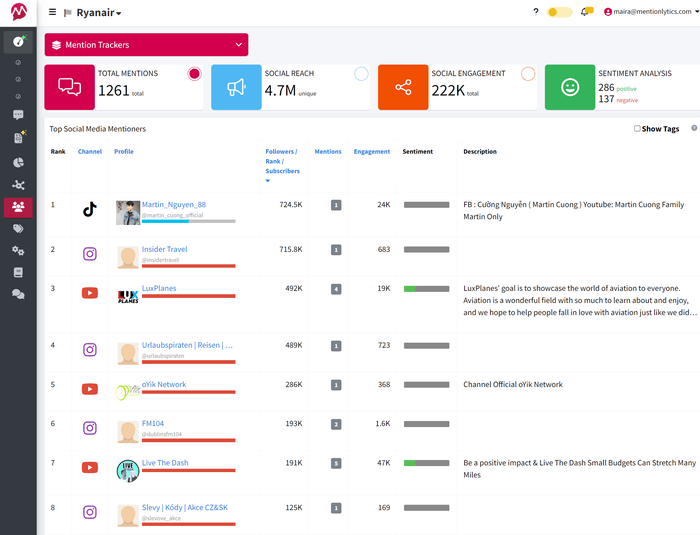
These accounts are your perfect influencer match. You can reach out to them with your offerings and ask them to partner up for your next campaigns.
6. Run social media contests and giveaways
Giveaways are almost synonymous with social media. If you work for a B2C brand, a giveaway of your products is a budget-friendly way to increase your engagement and follower count.
NYX Cosmetics runs regular giveaways. See an example below, in collaboration with another brand.
Δείτε αυτή τη δημοσίευση στο Instagram.
Encourage users to interact with your giveaway post by tagging a friend in the comments. Or sharing the post from their accounts.
Additionally, you can run a contest where the best UGC piece wins a special prize! Thus, you’ll reach new audiences and create buzz.
7. Embrace user-generated content (UGC)
Finally, you shouldn’t miss highlighting authentic user-generated content. There’s no better social proof that your brand rocks than actual customers sharing their honest opinions about it on social media.
GoPro leverages UGC in a legendary way. Its “Photo of the Day” posts are breathtaking and speak volumes about the brand’s quality products.

Source: Instagram
So, here’s what to do:
- Gather all your UGC pieces with social listening.
- Examine them and pick the best ones.
- Repost them from your account, tag the creator, and thank them.
That’s how you’ll spread the word to your followers.
Also, don’t forget to thank all the other UGC creators by commenting on their posts.
Integrate Social Media PR in Your Strategy
There are a hundred ways to integrate social media into your PR strategy.
But don’t get overwhelmed. You don’t have to put in place the above-mentioned tactics all at once.
Start by monitoring your brand mentions with Mentionlytics for free. All aspects of PR depend on it, from improving your brand image to handling crises.
FAQ
Is social media PR or marketing?
Social media can be leveraged for both PR and marketing purposes. For example, posting organic content from your brand’s profile is mainly considered a social media marketing tactic. However, when brands use social platforms to manage their reputation, respond to public issues, or share press releases and company updates, they’re engaging in public relations. The key difference lies in intent: marketing typically aims to drive sales or engagement, while PR focuses on shaping public perception and building long-term trust.
What is the meaning of social PR?
Social PR is basically using social media channels to manage your brand’s public image, build relationships with audiences, and spread PR messages like news, events, or announcements. It combines traditional public relations with the real-time, interactive nature of social platforms.
How is social media changing the face of PR?
Social media is changing the face of PR by making it faster, more interactive, and more transparent. As a PR pro, you can now engage directly with audiences, respond to issues in real time, and build relationships without relying solely on traditional media outlets.