Facebook competitor analysis is the process of studying your business rivals to evaluate their Facebook performance. In detail, it involves analyzing your competitors on Facebook to identify strengths and weaknesses in their social media strategy.
Just being popular online isn’t enough to keep up. Facebook marketing works when you know who you’re up against. That’s where social media competitor analysis comes into play.
In this article, we’re going to talk about everything related to Facebook competitor analysis. From benefits to steps on how to analyze competitors’ Facebook pages, we’ve got you covered.
So let’s start with the basics!
Table of Contents
Why Do You Need a Facebook Competitor Analysis?
Facebook is a great source of market information on competitors. With 3,049 million monthly active users, Facebook is leading the ranking of social media platforms. But how can Facebook competitor analysis help optimize your marketing strategy?
Here are 4 reasons why you need to monitor your competitors on Facebook.
To Understand Your Audience
When you’re beginning, there are always other businesses that’ve already made it. And that’s fine, as long as you play it right. Competitors’ engagement metrics will show you what types of content resonate with your target market.
Also, by examining Facebook audience demographics, you can identify potential leads. For instance, 89% of realtors use Facebook to find leads in real estate. In short, it’s the top social network for this niche.
To Identify Gaps in Your Facebook Strategies
Monitoring your competitor’s Facebook strategy helps you look at your own strategies from a distance. Their content performance and ad campaigns can lead you to discover areas where you may be underperforming.
Additionally, by analyzing top posts in your industry you can adjust your social media approach. There will be instances when you realize you’re not doing everything right. For example, do you know when is the best time to post on Facebook?
To Benchmark Your Performance
Competitive benchmarking is the best way to evaluate your Facebook marketing efforts accurately. You can choose to compare your performance against direct competitors or indirect ones, like industry leaders.
There are basic KPIs, like reach, engagement, and follower growth. There are also advanced Facebook metrics that we’ll cover later in the article. Assess your performance in comparison to your niche and competitors to start working towards improvement.
To Learn From Their Mistakes
This is a common benefit of regular competitor analysis! Tracking your competitors’ social media marketing strategies offers valuable insights into what’s working right now. Competitor analysis on Facebook isn’t much different.
Everyone makes mistakes on social media platforms. There are simple ones, like wrong hashtags, and complex ones, like bad content ideas. Tracking negative mentions and failed campaigns makes sure you’ll avoid making similar errors.

Source: Keith Boykin on X
For example, Dove’s 2017 Facebook ad started a brand crisis, showing a black woman transforming into a white woman. Users jumped into the comments to accuse the brand of racial ignorance. Facebook competitor monitoring led others to avoid similar failures.
How to Analyze Facebook Competitors for Free?
Are you on a tight budget?
Don’t worry! You can still work towards Facebook optimization without spending any money. Just use free Facebook competitor analysis tools, like Facebook Insights and other native analytic tools.
Don’t forget this is a manual method. You’re the one that has to do all the work.
So, let’s take a look at how you’ll do it.
Step #1: Identify Your Top Competitors
To find competitors on Facebook you can follow one (or all) of the following ways.
Industry & Niche Research
Most of your direct Facebook competitors are your actual competitors. Research your industry and niche and make a list of your top competitors. Then go over to the platform and search your competitor’s Facebook pages.
Facebook Search
You can also use the Facebook search engine to look for industry keywords and niche topics. Once you click on Pages, you can narrow down your search with filters, like Location and Categories.

Suggested For You
Facebook always shows you posts, pages, and creators based on your established preferences. These can be about topics, groups, people, or locations you’ve interacted with. Use the content suggestion feature to discover new competitor Facebook pages.
Step 2: Track & Record Their Key Metrics
Once you’ve made a list of your competitors, start monitoring their performance. To do so, make sure you track and record the following data.
Follower Count & Growth Rate
Followers are the first type of data numbers you’ll see when visiting a Facebook business page. It’s important to keep track of the way these numbers change each time you check.
Calculate your growth rate by dividing the new followers by the existing ones.
Post Frequency & Types of Content (Images, Videos, Text)
This requires more effort but it’s totally worth it! Make sure you’re writing down how often each competitor posts on Facebook. It will help you analyze your performance later.
Additionally, what types of content do they publish? It’s important to see how others from your industry shape their content strategies. For example, did you know that users spend 50% of their time on Facebook watching videos?
Engagement Metrics (Likes, Comments, Shares)
Here’s another simple task; But requires more time than you think. Tracking down and recording all the likes of every post your competitors publish is a lot. Now, add comments and shares as well.
AI optimizes competitor monitoring. But if you want a free Facebook competitor analysis, you need to start recording everything.
Paid Advertising Presence (if any)
This one applies only to competitors who pay for ads. But what brand doesn’t have a paid ad presence in 2024? A free Facebook ad competitor analysis won’t reveal much. But it’s enough to show you what’s working for your industry.
Step #3: Analyze Their Data and Content
Now you’ve managed to record all of the above by yourself. First of all, congrats! It’s time to analyze your competitor’s Facebook page. Try to do this process separately for each competitor. You don’t want to drown in data.
Compare your follower count name and growth rate to competitors to identify industry leaders on Facebook. Are you one of them? This will show you if you’re doing something right about your brand awareness.
Combine engagement metrics with content type records, captions, and hashtags. What’s viral and what failed to attract the audience’s attention? Engage with their content to understand their tone of voice.
Finally, post-frequency data guide you in planning your publishing strategy according to what the audience wants.
A free Facebook page analysis is a valuable solution but has certain limitations.
For instance, manual monitoring equals errors. Also, it takes so much time that you’ll probably need a team to do it. And don’t forget that you need to have marketing experience to gather comprehensive insights.
Step #4: Create a Report
You can’t analyze data without having everything assembled in a Facebook competitor report.
Organize your findings in a free spreadsheet or a shared document. Include key metrics (the ones mentioned before) but make sure the report isn’t just numbers. Instead, start visualizing important data into charts, graphs, and pies.
After having analyzed data for each competitor separately, look at the bigger picture. Identify patterns and trends in your competitors’ strategies. For example, what type of content and tone of voice resonates best with their audience?
Finally, start looking at their overall strengths and weaknesses and benchmark your performance. You’ll start noticing the general dos and don’ts inside your niche.
How to Perform an Advanced Facebook Competitor Analysis?
To analyze Facebook competitors and get intelligent insights you honestly need to use an advanced tool. Facebook competitor analysis tools like Mentionlytics offer benefits, like accuracy, speed, and real-time updates.
Also, scalability is important. You wouldn’t be able to handle large volumes of data manually.
Curious to find out how can advanced tools help you? Let’s look at a Facebook competitor analysis example using Mentionlytics. Here’s how to do it in 7 simple steps:
Step #1: Add Competitors to a Facebook Competitor Analysis Tool
Firstly, start your free trial with Mentionlytics by entering a brand name or keyword.

To perform a Facebook competitor analysis, you’ll have to enter everything related to your competitors. Enter their brand name, product/service names, and Facebook pages.
Tip: Throw your own branded keywords into the mix to compare your performance against competitors.
Step #2: Track Their Performance Over Time
Make sure to focus this social media competitor analysis strictly on Facebook. Next to Filters, choose the Facebook icon. An alternative option would be to click on Channel and check on Facebook.

Start monitoring your competitors on Facebook. The numbers of total mentions and social reach offer insights into their brand awareness. Also, social engagement and sentiment analysis show the audience’s reception.
Step #3: Create a Facebook Analytics Report
To manage all your Facebook analytics better, gather all data in a custom report.
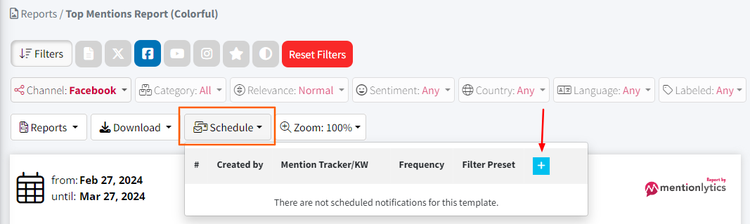
Go over to Reports, click on Schedule, and then on + to create a custom report.
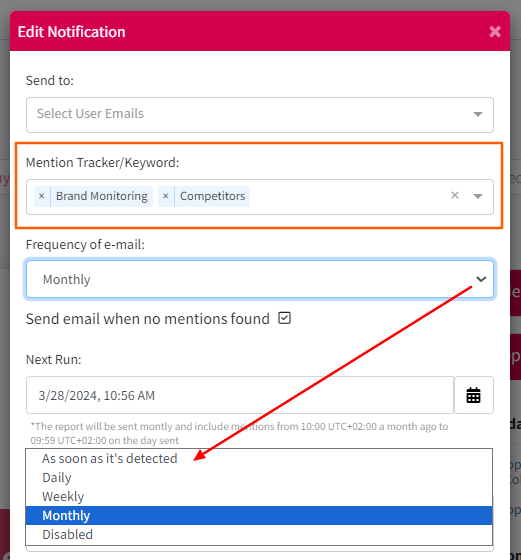
Choose what mention trackers or keywords you want the report to feature. Obviously, you’ll select Competitors, but you can also include your own Brand Monitoring keywords. This will automate your competitive benchmarking analysis.
Also, choose the frequency of your updates, between daily, weekly, and monthly.
Step #4: Compare Their Share of Voice
Go over to Share of Voice and check your results compared to competitors. In this section, you’ll discover if your audience talks more about you or your competitors.
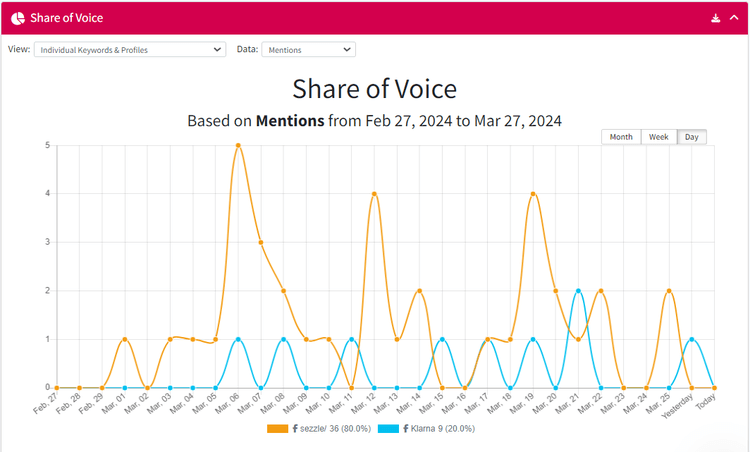
Some days your mentions are fewer than your competitors’ mentions. You can click on these days (by clicking on the dots) to understand what happened.
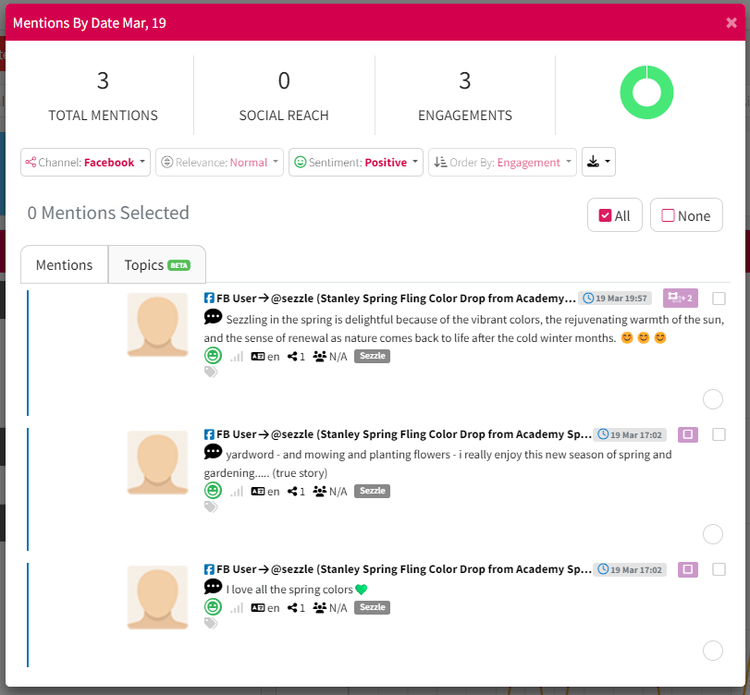
Here’s an example of something your competitors did to spike a positive increase in mentions.
Step #5: Analyze Hashtags & Find New Ideas
Facebook hashtags are undoubtedly a big part of going viral.
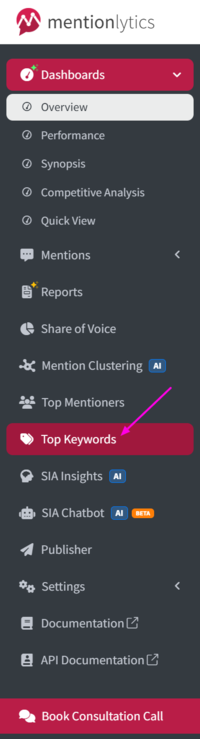
Go over to Top Keywords and then filter your results by clicking on Hashtags Only. Do you see the list of hashtags your competitors used? Now, rank your results by Reach and Engagement.

Sometimes, understanding what top hashtags worked for your competitors leads you to viral trends.
Step #6: Keep an Eye on Sentiment Analysis
As a social media analytics tool, Mentionlytics is an expert at delivering accurate sentiment results.

Use the Share of Sentiment segment of your Share of Voice report. You’ll gain insights into what sparked negative or positive reactions from your target audience.
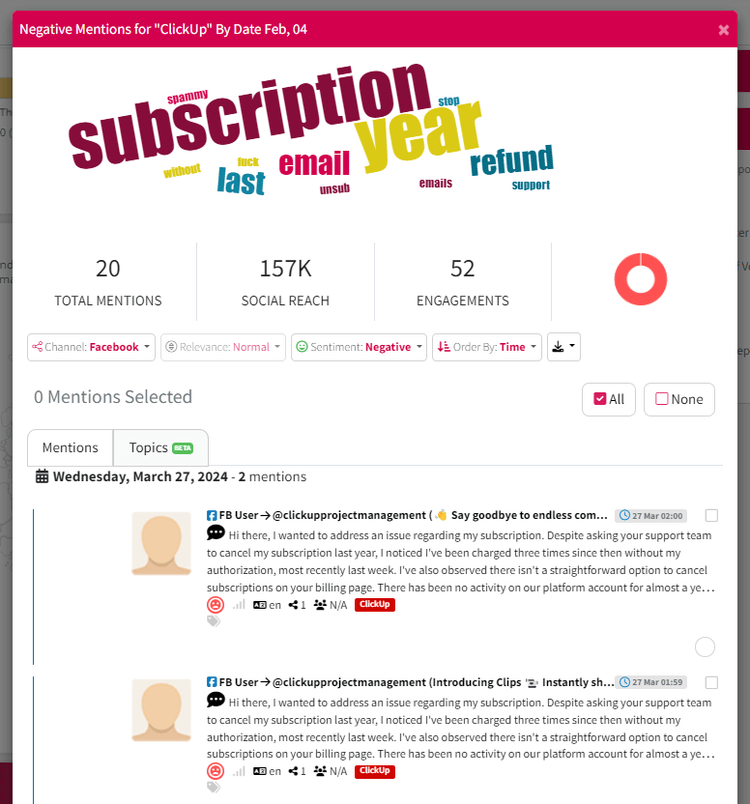
For example, click on your competitors’ part on the negative mentions pie. A pop-up will appear, showing you what’s behind the negative comments. The app even visualizes the most used keywords (ex: subscription, refund).
Step #7: Don’t Forget Facebook Groups
Finally, remember to monitor Facebook groups, where users with similar interests build brand communities. You can monitor an already established group dedicated to your competitor to assess audience engagement.
Alternatively, you can scan competitor mentions across industry-related groups to catch conversations and customer queries. Focus on observing audience preferences and online behavior to identify potential leads.
Now Over to You
In conclusion, to expand your digital footprint, you must understand what works on each platform. Facebook competitor analysis helps you observe market leaders, compare performances, and improve strategies.
Ready to grow your brand’s presence on the top social media platform? Start your free trial with Mentionlytics and master Facebook competitor analysis!
FAQs
How do I analyze Facebook competitors?
To analyze Facebook competitors you’ll need to use free Facebook analytics or competitor analysis tools. Identify your top competitors, track their Facebook performance, analyze data, discover trends, and create reports.
Is Facebook a good source of market information on competitors?
Facebook is the best source of market information on competitors because everyone is there. With more than 3,000 monthly active users, it’s at the top of the social media pyramid. In general, Facebook shows you your competitor’s audience, tone of voice, and posting behavior.
How to extract data from Facebook page competitor analysis?
To extract data from Facebook page competitor analysis use Facebook Insights or third-party tools. Alternatively, you can do it manually by tracking and recording your competitor’s performance.
What is the best Facebook competitor analysis tool?
Mentionlytics is the best Facebook competitor analysis tool because it provides multiple benefits. In short, Mentionlytics offers data accuracy, real-time updates, and sentiment analysis in all languages.
Are there any free tools to analyze competitors on Facebook?
You can analyze Facebook competitors with the platform’s native in-built features, like Facebook Insights. But some tasks require manual work from you. Also, you’ll need a marketing background to understand what those numbers mean and make decisions.