

A lot has changed since LLMs entered the search game, but one question has been haunting SEOs and marketers in every single meeting: “Our competitors are cited by ChatGPT, why are we not?” And you have been trying to figure out how to rank in ChatGPT, but there’s always something missing or changing.
The problem is that most people still treat ChatGPT visibility as if it were traditional SEO. It isn’t. Mentions, recommendations, citations, retrieval, reasoning, freshness, account type, and even the model version itself can all influence whether your brand appears in AI-generated answers.
We’ve researched, experimented, and analyzed data to find the right answers for you. In this article, we analyze all factors impacting your website ranking on ChatGPT search and explain the best strategies you can implement to rank higher (or get mentioned) for important queries.
Article Summary (TL;DR)
- ChatGPT is not a traditional search engine. Ranking in AI search requires a fundamentally different strategy, one focused on brand presence, ecosystem visibility, and content extractability, not just keywords and backlinks.
- 900M weekly users, 2.5B daily searches. ChatGPT’s scale is too large to ignore, representing roughly 12% of Google’s daily search volume.
- Three types of AI visibility exist: mentions (semantic association), recommendations (contextual fit and reasoning), and citations (retrieval-based). Each requires a different optimization approach.
- Content structure matters for citations. FAQs, pricing tables, concise definitions, and direct answers make content easier for AI to retrieve, parse, and quote.
- Third-party validation outweighs self-promotion. Reviews on G2, Capterra, and Trustpilot, Reddit threads, expert roundups, and independent blog mentions carry far more weight than your own website copy.
- Reddit is a major ranking signal. ChatGPT reformulates 31% of advisory queries to include Reddit and frequently cites it as a source, making forum presence essential.
- Bad reviews can exclude you entirely. Temu’s absence from top e-commerce lists despite massive marketing spend suggests that poor Trustpilot and review sentiment actively suppresses AI recommendations.
- Free vs. paid ChatGPT returns different results. Paid accounts favor fresher sources and broader retrieval, meaning most optimization efforts currently reach only around 5% of users on the paid tier.
Table of Contents
- Why You Need to Optimize Your Website for ChatGPT
- How ChatGPT Processes Queries
- Main Factors to Rank in ChatGPT in 2026
- Our Research: What Influences Freemium and Paid ChatGPT Search Results
- Why Reddit Appears So Often in ChatGPT Sources
- Bad Reviews Impact Rankings in ChatGPT: The Curious Case of Temu
- How to Rank in ChatGPT with 6 Simple Strategies
- Increase Brand Mentions and Make ChatGPT Notice You
- FAQ
Why You Need to Optimize Your Website for ChatGPT
Do you still doubt whether the juice is worth the squeeze? Let’s put it this way: with the skyrocketing popularity of ChatGPT, the potential rewards are too massive to ignore.
To Reach 900 Million Users Weekly
ChatGPT has made an impact we can’t deny. Back when it was first launched, it took just 5 days for ChatGPT to attract 5 million users. Fast forward to today: It boasts 900 million weekly active users.
These impressive numbers should be a fair motivation push for you to invest in optimizing your website and creating a new strategy for ChatGPT Search.
When OpenAI first launched ChatGPT almost four years ago, many speculated whether it could eventually replace Google search. The biggest limitation? The inability to pull real-time search results.
But for a long time now, that’s no longer the case. With its search functionality and more developed software, ChatGPT allows users to access up-to-date information and even set ChatGPT Search as their default search engine.
Though ChatGPT is not the only LLM offering real-time search recommendations (take, for example, Perplexity, Gemini, Claude), 81% of LLM users still lean towards it.
But if we’re talking about search, we know for sure that Google is not giving up, and still takes the throne with 13.7 billion daily searches, compared to ChatGPT’s 2.5 billion. Some might say, “Well, let’s stick only to Google search then”, but then they would be missing approximately 12% of the Google search volume.
To Defeat the Competition in the AI Game
All your competitors are trying to win the AI marketing game; don’t doubt for a minute. If you don’t believe it, ask ChatGPT. The moment you see your competitors on its recommendation list, it’s a clear signal you need to improve your brand’s visibility and upgrade your marketing strategy.
If your competitors keep appearing while your brand doesn’t, that’s not random. It usually means AI has stronger associations, more trusted sources, better ecosystem visibility, or clearer use-case positioning connected to those brands.
To Escape the Zero-Click Search Situation
For the past decade or so, SEO experts have been putting their souls and sweat into strategies to optimize websites for keywords, mostly for Google. And they knew the game rules.
Every now and then, Google surprises SEOs and shakes things up with an algorithm update. After a few months, everything would get back to normal.
And we all know that when users search for something on Google, Bing, or any other search engine, they have tons of options to click (which they used to do). But in the past two years, there’s been an increasing trend of zero-click searches. The study shows that in 2024, almost 60% of searches ended with zero clicks.
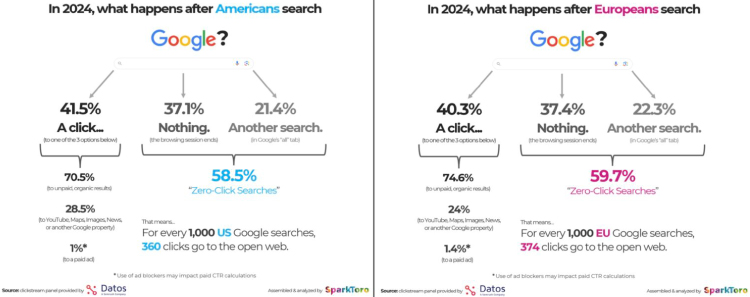
What does it mean? It means the user finds the answer directly on the search engine results page (SERP) without needing to click to access the information. Hip, hip, hurray for Google users, and bad news for websites and SEO experts, because that means no traffic.
This trend has left many businesses scrambling to figure out how to stay relevant and drive traffic.
With ChatGPT Search, AI Mode, and AI Overviews, the stakes are even higher. Users receive direct, conversational answers to their queries, meaning your brand’s visibility relies heavily on whether your content is chosen as a source, whether the prompt requires examples, or whether ChatGPT considers your brand worth recommending.
But visibility becomes much more complicated once you realize that not all AI answers are generated through the same process.
How ChatGPT Processes Queries
You know that in traditional SEO, you have four types of queries: Informational, Commercial, Navigational, and Transactional. Well, that gets a bit more complex with ChatGPT. ChatGPT processes queries based on intent and required capabilities, such as reasoning, coding, web search, or creative writing. So, it might not process all informational queries the same way.
At the beginning, we thought every query had the same process just like Google’s algorithms, but as LLMs keep developing, so do their processes. And now we’re in somewhat unknown and vague territory, because different types of queries trigger different processes.
On top of that, not all mentions are the same, and not all result from the same process.
So, let’s start from the beginning.
First, we have to understand how ChatGPT actually works and what type of AI visibility we’re talking about.
ChatGPT’s architecture combines Large Language Models (LLMs), Natural Language Processing (NLP), and Retrieval-Augmented Generation (RAG). So, it is fundamentally an LLM-based system that uses NLP techniques and may incorporate RAG for retrieval-grounded answers.
The catch is not that it combines these three, but that ChatGPT effectively uses different “parts of the brain” depending on whether it’s mentioning, recommending, or citing a brand.
Types of AI Search Mentions
When talking about AI visibility, we talk about:
- Mentions leaning more on semantic association and pretrained knowledge
- Recommendations leaning more on reasoning, ranking, and orchestration
- Citations leaning more on retrieval and grounding
And, as you can see, each relies on somewhat different selection logic.
But there are not enough studies to support theories about what process ChatGPT will use when you ask a question. However, there’s a case study with data collected from 667K samples of ChatGPT queries and answers, where the stats show that ChatGPT mostly uses web search when a commercial query pops up:
- Commercial queries: 53.5% web search rate
- Informational queries: 18.7% web search rate
- Generative queries: 8.9% web search rate
The visibility problem is that it’s extremely complex, and you have to tick so many boxes to cover all processes that most brands get lost somewhere in the middle.
That’s why, every time an update happens, it can mess up your ΑΙ results, and you might suddenly fall out of the race. For example, on April 23rd, 2026, ChatGPT introduced its new model, GPT 5.5, which likely affected the visibility scores of some brands.
Now let’s see what to improve for each type of visibility, based on available research on LLMs, RAG, generative engines, and our research on ChatGPT Search behavior.
When ChatGPT mentions your brand
Brand mentions are usually the most LLM-native form of visibility: ChatGPT naming a brand as an example or general fact. In many cases, this comes primarily from semantic association and patterns learned during training.
If a brand repeatedly appears next to phrases like “project management tool,” “AI monitoring software,” or “CRM for SMBs” across articles, reviews, forums, podcasts, and comparisons, the model becomes more likely to “think of it” naturally when that category appears.
Research on pretrained language models supports this behavior, showing that LLMs store factual and world knowledge in their parameters, allowing them to act like imperfect knowledge bases even without live retrieval.
To improve mentions, the goal is simple: strengthen the brand-category association everywhere the model might learn or retrieve from. Focus on:
- third-party mentions
- comparison articles
- Reddit/forum discussions
- review platforms
- podcasts
- interviews
- industry listicles
- competitor co-occurrence
A GEO paper from Princeton University shows that adding citations, quotations, and statistics can significantly improve visibility in generative engine responses across several query types.
Brand Recommendations in ChatGPT
Recommendations are different from brand mentions because ChatGPT is no longer simply recalling a brand. It is trying to judge fit.
If someone asks: “What is the best CRM for a 5-person real estate team?” the system may combine reasoning, retrieval, reviews, comparisons, forum discussions, and overlapping consensus across the web to determine which tools repeatedly match that exact scenario.
This is where “best for” positioning becomes critical. Recommendations rely heavily on:
- use-case clarity
- trusted reviews
- repeated third-party validation
- ecosystem consensus
The more consistently your brand appears in discussions around a specific audience, workflow, budget, or problem, the more likely it becomes to appear in AI-generated recommendations.
To improve your chances of getting recommended by ChatGPT, you should focus on:
- use-case pages
- alternative/comparison pages
- review platforms like G2 and Capterra
- Reddit and forum discussions
- third-party roundups where your brand appears alongside category leaders
Recommendations are not just mentions with lipstick. Here, ChatGPT is actively filtering choices and trying to determine which option best fits the situation.
OpenAI says ChatGPT can choose to search the web based on what the user asks, and ChatGPT Search provides timely answers with links to relevant web sources. A recent case study (2026) reported an average web search rate of 17.4%.
Citations and Links in ChatGPT
Citations are the most retrieval-heavy layer of AI visibility. ChatGPT does not cite a brand simply because it mentioned or recommended it. Instead, it cites the source that best supports the exact claim being made.
So if the model needs pricing information, a smaller but highly structured article stating, “Pipedrive costs $14 per user,” may get cited over a more authoritative website simply because the answer is easier to retrieve, parse, and verify.
This is where Retrieval-Augmented Generation (RAG) matters most. The system retrieves relevant documents, injects them into context, and uses them to ground its response.
To improve your chances to get cited by ChatGPT, your content needs to be highly extractable. Focus on:
- concise definitions
- FAQ
- pricing pages
- comparison tables
- original statistics
- schema markup
- source-backed claims
- pages that answer one question clearly and directly
The GEO study by Princeton University again supports this behavior, finding that citations, quotations, statistics, and structured formatting can significantly improve source visibility in generative answers.
The simplest rule is this: If you want to be cited, forget about writing beautifully. Write extractably.
Tiny tragedy for writers. Great news for tables.
Main Factors to Rank in ChatGPT in 2026
So, after all this is said, and the fact that ChatGPT and other LLMs constantly change and improve, here are 9 factors that have a strong impact on your mentions, recommendations, and citations in ChatGPT in 2026.
| Mentions favor | Recommendations favor | Citations favor |
|
|
|
ChatGPT Ranking Factor #1: Brand-Category Association
Brand-category association is how strongly your brand is connected to a specific topic or category across the web. If your brand repeatedly appears next to phrases that describe your industry, ChatGPT becomes more likely to mention it naturally.
This is strengthened by:
- co-occurrence
- listicles
- comparisons
- Reddit discussions
- podcasts
- reviews
- industry mentions
ChatGPT Ranking Factor #2: Third-Party Validation
ChatGPT trusts what the ecosystem says about you more than what you say about yourself. Strong signals include:
- review platforms
- independent blogs
- Reddit threads
- YouTube reviews
- guest posts
- expert roundups
- analyst mentions
The more independent sources reinforce your positioning, the stronger your visibility becomes.
ChatGPT Ranking Factor #3: Use-Case Relevance
Recommendations rely heavily on contextual fit. The more clearly your brand is associated with:
- a specific audience
- industry
- budget
- workflow
- problem
the more likely it is to be recommended for matching queries. This is why “best for” positioning matters so much.
ChatGPT Ranking Factor #4: Retrieval-Friendly Content Structure
Citations depend heavily on how easy your content is to retrieve, parse, and quote. Pages that perform well usually contain on of the following AEO best practices:
- concise definitions
- FAQs
- short answer blocks
- pricing information
- comparison tables
- structured formatting
- direct explanations
If AI can easily extract the answer, your citation chances increase.
ChatGPT Ranking Factor #5: Authority & Credibility
Authority still matters. Brands are more likely to appear in recommendations when they have:
- strong domain authority
- credible backlinks
- industry recognition
- social proof
- high-quality reviews
- repeated mentions from trustworthy sources
AI systems increasingly favor safer, consensus-driven recommendations.
ChatGPT Ranking Factor #6: Review and Sentiment Signals
Customer sentiment plays a surprisingly important role in AI visibility. Positive:
- G2 reviews
- Trustpilot ratings
- Capterra feedback
- Reddit sentiment
- public discussions
help reinforce trustworthiness. Negative reputation signals can weaken recommendation likelihood.
ChatGPT Ranking Factor #7: Competitor Co-Occurrence
Being repeatedly mentioned next to major competitors strengthens category legitimacy.
For example, if your brand is in the project management software industry, getting a mention in articles about “ClickUp alternatives” or “Asana competitors” helps AI systems understand: “this brand belongs in this category cluster.”
ChatGPT Ranking Factor #8: Original & Source-Worthy Content
Original research, statistics, quotes, reports, and unique insights improve citation potential significantly. Generative engines often prefer:
- source-backed claims
- unique data
- quotable information
That’s because they are easier to ground and cite.
ChatGPT Ranking Factor #9: Freshness & Ongoing Visibility
AI visibility is not static. Brands that continuously appear in:
- new reviews
- fresh discussions
- recent articles
- active Reddit conversations
- updated comparison pages
are more likely to remain visible over time.
Our Research: What Influences Freemium and Paid ChatGPT Search Results
I’ve been constantly testing ChatGPT for over two years now. As you probably already know, ChatGPT doesn’t return the same ‘best of’ or ‘top 10’ results across different account types. A logged-out session, a free account, and a paid account can produce noticeably different suggestions.
But then, recently, a LinkedIn post with statistics of ChatGPT users made me think. According to Tomas Bay, of the 800 million ChatGPT users, only 5% are paid users.
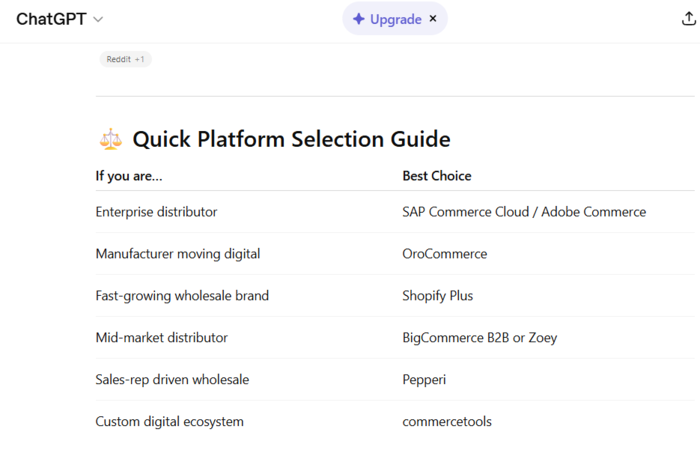
So I tested the difference in results and sources between these two account types by opening a freemium account in addition to my Plus account. I asked the same two questions (highly commercial queries) in both versions to see whether the suggestions and sources would differ.
- “What are the top ten B2B portal solutions for wholesalers?”
- “Show me the best 3-star hotels in Bali for a stay next week. Give me their current estimated nightly rates, their overall review scores, and a direct link where I can check their availability.”
Results for Freemium ChatGPT Account: Mini version
After exhausting the limited GPT-5.5 usage available on the free tier, the account automatically switched to the smaller ‘mini’ model. The free account version gave me this list as the answer to my first query: “What are the top ten B2B portal solutions for wholesalers?”
So, I scrolled a bit and found the sources, which were:
- Reddit (two posts: “Best Wholesale Ecommerce Agencies in 2026” and “Best B2B Customer Portal Development Companies in 2026”)
- Forbes “5 Best B2B Ecommerce Platforms”
- Two OroCommerce blog posts: “Best B2B eCommerce Platform for Wholesale: 5 Top Options in 2026” and “Best B2B eCommerce Platform: 5 Top Solutions Compared (2026)”
- B2B eCommerce association platform (directory)
- 15 more niche blog posts related to B2B and wholesale, not necessarily the combination of both.
Four things stood out to me:
- The suggestions from Reddit posts were not taken into consideration at all, but they are quoted as a source (perhaps because they are not a match to the queries). In other words, appearing as a source does not necessarily mean influencing the final recommendations. ChatGPT may retrieve pages for contextual understanding or validation while relying on completely different sources when generating the actual list of tools.
- The suggestions from the Forbes article also weren’t taken into consideration (1 of 5 tools made to the list).
- One of the sources has the 403 forbidden error.
- Some of the blog posts from the source list date 2023 and 2024.
The second question was apparently too much for a free account. I asked: “Show me the best 3-star hotels in Bali for a stay next week. Give me their current estimated nightly rates, their overall review scores, and a direct link where I can check their availability.”, and it gave me the list of 3 hotels you can see in the screenshot below.
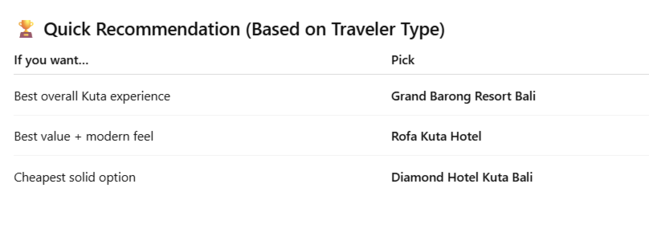
There were so many inaccuracies, but I won’t go through all of them, just the first hotel suggestion. According to ChatGPT, Grand Barong Resort Bali:
| What ChatGPT said | What is actually true |
| is a 3-star hotel (that was my query) | No, it isn’t, it’s a 4-star hotel. |
| has a review score of ~8.2 / 10 (Very Good) | Not true, the current review score on Booking is 7.9. |
| offers an estimated nightly rate of €38–€55 ($40–$60) | Not correct, the current price ranges from $170 – $220 per night |
| is located in Central Kuta (5-minute walk to Beachwalk Mall & nightlife) | This is the only correct information. |
| was checked for live availability | The link to Booking was broken. |
The response appeared to rely heavily on pre-trained or stale information rather than successfully grounding the answer in live travel data, as no links were provided to support its claim, aside from the broken link to Booking.
Results for Paid ChatGPT Account: Plus version
Then I logged into my paid account and asked the first question about the B2B portal solutions for wholesalers, and the results were pretty much the same, as for big names in that category. The differences were between smaller or newer competitors.
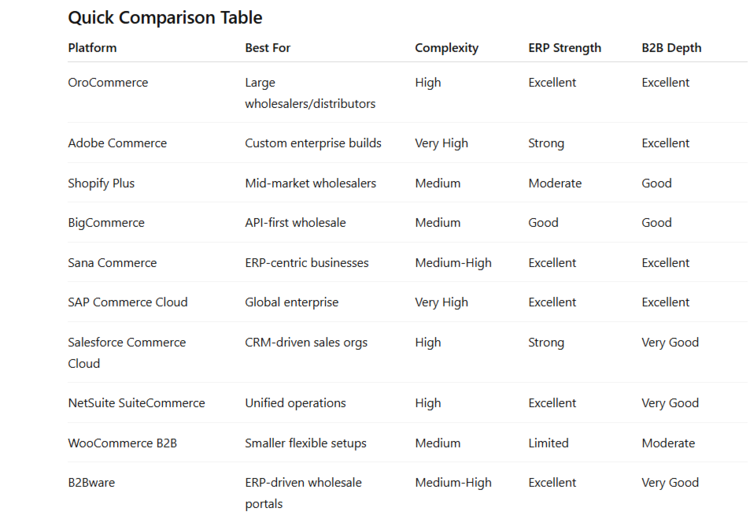
Interestingly, a paid Plus account gave me fewer sources (11), didn’t use Reddit as a source, and didn’t include any directories or statistics in the sources list.
But at the same time, the blog posts used as sources were all recent, not older than July 2025.
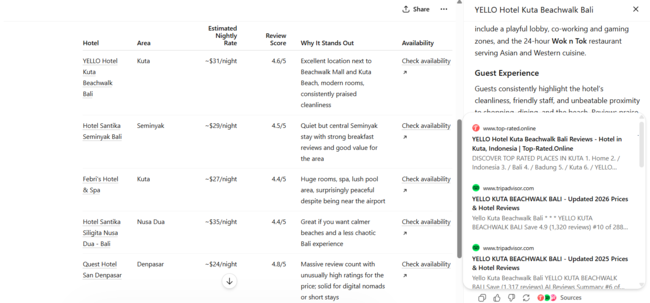
For the second question about the Bali hotel, I got a list of 6 hotels with prices, estimated nightly rates, review scores, what stands out, and a column with links to check availability. It pulled data from 22 external sources, including big names in the hotel industry, such as TripAdvisor, Booking, and Agoda. Some of the sources were not a good match to the query, since they were about the best hotels in Tenerife, Spain, or the Caribbean. Again, all sources were from July 2025 onwards.
Besides that, each hotel suggestion had separate sources supporting everything said about each hotel, and that was spot on.
Our Research Conclusion
What stood out most wasn’t just the quality difference in answers, but the difference in retrieval behavior itself. The Plus account appeared to prioritize fresher sources, broader web retrieval, and source-level verification, while the free version relied more heavily on prior knowledge and partial retrieval.
In practice, that means two users asking the exact same question may experience completely different versions of ChatGPT search.
In other words, much of what brands are currently doing to improve ChatGPT visibility may be affecting only a tiny percentage of users right now.
But AI models age fast. Today’s premium GPT-5.5 behavior could easily become tomorrow’s default “mini” model behavior. And when that happens, the way brands appear in AI-generated answers may change for hundreds of millions of users almost overnight.
Okay, this was partly a test, but mostly a logical conclusion based on statistical data that hasn’t been discussed enough.
Everyone is talking about AI search optimization, but the thing is, the results won’t be visible instantly, at least not for 95% of the users. It’s not like traditional SEO, where you optimize pages, let Google crawl them again, and voilà, you can see results within 2 weeks to a month.
When we’re talking about ChatGPT ranking factors, we’re not talking about an instant fix in (on average) 82% of queries. Why? ChatGPT will not use the search option for every query; it will rely on its pre-trained knowledge and reasoning. And when was the last knowledge cutoff? Well, that depends on the model you use.
According to OpenAI, the latest knowledge cutoff for each model in use is:
- GPT-5.5 (Instant/Thinking): Dec 01, 2025
- GPT-5.4 (Thinking): Aug 31, 2025
- GPT-5.4 (Instant): Aug 31, 2025
- GPT-5.2 (Instant/Thinking): Aug 31, 2025
- o3 (Legacy reasoning model): Jun 01, 2024
Why Reddit Appears So Often in ChatGPT Sources
Perhaps more than ever, now is the time to keep your eyes on social and web mentions, because ChatGPT increasingly treats them as consensus-validation layers. It pulls discussions and checks whether people talk about your brand positively or negatively, and how much fuss you make on social media, specifically Reddit, which is the most cited domain, surpassing Forbes on the list of sources.
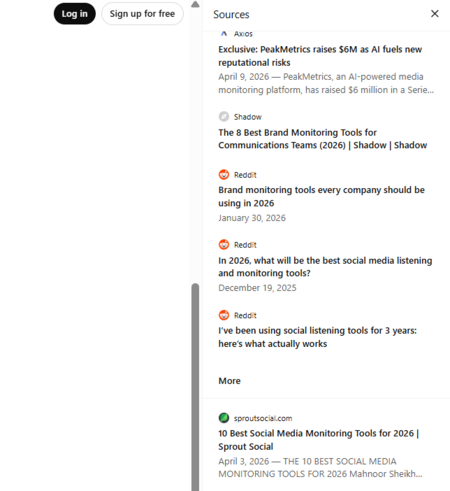
And there’s a case study indicating that ChatGPT reformulates queries to include “Reddit” in 31% of advisory/opinion queries.
I tried this myself from a logged-out account and the experiment showed the same results: Reddit appeared in 3 of 19 sources for the advisory query about the “best brand monitoring tool” asked from a logged-out account. Ypu may see the results in the screenshot below.
Bad Reviews Impact Rankings: The Curious Case of Temu
My third experiment with the factors that help brands rank in ChatGPT was around the query “What are the top 10 e-commerce marketplaces?” within my free account.
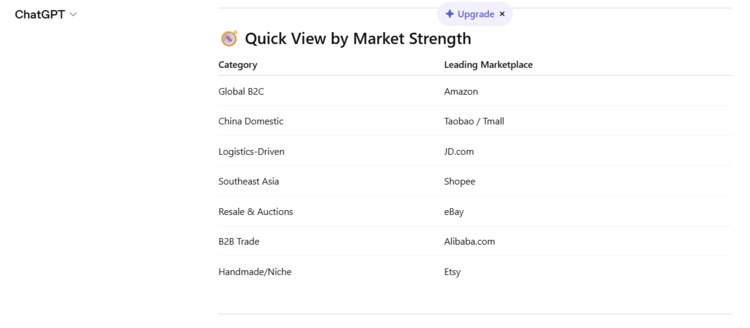
Interestingly, Walmart and AliExpress appeared elsewhere in the response but were missing from the final comparison table entirely.
Surprisingly, Temu didn’t make the list. Given its aggressive influencer marketing strategy, dominating platforms like TikTok, Instagram, and YouTube, you’d expect it to be a top contender. Temu hauls are everywhere.
But when I looked closer, I found that poor customer reviews on platforms like Trustpilot might be the reason why Temu is not on the recommended list.
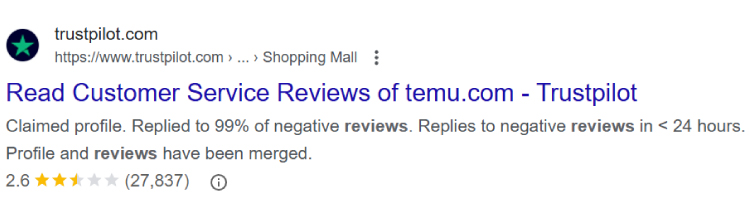
This stresses the importance of sentiment analysis and review monitoring tools.
It’s not just about being visible; it’s about being trusted.
This little experiment revealed two critical factors for success in the ChatGPT search:
- Authoritative Sources: Establishing your business on platforms like Wikipedia can significantly enhance your visibility.
- Customer Sentiment: Positive reviews and strong sentiment analysis are essential for maintaining a favorable online reputation.
It’s not enough to simply show up. You need to ensure your brand is perceived as both credible and trustworthy.
Do Sentiment Analysis Automatically with AI
Let AI analyze your brand mentions, comments, and reviews with Mentionlytics’ powerful sentiment analysis feature!
How to Rank Your Website on ChatGPT with 6 Simple Strategies
Does it seem as if you’re back to square one? Starting all over again with the race? Perhaps, but there are ways to improve your ranking on ChatGPT in the long run. Here are some actionable strategies that might help you secure a spot in ChatGPT’s answers across multiple queries.
Strategy #1: Track industry conversations and join them
Are you monitoring industry conversations? If not, perhaps it’s time to start with that. By tracking industry keywords with social media monitoring tools, like Mentionlytics, you can always get into conversations on social platforms and forums like Reddit and Quora, and engage with users. Let people from your industry talk about you.
Social media monitoring can help you improve the social signals of your brand. Why wait for people to find you when you can strategically place yourself right where the action is?
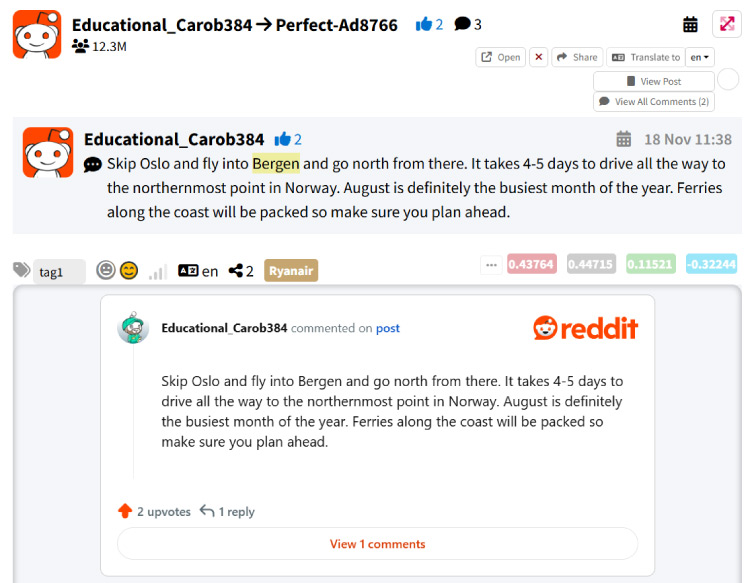
Example of an industry conversation on Reddit relevant to Ryanair
When you actively participate in conversations around industry-specific keywords, you’re increasing your social engagement and building a stronger brand presence.
People will start associating your business with key topics in your field, boosting your relevance and authority. Over time, these efforts will pay off in the form of increased brand awareness, more organic traffic, and, ultimately, greater trust from your audience.
The more your brand is mentioned in relevant conversations, the stronger your social signals become. These signals boost engagement and improve your brand’s visibility and relevance within your industry. Think of it as a snowball effect: the more you engage, the more people talk about you, and the more your presence grows.
Strategy #2: Become a part of highly relevant sources
Not all mentions carry the same weight. ChatGPT appears to trust some sources far more than others, depending on the industry and the type of query. In SaaS, that may be G2, Reddit, GitHub, or industry blogs. In travel, it might be Booking, TripAdvisor, Reddit, and niche review sites.
The key is identifying which sources repeatedly appear in AI-generated answers in your niche. Then:
- contribute there
- get featured there
- publish data there
- build partnerships there
- make sure your brand becomes part of those ecosystems naturally
Visibility in highly trusted sources improves more than referral traffic. It strengthens your authority, credibility, and retrieval potential across AI systems.
Because if ChatGPT keeps seeing your brand inside the same environments it already trusts, your chances of being surfaced increase dramatically.
Strategy #3: Audit your content and keep it fresh
Freshness matters much more than many brands realize. Our testing showed that newer ChatGPT models appeared to favor fresher sources, especially for commercial and recommendation-driven queries.
That means outdated pricing pages, comparisons, feature lists, statistics, screenshots, and product descriptions might quietly hurt your visibility over time.
And the problem is that AI systems may still retrieve old pages if they remain highly cited or strongly associated with a topic. So regular content audits matter. Update:
- statistics
- examples
- screenshots
- feature explanations
- comparisons
- references
Not because Google likes freshness, but because retrieval systems increasingly seem to prefer recently validated information.
Strategy #4: Find backlink opportunities with web monitoring
Why not go with the good old backlinking technique? If you forgot about it or think it’s no longer relevant, it’s time to revise your SEO and digital marketing strategy.
But this time, you’re not going to do it on foot. Use a social media and web monitoring tool to easily spot where your brand is mentioned but not linked.
Discover ALL Your Unlinked Mentions
Use Mentionlytics to track all the mentions of your brand in authoritative websites in your niche and boost your content collabs!
We know it’s an old strategy, but many marketing experts put it aside. The reason is probably that it recently lost its big impact on Google’s ranking. But not entirely. The search engines and ChatGPT still count your links.
Therefore, if your business is mentioned in a good-quality blog post (for example, a list of tools, software solutions, or products) but not linked, it’s time to reach out to these blog owners. Suggest a link exchange or some other marketing collaboration.
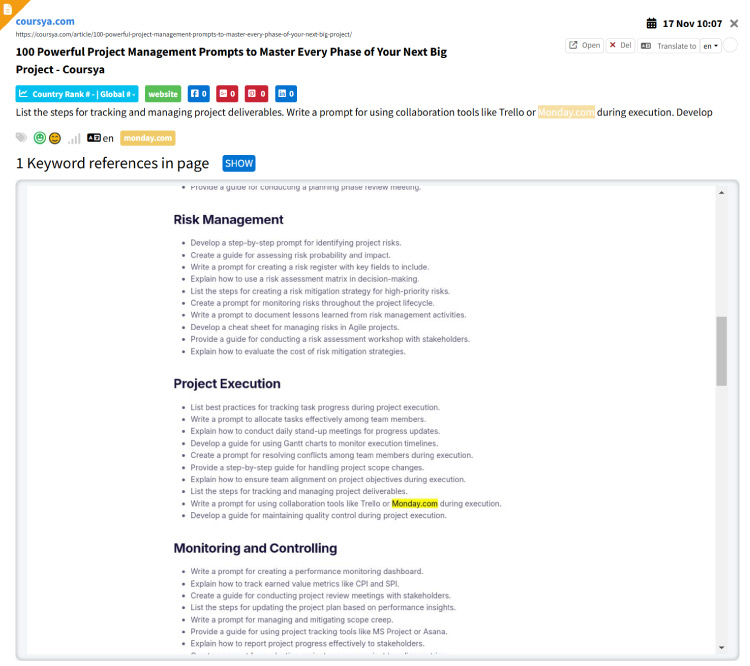
Example of an unlinked mention of Monday.com discovered by Mentionlytics
Don’t forget, no matter how small the impact is, it’s still an impact. You score better at website authority as you increase your DA (domain authority), and yes, links still do that.
Strategy #5: Produce content worth referencing
What AI systems increasingly favor is source-worthy content. Original research, statistics, reports, white papers, frameworks, comparisons, experiments, and unique insights are more likely to earn backlinks, citations, a place in Reddit discussions, podcast mentions, and third-party references.
And those references matter because generative systems seem to rely heavily on overlapping consensus and repeated validation across multiple sources. That’s why producing content worth referencing is one of the biggest GEO trends now.
The easiest way to become visible is to publish something others genuinely want to quote.
Strategy #6: Build strong product and comparison pages
If you want to improve AI visibility, your product pages need to become much clearer and much more extractable.
Many company websites still describe products using vague marketing language like: “next-generation AI-powered innovative solutions.” Which sounds impressive until nobody, including the AI, understands what the thing actually does.
Strong product pages clearly explain:
- what the product is
- who it’s for
- pricing
- use cases
- integrations
- features
- limitations
- workflows
Comparison and alternative pages are especially important because they help AI systems understand:
- category placement
- competitor relationships
- use-case fit
In other words, you’re building pages that sell and explain.
Increase Brand Mentions and Make ChatGPT Notice You
Optimizing for ChatGPT is not as straightforward as traditional SEO. You’re effectively playing two different games at the same time: competing for visibility in current retrieval systems while also becoming part of the training and association patterns future models may rely on.
That means visibility started to be more about presence than just rankings or keywords. Presence in industry discussions, Reddit threads, comparison pages, reviews, podcasts, trusted publications, and the broader conversations shaping your category.
The brands that consistently appear across those ecosystems are the ones AI systems increasingly recognize, retrieve, mention, recommend, and cite. And since none of this happens overnight, the best time to start building that visibility was probably a year ago. The second-best time is now.
Use Mentionlytics to monitor industry conversations, track your online mentions, discover backlink opportunities, and stay visible in the discussions shaping your niche.
See you in the sources list.
FAQ
How fast can you rank on ChatGPT?
How fast you can rank on ChatGPT depends on the type of visibility you’re trying to improve. Citations and retrieval-based visibility can sometimes change relatively quickly if your content gets updated, picked up by trusted sources, or starts appearing in fresh comparisons and discussions.
But mentions and recommendations often work differently. Since ChatGPT may rely heavily on pretrained knowledge and semantic associations, visibility can take much longer to build. In many cases, you’re not just optimizing for current retrieval systems, but also for future model training and knowledge cutoffs. In other words, ChatGPT visibility is usually more gradual and ecosystem-driven than traditional SEO rankings.
How to do SEO for ChatGPT?
Optimizing for ChatGPT is less about traditional keyword SEO and more about building strong brand visibility across the web. That includes:
- appearing in trusted third-party sources
- getting mentioned in Reddit and forum discussions
- creating comparison and “best for” pages
- publishing original research and statistics
- improving review sentiment
- structuring content so AI systems can easily retrieve and quote it
The goal is not just ranking pages. It’s building enough authority, relevance, and ecosystem presence for AI systems to recognize your brand as a credible answer.
How to get indexed in ChatGPT?
ChatGPT doesn’t work like a traditional search engine with a public indexing system or submission process. Your content may appear in ChatGPT answers through:
- pretrained knowledge
- live web retrieval
- Retrieval-Augmented Generation (RAG)
- citations from trusted sources
- semantic association patterns
That means there’s no “submit website to ChatGPT” button. Instead, brands improve visibility by strengthening their presence across authoritative websites, reviews, forums, publications, comparisons, and highly structured content pages.
How to appear on ChatGPT?
To appear on ChatGPT consistently, your brand needs to become visible across the broader ecosystem that AI systems rely on. That means:
- building strong brand-category associations
- getting featured in trusted industry sources
- encouraging reviews and discussions
- publishing original and quotable content
- staying active in the conversations shaping your niche
ChatGPT recommendations often seem to favor brands that repeatedly appear across multiple trusted sources, not just brands with strong websites.
How to optimize for ChatGPT search?
The best way to optimize a website for ChatGPT search is to focus on retrieval-friendly, source-worthy, and highly contextual content. That includes:
- clear product and pricing pages
- FAQs
- comparison tables
- use-case pages
- fresh statistics
- structured formatting
- schema markup
- content that answers specific questions directly
At the same time, optimization goes beyond your own website. Reddit discussions, reviews, podcasts, backlinks, industry mentions, and third-party validation all seem to influence how AI systems evaluate and recommend brands.


