


Let’s start with a short reminder that earned media is the attention you get from various sources for free. You don’t pay for it (that’s paid media), you don’t publish it (that’s your own media). It’s pure, spontaneous love you get from your audience.
And, believe it or not, earned media has just upgraded from prize to double win.
Whether it’s a blog post mentioning your brand, an influencer going viral on Instagram about your product, or praise of your latest campaign in a well-established media outlet, it builds trust and credibility. It was always like that.
But now, this brand awareness goes beyond your target audience and even influences AI search engines. These sophisticated AI models also read everything that others are saying about your brand through earned media, and it will influence whether or not they will recommend your brand in a query.
Wild, right? That means, organic PR can now bring you more high-quality leads than ever. So why not make the most of it? It’s cost-effective, most rewarding, and so enjoyable.
In this article, we’re going to show you some of the best earned media examples for your inspiration and make a quick distinction between owned, earned, and paid media to better understand the nuance.
Table of Contents
What are Examples of Earned Media?
Before we dive into our real-world hall of fame, let’s clarify: Earned media isn’t just media you earn through charm and good karma. It’s third-party exposure, a.k.a. attention you didn’t have to pay for, beg for, or post yourself.
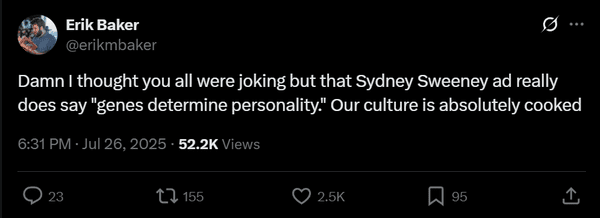
And since it’s a third-party exposure, you don’t have much influence on that. Look at how American Eagle’s campaign with Sydney Sweeney (July 2025) ended up.
It all started nicely and easily, with a Gen Z favorite actress advertising jeans. What could possibly go wrong? But then…
Social media and forums exploded (in a negative way), accusing the American Eagle commercial of promoting eugenics theory.
Did American Eagle try to defend it? Yes, of course. Numerous online articles featured the statement, and AE published it on their official social media accounts. But the heat remained on.
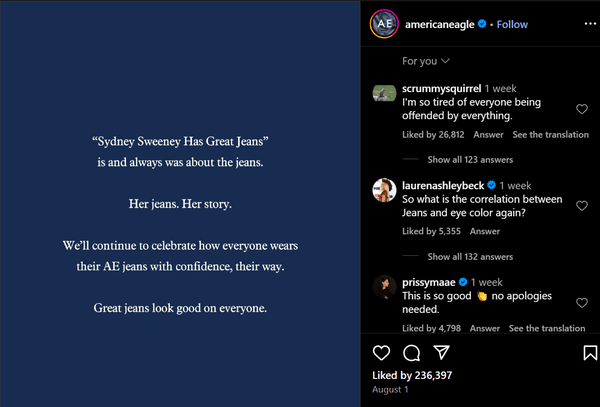
Source: @americaneagle
As you can see, this was not a positive example of earned media because it backfired and created a negative buzz. Perhaps public relations response could be faster or different, but in any case, it’s very difficult to stop the negative mentions once they are out in that volume and covering almost all media channels.
Besides positive and negative examples of earned media, this kind of publicity is almost always tied to the type of media. Depending on the media channel used for mention, endorsement, or review, the effect might be slightly different.
Earned Media Types
Here are the main earned media types we distinguish:
- Media Coverage: Your brand is making news articles or headlines in newspapers, magazines, or online outlets. The more trusted the source, the bigger the impact.
- Social Media Mentions: When the audience starts talking about your brand on social networks. LinkedIn, Instagram, TikTok, Facebook, X, or any other social media posts can stir things up.
- Online Reviews: This is a great channel for generating earned media, and it is mostly focused on review sites (especially for SaaS products), niche platforms, such as TripAdvisor for the hotel industry, or Google My Business or Yelp for local businesses.
- Social Media UGC: A happy customer creating content about your product = gold. A negative one? Well, let’s just say it’s time for some PR damage control. This holds a special place because people might not mention your brand directly.
- Unpaid Influencer Endorsements: When an influencer mentions your brand or your product, makes a review of it, or recommends it without being paid to do so, that’s peak credibility. A single story or review can outperform months of ads.
- Comparison Articles: Third-party blog posts or YouTube videos comparing your brand with competitors. If you come out on top, that’s serious street cred (especially for SaaS).
- Trade Publications: These are a form of earned media that every branch has. Despite the lower volume or reach, it has a high impact on the narrow audience.
- Blog Posts: When bloggers or content creators name-drop your brand, especially in a “top 10” or tutorial, it’s a powerful organic boost.
The list would go on and on, but the bigger challenge for PR pros is always how to calculate and present the earned media value, since the metrics and the lines between owned, paid, and earned media are not quite defined.
Now, let’s check what earned media looks like in real life.
8 Real-World Examples of Earned Media
The most extraordinary thing about earned media? It can be sparked by almost anything. A clever idea. A standout product. A wildly relatable customer experience. Even something as simple as the uniform your team wears or a bold days-off policy can light the earned media fire.
That’s the beauty of it: It’s organic, unexpected, and often unstoppable.
And once you start looking, you’ll notice it’s everywhere.
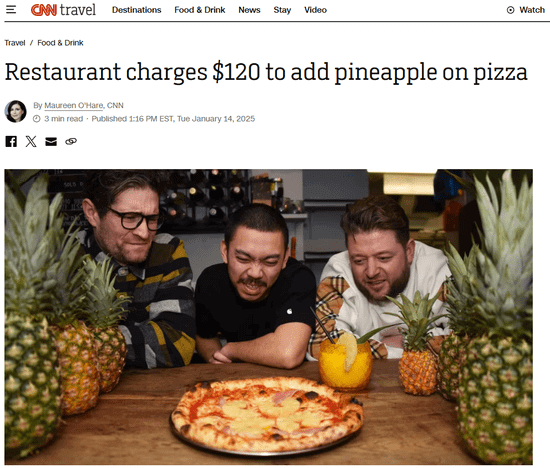
1. Free Media Coverage: Lupa Pizza’s £100 Hawaiian
Okay, we all know the everlasting debate about pineapple on pizza. And that inspired Lupa Pizza to take a different approach. They didn’t say, “We don’t put pineapple on pizza, that’s a crime“, they say, “Sure, you can have your pineapple slices on pizza, but you have to pay £100 for it“.
To clarify, at that time, Lupa Pizza was a small pizza shop in Norwich, UK, with little chance of being noticed by The Guardian or CNN. However, they still managed to garner media attention with their menu and pricing stunt.
Key Takeaway for Your PR Strategy
Watch closely for evergreen debates in your niche, and use them to create a new approach to your earned media strategy. All you need is the out-of-the-box thinking and original idea. It’s like a hook for media outlets. Everything else will follow.
2. Social Media Mentions: Bojangles and a Viral Typo
Now, this is quite a story about “accidental” earned media. Bojangles, an American regional chain of fast-food restaurants, renovated its facility in Knightdale, North Carolina, in 2024.
Nothing out of the ordinary there, except…. the new sign had a spelling mistake: It says “Bojagnles” instead of “Bojangles“.
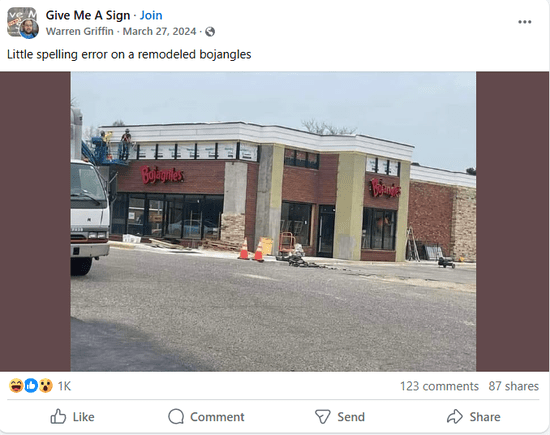
It was spotted and posted on Facebook first. In days, the post went viral, and Bojangles gained publicity thanks to a typo.
Key Takeaway for Your PR Strategy
Social media mentions and shares can boost brand awareness, even if it’s caused by chance. Sometimes, what seems like a PR crisis is actually your ticket to organic social media engagement.
3. Online Reviews: Mentionlytics’ First-Ever Review on G2
This type of earned media is extremely important if you’re a SaaS company (like us!) or in the hotel industry. Why? Because your target audience is more likely to scroll through G2 or TripAdvisor before buying or booking.
And the first review is always the most difficult to get, and if it’s a positive review, you’re on a good track.
We’ve got first-hand experience in this. Just a few months after our social listening tool was released, we finally got the first-ever review on G2, and it was 5 out of 5 stars.

Source: g2.com
Fast forward to today (9 years later), the G2 score is still an impressive 4.9/5. What’s the secret ingredient for this high score? A great customer support — that’s how you build a relationship with your clients, and create an atmosphere where they want to leave a review, and to show others that your service or product is worth it.
Key Takeaway for Your PR Strategy
Unlike paid media, this earned media type is packed with genuine impressions about your product or service. Reviews and testimonials are the first-hand experiences that have a high impact on your sales, since 71% of potential buyers read reviews before purchase.
4. Social Media UGC: Pizza Hut’s “Goodbye Pies”
A well-known brand, Pizza Hut, came up with the idea to create a “Goodbye Pies“, symbolically, on Valentine’s Day. Why break up the ordinary way, when you can always send a farewell meal? That controversy created tons of user-generated content on social media.
@mischiefusa Replying to @Johnna no it’s definitely real #fyp #goodbyepies #pizzahut #pizzahutgoodbyepies #pizza #breakup #breakupstory #breakuppizza #viral #xybca ♬ original sound – Mischief @ No Fixed Address
These organic mentions with UGC create buzz around the brand and increase its online visibility.
Spot Your UGC Even When You’re Not Tagged
Don’t miss the opportunity! Mentionlytics can spot even the quietest mention. Who knows, perhaps that’s the future viral post about your brand…
Key Takeaway for Your PR Strategy
Marketing strategy should always focus on original ideas. Yes, paid advertising can bring you a short-term boost, but unique digital PR campaigns can last for years.
5. Unpaid Influencer Endorsements: IT Cosmetics CC Cream Discovered by Influencer
When your brand is spotted and featured by an influencer (and you have nothing to do with it), you’re on the right track to become “sold out”. That was the case with the CC+ Cream, one of the IT Cosmetics products, recommended by a cosmetic micro-influencer on TikTok, Christin.
The influencer has 62.6K followers (by August 2025), but that video had more than 3 million likes.
@christinnnnnn Used this for years PLEASE its so good #makeup #foundation #itcosmetics ♬ original sound – CHRISTIN
Now, how do we know it’s an unpaid influencer endorsement? If it were a paid one, it would have #ad or # paidpartnership hashtag in its post.
Key Takeaway for Your PR Strategy
Influencer marketing doesn’t have to be expensive. You could be discovered by micro-influencers without spending a dime.
Social media accounts with 10K to 100K followers are sometimes more effective than paid and owned media together. The key is in their active audience. The higher the engagement rate these influencers have, the higher the chance it will positively influence your sales.
6. Shares & Reposts: Zillow Listing Went Viral
There’s a thin line between earned and owned media because sometimes, the owned media can become earned. That happens when you publish something on your website, listing portals, or social media that is so creative and captivating that people can’t resist sharing and reposting it.
That was the case with the real estate listing on Zillow, which has been shared widely online. A real estate agent, James Pyle, created a listing on a real estate platform, Zillow, but took a different approach. He posted photos of the house with a Ghostface showing up in almost all images.
View this post on Instagram
The post became so viral that it got 1.2 million views in just a few days, and, besides shares and reposts on social media platforms, it became news on TV shows and newspaper headlines. Even the New York Post wrote about it.
Key Takeaway for Your PR Strategy
Owned media can trigger earned media coverage if the approach is creative, unique, and catchy, regardless of the industry or form of media. Even the listings can be inspiring and shareable.
7. Blog Mentions (& Backlinks): Monday on Shopify’s Blog Post
Blog posts are not news, and don’t attract so much attention, but they are still extremely important for brand awareness, and if your brand is linked, it can bring you leads.
It could be a comparison blog post, or a listing of best tools, or just talking about a specific topic and recommending your brand as the perfect fit.
For example, Shopify mentioned Monday, in their blog post “Best Software for Small Business: 24 Essential Tools“, in a segment about the best project management tools.

The side effect of this kind of mention is that the AI search engines also track this, and the more mentions (positive, of course) you have, the more recommended you get by AI search engines.
Key Takeaway for Your PR Strategy
Depending on the DA and relevance, you could experience the true benefits of earned media, such as increased traffic, new leads, or increased sales. But if the DA is low, and the topic has nothing to do with you, it might do you more harm than good. That’s why media monitoring is a must to keep an eye on your mentions and their quality.
8. Podcasts & Interviews: When the Opportunity Knocks
According to statistics, there are more than 580 million podcast listeners around the world, and you have to admit, it’s too large a pool to be ignored.
But we have to distinguish the paid media offers, and those where you are invited to be a guest on a podcast, and share your perspective on some topic or tool, just because it would be interesting to the audience.
For example, our co-founder, Manos Perakakis, was invited to be a guest on a podcast show of the GIM Agency, talking about social listening, and it got more than 2.5K views in a month.
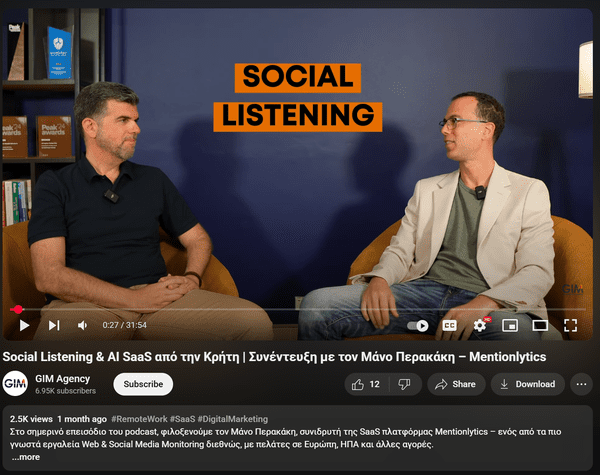
Since this wasn’t a paid advertisement, the value of the reach is undisputable.
Key Takeaway for Your PR Strategy
Don’t wait for podcast invites; position yourself to get them. Build relationships with hosts in your industry, just like you do with journalists, share thought leadership on LinkedIn, and make it easy for others to find your expertise. Podcasts are the new panels, and when you’re invited as a guest (without paying), it’s earned media with a voice and a face.
Find the Perfect Match for Your Brand Story
With Mentionlytics, you can find influencers, bloggers, or YouTubers who can boost your brand’s visibility without searching for hours.
Spot the Difference: 3 Examples of Paid, Owned, and Earned Media
The lines between paid, owned, and earned media can get a little blurry. Especially when all three work together in one campaign (which they often do).
But knowing the difference is key to planning a smart, balanced PR strategy. Here’s a quick breakdown, with real examples to help you tell them apart at a glance.
Paid Media Example
If you’re unsure what paid media looks like and how to spot it, different media channels have different methods.
For example, if we’re talking about influencer marketing, and earned media vs paid one, you should know that whenever a social media post is paid, that should be emphasized through hashtags or clearly labeled in the caption.
Here’s an example: Adobe partnered with @colinandsamir to promote their Creative Residency program. The post was marked as a paid partnership and shared across YouTube and Instagram, reaching a massive audience, but definitely falling under the paid media category.

Owned Media Example
Owned media is everything your brand creates and controls. Think of it as your digital real estate.
- Your website? Owned.
- Your blog? Owned.
- Your newsletter? Still owned.
- Your social media pages? Technically owned, even if you’re renting space from Zuckerberg.
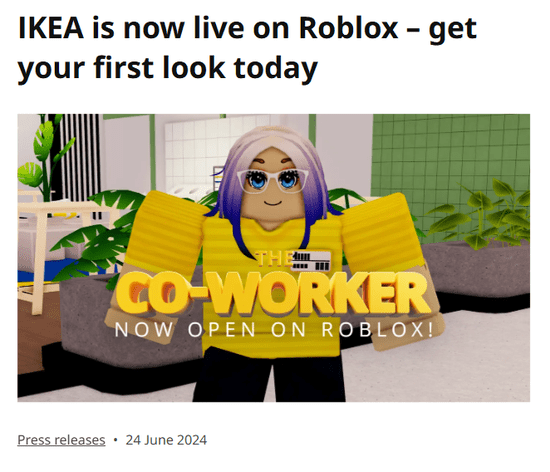
So, for example, IKEA UK and Ireland’s “The Co‑Worker” game on Roblox campaign focused on attracting people to apply for a paid position in a virtual IKEA store within the game. They had paid promotions, but they also published a press release on their website.
Earned Media Example
Now we’re not moving from the IKEA example, just continuing (as in real life). So, this was interesting news, and a lot of online media outlets wrote about it, but so did the TikTok influencers.
For example, a micro-influencer, Hannah, with her TikTok account banana.gov, talked about their campaign, and she had almost 680K likes on that post, and that’s pure earned media.
@bananadotgov Imagine a Roblox cashier getting paid twice what you do 🤧 #greenscreen #ikea #roblox #ikearoblox #ikearobloxjob #virtualreality #virtualwork ♬ original sound – Hannah
Gather All Your Earned Media Mentions in One Dashboard
Publicity can be good or… less than ideal. It all depends on how your audience perceives your brand or campaign. And let’s be honest, it’s not always easy to trace the butterfly effect that your paid or owned media might have on earned media.
As we’ve seen in the examples above, even the smallest spark can go viral.
That’s why it’s essential to track all your mentions in one place. It’s faster, more accurate, and gives you back the time (and brain space) to plan your next big creative move.
Earned media is like a mirror. Sometimes it flatters. Sometimes it reveals the spinach in your teeth. See it all with Mentionlytics’ free trial. It gives you the full reflection, with no credit card needed and no awkward surprises.
FAQ
What is NOT earned media?
Anything you pay for or post yourself isn’t earned, but either paid or owned media. Think sponsored ads, your blog, or branded content you control.
Are influencers earned media?
Only if they mention you organically. If you paid them or gifted them something with expectations, sorry, that’s paid media.
What is an example of an earned channel?
An example of an earned channel is when someone starts talking about your brand on a Reddit thread, for instance, or recommends you to a friend (yes, word of mouth still exists).
Are Pinterest pins and Twitter retweets examples of earned media?
Yes, Pinterest pins and retweets on X are examples of earned media if someone else shares your content without being asked or paid. That retweet or pin? That’s love.

