You could spend six months on a launch plan and still get blindsided the second real people start talking about your product out loud. That includes the comments, the tweets, and the “wait, does this thing do X?” questions that pop up in threads you never thought to check. With a social listening plan, you can catch that stuff early.
And you should. You don’t want to find out from a screenshot someone sends you the next morning, captioned “did you see this?” Um. No bueno.
Here’s how I build a social listening plan for a product launch, from the goals I set weeks in advance to the retro I run once the noise dies down.
Table of Contents
- Steps for a Social Listening Plan Before the Product Launch Phase
- Steps for a Listening Plan During the Product Launch Phase
- Steps for a Social Media Listening Plan After the Product Launch Phase
- How Far in Advance Should You Set Up Social Listening for a Product Launch?
- Can Social Listening Help with Product Development after a Launch?
- Create a Social Listening Plan with Mentionlytics
Steps for a Social Listening Plan Before the Product Launch Phase
I build my listening plan weeks before launch day. Here’s what I lock down first.
Step 1: Set Goals and Metrics for Your Social Listening Plan
Before I track a single mention, I always write down what I want to learn. Skip this step, and your dashboard can turn into something you refresh out of nerves instead of a tool that guides your next move.
Pick a priority for your launch, then build your tracking around it.
The goals I track include:
- Feature reception: Which features get praise, spark questions, or land with a shrug?
- Competitive positioning: How do people stack our product up against competitors?
- Advocacy potential: Who gets excited enough, on their own, to become a loud fan?
- Sentiment: How does the reaction shift over the first 48 hours? Good, bad, mixed?
- Support signals: Where do users hit a wall — bugs, confusion, friction?
Tie each goal to something you’ll track and measure with a social listening platform. For example, if sentiment tops your list, watch your scores against a pre-launch baseline. If support signals top your list, watch for keyword spikes tied to bugs or confusion.
Step 2: Choose Your Social Media Listening Tool
After you know what you’re listening for, pick a tool that can monitor it. I recommend leaning on Mentionlytics to get the most out of your social listening strategy.
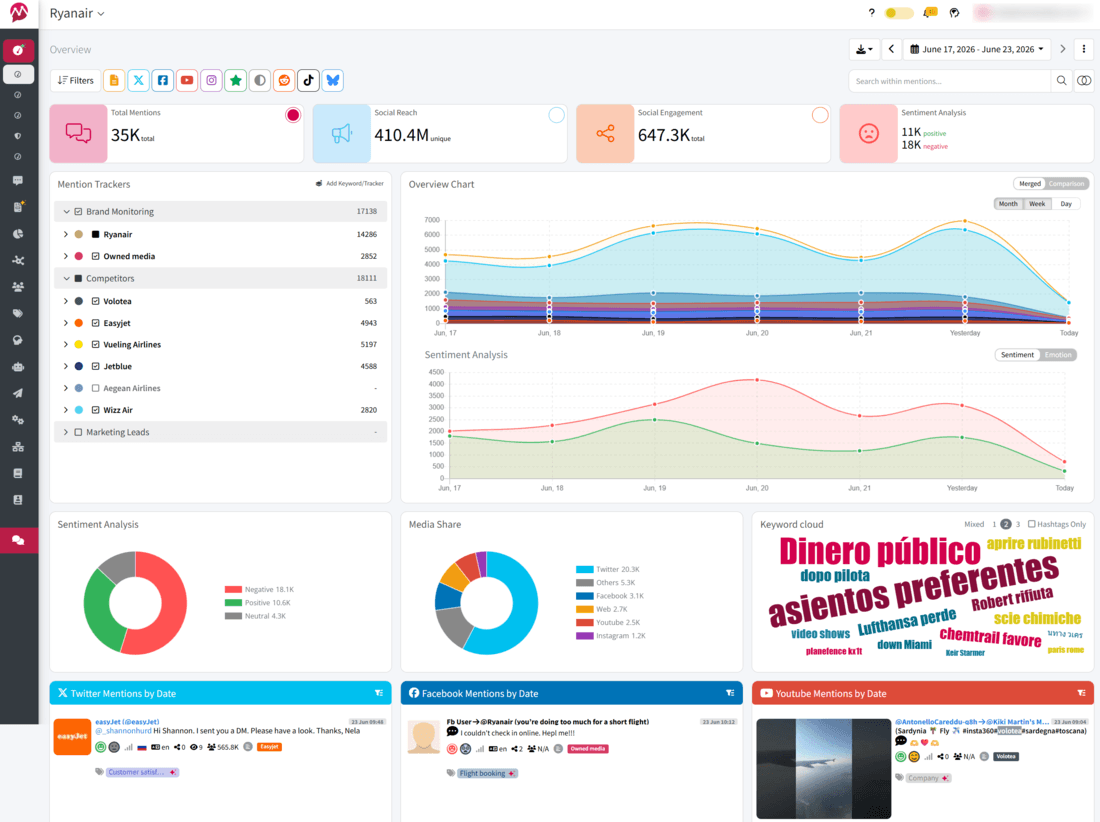
It tracks mentions across social platforms, news sites, blogs, and forums in real time. With its AI-powered Social Intelligence Advisor (SIA), I can turn a pile of raw mentions into something I can act on, instead of a spreadsheet I squint at for an hour.
Remember that launch week hits harder than any other stretch on your calendar. Mentions can spike, sentiment can turn on a dime, and you can’t scan every channel by hand once the conversation picks up. You really need a tool on your side that can help you automate monitoring.
Step 3: Set Up Tracking for Your Social Listening Tools
Invest time to set up your listening tools. This step decides whether your listening plan catches the right conversations or drowns you in junk. Get the foundation right now so every launch after this one is easier to set up.
Track, at a minimum:
- Your product and brand names, plus common misspellings.
- Campaign terms and taglines.
- Launch hashtags. Official ones and the ones that pop up on their own.
- Feature names your users reference.
- Boolean or advanced search queries that combine or exclude terms.
- Alerts that flag sudden spikes in volume or sentiment.
- Competitor and category terms that catch comparison chatter.
One thing I often see skipped: not building a pre-launch baseline.
I highly recommend tracking your brand and category terms for a week or two before launch, so you know what normal looks like. Otherwise, you’ll have no clue if launch-day chatter is high or if it’s just a regular Tuesday.
Step 4: Create a System for Categorizing, Routing, and Escalating Mentions
Build your escalation rules before launching. Here’s what I recommend experimenting with:
- Negative sentiment spike → routes to PR/comms for a coordinated response.
- Technical issue or bug report → routes to product/support for a fix.
- High-intent question (pricing, availability, “how do I buy this”) → routes to sales.
- Misinformation or false claim → routes to comms to set the record straight.
- Ordinary feedback or praise → gets logged and tagged for later.
Launch conversations tend to move faster than they do during a normal week. A social media mention you’d let sit for a day under ordinary circumstances may need a much faster response on launch day. That alone is reason enough to set your routing rules in advance.
Turn Launch Insights into Better Sales Conversations
Your listening plan needs somewhere to put its findings, not a log to sit in.
During launch week, the same product questions come up again and again in replies and comment threads, and the reps on your team who field those questions out loud sit on calls that same week.
I recommend feeding the repeat ones into sales training enablement. Have your reps practice the answer in a sandbox before a real buyer throws it at them cold.
Steps for a Listening Plan During Product Launch Phase
Your plan is ready, you’ve set up your tracking, and now… the conversation kicks off. Here’s what I do once it does.
Step 5: Monitor Conversations During Your Product Launch
This is the part everyone pictures when they hear the concept of social listening. And honestly, it earns that reputation.
Watch mention volume and sentiment closely as the day unfolds. Check both against the baseline you built in Step 3, since that’s the only way to know if what you’re seeing counts as unusual.
Watch for:
- Complaints that name the same feature or issue more than once.
- Praise and excitement you can amplify or turn into social proof.
- Recurring questions that hint at confusion about your product.
- Objections or hesitations that repeat across different users.
- Spikes or dips in sentiment against your baseline.
- Fresh conversations you didn’t see coming.
That last one catches people off guard the most. No launch plan predicts every reaction — and the surprises often teach you more about your audience than any part of your research did. Watch for them instead of dismissing them as noise.
Step 6: Use Automation to Act on High-Volume Launch Conversations Quickly
Speed matters as soon as your tracking goes live. When you see a sentiment spike, act on it immediately.
An agentic marketing platform can help you respond faster. It’ll flag urgent conversations, draft response options, and route them to the right person automatically. A great way to keep pace with the volume instead of falling behind.
Step 7: Recognize and Reward Customers Who Contribute to the Launch
Some mentions call for a thank-you, not a fix. Use social listening to spot the customers who send genuine feedback, happily jump into product testing, or push your brand on their own. They’re essentially running free marketing for you.
When your campaign includes rewards for that kind of participation, a gift card API can send the reward straight from the same workflow, so you can skip the manual work of issuing and tracking each one.
Your recognition could turn into a system instead of a one-off tweet you remember to send three weeks later. Your top fans get their reward while the moment still feels fresh.
If your campaign doesn’t include rewards, remember to say thank you and keep the conversation going. For example, if someone gushes about your new cherry rose lip tint, let them know if you have any other bold new colors coming out soon.
That could lead to a whole thread of very happy shoppers, eager to see when your next products drop. This also gives you a natural opportunity to invite people to join your newsletter for freebies and discounts.
Steps for a Social Media Listening Plan After Product Launch Phase
The conversation keeps going after launch, but the pace may slow. This is your window to look back at what worked.
Step 8: Review Your Findings and Refine Your Listening Strategy
Once the first wave settles, sit down and review what your listening plan caught and what it missed.
Look back at:
- Conversations you didn’t see because they used terms outside your tracking.
- Channels that gave you the strongest insights versus the highest volume.
- New slang, hashtags, or phrasing that showed up during launch.
- Alerts that turned into noise, and what triggered them.
- Categories or tags that proved handy for routing.
Use what you find to tighten your tracking before the next launch.
Add the terms you missed, cut noisy alerts, and keep the channels and categories that gave you the strongest signals. That way, you’re not rebuilding your listening plan from scratch each time. You’re making it smarter with every launch.
How Far in Advance Should You Set Up Social Listening for a Product Launch?
Set up social listening at least one to two weeks before launch. That gives you time to test your keywords and alerts, remove irrelevant mentions, and establish a baseline for accurate social media sentiment analysis and conversation volume before launch-day activity changes the picture.
Can Social Listening Help with Product Development after a Launch?
Yes, post-launch conversations can reveal feature requests, unexpected use cases, recurring pain points, and language customers use to describe your product.
Feed those insights back into product, marketing, and customer success teams. They’re valuable data you can use to improve your product roadmap, positioning, onboarding, and future campaigns.
Create Your Social Listening Plan with Mentionlytics
Your product launch can stir up more conversation, faster, than almost anything else your brand does all year. A listening plan turns that buzz into something you can use.
Remember to:
- Set your goals before launch.
- Pick a tool built for the volume, like Mentionlytics.
- Spell out how mentions route and escalate.
- Build in a review step so each launch teaches the next one something.
Ready to build a social listening plan that keeps pace with your next launch? See how Mentionlytics can help you track it from day one.