


How many times have your clients asked you, “Why doesn’t ChatGPT mention us?” this week alone? I know… you stopped counting. And the answer is so complex that it doesn’t fit into an average consultation meeting. On top of that, clients are not interested in long explanations. All they want to know is what you’ll do for their AI brand visibility.
At the same time, you feel like you’re running through nine circles of hell, with no ranking rules, citations changing with every prompt run, traffic going down no matter what you do, and AI models updating randomly and changing their preferences in the blink of an eye.
How convenient!
So how can you take action to produce valid results for AI search visibility? In this article, we help you understand how generative AI affects your clients’ brand visibility, how to track it to get meaningful metrics, how to interpret those metrics, and which warning signs to watch for.
Table of Contents
- What Is AI Brand Visibility in Marketing?
- How Generative AI Affects Brand Visibility in 2026
- 5 AI Brand Visibility Strategies Agencies Can Implement for Clients
- How Often to Monitor Brand Visibility in AI Search for Your Clients
- What Agencies Should Watch Out For When Assessing Client Brand Visibility in AI Assistants
- How CMOs Should Interpret AI Brand Visibility Metrics
- Make AI Brand Visibility a Standing Client KPI
- FAQ
What Is AI Brand Visibility in Marketing?
AI brand visibility describes how often the brand appears in AI answers, whether its content is cited as a source, or their brand name mentioned or recommended. An AI brand visibility tool tracks three aspects, in most cases:
- citations
- mentions
- recommendations
They are not the same, and they don’t have the same effect on a brand’s traffic, leads, or sales. And that’s how you should present it to your clients. It’s not one score you’re hunting for; it’s all three aspects you’re putting effort into.
Citations: How relevant your client’s brand is as a source of knowledge and information
Citations are probably the most complex aspect of AI visibility, because they depend on various factors:
- Platforms’ preferences. ChatGPT, Perplexity, and Google AI Overviews may have totally different sources for the same prompt.
- Relevance. Does the page answer the user’s question (prompt)?
- Evidence. Are your claims supported with relevant data, so AI can trust and cite your website/research?
- Citation consistency. Did the page show up just once as a citation, or does it turn up every time the prompt runs?
- Frequently cited domains. Which domains are favorite go-to sources for a specific LLM for the specific topic?
- Freshness. Is the information still current?
- Original insights. Does it offer new perspective, new insights, or is it just a rephrased version of the most cited domain?
- Prompt wording. Does the headline reflect the question people ask?
- User journey phase. Category research and problem-solving prompts will make AI models search for different sources.
- Industry. The sources will vary depending on the industry.
- Platform updates. Have changes to the model or search system shifted which sources appear?
On top of that, besides sources AI retrieves, you have sources that are invisible to the user — those fan-out queries — that don’t show up on the list of citations but impact the answers anyway.
Mentions: Does your client’s brand show up in the answers for relevant topics?
Even if your client’s brand content regularly shows up as citations, AI outputs can still surprise you. Unfortunately, that doesn’t guarantee the brand will be mentioned. And even if it shows up, you have to pay attention to the sentiment. Is it positive, negative, or neutral?
Though AI may lean toward neutral and positive answers, there’s an interesting study of Google AI Overviews and ChatGPT answers that shows negative sentiment appears. According to Brightedge, negative sentiment shows mostly in the informational type of intent (58.7%).
That means you might lose potential clients early in their research if you don’t check sentiment and answers.
Recommendations: When AI suggests your client’s brand as a solution
This is probably the most important type of AI brand mentions for conversion. AI suggests your client’s brand as the best fit for the user’s problem. For your clients, the important question is what the brand is being recommended for. Does it appear as an affordable option, a premium choice, or the best fit for a particular industry?
If the brand is recommended to the wrong target audience, or for features it doesn’t have, it can hurt sales.
Remember that all recommendations are mentions, but not all mentions are recommendations.
Find Out What Your Client’s Brand is Recommended For
Mentionlytics gives you access to raw answers just like a human prompt would!
How Generative AI Affects Brand Visibility in 2026
The AI era has brought many changes to SEO and marketing positioning. Brainlabs’ research showed that about 60% of users use AI at some point in their journey and almost 30% of consumers use it for product research.
Now, if we compare that with how consumers researched before AI platforms became widely accepted, we can see the environment has changed: the old “awareness – research – comparison – choice” pattern has shattered into a million pieces and sublimated into a few AI-generated answers.
Before, users typed fragmented keywords into the search bar, and once a list of suggested websites appeared, they clicked on five to ten blue links. But since 2011, SERPs have kept changing by introducing Featured Snippets, People Also Ask, AI Overviews, AI Mode, and summarized answers, which have driven the zero-click trend. The latest stats show that 68% of Google searches end up with no clicks.
Today, research is conversational: the user asks a question (prompt or query), even if they use traditional Google Search. And what shows up next is AI Overviews or AI Mode with a summarized answer. That means discovery, comparison, and decision now happen inside one answer, so brands are either on the shortlist or invisible.
Brand Visibility in AI Overviews
Since Google introduced AI Overviews in 2024, the SERP is no longer the same. A Pew Research study shows that users who encounter AI summaries are almost 50% less likely to click links from traditional search.
And since it’s positioned at the top of traditional search, you’ll want to start your AI brand visibility optimization there.
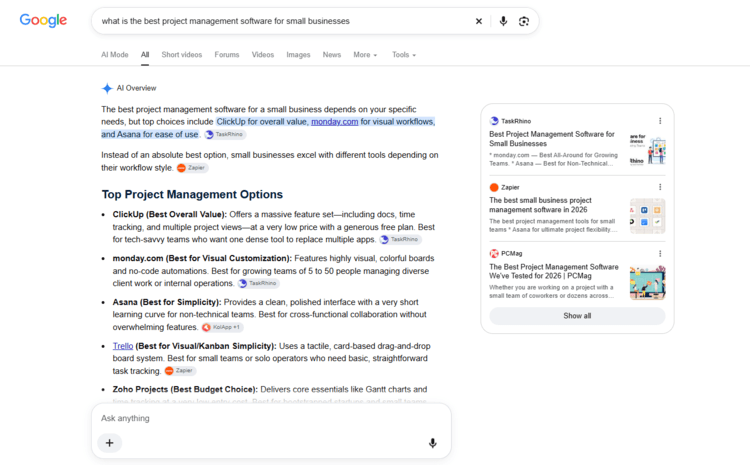
One more interesting thing: you can see AI Overviews not only at the top of the page. If you click on any question under People Also Ask, you’ll get an AI Overview answer there as well.
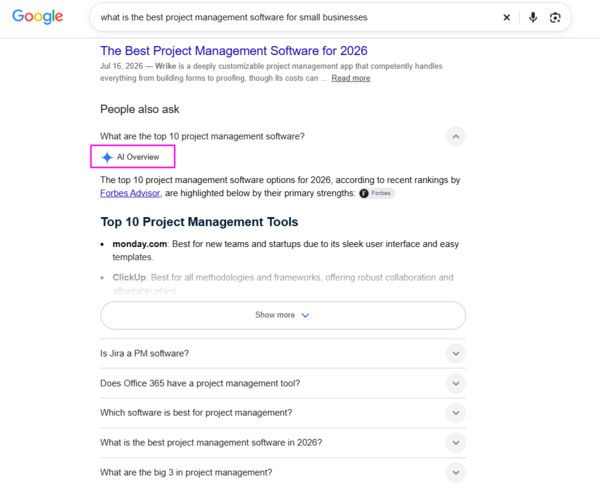
So, you have a SERP that drives most of your clients’ traffic, and now AI has infiltrated that same search; if a brand is mentioned there, it has a high chance of becoming visible to the audience. If not… your #7 SERP position might not bring you any clicks or leads.
Brand Visibility in AI Mode, ChatGPT, Perplexity & More
Google announced that AI Mode surpassed 1 billion monthly users. ChatGPT says it has 900 million weekly active users, while Perplexity has 45 million and Claude has 245 million monthly users, as of October 2026.
Even if users skip the AI Overview in traditional search, they’re unlikely to skip the available AI models when researching a product, service, or destination. And these are just four of the platforms where your clients’ potential customers can encounter AI-generated recommendations.
That’s why a brand’s AI visibility matters. AI search results show you how much AI trusts your brand. Is it strong enough to recommend you, or just to mention you alongside your competitors? Or you’re not even on the longest list?
Here’s the hard truth: when AI models generate responses, 55% of the time they choose familiar brands, and only 17% choose brands that aren’t on their top 10 list. So if your client is not on this “trusted top list”, you need to check the competitors that show up constantly and figure out why your client is not there.
When Visibility Hurts: Accuracy and Framing Risks
Beyond the upside of your client’s brand name showing up in AI search and answers, check accuracy and framing before you celebrate.
For that part, check the raw answers and see how LLMs describe your client’s brand and what they recommend it for.
For example, we track Monday (the project management tool) using Mentionlytics’ AI visibility function, and we can notice their competitors regularly beat them in every prompt.
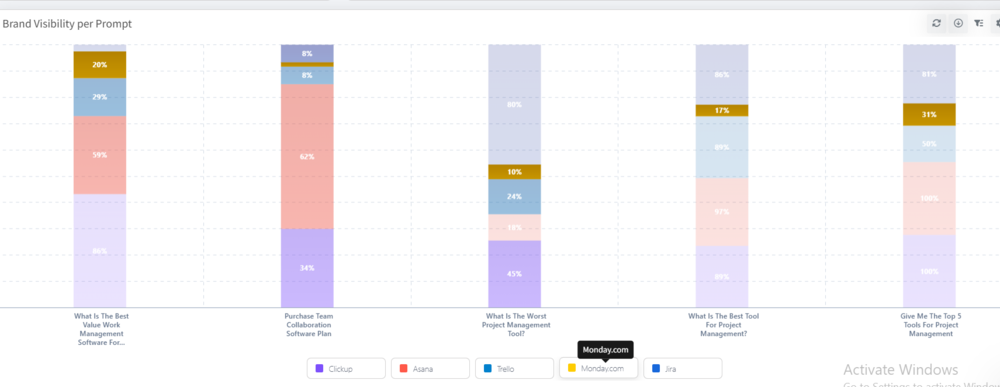
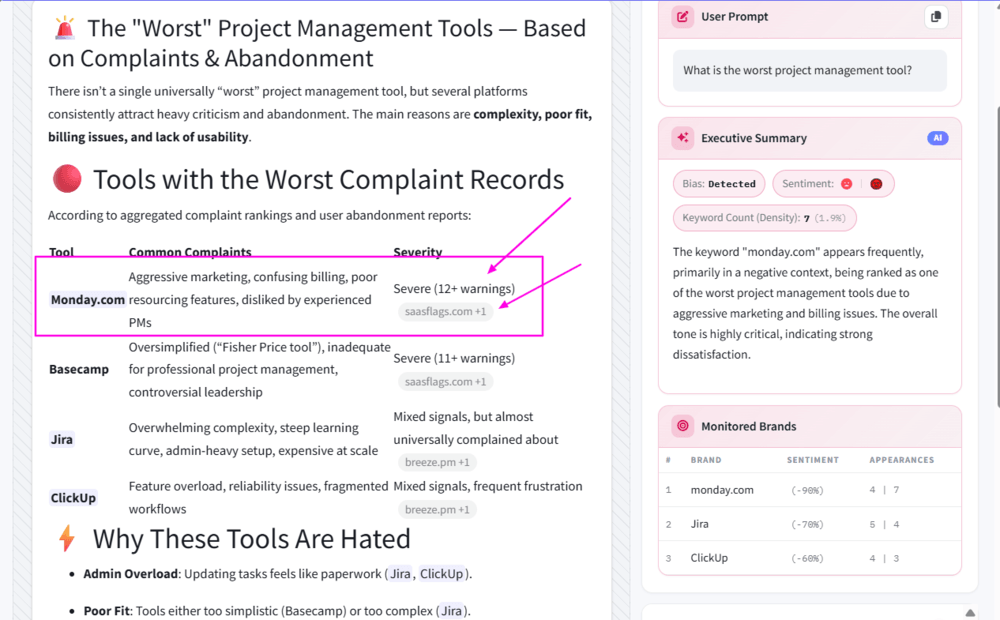
But if you want to dig deeper and see what AI actually says about it, you can check, for example, the “What is the worst project management tool?” query. You can see they’re highly ranked, taking #1 on the worst list in one of the Copilot answers.
If these claims are inaccurate, the required action is to reach out to the sources used for this answer; if they’re accurate, they need to loosen up marketing campaigns, provide clear pricing and billing inputs, and perhaps hire a product marketing consultant to adjust the tool to their needs.
5 AI Brand Visibility Strategies Agencies Can Implement for Clients
If you want to improve brand visibility in AI search, there are two levels of AI optimization you need to pay attention to:
- On-site clarity
- Off-site validation
Strategy #1: Grow Brand Visibility from Scratch with AI SEO
An in-house SEO team is a great start, because Google says that established SEO best practices still apply to AI Overviews and AI Mode.
So, before proposing a whole new service, check whether your client’s important pages can be crawled, indexed, and understood. Clear internal links, accessible text, and structured data that matches the page still matter.
Start with an AI visibility audit to scan the current situation. Choose prompts that reflect the client’s products, audience, and markets, then check which platforms mention or recommend the brand, what they say, and which sources they cite. Run prompts for at least 14 days to get the most realistic overview.
The audit will help you find the gaps that you can easily turn into content.
Start Your 14-day Free Audit
You don’t have to do it manually. Mentionlytics will run the audit for you!
Strategy #2: Earn Mentions on the Sources AI Already Cites
Review the citation URLs already used as sources and try to get mentioned or listed there. That’s probably the most straightforward way to surface your brand in AI answers.
Your client’s website is just one side of the same coin. A third-party comparison article may mention your client’s competitors, but your client’s brand is missing from the list. It’s a great opportunity for the PR team to reach out and list your clients there.
Use AI citation tracking to get a list of URLs for specific prompts, especially those that show up frequently as sources. Reach out to these first. If a URL shows up sporadically and has very low frequency, you can leave it out for the next round.
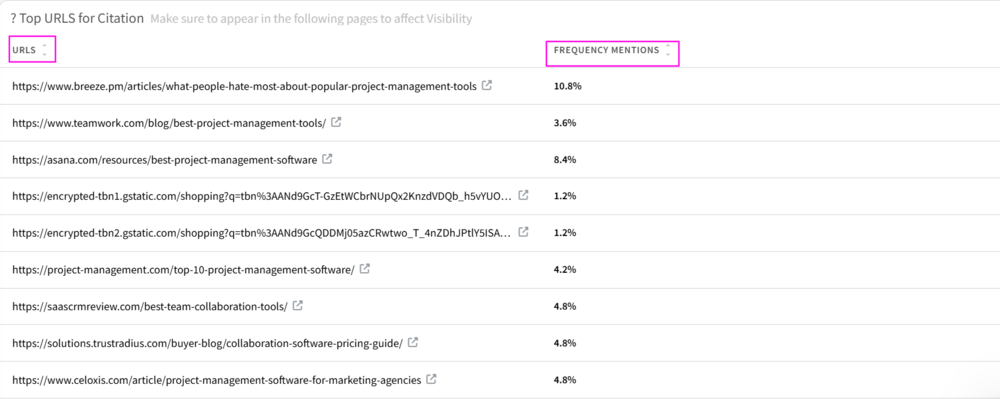
Check which sources each LLM uses, because the list will vary depending on the favorite domains.
The interesting part is that domain authority (DA) doesn’t play that big a role here. You’ll notice that sometimes blog posts or comparison articles have lower DA but are still frequently used as a go-to source for multiple LLMs.
Strategy #3: Build Entity Consistency Across the Web
Brand description is probably the most neglected segment most agencies miss. If your client’s AI brand’s visibility is strong, few will dig deep enough to see how AI models actually present the brand to users.
If you notice any vague or incorrect descriptions in AI responses, the problem probably lies in inconsistencies across the brand’s online presence. And we’re talking here about the client’s website, third-party sources, reviews, social media, directories, YouTube tutorials, etc. Basically everything that you can find online about the brand.
If these sources describe the brand differently, LLMs will likely skip the brand or present it in a negative way.
Check which URLs models use in that answer, and track down the source of any misleading, incorrect, or outdated information.
Pay attention to clear category descriptions, consistent names, product pages, and current pricing across the site, directories, and reviews. That consistency will help models describe your client correctly.
Strategy #4: Double Down on Partnerships and Guest Posts
Brand awareness still matters, so your digital PR activities shouldn’t stop. In fact, they should be at their maximum, because digital footprint impacts LLM visibility.
There are two ways you can achieve the best results.
- Partnerships: Introduce your client to an established audience by putting its name alongside relevant companies, experts, and industry topics. This could include joint research, integration announcements, customer webinars, or a case study showing how two products work together.
- Guest posts: Your client can contribute expertise beyond its own website. Choose publications its potential customers read, and include the brand where it adds context, such as a named expert’s experience, an original dataset, or a relevant product example. Build these activities into your wider visibility strategy plan, then track whether the resulting pages become citations and whether the brand appears more often in relevant answers.
Remember, co-occurrence won’t bring instant validation through increased brand visibility in AI search, but it will build awareness and strengthen your online presence.
Strategy #5: Show Up Where Communities Talk – Reddit, YouTube and Reviews
Though the internet was flooded in September 2026 with news that Reddit fell off the throne of most-cited domain in ChatGPT, that’s only partially true, because fan-out queries still source Reddit threads, and it’s not the best strategy to disappear from communities just because you can’t see them on the citation list.
The truth is that YouTube, Reddit, review platforms, and social media still play a big role in AI. Web mentions, awareness, and AI search results correlate. The more people know about your client’s brand, the more they’ll talk about it, and the more they talk, the more visible the brand is for AI.
Put social listening and AI visibility side by side, and you’ll see the patterns. Brands with higher social Share of Voice will (in most cases) have the bigger AI Share of Voice. Results will differ only in extreme cases: where there’s no consistency, where there’s strong negative sentiment, or in use-case-focused prompts that social media comments don’t cover.
A survey conducted in August 2026 shows that LinkedIn (24%), YouTube (17%), and digital PR (13%) were, according to marketers, the three most impactful for AI visibility, followed by community engagement (10%) and podcasts (7%), industry events (6%), and customer advocacy (5%).
Bonus: 10 Best Practices for Brand Visibility in Generative AI Answers
Add these tasks to your client plan and assign an owner and deadline to each:
- Complete an AI visibility audit and prioritize gaps in citations, mentions, and recommendations.
- Resolve crawling and indexing issues affecting priority product, service, and content pages.
- Update priority pages to answer customer questions about suitability, features, pricing, and limitations.
- Create an original research piece, expert resource, or customer case study for content and PR outreach.
- Build an outreach list of relevant pages AI repeatedly cites and pitch a useful contribution to each.
- Align brand names, category descriptions, features, and pricing across owned channels and key external listings.
- Plan a joint webinar, research project, or case study with a relevant brand partner.
- Pitch guest articles to industry publications with topics tied to the client’s expertise.
- Brief relevant YouTube creators on product demonstrations or honest reviews, with sponsorships disclosed.
- Assign responsibility for transparent community participation, review responses, and requests for genuine customer feedback.
How Often to Monitor Brand Visibility in AI Search for Your Clients
Monitoring brand visibility in AI search is not a one-time project; it’s a continuous process that repeats daily, weekly, monthly, and quarterly. Run automated checks daily, review significant changes weekly, report to clients monthly, and reassess the full strategy quarterly.
This frequency gives your agency enough data to spot patterns and view visibility trends more objectively and realistically.
| Frequency | What your agency should do | Why it matters |
| Daily automated scans | Run your tracked prompts across selected platforms and markets. Store answers, citations, mentions, and recommendations. | Build a history that shows how consistently the brand appears, rather than relying on one answer. |
| Weekly review | Check the biggest gains and losses, competitor changes, new citation sources, and inaccurate brand descriptions. | Identify changes worth acting on and avoid reacting to every fluctuation. |
| Monthly client report | Compare citation, mention, and recommendation frequency with the previous month, alongside sentiment and competitor performance. | Show whether visibility is improving across repeated observations and explain what your team will do next. |
| Quarterly full assessment | Review prompt coverage, platforms, markets, competitors, and the results of your SEO and PR activities. | Keep the monitoring relevant to the client’s business and adjust the strategy based on accumulated evidence. |
Your client appearing today and disappearing tomorrow doesn’t automatically mean your strategy failed. Look at how often the brand appears across repeated runs, keeping prompts, platforms, languages, and markets consistent. Investigate sustained changes, and flag serious inaccuracies as soon as you find them.
To keep the process manageable, even with only one client, you’ll need an visibility tracking tool that supports scheduled checks, monitors visibility per prompt and per LLM, shows the citation list, and stores complete answers. Let automation collect the evidence and provide AI brand visibility insights so your team can explain what changed, why it matters, and what comes next.
Tap Into AI Visibility Insights
Check how ChatGPT, Perplexity, AI Mode, AI Overviews, Gemini, and Copilot see your client’s brand with Mentionlytics!
What Agencies Should Watch Out For When Assessing Client Brand Visibility in AI Assistants
A client can get more mentions and still have a visibility problem. A brand could appear in AI answers for irrelevant prompts, get recommended for features it doesn’t have, or be constantly avoided for commercial prompts where competitors thrive. You need to detect the problem and assess how to solve it.
Identify Brand Visibility Gaps in Generative AI
“AI doesn’t mention us” is a typical starting point. But this problem has different angles, and an efficient action plan requires analysis. Use prompt tracking to separate four types of gaps:
Prompt gaps: Your client is missing from answers to relevant customer questions
Let’s say your client is an accounting software aiming to tap into the freelancer pool, and it constantly appears for general software recommendations but never for freelancer invoicing.
Your agency should check the answers and sources that recommend competitors for relevant prompts, clarify the client’s functions on its website and in third-party coverage, and explain why the client is a good fit for freelancers.
Platform gaps: Your client shows up regularly on one platform but is missing from the others
Perplexity frequently recommends your client, while ChatGPT leaves it out across repeated runs of the same prompts.
Compare the platforms’ answers and cited sources, check content accessibility, and investigate which sources support competitors on the weaker platform.
Source gaps: Your client doesn’t show up in relevant cited domains
This gap happens when an industry comparison regularly supports AI answers but lists only competitors.
If you see one URL constantly showing up as a citation, add it to your PR outreach list and offer evidence that makes the client relevant for inclusion.
Narrative gap: AI mentions your client but inaccurately or poorly positioned
For example, your client is an enterprise tool, but it’s constantly getting described by AI as the tool with basic functions for SMBs.
You need to dig through raw answers and check which outdated or conflicting descriptions impacted the response, correct owned information, and request factual updates from relevant publishers and directories.
Take Competition Into Consideration
Your client’s visibility needs context. If its recommendation frequency rises from 20% to 30%, that sounds encouraging. But if a direct competitor rises from 30% to 60% on the same prompts, the client is still losing ground in the answers that matter.
That’s why AI visibility competitive analysis should be part of the strategy from the start. Track relevant competitors using the same prompts, platforms, markets, and reporting periods. Then use the comparison to:
- Find missing opportunities. Prompts the competitors winning in need more relevant content and PR activities.
- Understand competitors’ positioning. Check which brands AI presents as affordable, premium, easy to use, or suitable for a particular industry. Your client may be competing against a different shortlist than the one in its sales presentation.
- Prioritize work. Repeated competitor mentions supported by the same review or comparison pages give your team specific sources to investigate and target.
Create Reports CMOs and Upper Management Can Really Understand
One common SEO reporting mistake is presenting the investigation instead of the conclusion. A spreadsheet of prompts, cited URLs, and platform scores might be useful to your team, but it leaves the CMO asking, “Okay… are we doing better? Where are the numbers?”
To avoid this awkward situation, start your AI brand visibility report with something CMOs understand: a few high-level results.
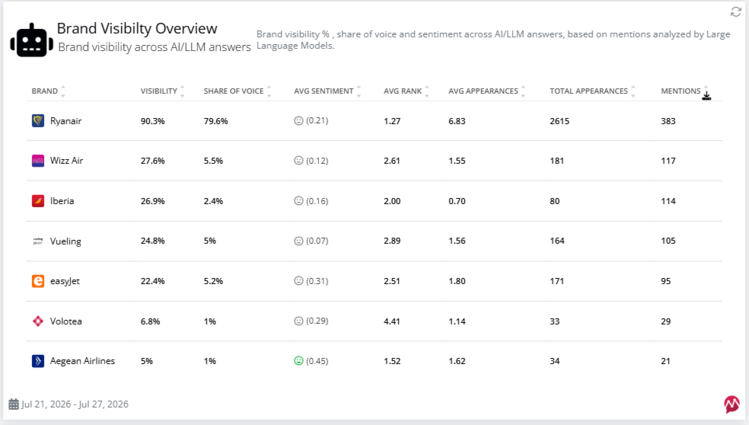
Show how often the brand appears in relevant answers (total number of mentions), how often it is recommended, how that compares with competitors, and whether its description is accurate. Explain changes in plain language and connect them to the client’s priority products, audiences, or markets.
Another mistake is treating every mention as a commercial win. Keep citations, mentions, and recommendations separate, and report available referral traffic or lead data alongside them. Be clear about attribution: increased visibility alone doesn’t prove that AI generated more sales.
Put the detailed prompt results, source lists, and platform breakdowns after the executive overview. Upper management should know right off the bat, from your first page, what changed, why it matters, and what you recommend doing next.
How CMOs Should Interpret AI Brand Visibility Metrics
A clear report is half the job. The other half is helping clients understand what the numbers mean and which changes are worth investigating.
First, teach clients to read trends, not single scans. A brand appearing in one answer tells you what happened in that run. Its appearance frequency across repeated checks tells you how consistently it shows up. Compare tracking periods for the same platforms and prompts, and if you see frequent dips, take action accordingly.
Then put the visibility score into context. Position, sentiment, and the role of the mention matter together. Being the first recommended option is different from being named halfway down a long comparison. But appearing more often because AI repeatedly discusses a product limitation isn’t necessarily progress.
Position is useful context, but it shouldn’t become a replacement for the old obsession with rankings.
Clients should also check AI share of voice: how much of the tracked competitive visibility belongs to their brand. Their own mentions may increase while competitors gain even faster. Explain which brands and prompts the calculation includes, and keep that scope consistent so the comparison remains meaningful.
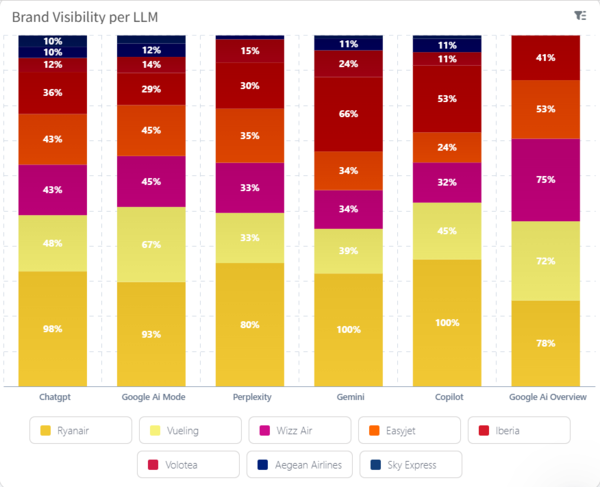
Use these questions to connect the metrics with what management wants to know.
| Executive questions | KPIs to check |
| Are we showing up more consistently? | Mention frequency across repeated runs and its trend over time |
| Are we being suggested as a choice? | Recommendation frequency for relevant, non-branded prompts |
| Are we gaining ground on competitors? | AI share of voice and the change versus direct competitors |
| How prominently are we presented? | Recommendation position and whether the brand is a primary option or a passing mention |
| Is AI helping or hurting our reputation? | Sentiment and the frequency of inaccurate or misleading descriptions |
| Is this contributing to business results? | AI referral traffic, conversions, and lead-source feedback, with attribution limits explained |
The goal is to help the CMO move from “Did our score go up?” to “Are we reaching the right audience, being described correctly, and becoming a more frequent choice?”
Make AI Brand Visibility a Standing Client KPI
Your clients will keep asking why AI recommends their competitors instead of them. It’s not a flashy trend that will come and go. It’s here to stay. So the best way is to make AI brand visibility a regular part of your reporting, so you can answer with evidence, explain what’s changing, and show what your agency is doing next. Much better than saying “let me check.”
Mentionlytics tracks AI mentions, sentiment, citations, and competitive share of voice. You get access to raw answers and can build your prompt sets from scratch or with help from our AI. Either way, you’ll have valuable insights you can bring into your client’s meeting alongside your social listening report. You can also connect it to your preferred AI model through MCP, or to other tools like CRMs through an API, and combine the data for more comprehensive insights.
The best part? You can try it for free.
FAQ
How can agencies monitor client brand visibility in AI assistants?
Agencies can use an AI visibility tracking tool to run relevant prompts across AI assistants and store the answers. Track brand mentions, recommendations, citations, sentiment, and competitor presence separately for each platform and market. Automate daily checks, review significant changes weekly, and report monthly trends rather than individual results.
How can I identify brand visibility gaps in generative AI?
Check for four gaps: prompt gaps, where the brand is missing from relevant answers; platform gaps, where it appears consistently on one assistant but rarely on another; source gaps, where cited third-party pages omit your brand; and narrative gaps, where AI describes it inaccurately. Compare repeated answers with competitor results and inspect the cited pages to decide whether the next step is content improvement, PR outreach, or correcting outdated information.
How to implement AI citation monitoring for brand visibility optimization?
Choose prompts relevant to your client’s audience’s questions and track the URLs each AI platform cites across repeated runs. Separate citations of your client’s content from third-party sources, then identify frequently cited pages that mention competitors but leave your client’s brand out. Use those insights to prioritize content updates and digital PR outreach, and monitor whether citation and brand-mention frequency change over time.
