


You’re reading tons of research, scrolling Reddit for new GEO advice that could miraculously bring back traffic, and you don’t see any improvement. Well, maybe… You forgot the first step in a proper optimization process: the AI visibility audit!
People are using ChatGPT, Claude, Gemini, and Perplexity in their discovery phase, and if you’re not showing up in the answers, you’re invisible to them. But to improve your AI visibility, the first thing you need to do is scan your current situation.
The thing is, if you have no idea where you are, how would you know what you need to do to improve? Let’s call that diagnostic. You need to check:
- AI presence, a.k.a. how often AI models mention your brand.
- AI share of voice and what that looks like compared to your competitors.
- What is the sentiment in these AI answers? Are models talking about your brand positively, negatively, or are they neutral?
- Are the answers presenting accurate facts? Is it true what these models are saying about your brand?
- What sources have been used for the answers? What citations show up, and what forums, blog posts, news, or influential voices impact the responses?
- Is your website technically ready for AI to read it? I mean clear heading structures, answer-first content blocks, entity schemas, and agent-discovery files.
In this article, we’ll walk you through the whole process and show you the best way to run your first (crucial) free LLM visibility audit.
Table of Contents
What Is an AI Visibility Audit?
AI visibility audit is a process of checking up on a brand’s AI presence, the sentiment in the AI answers around the brand, the context it’s mentioned in, accuracy, and how often AI engines cite or recommend the brand compared to competitors.
The statistics show that social media is still the #1 channel where buyers discover a brand, followed by friends, traditional search, and (surprise, surprise) LLMs. And in a time when LLMs hold 4th place on this scale, with 16% of the share, and considering the fact that their impact is constantly growing, it’s obvious that you need to audit this channel as well.
On top of that, PwC research shows that, for example, 94% of B2B buyers use LLMs in the buying process.
What does an AI visibility audit measure?
AI visibility audit typically measures AI presence. AI share of voice, sentiment, accuracy, and AI citation analysis. And it’s a process that takes time. It’s not something you do once, and then you’re done.
AI models use Retrieval-Augmented Generation (RAG), meaning their answers are probabilistic and will vary. To get the right data for your audit, you need to invest at least 14 days to scan the environment and then analyze the results.
Is an LLM visibility audit the same thing?
LLM visibility audits and AI brand visibility audits are basically the same thing, used by two different roles: marketing and SEO/GEO (since the SEO/GEO consultants and agencies started using this term).
Yes, you might find slightly different points of view from an SEO/GEO perspective (wanting to find what impacts search results, AI responses, and the whole mechanism running behind the query) and a marketing perspective (wanting to see results through share of voice or an AI brand visibility score).
But these two terms describe the same process, and since both are relatively new, there’s basically no distinction between them.
AI Visibility Audit vs Traditional SEO Audit
The LLM visibility audit process is similar to a traditional SEO audit, where you would check the keywords your webpages show up for and scan for blue links and see if they bring any traffic, or if they show up on a spammy website and do more harm than good. In SEO, you check keywords; in AI, you check your brand mentions; in SEO, you check backlinks; in AI, you check citations; in SEO, you check link health; in AI, you check sentiment and semantic context. And as you can see, it’s all about how your brand is presented in the specific environment.
But these two processes differ in four particular ways:
- You’re scanning a different environment.
- You’re measuring and analyzing different things.
- The LLM environment is much faster-changing and needs more frequent scanning.
- Each LLM or AI search engine has its own rules that it follows when citing or recommending.
| Audit Area | Traditional SEO Audit | AI Visibility Audit |
| Environment | Search engine results page (SERP): Google, Bing | AI-generated answers throughout LLMs and AI search engines: ChatGPT, Perplexity, Gemini, etc. |
| Unit metric | Keywords, rankings, backlinks | Prompts, complete AI answers, citations, and recommendations. |
| Accuracy and sentiment | Usually not a core part of the audit | Essential part of the audit, checking accuracy and whether the brand is presented positively, negatively, or neutrally in the answers |
| Primary metric | Keyword tracking, organic traffic, impressions, and clicks | Brand mention rate, AI share of voice, sentiment, citation presence |
| Geographic analysis | Country, region, language, device, and local rankings | Differences for different countries, markets, and languages |
| Source analysis | Backlinks, referring domains, competitors’ ranking pages, link quality, and authority | URLs and domains cited in LLMs’ answers and raw answers |
| Frequency | Weekly or monthly | Daily |
Before You Start: What You Need to Run a Free AI Visibility Audit
So, before you opt for the tool and start running your AI visibility audit, here are some things you have to do prior to it:
- Define scopes and targets: determine what markets you want to scan, what competitors you want to be compared with, and what platforms you want to check.
- Build a prompt library: for what prompts you want your brand to show up in the answers, and what prompts you should track to get the best insight on how LLMs perceive your brand. You can use questions people ask on forums (like Reddit), from Google Search Console, sales calls, or tickets, to align as much as you can with what people genuinely ask. Group those questions into categories (branded, conversational, informational) so that you can see the results for each group separately.
- Check your website for AI crawlers to confirm that, from your side, the website is ready to go and AI models can crawl and read it. Check structure, FAQs, product and review schema, and other technical factors that might block your AI search visibility.
How to Run an AI Visibility Audit with Mentionlytics
Mentionlytics offers a 14-day free trial for its dedicated AI brand visibility platform, which is ideal for your first scan. It gives you enough data and insights to run your AI engine optimization afterward.
Step 1: Define What You’re Auditing
So, what do you want to audit? Is it your brand, or is it a specific product? Because these two are separate things. AI models might phrase your brand in general, but your specific product might end up on a list of “the worst products for XX“. To get the most accurate results, know from the start what you want to focus on, and cluster your prompts so you can filter for what you want to focus on.
The same goes for the AI platforms. Choose the platforms that matter most. You don’t need to run an audit for DeepSeek if your target audience doesn’t use it, or if you see that LLM traffic isn’t coming from that direction. But if you don’t know which platforms to choose, rely on statistics and scan the ones your target audience’s industry is using.
For example, a specialized digital marketing and AI discovery agency, Pervisible, had an interesting study last year that shows that ChatGPT drives 84% of discovery traffic, but it’s a broad one; for a more focused approach, you should take into consideration some other LLMs as well.
| Finance | Copilot, Perplexity, Gemini |
| Education | Copilot, Claude |
| SaaS | Copilot, Claude, Gemini |
| Publishers | Claude |
| eCommerce | Gemini |
And lastly, select your competitors. You can use the ones you already know are competing in your niche, but you can also check which competitors show up for the prompts that matter most. You might be surprised, because sometimes it surfaces brands you haven’t even thought about. If they already show up in the answers, make sure to include them on your list.
Step 2: Build a Prompt Set That Reflects Real Buyer Language
Slight variations within prompts can change outcomes and audit findings, so pay close attention to your prompt set.
So, you’re looking for a set of 15-30 prompts that real buyers could use during the discovery and evaluation phase. You don’t want to audit for questions no one asks or that rarely appear in AI search. The easiest way is to follow some simple rules, such as:
- Use the language your customers use. Don’t overpack your prompts with industry terms if your audience doesn’t use them. You can use a social listening tool to check how people talk about your niche on social media, or you can easily find out by going through your sales calls and tickets.
- Cover all the stages of the customer journey. There’s a huge difference in the type of questions potential buyers could ask depending on the stage they’re in. For example, people who don’t even know that there’s a solution to their problem might ask, “How can I do an AI visibility audit for brands“, whereas those who are almost at the final stage may ask, “How reliable is XX (your brand) tool?”
- Include prompts for a specific use case. If you know your target audience, make sure to write prompts that include their use cases. For example, “What is the best social listening tool for marketing agencies with multiple clients?” Don’t be afraid to use extensive sentences because LLMs will use their knowledge about the user and take it into consideration when replying.
- Combine branded and unbranded prompts. Unbranded prompts show you where your brand stands in terms of the brand’s AI visibility, and where it enters the conversation naturally. Branded prompts show how AI sees and presents your brand to the audience, and they’re best for checking accuracy.
- Write prompts in the language of your target market: The same prompt written in different languages may produce different responses. Research shows that language affects the answer, reasoning accuracy, and LLM performance. Differences in training-data representation may contribute, but they may not be the only explanation.
If you find this challenging, you can always use suggested prompts from the best AI visibility tools, based on your industry and niche.
Find Out the Best Prompts for Your Brand
Take your chance with Mentionlytics prompt suggestions, and see how your brand appears in the Google AI Overviews, AI Mode, ChatGPT, Perplexity, Copilot, and Gemini.
Step 3: Run Your Prompts But Give It Time
Once everything is set, run your prompts across generative engines and review the results. But don’t jump to conclusions after the first run; you will need to run prompts daily for a while to confirm consistency and collect enough data to conduct a thorough LLM brand visibility audit.
Step 4: Score Presence, Prominence, Sentiment, and Accuracy
Once you’ve run the prompts and collected enough data, check your brand’s presence, prominence, sentiment, and accuracy. The main reason to audit your brand’s AI presence is to increase AI visibility and drive more traffic and leads. You can do that by removing obstacles, and obstacles are hidden somewhere within these metrics.
Presence: How many times does your brand show up in the answers?
What pages from your website does AI use as citations, and how frequently? You can check them through the Brand Visibility Score, AI Brand Visibility change over time, Number of mentions, and Citation chart.
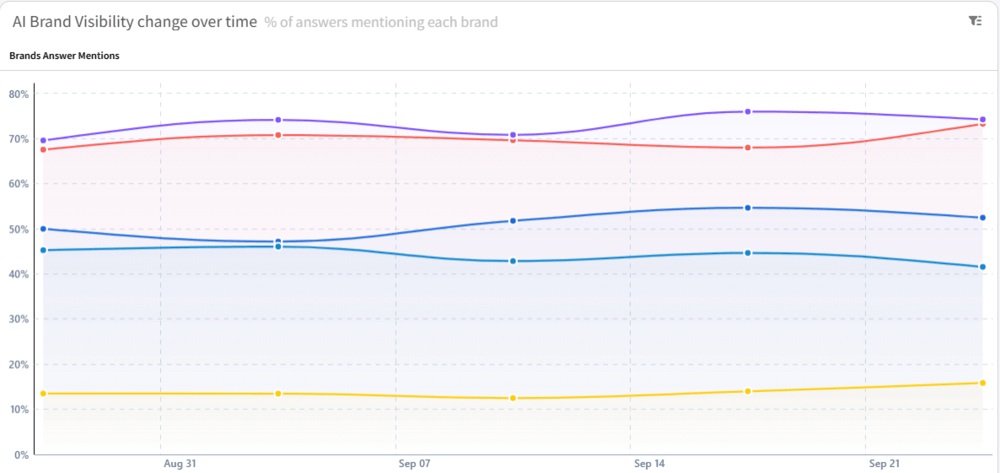
For the most accurate results, exclude branded prompts, then check the results, because they will increase your brand visibility but won’t reflect the real situation.
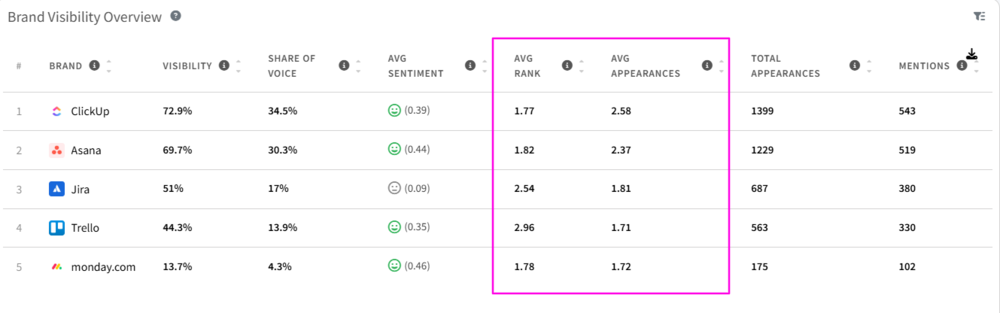
Prominence: If your brand is recommended, what position is it taking?
Is it the first, second, third, or fourth option? You can check it through Brand Visibility Overview (Average Appearance and Average Rank).
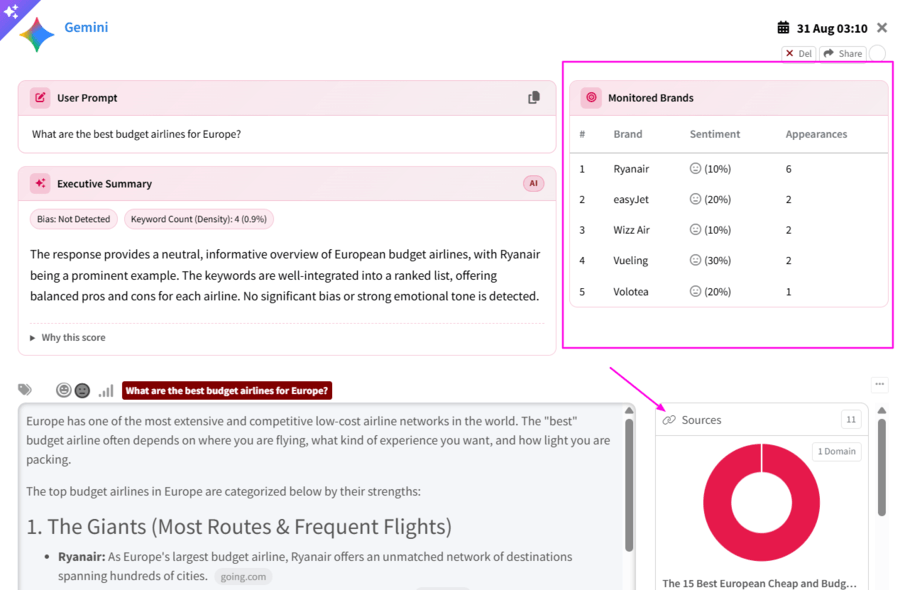
Sentiment: Do LLMs describe your brand in a positive, negative, or neutral light?
The more positive the score, the higher the chance of getting more traffic and leads from LLMs. Review answers with negative or neutral sentiment and see which sources LLMs retrieve when answering these prompts.
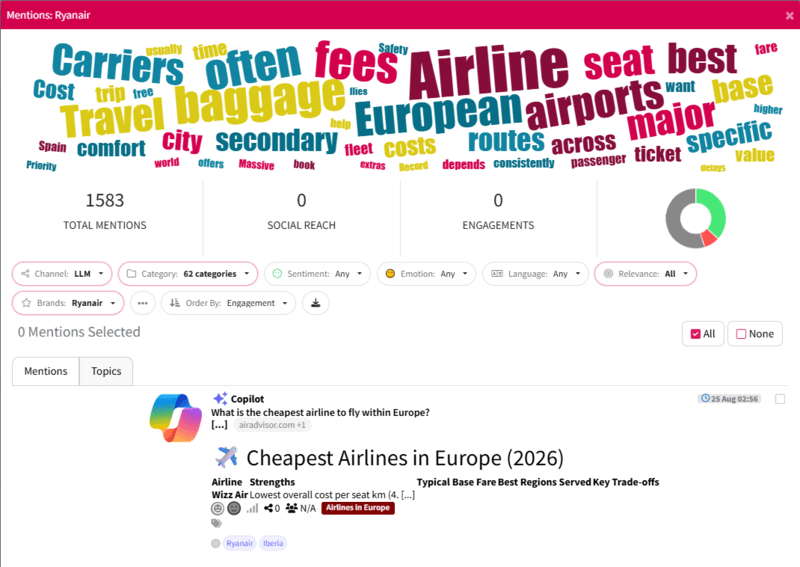
Accuracy: How does the LLM describe your brand?
Does it have relevant data? Does it pull relevant and up-to-date sources? Inaccuracy can happen with both branded and unbranded prompts, so it’s a good idea to check them both, starting with branded ones.
To find a source of inaccuracy, check the raw answers and see if anything suspicious appears. It could be an outdated product page, an incorrect price, or a feature description.
Step 5: Map the Sources Feeding the AI Answers
Check which source domains feed the AI answers, and you will find domain influence varies by LLM. For some, the primary source will be Reddit, while some LLMs won’t have it in the citations at all.
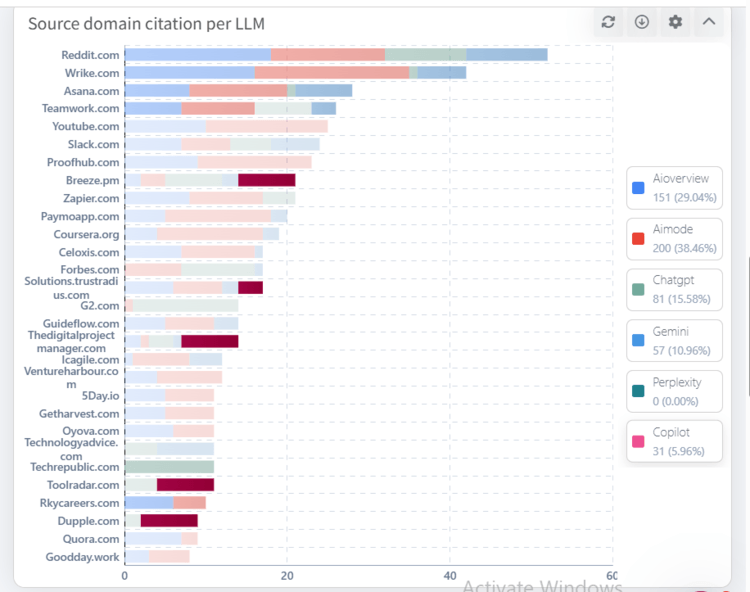
Then check the citations tab, pull every cited URL, and categorize it by three criteria:
- Ownership: Brand-owned, competitor-owned, independent third-party.
- Source category: Is it your website or your competitors’, news and industry publications, social platforms, comparison and review platforms, marketplaces and retail pages, forums, or a knowledge base like Wikipedia?
- Content type: Is it a listicle, review, product pages, comparison articles, directory listings, news articles, video, blog post, research paper, community thread?
Remember, the citations users see in ChatGPT, Gemini, or any other LLM are only part of the LLM’s research process. LLMs run fan-out queries in the background when you run a prompt, and these hidden processes might influence the answer.
You’ve probably had a situation where ChatGPT recommended your competitor instead of you, even though your brand was on the listicles that showed up as a source. The problem is that the research goes wider and deeper than we think. It connects what users are saying about your brand, your review scores on review sites, and what training material they were fed. The training material changes because model updates happen every six to 12 months.
So you need to pay attention to these conversations happening online, which, without an accurate social listening software, you can’t grasp or correct.
You cannot inspect private conversations between users and AI platforms. But you can analyze online conversations where buyers express the same questions, preferences, complaints, and misconceptions they are likely to bring into AI search. Make sure you track:
- Your brand, product names, and common misspellings
- Competitor names and comparison phrases
- Founders, executives, or other people strongly associated with the brand
- Category terms and relevant use cases
- Questions people ask before choosing a product
- Recurring complaints, objections, and feature requests
- Claims about your pricing, reliability, customer service, or product capabilities
If you see negative sentiment around a specific topic, product, or your brand in general, investigate what is driving it. Join conversations, reply to negative reviews, correct inaccurate claims, and show customers you are listening.
Now, sometimes the source of inaccurate information is a third-party website, platform, glossary, or listing. And in these cases, you have to contact the author or publisher and ask for correction. If you have more than one sources that imply something that’s not quite true, then prioritize:
- Frequently cited sources
- URLs that rank high in SERP
- Sources with high traffic or engagement
- Errors that could affect buying decisions
If that incorrect information starts showing up on multiple third-party sources, publish the correction or explanation on your website as well. Update the relevant product pages, pricing pages, documentation, FAQs, and structured data so the correct information is easy to find and verify.
Step 6: Check Whether AI Can Reach Your Content
This is a technical part of generative engine optimization (GEO), which some call AI searchability, and its goal is to make your content accessible for AI.
So, what you need to do is check the following things on your website:
- Do you have a robots.txt file, and do you allow each AI search engine to have access to your website?
- If you use third-party software solutions, do they block AI crawlers by default?
- Do you have schema markup? (especially for FAQ page schema)
- Is the most important information in the HTML format? Don’t put it behind JavaScript.
Note: Don’t forget that ChatGPT uses two types of bots for two purposes:
- OAI-SearchBot is for search.
- GPTBot is for crawling content that may be used in training its generative AI foundation models.
Step 7: Benchmark Competitors and Build the Action Plan
Your brand appears in AI answers alongside your competitors. Check which of them show up most and how often AI answers recommend and cite your brand versus theirs. AI Share of Voice can tell you that.
You can do it manually by dividing your total number of AI mentions by the total number of category brand mentions across a defined set of prompts, then multiplying by 100. Or use an AI visibility tool to calculate it automatically.
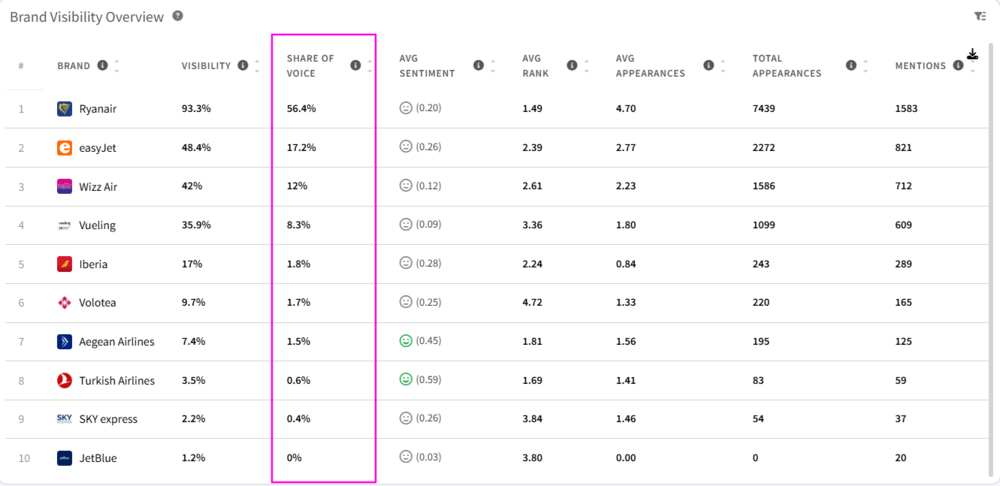
The best option is to check how you stand against your competitors prompt by prompt, and when you spot the gap — prompts where your competitors appear and not you — pay special attention to that. Check the sources (citations) used for that specific prompt and inspect them. See if your brand is listed or mentioned there and take action.
The easiest way is to sort your findings into three groups:
- Fix: Correct the inaccurate, incomplete, or outdated information that causes AI answers to position your competitors more favorably.
- Build: Create content for the prompts, topics, use cases, and comparison criteria where competitors appear, but your brand is missing.
- Influence: Target the third-party sources that mention or recommend your competitors but overlook, misrepresent, or exclude your brand.
How Often to Re-Run Your AI Visibility Audit
Because the LLM environment changes so quickly, an AI visibility audit is an ongoing process you should run about every 30 days if you actively invest in GEO, or quarterly if you’re putting less effort into this strategy.
A monthly audit should show you whether your brand has been recommended and cited in AI more than it used to be before you implemented a series of changes.
Use the same core prompts, AI platforms, locations, languages, and settings each time so you can distinguish genuine progress from a different test wearing the same name.
Start Performing Your AI Visibility Audit Now for Free
Do you have a list of prompts but haven’t tried running them all? Of course you can do it manually, but repeating dozens of prompts across AI engines and recording every mention, recommendation, competitor, sentiment, and citation can break your spirit in the blink of an eye.
That’s why the easiest option is to use Mentionlytics’ 14-day free trial. During this period, you can collect enough data for your first audit, and it’s free. You don’t need a credit card, a contract, a demo, or anything else.
It’s time for your LLM visibility audit; check your brand’s presence across AI Models and gain valuable insights!
FAQ
What are the most reliable AI visibility audit providers?
Reliable AI visibility audit providers are Profound, Scrunch, Mentionlytics, Peec AI, and many more. You need to look for a tool that provides transparent methodology, complete AI answers, timestamps, prompt-level results, competitor benchmarking, citation analysis, sentiment, and separation by AI platform and market.
What are the best AI visibility audit tools for B2B companies?
Mentionlytics is a strong choice for B2B companies because it combines AI visibility tracking with social listening, allowing brands to connect what LLMs say with the wider online conversations that may influence those answers. Profound and Scrunch suit enterprise teams, while Ahrefs is useful for companies that want AI visibility within a broader SEO toolkit.
How do I perform an AI visibility audit for my brand?
Set clear objectives, select the AI platforms and markets that matter, and build a representative set of buyer prompts (both branded and unbranded). Run each prompt several times, record your mentions, recommendations, sentiment, accuracy, competitors, and citations, and check whether AI crawlers can access your content. Turn the findings into Fix, Build, and Influence actions, then repeat the audit using the same setup to measure progress.
