

It’s the Wild West out there when it comes to AI visibility tracking tools. Everywhere you look, there’s at least one feature in most marketing tools that tracks, optimizes, or checks your visibility in AI answers. Finding the right tool for your business or agency can feel like a nightmare.
With at least 50 tools out there that offer AI brand visibility checkups, I tested most of them, and in this article I brought the best AI visibility tracking tools right to your doorstep. I’ll be as objective as possible with this list, because you all know I work for Mentionlytics; I’m used to its dashboards and features, and for the other tools, I tried most of them for the first time.
I used seven criteria to build the list and clustered them by team size; on a separate list, I included SEO tools that have expanded into LLMs and AI search engines.
Table of Contents
- 7 Criteria I Used to Assess Every AI Brand Visibility Software Option on the List
- Best AI Visibility Tools at a Glance: A Fair Comparison Table
- Best AI Visibility Tools for Brands That Also Need Social Listening
- Best LLM Visibility Tools for Enterprise Teams
- Best Lightweight Tools for Tracking LLM Brand Visibility for Small Teams
- Best AI Search Tracking Software Inside an Existing SEO Suite
- Test Mentionlytics AI Visibility Tool for Yourself Today
- FAQ
7 Criteria I Used to Assess Every AI Brand Visibility Software Option on the List
So, here’s my list of rules every AI brand visibility tracking software on the list had to pass:
- Accuracy and data transparency (max. score: 20%)
Are the results accurate, reliable, and easy to verify? This is non-negotiable, and I focused on transparency, raw answers, and timestamps. - AI platform coverage ( max. score: 15%)
Does it support most platforms? ChatGPT and Google AI Mode were non-negotiable for this comparison. I then gave additional points for relevant platforms such as Gemini, Perplexity, Copilot, and Claude. - Prompt and AI-answer analysis (max. score: 15%)
Can I generate my prompts and see the full AI-generated answers? Suggestions are great, but I have my own list. As for answers, some marketers might consider them unimportant, but for me they’re a wealth of knowledge. - Citations and source analysis (max. score: 15%)
Does it offer a citation (URL) list? A plus is if the list is downloadable, every URL is clickable, and you can filter it by prompt or LLM. - Competitor comparison (max. score: 10%)
Does it track competitors at the same prompts? If you don’t see how your competitors are ranking for the same prompt, you’re in a bubble and have no clue what the big picture looks like. - Country, language, and reporting flexibility (max. score: 15%)
Can I see results by country, language, prompt, and individual AI engine? AI answers aren’t universal, and the same prompt can return different brands, sources, and recommendations depending on the country, language, and platform used. - Pricing and overall value (max. score: 10%)
How much usable data from tracking do you actually get for the price? Price wasn’t an automatic rule-out factor, but I did consider what each plan included. I compared the number of prompts, AI platforms, competitors, markets, runs, users, and historical data.
Best AI Visibility Tools at a Glance: A Fair Comparison Table
| Tool | Models | Prompts on entry plan | Entry price | Cost per prompt | Off-site listening | Best for |
| Mentionlytics | 6 models:
| 25 | $49/month | $1.96 | Full | Agencies and marketers combining AI visibility with brand monitoring |
| Meltwater | 9 models:
| Plan-dependent | From $10,000/year | Not disclosed | Full | PR teams already using Meltwater |
| Lumen by Talkwalker | 4 models:
| Plan-dependent | Custom | Not disclosed | Full | Companies needing a basic AI layer with social listening |
| Profound | 9 models:
| Custom | Custom | Not disclosed | Limited | Enterprises teams |
| Scrunch | 9 models:
| 125 | $250/month | $2.00 | No (Crawler analysis available) | Teams combining GEO monitoring with website optimization |
| AthenaHQ | 11 models:
| Credit-based; 300 free credits | Free plan available, paid from $295/month | Varies by models and runs | No | Marketing teams finding content gaps |
| Evertune | 9 models:
| 100,000 total, 250 custom | $800/month | 0.008 overall | No | Global consumer brands analyzing prompts, advertising, and shopping |
| Otterly AI | 7 models:
| 15 | $29/month | $1,93 | No | Small teams needing easy AI mention and citation tracking |
| Peec AI | 6 models:
| 50 | $95/month | $1.90 | No | SEO teams |
| Trakkr | 8 models:
| 50 | $100/month | $2,00 | No | Small teams connecting AI visibility with content optimization |
| Rankscale | 17 models including:
| Credit-based | $20/month | Varies by engine and frequency | No | Teams wanting flexible platform selection and run frequency |
| Promptwatch | 11 models:
| 50 | $95/month | $1.90 | No | Marketing teams combining AI visibility and content |
| Semrush AI Visibility Toolkit | 4 models:
| 25 | $99/month | $3.96 | No (separate Semrush tools) | Existing Semrush users connecting SEO and AI visibility |
| Ahrefs Brand Radar | 7 models:
| Around 80 custom prompts (2,500 checks) | Custom prompts from $50/month, Brand Radar from $199 | About $0,63 for custom prompts | Limited (Reddit, YouTube, and TikTok) | SEO teams connecting AI answers with search demand |
| SE Visible | 4 models:
| 200 | $99/month | $0.50 | No | Agencies needing generous prompt limits |
| Positive Surfer | 5 models:
| 50 | $95/month | $1.90 | No | Content teams for AI optimization |
| Amplitude | 5 models + identifiable referrals:
| Not applicable | Free plan available | Not applicable | No | Measuring what visitors do after clicking an AI citation |
Cost per prompt is calculated from the advertised monthly entry price and included prompt allowance. But credit-based plans, custom quotes, model add-ons, annual billing, and automatically generated prompts make direct comparison impossible.
Best AI Visibility Tools for Brands That Also Need Social Listening
I reviewed three best listening tools that offer AI visibility tracking, and here are the scores.
| Tool | Data transparency 20% | Platform coverage 15% | Prompts & answers 15% | Citations 15% | Competitors 10% | Markets & reporting 15% | Value 10% | Final score |
| Mentionlytics | 20% | 12% | 15% | 15% | 10% | 15% | 9% | 96% |
| Meltwater | 16% | 15% | 12% | 15% | 10% | 12% | 4% | 84% |
| Talkwalker | 12% | 6% | 9% | 12% | 8% | 12% | 3% | 62% |
Mentionlytics for AI visibility tracking inside a full listening platform
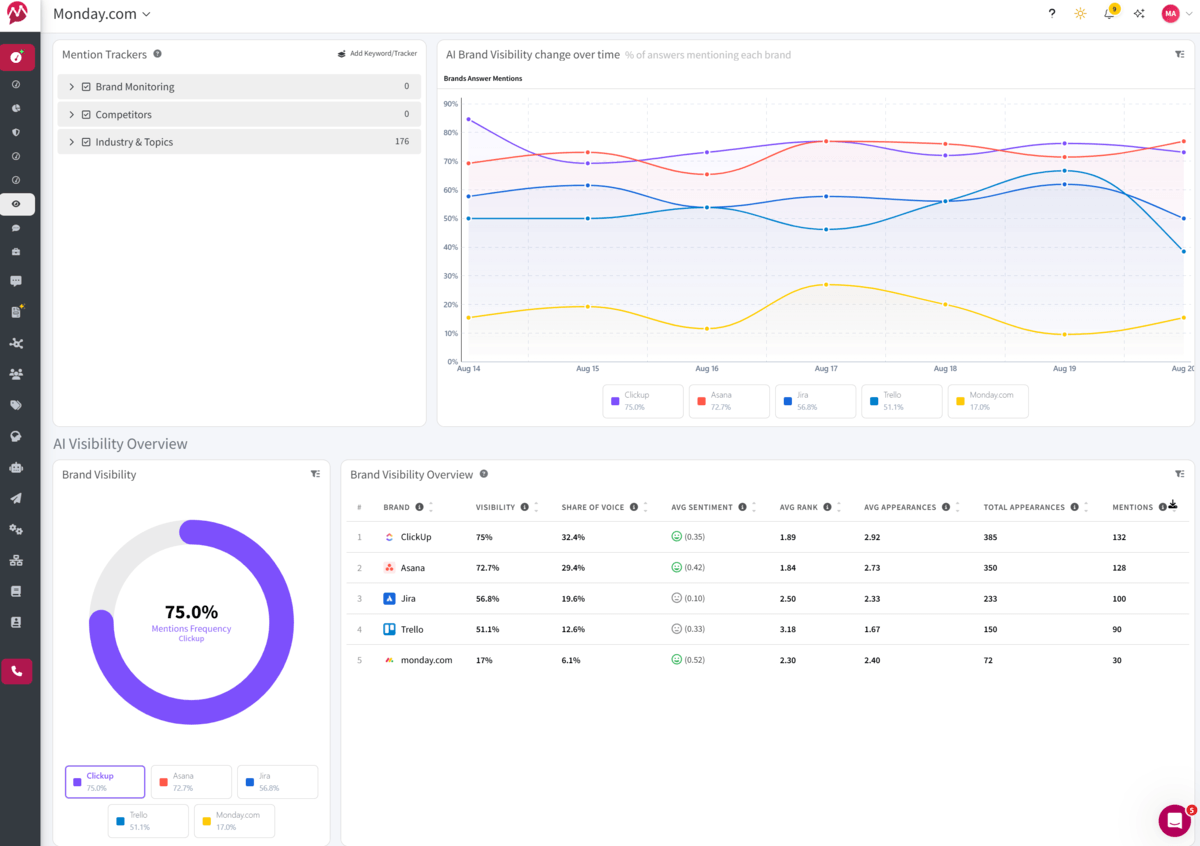
Mentionlytics’ AI brand visibility analysis tool enables you to track your online brand presence and within AI responses side by side.
Models covered
- ChatGPT
- Google AI Mode
- Google AI Overviews
- Gemini
- Perplexity
- Copilot
Prompt sourcing and limits
Mentionlytics lets you choose which prompts to use, or, if you’re stuck, you can use AI suggestions based on your brand and industry. Within the entry plan, you get 25 prompts, and you can run them 1 – 4 times a day, or weekly, or monthly, and decide which market you’re going to run them for.
Mentionlytics Pricing
Mentionlytics’ AI visibility tracking tool starts at $49 per month, which translates to $1.96 per prompt.
My honest take: Where it wins and where it falls short
Like most AI brand visibility tools, Mentionlytics has everything one thorough analysis needs: raw answers, a downloadable and clickable citation list, AI share of voice (where you stand against your competitors), what domains prevail as sources, and it tracks your visibility and domains over time, so you can see if your visibility is dropping or when one source started losing its influence.
But the most interesting part is that you can combine standard social listening with AI visibility and compare results from both segments in one tool. Plus, every chart is clickable, and you can see the exact answers behind the presented percentage.
I’ve been in this AI visibility space for over a year, since I work for Mentionlytics, but the truth is this AI visibility tool is a bit steep for small teams or solo SEOs. And if you’re already paying for a social listening tool, this extra cost can become a budget burden.
Meltwater for PR teams looking for AI visibility scoring
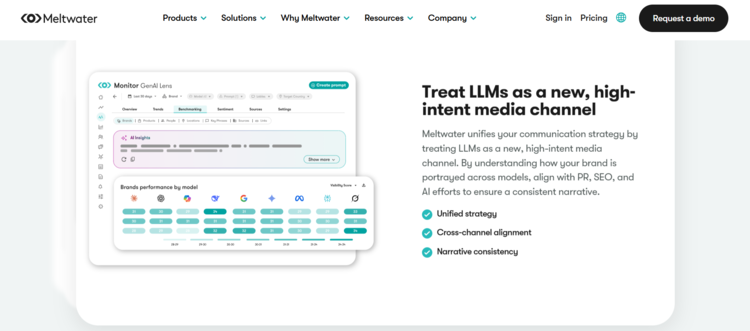
Meltwater’s GenAI Lens feature lets you track AI visibility alongside the traditional media databases and find voices shaping the AI narrative.
Models covered
- ChatGPT
- Perplexity
- Google AI Overviews
- Google AI mode
- DeepSeek
- Llama
- Claude
- Gemini
- Grok
Prompt sourcing and limits
The catch with Meltwater’s GenAI Lens is that the prompt limit is tied to your plan, and you can insert prompts manually, but you can also use their suggestions. You can even import a CSV with the prompts. The problem is that GenAI Lens automatically creates up to 10 additional queries for each prompt, and it counts toward your allowed limits. So pay attention to that.
Meltwater Pricing
According to Meltwater’s official blog, the Starter plan starts at $10,000 a year because of its modular system, which means you can choose from available features for your plan, including which ones you want to include; the final price may vary.
My honest take: Where it wins and where it falls short
Meltwater definitely wins on the number of AI search engines available for tracking, and it has pretty good trend charts, which can be useful. Combining the journalist list from the traditional media database and the voices influencing AI answers is a plus.
The fact that it adds additional prompts is interesting, and I like the idea (something LLMs do when you ask a question), but it also eats up your prompt limit, which is very inconvenient.
Meltwater is massive, as it was even before AI search visibility, which can be tiring for small teams, and you have to put a lot of effort and time into getting the insights you need.
Talkwalker for social listening with an LLM insights layer
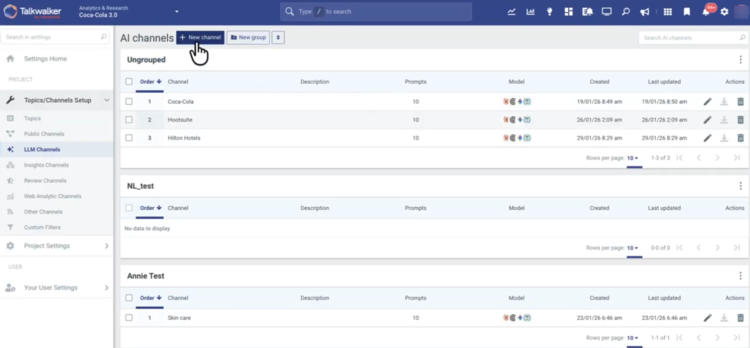
Talkwalker, recently renamed Lumen by Talkwalker, brings social listening with an LLM insights layer. Although it’s primarily a social listening tool, it offers useful insights into AI visibility across a limited number of AI models.
Models covered
- ChatGPT
- Perplexity
- Gemini
- Claude
Prompt sourcing and limits
Lumen by Talkwalker offers prompt templates that generate prompts based on your plain-language prompt set. The principle is almost the same as with Meltwater, meaning you put a prompt in and Talkwalker generates 10 more, and you’ve already reached the limit. Since this system is automated, you’ll need to factor in additional setup time to filter these automated prompts. The prompt limit depends on your plan.
Talkwalker Pricing
Talkwalker pricing isn’t public and is based on custom quotes, but some third-party sources mention $500 a month.
My honest take: Where it wins and where it falls short
It’s always been a great social listening tool, with tons of sources, but I have to admit that when it comes to LLM visibility, I have a feeling Talkwalker is not investing a lot in it. Yes, it has everything that other tools offer, including AI share of voice per LLM, sentiment, and mention rate, but it’s not quite giving the signal that it’s dedicated to this niche.
A few weeks ago, in early September 2026, they introduced citations and a sources table, which were previously missing. And speaking of missing things, there’s a gap with AI Mode and AI Overviews.
But my frustration with Talkwalker comes from the mystery around every detail that counts. There’s no public pricing and no explanation about prompt limits. For all the info, you need a demo.
Best LLM Visibility Tools for Enterprise Teams
For enterprise teams, I took into consideration Profound, Scrunch, AthenaHQ, and Evertune, and the scoring results look like this.
| Tool | Data transparency 20% | Platform coverage 15% | Prompts & answers 15% | Citations 15% | Competitors 10% | Markets & reporting 15% | Value 10% | Final score |
| Profound | 14% | 15% | 15% | 15% | 10% | 15% | 8% | 92% |
| Scrunch | 16% | 15% | 15% | 15% | 10% | 14% | 8% | 93% |
| AthenaHQ | 18% | 15% | 15% | 15% | 10% | 12% | 6% | 91% |
| Evertune | 12% | 15% | 10% | 15% | 10% | 15% | 6% | 83% |
Profound for enterprise teams operationalizing AI visibility at scale
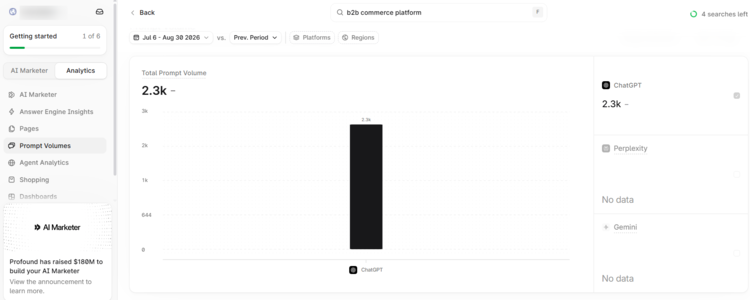
Going far beyond simply monitoring a few prompts and entering the results into a colorful dashboard, Profound combines Answer Engine Insights with data on prompt demand, AI traffic analytics, shopping visibility, content workflows, and marketing agents who can turn the gaps they have identified into real work.
Models covered
- ChatGPT
- Perplexity
- Google AI Mode
- Google AI Overviews
- Gemini
- Claude
- Copilot
- DeepSeek
- Exa Search
Prompt sourcing and limits
Profound offers suggested prompts according to your industry, whereas Enterprise customers have the option of editing, disabling, or adding their own prompts. Prompts are monitored on a daily basis, and the specific limit is tailored to each Enterprise account.
Profound pricing
Profound pricing isn’t publicly available because it’s based on custom quotes. Everything you need is custom, and so is the price. But you do have a free trial (one-time – one prompt – ChatGPT).
My honest take: Where it wins and where it falls short
When I first tried Profound, it felt like a space shuttle. And my first impression is that it’s more than just an AI visibility tracking tool. For example, it gives you prompt volume for each search engine and relevant keywords, which is a big help for every marketing team looking for content topic ideas. It’s like a GEO platform, like Ahrefs.
What impressed me most is that, though it’s feature-rich, the platform is easy to navigate and lets you create your own dashboard. One more thing: besides prompts, you have a tab with query funnels, which is great if you can’t think of a prompt you’d use or FAQ ideas for your next blog post.
The downside is that I don’t see the answers, and I’m not sure how these relevant keywords and prompt volumes are estimated. The transparency isn’t as good as I would like.
Scrunch for optimizing website and brand AI appearance
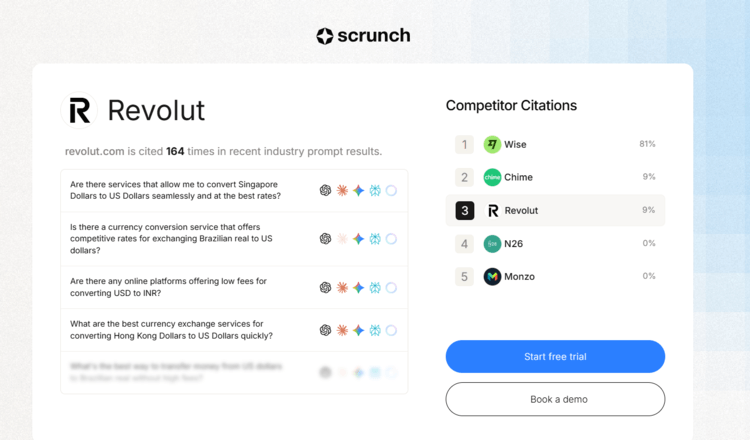
Scrunch combines AI visibility monitoring with technical website analysis, and its Agent Experience Platform, or AXP, lets you create lightweight, structured versions of web pages that AI agents can crawl and interpret more easily.
Models covered
- ChatGPT
- Google AI Mode
- Google AI Overviews
- Gemini
- Perplexity
- Claude
- Meta AI
- Copilot
- Grok
Prompt sourcing and limits
The number of prompts depends on your plan, starting with 125 unique prompts, but the number of LLMs is limited to 4 (ChatGPT, Copilot, Perplexity, Google AIO) and to one country, which may be inconvenient for those operating in multiple markets.
Scrunch pricing
The Core plan for brands starts at $250 a month and offers a 7-day trial.
My honest take: Where it wins and where it falls short
I love the option to audit your website. It’s a great help in getting your GEO done. And I’m pretty impressed with the AI search trends feature. You can track competitors, see how you stand up against them in LLMs, and see whether or not your brand shows up in answers and citations.
Scrunch offers insights about bot traffic on your website, which can point out the LLM platforms you need to optimize more. After you finish the audit, you can compare results within the platform, which is pretty useful.
Now, there are a few things (besides the price) that I don’t like. First, the frequency of your prompt runs. New prompts run daily for the first two weeks, then (after two weeks) weekly, and after day 90, once a month. And the second thing I would point out is that you can track only one language (country) for your set of prompts (if you’re on the starting plan).
AthenaHQ for conversational AI visibility checkup and content suggestions
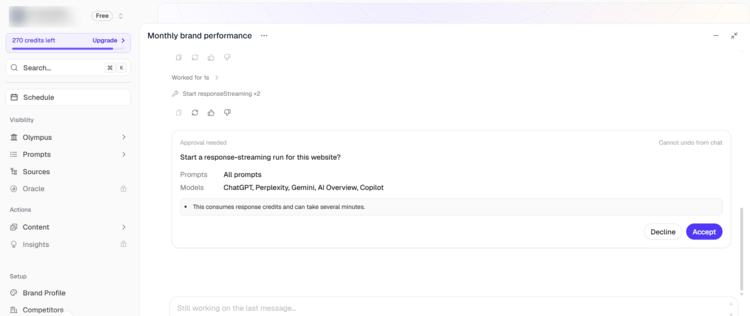
AthenaHQ combines AI visibility tracking with content recommendations, technical GEO actions, citation intelligence, and AI agents.
Models covered
- ChatGPT
- Perplexity
- Google AI Overviews
- Google AI Mode
- Gemini
- Claude
- Copilot
- Grok
- DeepSeek
- Meta AI
- Mistral
Prompt sourcing and limits
AthenaHQ will suggest prompts for your brand based on your website, but you can edit them to fit your needs. Now, you will have a number of prompts based on the plan, but the bigger limitation is the credits you get with each plan, because they will be spent with every prompt run, for every LLM.
AthenaHQ pricing
This is one of the rare tools with a free plan, though you can’t do much with it, since the credits are very limited (you get 300 credits, which you can spend in a week with 10 prompts running every day), while the Starter plan starts at $295 a month. Also, please note that the free plan has limited sources available.
My honest take: Where it wins and where it falls short
A free plan was refreshing news, but when I set things up and ran the first round of prompts, I found it’s very limiting if you want continuous tracking. For that, you’ll need a paid plan. With the Olympus feature, you have metrics like AI share of voice, attributed citations, mention and citation rate, sources driving mentions, etc.
Another interesting addition is AI content suggestions. You get all packed blog posts you might want to revise, edit, and use for your next blog post. Plus, you can use a conversational dashboard to talk to your tool and ask for analysis. Heads up: it will eat your credits.
And though it might seem like a dream come true, remember that credits are easy to spend, and the free plan doesn’t include AI Mode, for example.
Evertune for tracing LLM ads and overall AI visibility
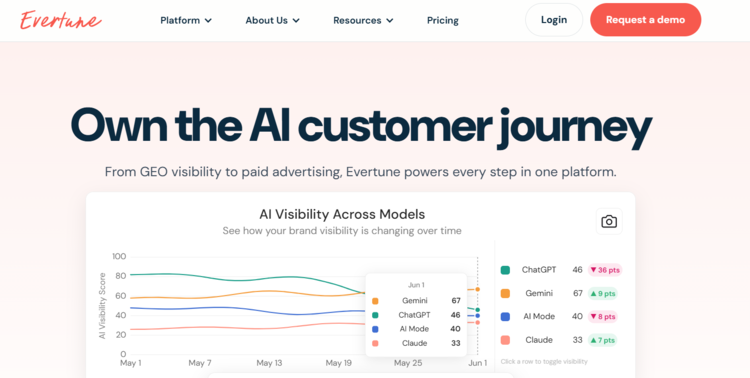
Evertune takes a research-heavy approach. Its EverPanel contains more than 150 million real-user prompts, and the platform can run one prompt up to 100 times per model to see how much the answers vary.
Models covered
- ChatGPT
- Google AI Mode
- Google AI Overviews
- Gemini
- Claude
- Perplexity
- Copilot
- Meta AI
- DeepSeek
Prompt sourcing and limits
Evertune’s Prompt Agent uses its EverPanel dataset to identify questions consumers ask about a particular category. It then groups related prompts into topics and uses them to build the tracking strategy. Your starting plan includes 100,000 prompts (impressive, I know!), but you can insert only 250 customized ones. The rest will be auto-generated.
Evertune pricing
Evertune’s price starts at $800 per month.
My honest take: Where it wins and where it falls short
Evertune is an interesting tool, not only because you can track a large number of prompts, but also because you get 25 AI-optimized content pieces in your monthly plan. On top of that, you have an ads option, which is a great addition.
I like that you can track different prompt sets for different countries or languages, which is ideal for multinational companies, and the way it automatically clusters your customized prompts, but I still can’t say it’s my favorite brand visibility tracking software. Why?
First, you don’t see raw answers, and that’s a no-go for me. I understand it’s due to the number of prompts, but still… I like to draw my own conclusions from the answers. The second thing I’ve noticed is that, because of this huge amount of AI-generated prompts, your visibility results depend heavily on them and might be slightly off. The price… I won’t even go there.
Need More Control Over Prompts You Track?
Mentionlytics gives you all the freedom you need. Pick suggested prompts or create your own!
Best Lightweight Tools for Tracking LLM Brand Visibility for Small Teams
If you have a small team, you’ll probably opt for one of these tools.
| Tool | Data transparency 20% | Platform coverage 15% | Prompts & answers 15% | Citations 15% | Competitors 10% | Markets & reporting 15% | Value 10% | Final score |
| Otterly.ai | 18% | 8% | 13% | 15% | 8% | 12% | 8% | 82% |
| Peec AI | 18% | 10% | 15% | 15% | 10% | 14% | 7% | 89% |
| Trakkr | 14% | 10% | 9% | 13% | 5% | 10% | 7% | 68% |
| Rankscale | 18% | 15% | 14% | 15% | 10% | 14% | 5% | 91% |
| Promptwatch | 18% | 11% | 14% | 15% | 10% | 12% | 7% | 87% |
Otterly.ai for quick checkup on AI-generated answers and citation tracking
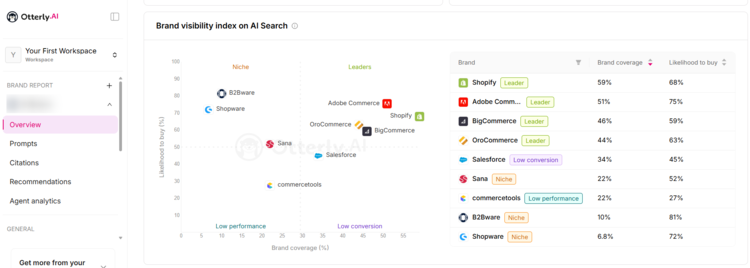
Otterly.ai is one of the easiest ways for a small team to start monitoring brand mentions and citations in AI-generated answers without committing to an enterprise contract.
Models covered
- ChatGPT
- Google AI Overviews
- Perplexity
- Copilot
Available as an add-on:
- Google AI Mode
- Gemini
- Claude
Prompt sourcing and limits
Otterly.ai lets you enter your own prompts and tracks them daily. The number of allowed prompts depends on your plan, starting at 15.
Otterly.ai pricing
Otterly’s price starts at $29 a month and includes a 7-day free trial.
My honest take: Where it wins and where it falls short
I have to admit Otterly is a useful, straightforward AI brand visibility checking tool. It gives you all the metrics you need for a quick overview of your AI visibility: the share of voice, citations, raw answers, sentiment, domain sources, etc.
I liked the citation analytics most; it tracks which citations increased, decreased, were lost, and remained stable. You can also filter the domains by category, which is very useful when analyzing which domains show up the most. On top of that, this tool offers GEO optimization and AI Prompt Research features.
I can’t say I found anything annoying enough to label as a red flag; maybe the platform is just not that user-friendly, despite the welcoming demo video. It’s simple, and yet the most interesting features are somewhere in the dropdown menu. And of course, I didn’t like the fact that AI Mode is not included in the set (and you can’t even add it to your plan if you’re on Lite).
Peec AI for teams that prioritize clean and simple reporting
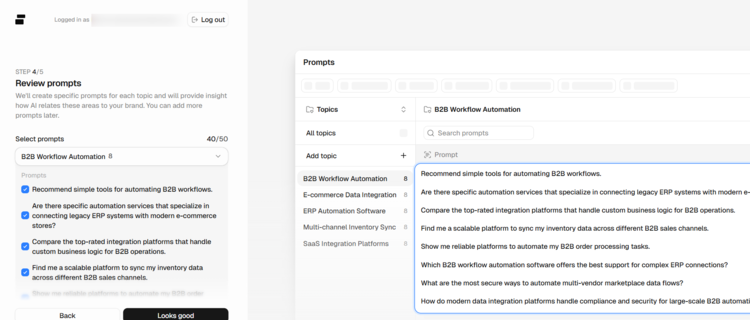
Peec AI combines an easy-to-use dashboard with enough prompt, competitor, and citation data to conduct a proper AI visibility analysis.
Models covered
- ChatGPT
- Google AI Mode
- Google AI Overviews
- Copilot
- Gemini
- Naver AI
Enterprise accounts can choose additional models such as Perplexity and others via API, including Claude Sonnet 4, GPT -5 Search, Grok, DeepSeek, Qwen, Mistral, and Meta Spark.
Prompt sourcing and limits
You can add prompts manually, import them in bulk, or generate ideas from keywords and Peec’s suggestions based on your brand context and gaps in your existing prompt coverage. The number of prompts depends on the plan you choose, and starts with 50. But the limitation is more related to LLM models, meaning that within your package you choose only three platforms to track.
Peec AI pricing
Peec AI’s pricing starts at $95 monthly. It has a free trial, but requires a credit card.
My honest take: Where it wins and where it falls short
Peec AI is probably one of the easiest tools on this list to navigate. It has clean dashboards and nicely organized information, and you can move from a general visibility score to individual prompts, answers, sources, markets, and competitors.
The prompt-management system is what blew me away. So, instead of one large, messy prompt list, it lets you classify prompts by intent, persona, topic, region, and whether they’re branded or non-branded. Its shopping-tracking features are very useful for eCommerce brands, and it also has a local GEO segment.
The biggest problem is that the standard plans let you select only three models. So six models are listed, but you can’t track them all, and even more so if you want to track both Google AI Mode and AI Overviews alongside ChatGPT, Gemini, and Copilot.
Trakkr for connecting AI visibility with content optimization
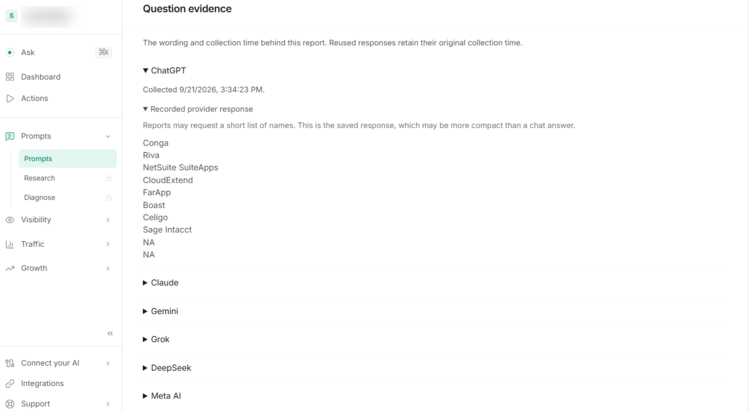
Trakkr combines AI visibility monitoring with website analysis and content recommendations, making it suitable for small teams that want to move from tracking to optimization inside the same platform.
Models covered
- ChatGPT
- Claude
- Gemini
- Perplexity
- Google AI Overviews
- Grok
- DeepSeek
- Meta AI
Prompt sourcing and limits
You can add your own prompts, paste a list, or import them from a CSV. The Growth plan includes 50 prompts for one brand, with daily tracking across all eight models.
Trakkr pricing
Trakkr’s price starts at $100 a month. You can try a 14-day free trial, which requires a credit card.
My honest take: Where it wins and where it falls short
The biggest advantage is that Trakkr includes all eight advertised models. You don’t have to choose three or four platforms and then pay more whenever you want to expand the analysis.
Trakkr also goes beyond presenting charts. It connects citations and brand-perception findings with website audits, content recommendations, and optimization tasks. You also get 25 articles per month, so that’s a great deal.
However, its platform coverage has one noticeable gap: every interesting feature I wanted to try was locked behind the higher tier. Oh, want to see the prompt analytics? Oops, it’s within the Growth plan. Want to see how you stand against your competitors… sorry, not on this plan. That’s probably why this isn’t one of my favorite trials.
Rankscale for credit-based AI visibility tracking
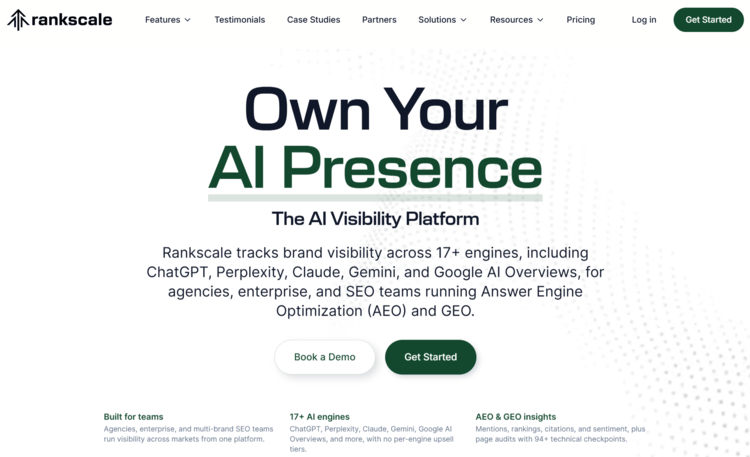
Rankscale offers one of the broadest feature sets in the lightweight category, with flexible scheduling, extensive platform coverage, citation analysis, competitor benchmarking, and query fan-out data.
Models covered
Rankscale supports 17 AI engines, including:
- ChatGPT
- Google AI Mode
- Google AI Overviews
- Gemini
- Perplexity
- Claude
- Copilot
- Grok
- DeepSeek
- Mistral
Additional GUI- and API-based engines are also available, and you decide which engines to run.
Prompt sourcing and limits
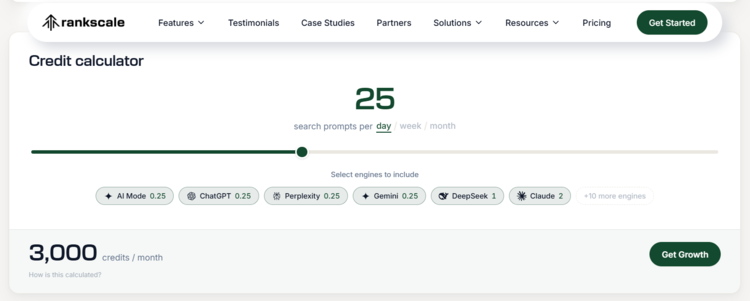
Rankscale plans are credit-based, meaning the plan has no limits on prompts, frequency, or engines, but the more options you choose, the more credits it will spend. Using their calculator, I calculated that for 25 prompts running daily on 6 platforms, you’ll need 3,000 credits/month, which is nowhere near the essential plan.
Rankscale pricing
Rankscale essential plan starts at $20 a month, and they offer a credit-card-based free trial for the Pro plan.
My honest take: Where it wins and where it falls short
Rankscale wins on flexibility. You aren’t locked into running every prompt on the same engines or at the same frequency, and its platform coverage is among the strongest in this category.
Query fanout is another interesting feature. It lets you see the searches an AI platform performed while preparing its response, which can uncover topics, phrases, and sources that aren’t obvious from the final answer alone.
On the other hand, its credit-based system makes expenses less predictable. The $20 starting price looks extremely accessible, but when you do the math, you might stay open to other options.
Promptwatch for combining visibility monitoring and content optimization
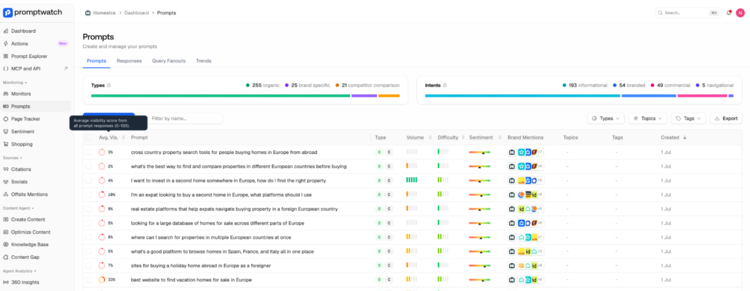
Promptwatch tracks brand visibility across leading AI platforms and combines the results with citation analysis, competitor monitoring, crawler data, and content recommendations.
Models covered
- ChatGPT
- Perplexity
- Google AI Overviews
- Google AI Mode
- Claude
- Gemini
- Meta Llama
- DeepSeek
- Grok
- OpenCode
- Claude Code
Note: You can choose only 4 models from the list.
Prompt sourcing and limits
You can enter your own prompts and compare the full answers produced by each selected model. The Essential plan includes 50 prompts, four models, and up to 6,000 responses, with daily tracking. But you also have a credit cap.
Promptwatch pricing
Promptwatch’s Essential plan costs $95 per month and includes 50 prompts, four models, one project, and 500 Agent Credits. You can also get a free trial, but you’ll need a credit card.
My honest take: Where it wins and where it falls short
Promptwatch offers a strong amount of monitoring for $95. Fifty prompts running daily across four models is enough for many small brands, and country-level tracking, API access, and raw responses are included in the entry plan.
I also like that it collects answers from the platforms’ user-facing interfaces. This gives you a closer representation of what an actual user may see than relying exclusively on API responses.
But the model limit is something to watch. Promptwatch promotes a long list of supported platforms, while the regular plans cover only four selected models. Agent Credits also introduce a second usage limit alongside prompts and responses, making the pricing structure slightly more complicated than it first appears.
Need More LLMs to Check?
Stay on budget while checking the most important prompts across major AI engines with Mentionlytics!
Best AI Search Tracking Software Inside an Existing SEO Suite
Your marketing team would probably opt for one of the SEO tools they already use.
| Tool | Data transparency 20% | Platform coverage 15% | Prompts & answers 15% | Citations 15% | Competitors 10% | Markets & reporting 15% | Value 10% | Final score |
| Semrush AI Visibility Toolkit | 16% | 9% | 13% | 12% | 10% | 15% | 7% | 82% |
| Ahrefs Brand Radar | 18% | 15% | 15% | 15% | 10% | 13% | 4% | 90% |
| SE Visible by SE Ranking | 20% | 10% | 15% | 15% | 10% | 14% | 10% | 94% |
| Positive Surfer AI Tracker | 20% | 15% | 12% | 15% | 8% | 10% | 7% | 87% |
Semrush AI Visibility Toolkit for combining traditional SEO and AI search analysis
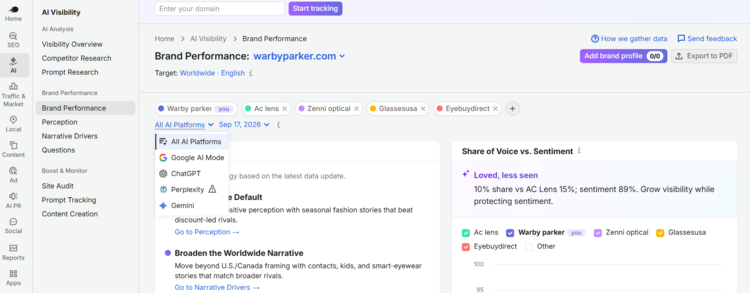
Semrush’s AI Visibility Toolkit combines prompt tracking, competitor research, brand-perception analysis, and technical site auditing with the traditional SEO data already available inside Semrush.
Models covered
- Google AI Mode
- ChatGPT
- Gemini
- Perplexity
Prompt sourcing and limits
You can add your own prompts or use Semrush’s Prompt Research feature to discover relevant questions based on your brand, industry, competitors, intent, and estimated demand. The standalone AI Visibility Toolkit includes 25 custom prompts with daily tracking. You also get 300 daily queries for AI Analysis reports and 1,000 daily queries for Prompt Research.
Semrush AI Visibility Toolkit pricing
Semrush’s AI Visibility Toolkit as a standalone product starts at $99, and you don’t have a trial option for it.
My honest take: Where it wins and where it falls short
If you’re already using Semrush, it’s a great addition, and the price for this specific function is fair enough. The advantage is that you can combine your SEO data with new AI visibility and make correlations between the two.
The Prompt Research feature is particularly interesting because it tries to bring some of the logic of keyword research into AI visibility. It adds intent and demand data, highlighting which prompts deserve attention. On top of that, its local coverage is a great addition.
The downside is the variety of AI models available for tracking. Tracking ChatGPT and AI Mode satisfies the minimum requirement, but two platforms look rather modest next to tools covering five, six, or ten AI engines. The pricing can also escalate quickly once you add prompts, locations, domains, or additional users.
Ahrefs Brand Radar for connecting AI mentions with real search demand
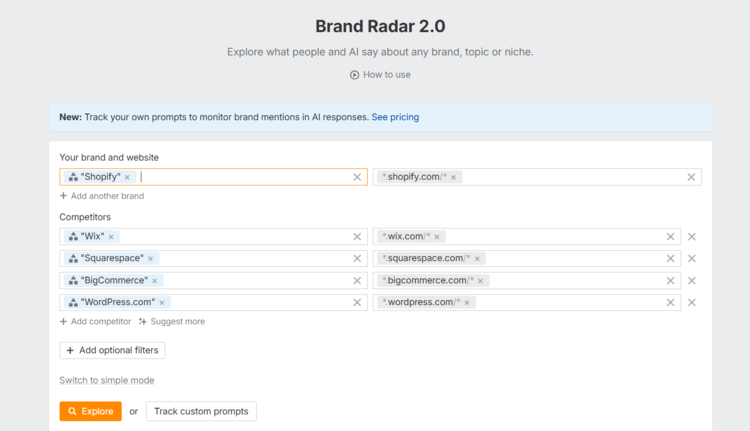
Ahrefs Brand Radar combines an enormous pre-collected AI visibility database with custom prompt tracking, citations, competitor benchmarking, fanout queries, and Ahrefs’ traditional SEO data.
Models covered
- ChatGPT
- Google AI Mode
- Google AI Overviews
- Gemini
- Perplexity
- Copilot
- Claude
Prompt sourcing and limits
Brand Radar offers two different ways to analyze AI visibility, and they are charged separately. The first is Brand Radar, which provides AI visibility metrics based on its search-backed prompts. And here, the limit comes with pricing per LLM model. But if you want a custom prompt, you’ll need to add one more standalone tool, Custom Prompts, which gives you the option to use around 80 prompts (2,500 checks a month).
Ahrefs Brand Radar pricing
Custom Prompt tracking starts at $50 a month, while Brand Radar starts at $199 per LLM.
My honest take: Where it wins and where it falls short
Ahrefs has one major advantage over most tools on this list: it doesn’t rely exclusively on the prompts you thought of yourself. Its existing index lets you discover questions where your brand already appears, compare entire markets, and connect AI prompts with estimated traditional search demand.
It also stores the answers and connects citations to Ahrefs’ SEO database. You can move from a cited page to its backlinks, organic visibility, authority, traffic estimates, and competing pages. That’s the kind of connection you would expect from an AI visibility feature built inside Ahrefs rather than bolted onto it during a particularly enthusiastic product meeting.
The problem is the pricing structure. The number of prompts included with regular Ahrefs subscriptions is small, while complete Brand Radar coverage gets expensive. Its enormous index may also be less useful for niche or unknown brands with little existing search demand, although custom prompts solve part of that problem.
SE Visible for agencies combining SEO and AI visibility reporting
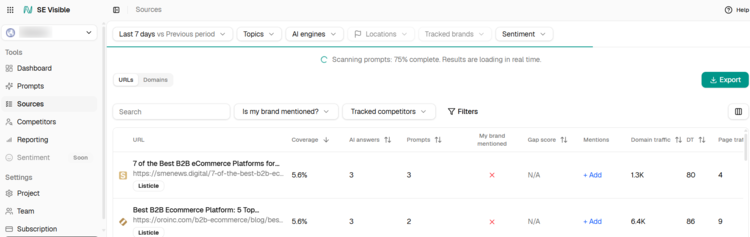
SE Visible platform provides prompt-level AI visibility, competitor, sentiment, and citation analysis alongside SE Ranking’s existing rank tracking, website auditing, backlink, and reporting tools.
Models covered
- ChatGPT
- Google AI Mode
- Google AI Overviews
- Gemini
Prompt sourcing and limits
You can create your own prompt set and organize it by niche, topic, intent, and market. The system also helps identify prompts where your brand or competitors already appear. The Basic plan includes 200 prompts and approximately 30,000 analyzed answers per month.
SE Visible pricing
SE Visible starts at $99 a month and includes a 10-day free trial.
My honest take: Where it wins and where it falls short
SE Visible offers one of the strongest prompt-to-price ratios in this group. Two hundred prompts across five engines for $99 per month is considerably more generous than many tools that offer 25 or 50 prompts at approximately the same price.
Another strong point is the reporting structure. You can separate results by prompt, intent, topic, competitor, and AI engine, examine daily changes, and export the results for clients. That makes it particularly suitable for agencies already using SE Ranking for standard SEO reporting.
Now, I have to mention that, though I really liked SE Visible, it feels like a separate product under the SE Ranking umbrella. The connection with traditional SEO is there, but it isn’t necessarily one seamless dashboard where every traditional and AI metric lives side by side. And of course, you have 4 models to track, so the list isn’t that long.
Positive Surfer for optimizing content with AI visibility insights
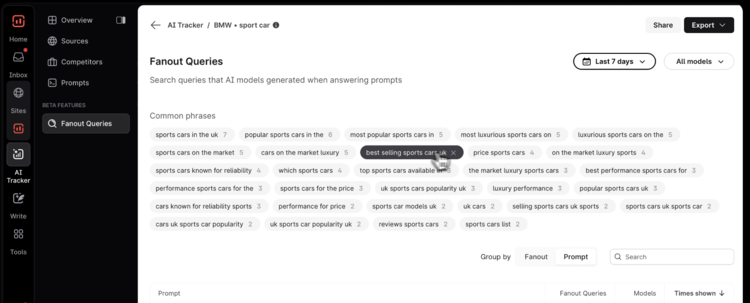
Positive Surfer combines prompt monitoring and citation analysis with it’s content-planning, writing, and optimization tools.
Models covered
- ChatGPT
- Google AI Mode
- Google AI Overviews
- Gemini
- Perplexity
Note: Standard plan tracks only ChatGPT.
Prompt sourcing and limits
You can enter your own buyer-intent, commercial, product, and brand prompts. The AI Search Analytics plan includes 50 prompts with daily tracking.
Positive Surfer pricing
A standalone AI tracking function starts at $95 a month, and a free trial comes only with the Pro plan.
My honest take: Where it wins and where it falls short
The Positive Surfer’s greatest advantage is its ability to collect data; it scrapes the user-facing interfaces of all five platforms, something you can observe in the answers.
It also processes each prompt using all five engines without counting them as five individual prompts. As a result, its allowance of 50 prompts is more useful than the limits imposed by tools that require you to choose only three platforms.
The reason for selecting Positive Surfer is that if you identify a missing mention or citation gap, you can go straight to Topical Map, Content Editor, fanout analysis, or content auditing and create or optimize the missing page (of course, provided that you are using the full package).
The problem is that the standalone tracker doesn’t include the full optimization suite; if you want to run the complete track-analyze-optimize process, you’ll need the $219/month Pro plan.
Bonus: Amplitude for measuring what AI-referred visitors do after they land
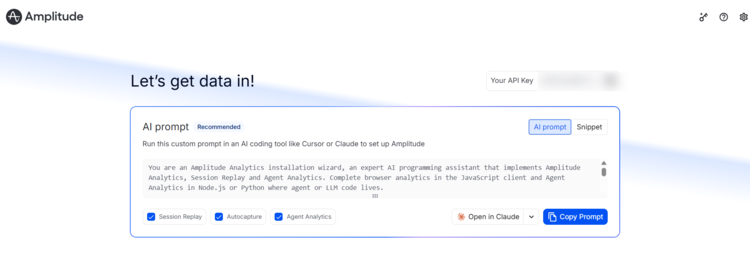
Amplitude can identify traffic coming from AI platforms and analyze what those visitors do after reaching your website.
Platforms covered
Amplitude can segment incoming website traffic from identifiable AI referral sources, such as:
- ChatGPT
- Perplexity
- Gemini
- Copilot
- Claude
- Other AI platforms that pass referral information
This is referral tracking, not monitoring the answers generated by those platforms.
Prompt sourcing and limits
Amplitude doesn’t let you enter prompts, run them across AI engines, or store the answers. It basically measures the effect of your AI visibility.
Amplitude pricing
Amplitude offers a free plan that includes up to two million events per month.
My honest take: Where it wins and where it falls short
Amplitude answers a key question most AI visibility tools can’t: how many AI referrals land on your website, and what happens next? That’s why I included it in the list.
You should compare AI-referred visitors with those who come via organic search, social media, paid advertising, and direct access to find out whether the AI traffic signs up, makes a purchase, explores the product, or simply leaves after realizing that your well-cited page does not answer the question.
Although Amplitude doesn’t tell you how often your brand is mentioned, what an AI engine has to say about it, or which sources were referred to in the cases where users did not click on your website, it’s useful if you want to link visibility with website behavior and business results. That’s why I thought it was worth including in here.
Test Mentionlytics AI Visibility Tool for Yourself Today
The list of the best AI visibility tracking tools is long, and that’s just a glimpse of what you can find on the market today. And before you lose your mind in research, give Mentionlytics a try.
Check your AI visibility today with a tool that is built to listen, analyze, and provide actionable insights. Any country, any language, no obstacles.
FAQ
What are the best AI search monitoring tools?
The best AI search monitoring tools are: Mentionlytics, Rankscale, SE Visible, Ahrefs Brand Radar, Peec AI, and Profound. The right option depends on whether you need affordable prompt tracking, enterprise reporting, social listening, SEO data, or content optimization alongside AI visibility monitoring.
What is the most affordable AI visibility tracking software for B2B companies?
Rankscale has the lowest starting price at $20 per month, but its credit-based system means costs will rise if you want continuous daily tracking. Otterly.ai starts at $29 per month for 15 prompts, although Google AI Mode isn’t available on that plan. Mentionlytics starts at $49 per month for 25 prompts and is a better option for B2B companies that also want competitor tracking, raw answers, citation analytics, and the option to combine AI visibility with social listening and brand monitoring.
What are the best tools for tracking brand visibility in AI responses?
Mentionlytics is a great option for tracking brand visibility alongside online mentions and social listening. Rankscale covers a lot of platforms and has flexible scheduling, while Peec AI stands out for easy reporting and prompt organization.
