


AI citation tracking is the process of monitoring LLMs and AI platforms to see how often, where, and for what prompts URLs show up as sources in the generated answers.
Now… I have the feeling that most brands have been focused on the wrong part of citations: tracking and presenting only citations from the brand’s website. The number of times your brand got cited in answers is not an actionable insight. Instead, you should inspect the gaps: citations from third parties where your brand was not mentioned. It’s like rank tracking with a plot twist.
But you’re an SEO person. You’ve built a career around solving puzzles, spotting patterns, and refusing to accept that an algorithm is “just unpredictable”.
In this article, we’ll look at the three main goals of LLM citation tracking, how to determine whether your content is being cited, and how to find out the sources AI platforms use when your brand is missing. Finally, you’ll learn how to turn a list of cited domains into an actionable target list for your SEO and digital PR teams.
Table of Contents
- AI Citations vs. Brand Mentions vs. Backlinks
- AI Citation Tracking vs. Backlink Tracking: Same Instinct, Different Game
- The 3 Jobs of AI Citation Tracking (Most Teams Only Do the First)
- How to Track AI Citations of Your Own Content
- The 5 AI Citation Metrics Worth Reporting
- How to Turn the Cited-Domain List Into a Digital PR Target List
- How to Benchmark the Cited Content and Build the Better Version
- AI Citation Tracking Tools: What to Look For and Which Ones Do What
- Start Tracking Your Citations in AI Search with Mentionlytics
- FAQ
AI Citations vs. Brand Mentions vs. Backlinks
A backlink is a clickable link from another website to yours. A brand mention is any reference to your brand, product, or spokesperson, whether or not it includes a link. It can happen online, on social media, in the news, or in a random blog post, or even within an LLM. An AI citation is a source an AI engine used to support or construct its answer.
As you can see, AI citations, brand mentions, and backlinks can all increase your brand’s visibility, but they are not interchangeable. They appear in different places, signal different things, and require different tracking methods.
| What is it | Where it lives | What it proves | |
| Backlinks | A clickable link directing users from one webpage to another | Websites, blogs, news articles, directories, forums, and other indexable pages | Another page considers your content relevant enough to reference and send visitors to |
| Brand mentions | A reference to your brand, product, or service, with or without a link | News articles, social media, reviews, forums, podcasts, videos, and other online conversations, or LLMs and AI search engines | Your brand is being discussed, recognized, recommended, criticized, or compared |
| AI citations | A URL or source domain an AI engine references when generating an answer | ChatGPT, Gemini, Perplexity, Copilot, Google AI Overviews, AI Mode, and other AI-generated results | The AI platforms relied on that source to support the information presented in its response |
The easiest way to remember the distinction is this:
- a backlink points people to a page
- a brand mention puts a name into the conversation
- an AI citation helps an LLM build its answer
One webpage can produce all three signals, but it doesn’t have to. An article may mention your brand without linking to it; it may link to your website but never recommend it; or an LLM may cite a third-party comparison page that discusses your competitors while leaving your brand out entirely.
That last scenario is exactly why tracking citations deserves its own place beside monitoring your backlinks and brand mentions.
AI Citation Tracking vs. Backlink Tracking: Same Instinct, Different Game
The good news for SEOs is that AI citation tracking is not an entirely foreign discipline. SEOs have been tracking third-party signals of authority for more than 20 years.
The object has simply changed. Your instincts transfer. Your tooling and metrics don’t.
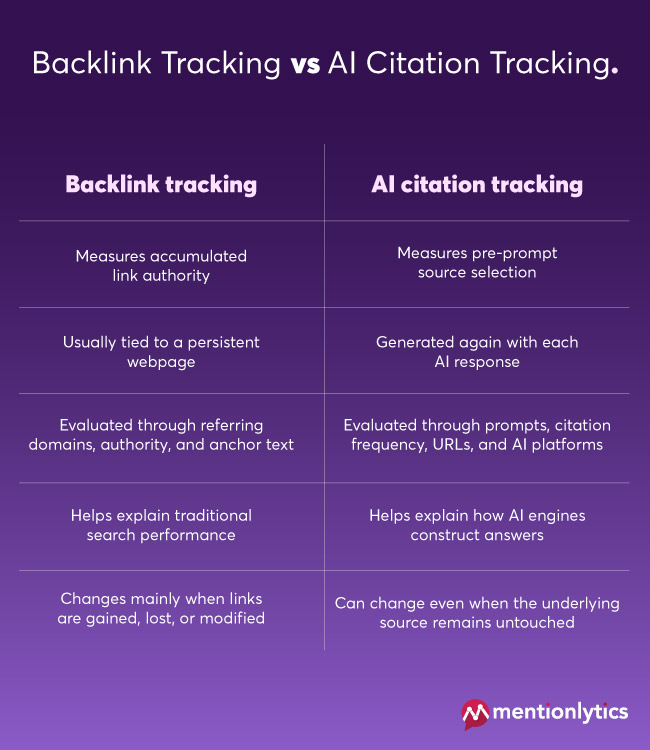
What did backlinks measure and what do AI citations actually measure?
Backlink tracking focuses on referring domains, authority, anchor text, link growth, and lost links. AI citation tracking focuses on citation frequency, cited URLs, prompts, platforms, competitors, and changes over time.
Backlinks measure accumulated authority. A relevant link from a trusted domain can strengthen a page over time, pass referral traffic, and contribute to its ability to rank across multiple searches. Once acquired, it becomes a relatively persistent asset.
So there was no confusion. Then we faced a huge shift in the customer journey, and we turned to AI citations expecting the same consistency and the same metrics we used to have… But AI citation tracking measures something more immediate: whether an LLM considered a source useful for answering a particular prompt at a particular moment.
That makes citations far more moody. AI might cite your guide for one prompt, but ignore it for a slightly different version. Run the same prompt again the next day or week, or sometimes five minutes later, and the citation list may change.
What do AI citations mean for your existing link-building program?
The importance of citations in 2026 doesn’t mean you should kill your outreach strategy for link building, fire your team, and start sending press releases to Reddit usernames.
Backlinks still support rankings, discovery, referral traffic, and domain authority. Many of the pages cited by AI engines are discoverable partly because they already perform well in search. The smarter move is to add AI citation data to your prospecting criteria: “Does this domain actually get cited by AI search engines for the prompts that matter to our brand?”
If AI engines keep returning to a source, that source deserves your attention, even if traditional SEO metrics would have placed it halfway down the spreadsheet.
And you have to know that not all LLMs prefer the same domain sources. I discovered through Mentionlytics that, for example, when it comes to airlines, the most cited domain is Reddit (28.2%), but not for every prompt.
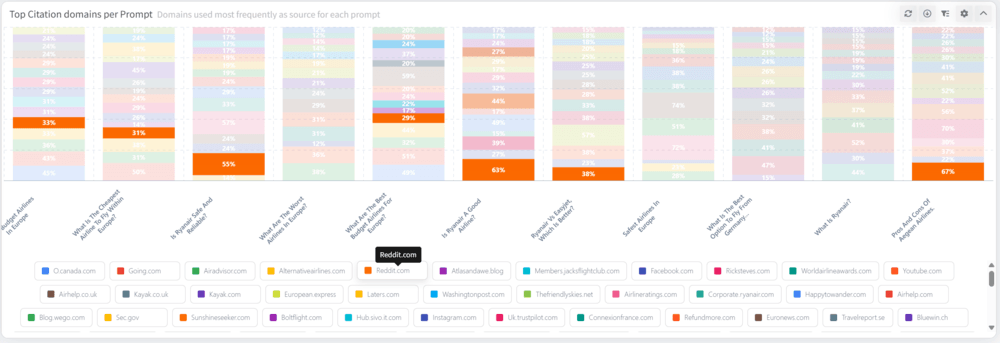
You can see that for four prompts, Reddit doesn’t show up at all, but it is used for comparison prompts, pros and cons, and AI answers related to budget.
This means you need to pay attention to which prompt is relevant to you, then check the sources for that specific prompt and build backlinks there.
The 3 Jobs of AI Citation Tracking (Most Teams Only Do the First)
When we talk about AI citation tracking, most marketing teams focus only on whether AI models use their content for citations. But citation analysis goes far beyond that first line.
Job 1: Prove your content gets cited for SEO reporting purposes
So, you’re putting all the AI optimization effort into making LLMs notice you, and you want to see the results somehow. One of the easiest ways to do that is to regularly check AI citations and see if the number of citations for your content has grown.
It’s one of the easiest and most straightforward ways to present LLM visibility results in SEO reports when the traffic turns its back on you. With a number or percentage that everyone will understand.
And yes, it might calm the situation down, but you know it’s insufficient and needs deeper analysis, broader insights, and more research to truly make the needle move (I’ll talk about it in one of the following chapters).
Job 2: Mine the cited domains to know where to focus your digital PR
Now this is an interesting part; not many brands are actually doing it. The point is to check the citation list, find out which domains are cited the most for a specific prompt and LLM, set your priorities, and build your own PR list (which might be totally different from what you’ve had before LLMs shook the whole digital space).
Check which trusted sources AI systems use regularly, and whose voice might be crucial for AI visibility.
The process is relatively simple. Identify the domains cited most frequently for your important prompts, check which brands they mention, and separate the sources into three groups:
- Sources that already mention and recommend your brand.
- Sources that mention your brand but position competitors more strongly.
- Sources that are frequently cited but do not mention your brand at all.
The third group is where the most interesting opportunities usually hide. These are sources AI platforms already trust for the topic, but your brand is missing from the narrative they provide.
That doesn’t mean sending every publisher an email saying, “ChatGPT likes you; please add us.” It means looking for a legitimate route into the source through expert commentary, original research, product reviews, partnerships, or a useful update to an existing article.
Job 3: Benchmark the cited pages to inform your content strategy
The third job is to stop looking at cited URLs only as reporting data or outreach targets and start treating them as a content research library.
For every important prompt, analyze the sources AI engines selected. What topics do they cover? How do they structure the information? What claims do they support with data?
You’re looking for GEO well-performing practices and patterns that explain why those pages were useful enough to cite.
The goal is to understand the information gap behind the citation and create something more complete, specific, current, or credible.
How to Track AI Citations of Your Own Content
For SEO reporting, the first question is usually the most obvious one: “Are AI platforms actually citing our content for relevant topics and prompts?”
To answer it, you need to track a fixed set of commercially relevant prompts across the AI platforms your audience uses, record every cited URL, and identify which citations belong to your domain. Doing this once will give you an interesting screenshot. Doing it consistently with reliable software for AI brand visibility tracking will show whether your content is becoming a trusted source for AI-generated answers.
How to Track AI Citation Frequency and Share of Voice in AI Search
AI citation frequency is the number of times URLs from your domain appear as sources across your tracked prompt set.
If you monitor 100 prompts and your website is cited in 27 generated answers, you have 27 citation appearances. If one answer cites two different pages from your website, you can count that in two ways.
- Citation appearances: How many times your domain appeared as a source.
- Unique cited URLs: How many individual pages from your website earned at least one citation.
Both are useful, but they answer different questions. Citation appearances show the overall frequency of your visibility, while unique cited URLs reveal whether that visibility is distributed across your content or being carried by one heroic blog post doing all the work.
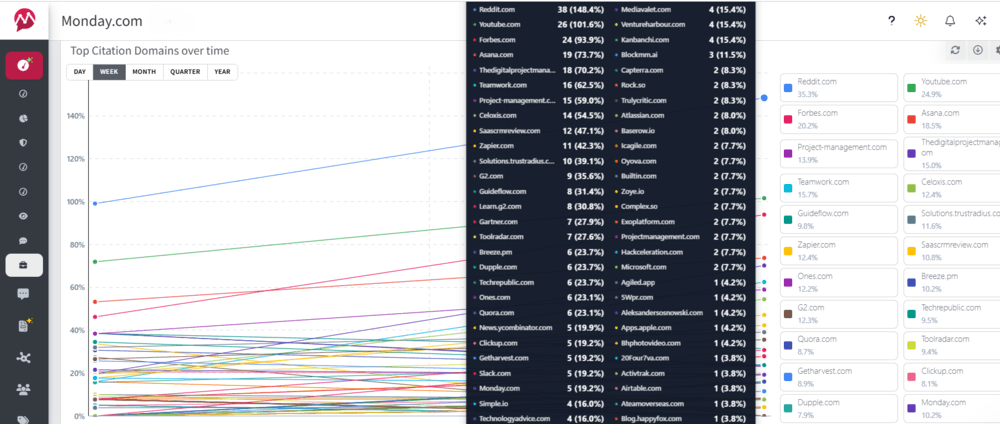
Take Monday, the project management tool, for example. I did AI brand citation tracking for several prompts, and we can see that it appeared only 5 times the previous week.
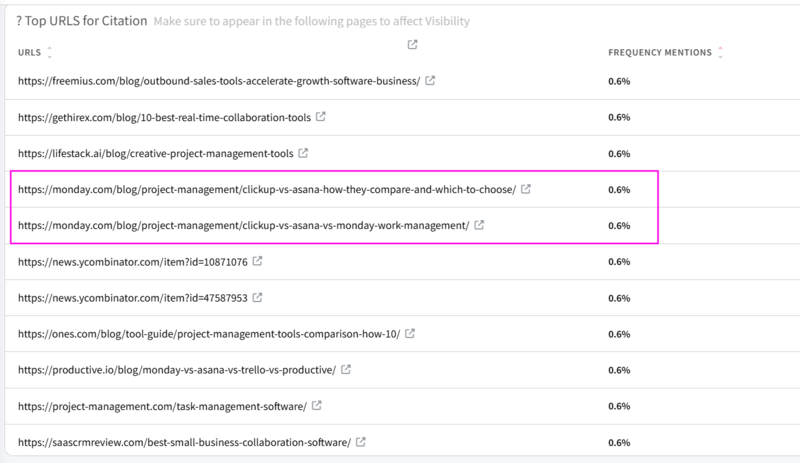
But if we dig deeper into citation URLs, we can see that only 3 of their blog posts and their pricing page showed up as cited sources, each with a very small percentage of frequency (0,6% or less).
The disadvantage of raw citation count is that it lacks competitive context. Twenty citations may sound impressive until you discover that competing domains received 200.
That is where AI citation share of voice becomes useful. You can check it automatically with Mentionlytics, as I did for Monday (their domain showed up as a source at 6.9%, as you can see in the screenshot).
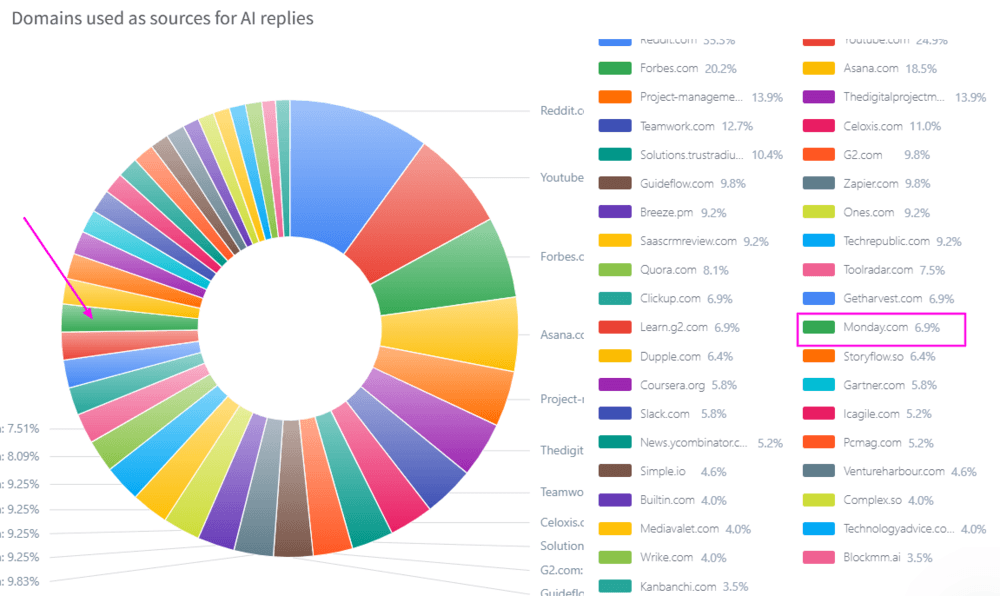
Or you can calculate it manually: Citation share = (Citations to your domain/Total citations across the tracked prompt set) × 100
Now, the denominator is what gives the metric meaning. If your citations increase from 40 to 50, that initially looks like a 25% improvement. But if the total number of citations across the prompt set rises from 500 to 1,000, your share has actually fallen from 8% to 5%. You received more citations, but claimed less of the available source visibility.
Raw citation frequency tells you whether your numbers are growing. Citation share tells you whether you are growing faster than the source ecosystem around you.
Ideally, you should calculate citation share at several levels:
- Overall across all tracked prompts and platforms
- Per AI platform
- Per topic or prompt group
- Per country or language, if you operate in several markets
- Against a selected group of competitors or domains
This separation prevents a strong performance in one area from hiding a problem elsewhere. Your overall citation share may be stable while ChatGPT ranking is increasing, Gemini visibility is falling, and Perplexity has apparently decided to spend the month on Reddit.
How to Track AI Citation Rates Over Time
AI citations are not fixed search results. They can change even when you have not edited the cited page, lost any rankings, or done anything particularly offensive to the algorithm.
This means some week-to-week fluctuation is normal. A single decline should therefore not trigger an emergency content rewrite.
Track frequently enough to capture volatility, ideally daily, but report performance using weekly or monthly averages.
A practical reporting cadence looks like this:
| Cadence | What to use it for |
| Daily tracking | Capturing citation changes and detecting technical problems |
| Weekly review | Identifying early patterns without reacting to every individual run |
| Monthly reporting | Measuring meaningful trends and communicating performance |
| Quarterly analysis | Reassessing prompts, competitors, source types, and content priorities |
As a practical starting rule, investigate a change when citation share or prompt coverage moves by more than 15–20% relative to its four-week average and remains there for at least two consecutive reporting periods.
For example, if your average citation share is 10% (like in Monday’s example), a relative decline of 20% would take it to 8%. That deserves investigation if it persists. A movement from 10% to 9.8% probably deserves a cup of coffee, not a crisis meeting.
You should also investigate smaller changes when they affect high-value prompts.
Track Your AI Citations Over Time With Mentionlytics
And spot fluctuations in AI answers to adjust, correct, and improve your GEO efforts accordingly.
The 5 AI Citation Metrics Worth Reporting
A giant export of cited URLs may delight the person who built the spreadsheet, but it will not tell the SEO team what to do next. A useful report needs a smaller group of metrics that connect citation performance to actual decisions.
Citation Share
Citation share is the percentage of all citation appearances across your tracked prompt set that belong to your domain. Calculate it by dividing your domain’s citations by the total citations generated across the same prompts, platforms, and reporting period, or check the overall score with Mentionlytics.
This is the best top-level metric for showing whether your content is claiming a larger or smaller part of the trusted AI sources. If your raw citation count rises but your share falls, competitors or third-party sources are growing faster, and your SEO team needs to find out why.
Prompt Coverage
Prompt coverage shows how much of your tracked demand your content reaches and on what platforms. Calculate it by dividing the number of prompts that produced at least one citation to your domain by the total number of tracked prompts:
Prompt coverage = (Total tracked prompts/Prompts citing your domain) × 100
If your website appears for 30 out of 100 prompts, your prompt coverage is 30%. This metric reveals whether your citations are broadly distributed or concentrated around a few questions. Low coverage may point to topic gaps, weak commercial content, missing use-case pages, or poor visibility for particular audiences and stages of the buying journey.
Answer Position
Answer position records where your brand appears within the AI-generated response when your content is cited: first recommendation, second option, part of a later list, or buried in the explanatory text. You can find this metric within AI citation tracking tools for marketing agencies, like Mentionlytics.
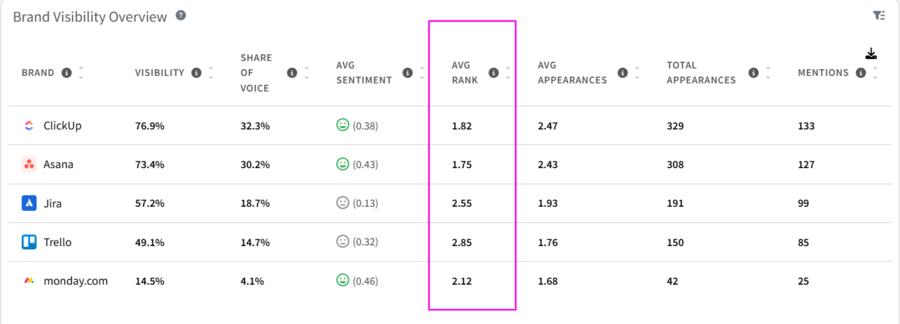
For example, you can see in the screenshot below that Monday has a 2.12 average rank.
This metric helps determine whether your content is merely supplying information or whether that information contributes to prominent brand visibility. If citation frequency rises while average answer position worsens, the engine may trust your content without considering your brand a leading recommendation.
Average Sentiment
Average sentiment measures the tone used when the AI answer discusses your brand in responses where your content, or another relevant source, is cited.
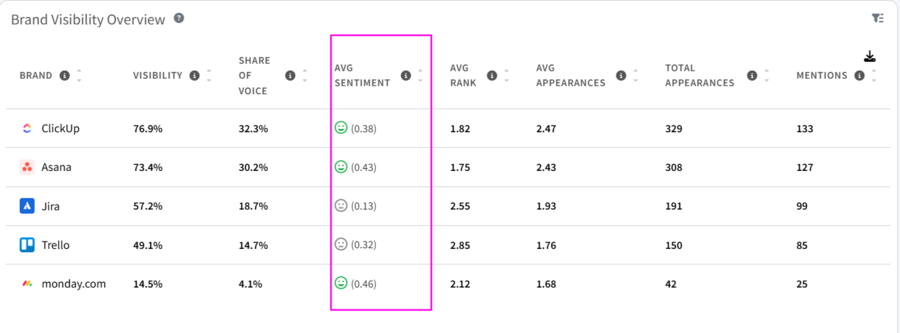
But if you want to check what sentiment each prompt and each LLM brings out about your brand, Mentionlytics allows you to click on the prompt, the source, the answer, and get an analysis of the sources and sentiment in that particular answer.
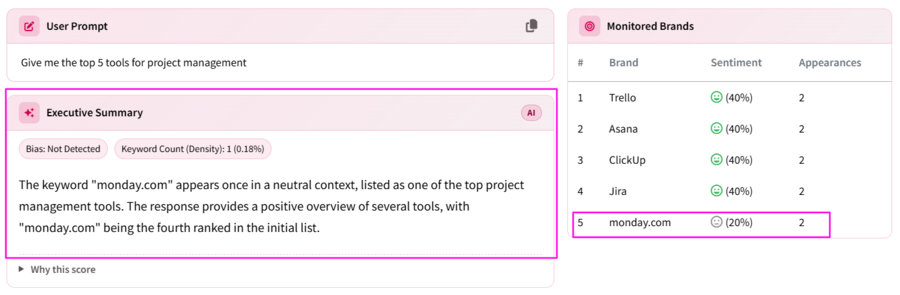
This shows whether citations support a favorable narrative, merely confirm factual information, or contribute to answers that emphasize limitations and complaints.
Source Type
Source type groups cited URLs into categories such as owned websites, competitor sites, editorial media, review platforms, etc.
For example, when it comes to project management tools, Reddit (35.26%) and Quora (8.09%) together make around 43% of citations. That indicates a strong impact of forum conversations on LLMs when providing answers related to software solutions for project management.
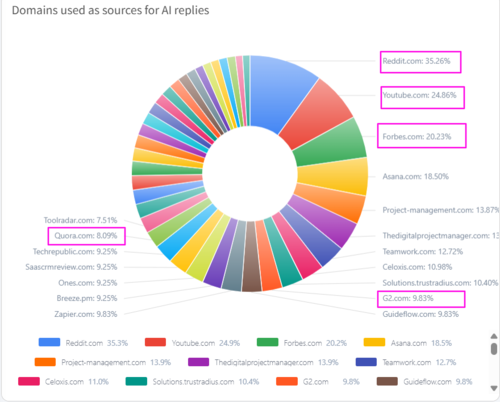
We can also see that Forbes made its way to the very top of the influential sources, just below YouTube. Review sites like G2 and ToolRadar also made it to the list.
Now, if you want even deeper analytics, calculate the percentage of total citations belonging to each category and compare it across platforms and prompt groups.
This metric tells SEO, content, and PR teams where authority is coming from.
Key Takeaway for SEOs
Tracking your own AI citations gives you a measurable way to demonstrate that content remains visible even when users do not click through to the website. But the raw citation count is only the beginning.
The most useful AI citation report shows which content earns trust, for which prompts, on which platforms, with what effect on the brand, and what the SEO team should do next.
How to Turn the Cited-Domain List Into a Digital PR Target List
A cited-domain export may look like another spreadsheet, but inside it is something genuinely useful: a list of the sources already influencing AI-generated answers in your category.
The job is to turn that raw list into a focused digital PR plan to earn you a seat at the AI-generated answers table.
Why AI engines cite the same handful of domains over and over
Citation lists are often much more concentrated than traditional SERPs. Google can display hundreds of different domains across variations of a query, while an AI platform may repeatedly return to the same publications, forums, comparison sites, and content platforms.
One study of ChatGPT citation patterns found that approximately 30 domains captured 67% of citations within a topic. The study also associated frequent citation with broad topical coverage and clusters of related content, rather than isolated pages targeting individual keywords.
LLMs like sources that are easy to trust, extract, and verify. Reddit, Quora, and review platforms represent a first-hand experience library; well-structured websites fit into RAG, and established legacy or open-knowledge platforms reduce the risk of hallucination.
But remember, the go-to sources might not be the same for every industry, country, prompt, or LLM.
Reddit, Quora, and forums: the citation sources nobody can really pitch
Redditors are highly suspicious of marketing, promotion, and anything that smells like a PR campaign, even when it arrives dressed in a sweet little “just another happy customer” costume.
That leaves brands in a frustrating position. Communities such as Reddit and Quora can strongly influence what LLMs say, yet you cannot approach them as traditional media outlets.
So, what can you do about it?
Start with the specific discussions appearing in your citation data, not Reddit or Quora as whole domains.
You can do it with Mentionlytics’ Top URLs for Citations. Sort it by Frequency Mentions, and you’ll get the list of specific URLs that are cited the most. Among them, you’ll find forum threads and conversations.
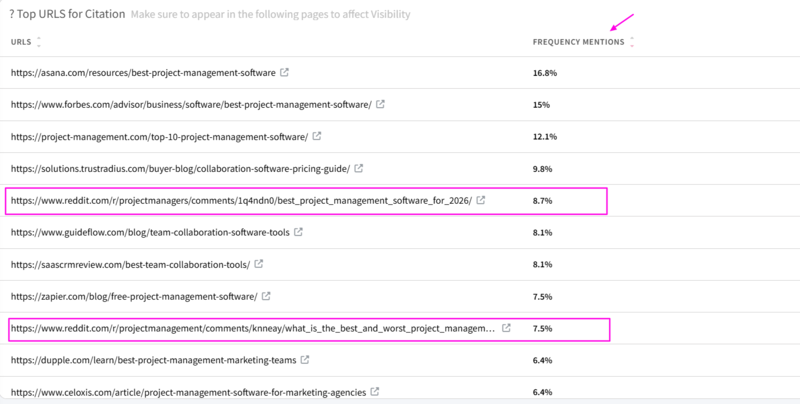
Click on the link of the source and check whether each conversation is still active, what question people were trying to answer, which comments received the strongest response, and why particular brands were recommended.
If the discussion is still open and you can genuinely improve it, enter the conversation as someone who can help. Answer the actual question, share relevant experience, acknowledge the limitations of your solution, and disclose your connection to the brand. Do not force a product mention into a thread where it does not belong. Reddit can detect a sales pitch from several subreddits away.
For older or inactive discussions, resist the urge to revive them purely to mention your product. Instead, treat them as marketing intelligence data.
How to build a PR target list from AI citation data, in 5 steps
A cited-domain list becomes useful only after you connect each source to a concrete opportunity. Here is a repeatable process you can use for one campaign, product category, market, or client.
Step 1: Export the Cited Domains for a Fixed Prompt Set
Start by exporting every URL cited across the prompts that matter to your brand. Include the prompt, AI platform, date, cited URL, domain, answer, and any brands mentioned in that AI answer.
Choose one commercially meaningful group of prompts, such as:
- “Best project management tools”
- “Project management tools for agencies”
- “Project management software for small businesses”
- “Asana alternatives”
Keep the prompt set, country, language, AI platforms, and tracking period consistent. Otherwise, you will not know whether a domain is influential or merely benefited from being included in a much larger sample.
Step 2: Segment Every Domain by Source Type
Next, categorize each source according to how it can realistically be influenced. Useful segments include:
| Source segment | Examples | Potential route in |
| Editorial publications | Forbes, industry magazines, news websites | Journalist outreach, expert commentary, research, contributed content |
| Listicles and review sites | “Best X” articles, G2, TechRadar | Product inclusion, review, updated information, comparison data |
| Blogs and niche publishers | Independent industry sites, consultants | Guest expertise, collaboration, original data |
| Communities and forums | Reddit, Quora, specialist forums | Transparent participation, community support, customer advocacy |
| Social and creator platforms | LinkedIn, YouTube, Substack | Creator partnerships, interviews, demonstrations, expert contributions |
| Institutional sources | Universities, associations, government sites | Research, partnerships, authoritative resources |
| Competitor-owned content | Competitor blogs and product pages | Competitive intelligence rather than outreach |
| Your own domain | Blog posts, guides, product pages | Content optimization and internal linking |
This step prevents your team from applying the same outreach tactic to every URL. A Forbes contributor, a Reddit moderator, and a competitor’s product manager are not three names for the same email sequence.
Step 3: Score Domains by Citation Influence
Now determine which domains deserve attention first. Begin with citation frequency: how many times did each domain appear across the tracked prompt set? Score the list by frequency, and you’ll see which URLs showed up across AI models the most.
Sweta Panigrahi, Senior Account Manager at Rankingonai.com
Before jumping on the list and reaching out to every single creator, author, or platform from the list, check which prompts these citations show up in and for which LLMs.Your priority should be those that bring you leads and make you get recommended by AI assistants.
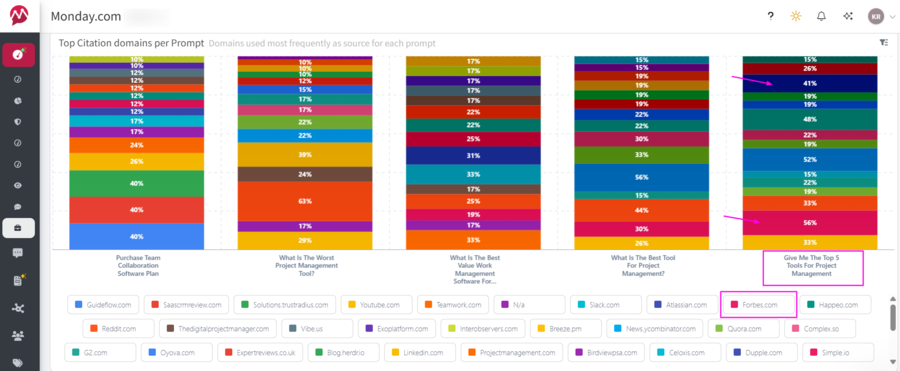
So, in my Monday example, the most used source for answering the prompt “Give me the top 5 tools for project management” is Forbes, accounting for 55% of the answer engines, and the second best is Asana.
But when I check domains per LLM, I can see that these two domains impact AI Mode, AI Overviews, Gemini, and ChatGPT, and not Perplexity or Copilot.
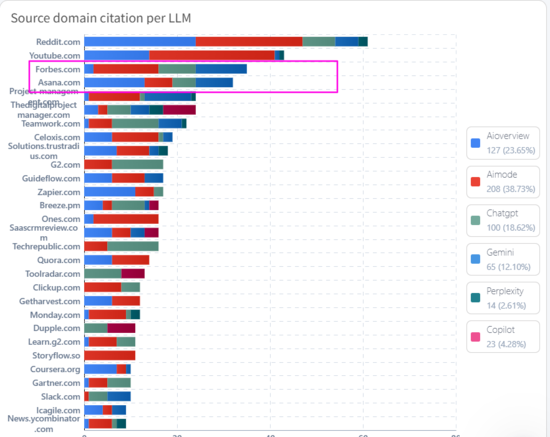
If I want to improve my position for a specific prompt, I need to know exactly which LLMs use it and what the exact URLs are that I should go for. So I just scrolled down a bit to the Top citations table, sorted them by frequency, and I got two URLs that had the greatest impact.
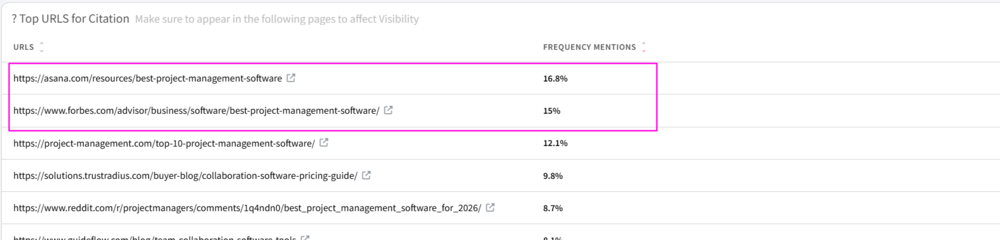
So, even though Reddit and YouTube are cited more than these two in general, these are the sources that have the greatest influence on the prompt where I want to see improvements. If I wanted to improve AI visibility in Perplexity and Copilot, my list would look completely different.
Step 4: Check Whether Your Brand Is Already Present
A frequently cited domain is not automatically an outreach opportunity. First, inspect the exact cited URL and classify your current presence. Use four categories:
- Present and positioned strongly. Your brand is included accurately and favorably.
- Present but positioned weakly, Your brand appears, but competitors receive more detail, better placement, or a stronger recommendation.
- Absent but relevant. The content covers your category and includes comparable competitors, but not your brand.
- Not a realistic fit. The page is cited for background information, covers a different market, or offers no legitimate reason to include you.
For pages where your brand is absent, identify the likely reason. That gap determines the outreach angle.
Step 5: Assign One Outreach Approach to Every Viable Target
The final step is to turn each opportunity into an actual assignment. Add the contact, owner, outreach approach, supporting asset, deadline, and status to the list.
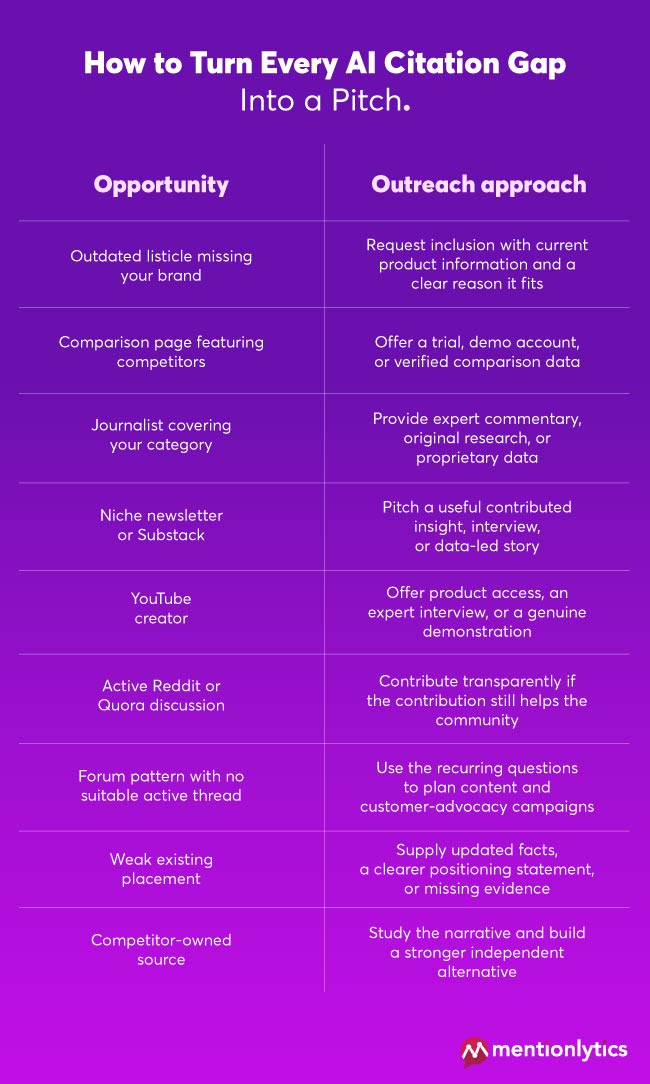
Key Takeaway for Agencies and PR Teams
Prioritize the domains that repeatedly influence AI answers, identify where your clients are absent or weakly positioned, and match each source with a realistic route in.
Then measure whether the placement changed citation share, prompt coverage, or brand position across the same prompt set.
How to Benchmark the Cited Content and Build the Better Version
Once you know which pages AI engines cite for your priority prompts, the next question is obvious: what do they have that your content doesn’t?
Reverse-engineer why that page got cited
AI engines usually cite a page because a particular passage supports part of their answer. That means the real unit of answer engine optimization is often the paragraph, table, or list, and not the entire page.
Start with the exact prompt, identify the claim connected to the citation, and find the passage that appears to support it. Then check:
- What question does the passage answer?
- How quickly does it provide the answer?
- Is it a paragraph, list, definition, statistic, or table?
- Does it name specific products, features, audiences, or limitations?
- Is the claim supported by data or expert evidence?
- What could you explain more clearly or completely?
For example, a competitor may be recommended as the best tool for agencies because its page explicitly connects white-label reporting and client dashboards with agency workflows. If your page lists the same features without explaining who they are for, that missing connection may be the real content gap.
How to track competitor citations in AI search results
Run the same prompt set for your brand and competitors. For each prompt, note:
- Which competitors appear
- Which competitor or third-party pages are cited
- Which LLM produced the answer
- What position and sentiment each competitor receives
- Which feature, audience, or use case is associated with them
Every prompt where a competitor is cited and your brand is absent becomes a potential opportunity.
When to restructure existing content vs. build new
It’s basically very simple. Use two questions: Does an existing page answer the same question, and does it already rank within the top 20?
| Current situation | Best move |
| Same intent and top-20 ranking | Restructure and strengthen the existing page |
| Same intent but weak rankings | Improve content, authority, and technical performance first |
| Partial intent match | Add a dedicated section to the existing page |
| No page answers the question | Create new content |
The simple rule is: restructure when an existing page matches the intent and already has search traction; build new when cited sources answer a question your content has never addressed.
Maira Volitaki, Senior Content Manager at Mentionlytics
Key Takeaway for Content Marketers
Benchmark the passage, not just the page. Start with the prompt, identify the information supporting the AI answer, and study why it was easy to extract and trust. Then improve an existing page when it already matches the intent, or create something new when the question remains unanswered.
AI Citation Tracking Tools: What to Look For and Which Ones Do What
AI citation tracking tools may appear remarkably similar until you try to use the data. The real difference is whether the platform helps you prove your SEO influence on how often AI models cite your content, find digital PR opportunities, and benchmark the content AI engines cite instead of yours.
Now, if you’re very new to AI visibility tracking, some things may never come to your mind until you’re already in a yearly contract with an LLM citation monitoring tool. To prevent that, make sure to check these things first:
- Engine coverage
- Prompt limit
- Citation exports
- Historical data
- Multi-client support
Comparison Table: Which tools track which engines, and which support all 3 jobs
| Tool | AI search engines tracked | SEO proof | PR targeting | Content benchmarking | Best for |
| Mentionlytics | ChatGPT, Gemini, Perplexity, Copilot, AI Mode, AI Overviews | Tracks cited domains and URLs by prompt, LLM, and frequency and shows visibility trends for the set of prompts | Sortable and exportable Top Citation URLs reveal influential sources per prompt and LLMs, where your brand is absent | Shows the exact answers, cited URLs, competing brands, and prompts behind each citation | Cross-functional marketing, SEO, PR, and agency teams |
| Profound | ChatGPT, Perplexity, Gemini, Claude, Copilot, AI Mode, AI Overviews, Grok, DeepSeek, and others* | Measures citation authority, visibility trends, and AI crawler activity at enterprise scale | Identifies the domains and narratives influencing brand visibility across markets and engines | Deep answer, competitor, query fan-out, and brand-accuracy analysis | Enterprises with a dedicated GEO owner |
| Ahrefs Brand Radar | ChatGPT, Gemini, Perplexity, Copilot, AI Mode, AI Overviews | Connects AI citations with rankings, backlinks, organic mentions, and search demand | Reveals third-party pages citing or mentioning competitors, supported by familiar Ahrefs authority metrics | Combines discovered AI queries with competitor and content research inside the existing SEO workflow | SEO teams already using Ahrefs |
| Peec AI | ChatGPT, Gemini, Perplexity, Copilot, AI Mode, AI Overviews* | Monitors citation visibility and brand position across a fixed prompt set | Surfaces frequently cited sources and competitor wins without an enterprise-level setup | Makes it easy to compare prompts, competitors, sentiment, and cited sources from one dashboard | Small and mid-sized in-house teams |
| OtterlyAI | ChatGPT, Perplexity, Copilot, AI Overviews; additional engines available as add-ons* | Provides simple daily tracking of brand mentions, links, and citation changes | Helps small teams spot recurring third-party sources across a limited prompt set | Offers an accessible way to compare cited links and competitor appearances before investing in deeper analysis | Solo marketers and teams testing AI-search monitoring |
*Coverage may depend on the selected plan.
Now, depending on your budget, primary intention, and goal, your choice might be any of these AI citation trackers.
Tool #1: Mentionlytics for AI Citation Monitoring and Deep Analysis of Brand Visibility
Mentionlytics is best for teams that want to analyze AI citations alongside brand visibility, sentiment, competitor performance, and conversations happening across the web and social media.
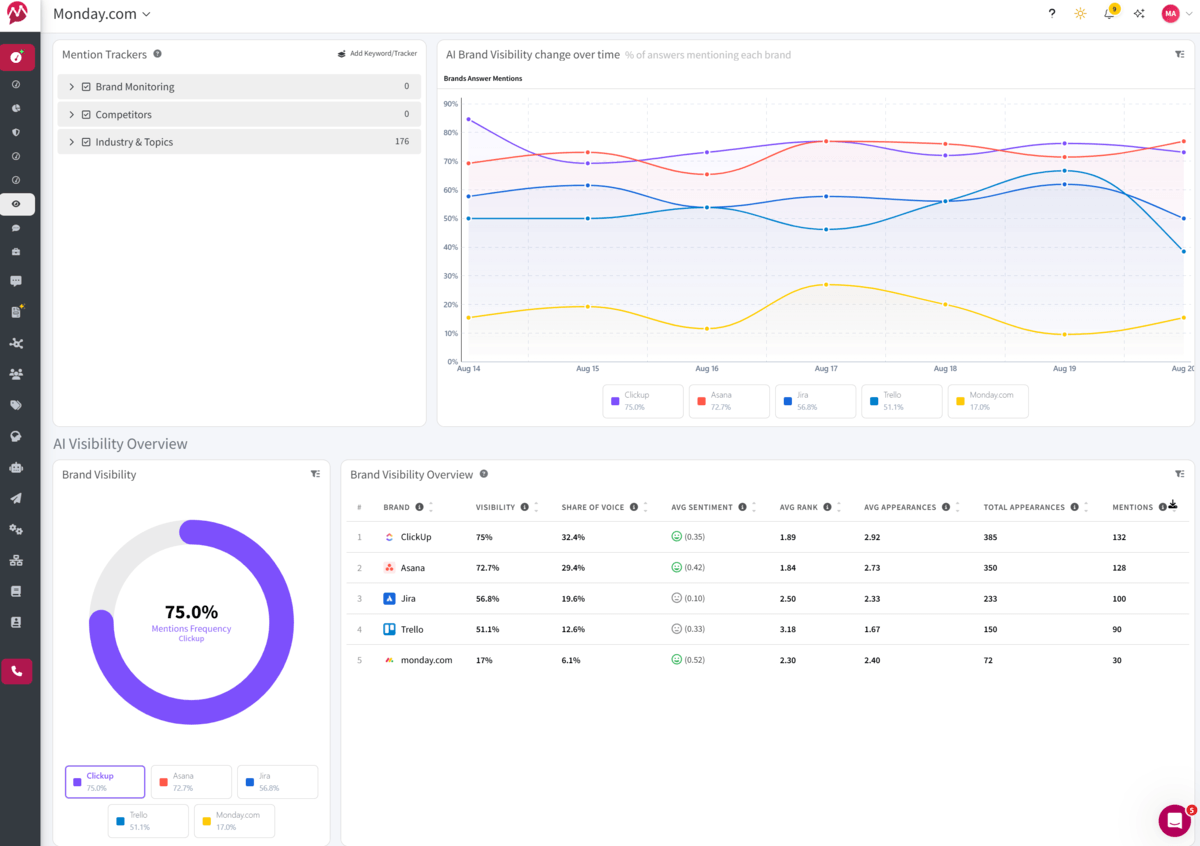
Mentionlytics’ AI Brand Visibility software tracks ChatGPT, Gemini, Perplexity, Microsoft Copilot, Google AI Mode, and AI Overviews. Users can view the analytics through three available dashboards:
- AI Visibility Overview
- AI Answers Analysis
- AI Citation Analysis
You can compare visibility by prompt and LLM, inspect the generated answers, and see which domains and URLs are cited most frequently.
It’s useful for SEOs, digital PR, and content management teams because it provides context: a citation can be evaluated alongside the brand’s answer position, sentiment, competitors, co-mentions, and the conversations shaping its reputation elsewhere online.
Best for: Marketing, SEO, PR, and agency teams that want to manage all three citation-tracking jobs within a wider brand-intelligence platform.
Pricing: AI Brand Visibility is available as an add-on to any of the existing plans, and starts at $49 per month, billed monthly.
Tool #2: Profound for Enterprise AI Search Intelligence
Profound and its Answer Engine Insights platform monitor visibility, citations, sentiment, competitors, and brand accuracy across a broad selection of AI engines. It also offers features such as Citation Authority, FactCheck, query fan-out analysis, and AI crawler analytics.
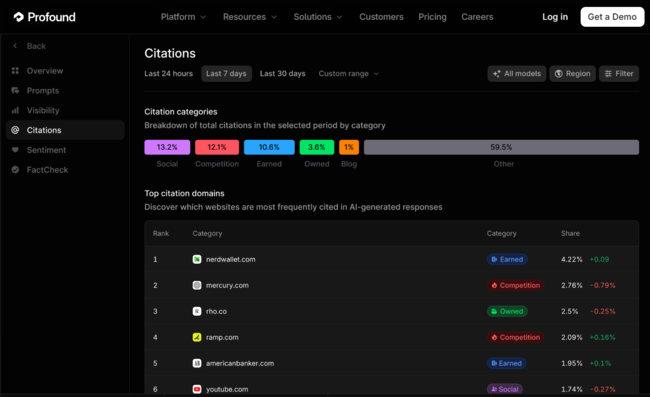
Teams can examine which sources influence AI answers, identify inaccurate claims, compare competitors, and investigate how different engines interpret a brand. This makes Profound suitable for organizations treating GEO as a dedicated function rather than another report added to Friday’s SEO meeting.
Best for: Large brands with a dedicated GEO owner, multiple markets, substantial prompt sets, and teams ready to operationalize advanced AI-search data.
Pricing: Starter begins at $99 per month for ChatGPT and 50 prompts.
Tool #3: Ahrefs Brand Radar for SEO Teams That Already Use Ahrefs
The greatest strength of Ahrefs Brand Radar is workflow gravity. If your team already checks rankings, backlinks, competitors, and content performance in Ahrefs every day, having AI visibility data in the same ecosystem is extremely convenient.
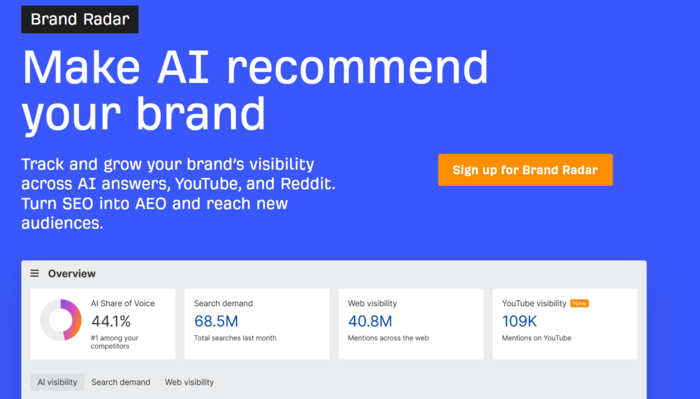
Brand Radar combines a large database of organically discovered prompts with custom prompt tracking, allowing teams to investigate brand mentions, citations, competitors, and visibility trends without building every tracked question manually.
It can support all three jobs, but its natural center of gravity remains SEO. It is particularly useful for comparing AI citations with rankings, backlinks, web mentions, and search demand. The tradeoff is that teams needing deeper prompt-level narrative analysis, digital PR workflows, or broader reputation monitoring may prefer a dedicated platform.
Best for: SEO teams already paying for Ahrefs that want AI citation data beside the rankings and backlink reports they regularly use.
Pricing: Individual AI platform indexes cost $199 per month.
Tool #4: Peec AI for Fast, Focused AI Visibility Tracking
Peec AI is designed for teams that want to set up their brand, prompts, competitors, and selected AI models without spending weeks building an enterprise measurement system.
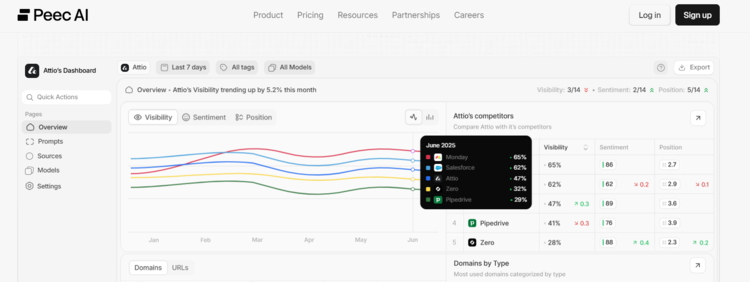
Standard plans let users select three models, while additional coverage depends on the package or add-ons.
Its strongest use case is straightforward prompt and competitor monitoring. Teams can quickly see where their brand appears, which competitors win, and which sources contribute to those answers. Citation analysis and exports are available, making it useful for content benchmarking and basic PR targeting.
It is lightweight to operate, but not necessarily a lightweight expense once several engines, markets, and clients are added.
Best for: Small and mid-sized in-house SEO or content teams that want daily tracking and clear competitor insights without the complexity of an enterprise suite.
Pricing: Starter costs $95 per month for 50 prompts, three selected models, and one project.
Tool #5: OtterlyAI for an Affordable Start With AI Citation Tracking
OtterlyAI earns its place in many tool comparisons because it offers one of the lowest entry points for ongoing AI-search monitoring. Its interface focuses on prompt tracking, brand mentions, citations, competitor benchmarking, and changes in visibility over time.
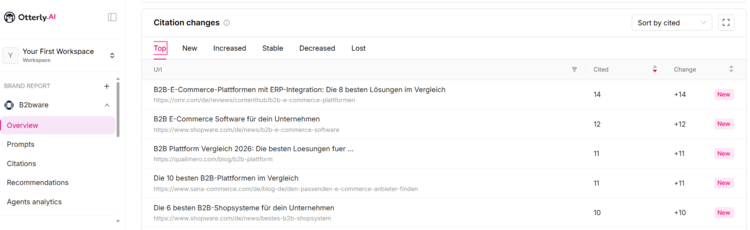
The Lite plan tracks 15 prompts daily across ChatGPT, Perplexity, Microsoft Copilot, and Google AI Overviews. Gemini, Claude, and Google AI Mode are available as additional add-ons. OtterlyAI also offers free single-use tools for checking visibility or citations, but those checks are better for an initial look than continuous reporting.
Fifteen prompts are enough to monitor a small, carefully chosen commercial prompt set. They are not enough to map multiple products, audiences, funnel stages, countries, and competitors. Teams usually outgrow Lite when they need broader prompt coverage, several workspaces, detailed PR prioritization, or more sophisticated analysis of why particular pages keep getting cited.
Best for: Solo marketers and small teams testing AI-search monitoring before investing in a broader platform.
Pricing: Lite starts at $29 per month on monthly billing.
Which AI Citation Tool to Choose?
Choose the tool based on the job you need to perform after the graph tells you that your citation share is 12.4%.
- Choose Mentionlytics if you want to connect citation tracking with digital PR, sentiment, competitor intelligence, and wider brand monitoring.
- Choose Profound if AI search is becoming a dedicated enterprise function with its own owner, budget, and cross-team workflow.
- Choose Ahrefs Brand Radar if your AI visibility work naturally belongs inside your existing SEO workflow.
- Choose Peec AI if you want focused prompt, citation, and competitor monitoring with relatively fast setup.
- Choose OtterlyAI if you want to begin with a small prompt set and a lower monthly commitment.
Start Tracking Your Citations in AI Search with Mentionlytics
We’re all witnessing that AI models have their favorite citation sources, and that these sources impact how often your brand pops up in the answers and recommendations. That’s why AI citation tracking is quickly becoming another essential routine for marketing teams.
For that, you need a tool that will enable you to understand how AI models think and what sources they rely on for specific prompts. Mentionlytics covers citation and visibility monitoring and helps you win this new race we’re in. Try it free and close the citation gap that’s preventing new leads from coming your way.
FAQ
What is AI citation tracking?
AI citation tracking is the process of monitoring which domains and URLs AI platforms use as sources in their generated answers. It shows whether your own content is being cited, which third-party pages influence your brand visibility, and which sources help competitors appear in recommendations.
How do I track AI Overview citations?
You can track AI Overview citations manually by searching your target queries in Google and recording the sources shown in each Overview. However, results can vary by location, account, query wording, and time. For continuous tracking, use a platform that monitors Google AI Overviews automatically, like Mentionlytics. Track a fixed set of prompts, record which URLs are cited, and compare the results over time to see whether your content gains or loses visibility.
Can I track brand citations in Perplexity?
Yes, Perplexity displays the sources supporting its answers, so you can check manually whether your domain or third-party content mentioning your brand is cited, or use Mentionlytics to get the citation list automatically.
How often should I check AI citation data?
Check high-priority commercial prompts daily or several times per week, and review broader citation trends weekly or monthly. AI answers fluctuate, so one isolated result should not trigger an emergency content rewrite before breakfast.
