


When the whole world is busy debating AI (“Will it replace us?”, “Will it finally write that novel I never finished?”), I decided it’s time to shift the spotlight onto another kind of intelligence: marketing intelligence.
Why? Because I’ve noticed far too many marketers mix it up with market intelligence. And market intelligence is just a part of a broader picture: a marketing intelligence system, sitting alongside customer, competitor, and product intelligence.
Put them all together, and you’ve got the real engine that powers smart marketing strategies.
Marketing Intelligence focuses on data related to your marketing activities and everything that has an impact on your marketing performance. Therefore, it’s like audience behavior, competitor campaigns, channel performance, and what’s trending in your industry. Basically, it answers “How do we market smarter?”
On the other hand, market Intelligence is about the overall market landscape, such as size, demand, supply, economic trends, regulations, and broader industry shifts. This one answers “Where should we play?”
So, in this article, we clear the air, unpack what marketing intelligence really means, how to enrich it with insights from social media, and how you can actually use it before your competitors beat you to it.
Table of Contents
- What is Marketing Intelligence?
- How Does Marketing Intelligence Help Drive Marketing Strategy?
- 5 Most Valuable Sources of Marketing Intelligence
- How to Collect Marketing Intelligence from Social Media & the Web
- What is the Best Marketing Intelligence Software?
- Ready to Enrich Your Marketing Intelligence Reports?
- FAQ
What is Marketing Intelligence?
Marketing intelligence is the process of gathering, analyzing, and applying data about your market (market intelligence), product (product intelligence), customers (customer intelligence), competitors (competitive intelligence), and industry trends to make smarter business decisions.
And these four key dimensions will determine what your marketing strategy should look like.

It’s like the GPS of marketing: it tells you where your brand is, shows you the best routes to reach your goals, and warns you about traffic jams (your competitors).
Marketers use marketing intelligence to:
- Build effective marketing strategies
- Understand potential customer behavior and preferences
- Monitor competitors’ moves (without turning into full-time spies)
- Discover competitive advantages
- Spot market opportunities and risks before they become obvious
- Optimize marketing campaigns for better ROI
At the end of the day, marketing intelligence turns raw data into actionable insights.
2 real-world examples of marketing intelligence
Because of its real-time insights, social listening is one of the most important components of marketing intelligence. It helps brands keep track of what’s being said about them, their competitors, and their industry in the exact moment it’s happening.
Let’s focus on two of the most common B2B marketing intelligence use cases that can make a real difference: Share of Voice (to see how loud your brand is compared to competitors) and Channel Effectiveness (to measure which platforms are truly paying off).
Share of Voice (SoV): Your Ticket to AI Search Engines’ Recommendations
Share of Voice (SoV) is often seen as part of competitive intelligence, since it compares how much of the online conversation your brand owns versus your competitors. But it’s also a key part of marketing intelligence, because it shows how effective your campaigns are at capturing attention in real time.
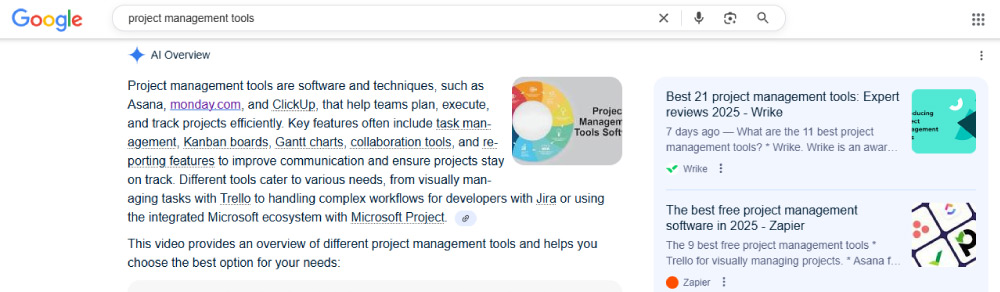
Take project management tools as an example. If you check Google’s AI Overview, you’ll see a handful of familiar names.
And when you compare their Share of Voice, Trello is currently leading the conversation, followed by Asana, then ClickUp, with Monday trailing behind by a couple of thousand mentions weekly.
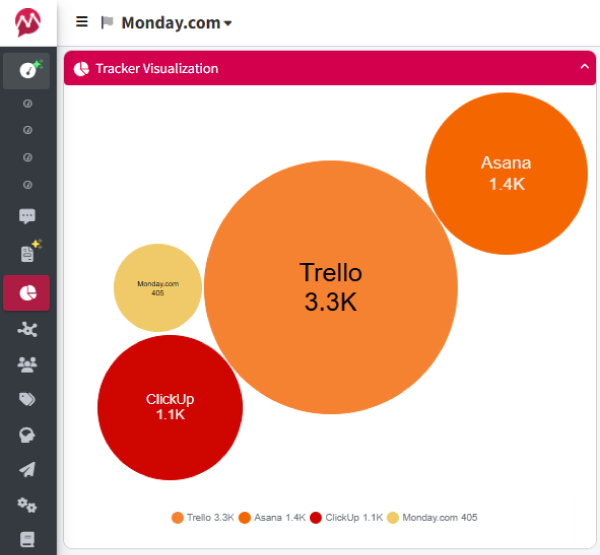
Now, this doesn’t mean Monday is in trouble; it still has strong visibility. But here’s the twist: when I asked ChatGPT to list the best project management tools, it gave me the exact same ranking as the SoV results.
Coincidence? Probably not.
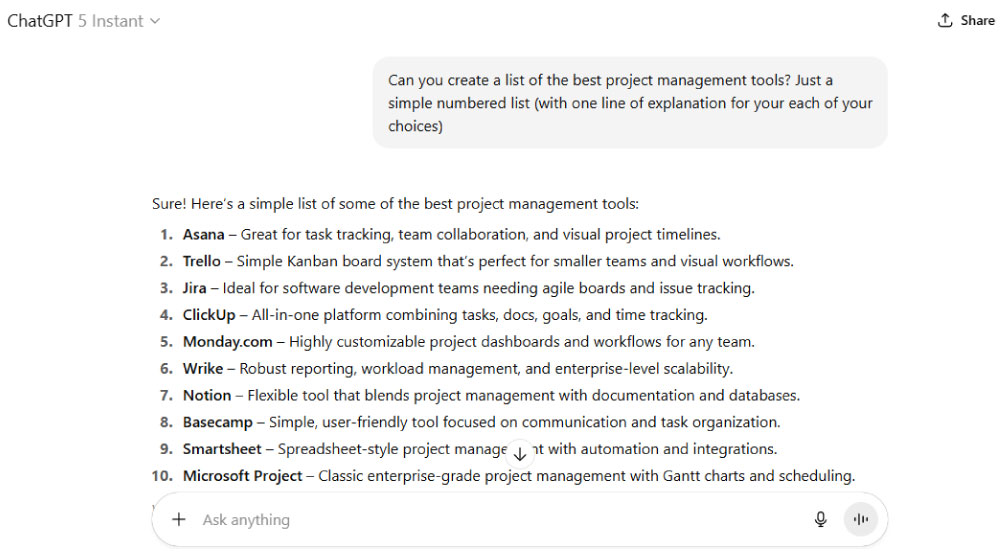
With ChatGPT holding 80.92% of the AI market share, this is a strong signal that Share of Voice doesn’t just reflect today’s buzz but directly influences how ChatGPT ranks and recommends tools and brands. And that means your visibility in conversations today could shape your visibility in AI search tomorrow.
Channel Effectiveness: To Invest Where You’ll Get the Most ROI
Not all marketing channels are created equal. Some will bring you visibility, clicks, and leads, while others will happily eat your budget and give you nothing but vanity metrics in return.
That’s where Channel Effectiveness comes in. It tells you which platforms are really delivering value.
Now, it won’t be the same for every segment of your marketing strategy. For example:
- If we’re talking about email campaigns, you’ll search for the open rate.
- If we’re talking about ads, you’ll have to check which channel brings high CTR.
- And if you’re focused on organic growth, engagement is your metric to check.
For example, many companies discover that LinkedIn doesn’t always deliver the biggest numbers in terms of likes or shares, but it consistently outperforms other platforms when it comes to lead quality. On the flip side, a platform like X might give you more buzz, but not the same conversion power.
Take Ryanair: the busiest channel for the airline is X, as you can see in the Total Media Share by Mentions Volume below. But once you filter media share by sentiment, X is where Ryanair has the most negative buzz, with a huge difference from the second channel.
In other words, being the loudest doesn’t always mean being the most loved.
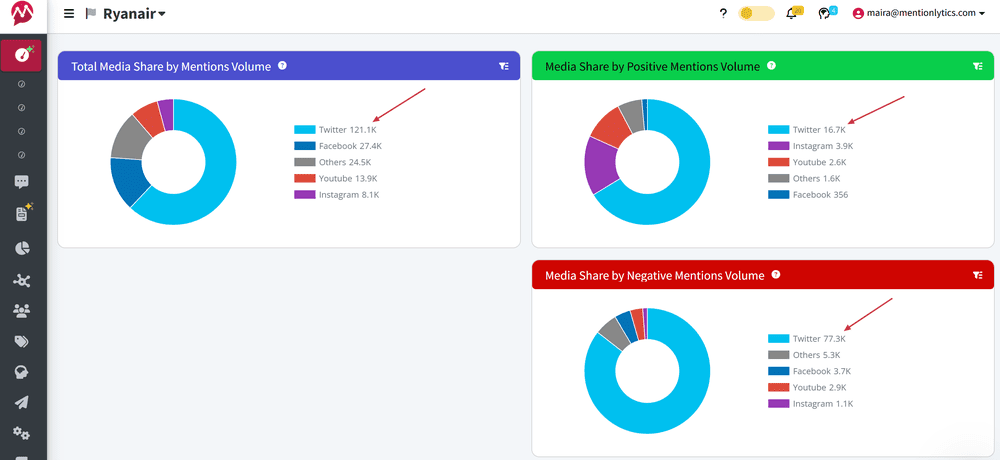
By measuring channel effectiveness, you can focus on the channels that matter most, reallocate budgets away from underperformers, and ensure your marketing mix is optimized.
Find Out Your Best Win
Mentionlytics will show you which channel delivers the biggest impact for your marketing strategy, so you don’t just shout louder, you win smarter.
Market research vs Marketing Intelligence
Things are becoming even more complex with the addition of market research.
No, it’s not a synonym. It means (again) something slightly different.

- Market Research: Usually project-based and specific. You have a question (“Do Gen Z shoppers like our new packaging?”) and you run surveys, focus groups, or experiments to get the answer. It’s focused only on a specific segment, product, target market, or campaign.
- Marketing Intelligence: Broader and ongoing. It constantly collects data from multiple sources (competitors, customers, campaigns, social media, industry news) to give you a full picture.
So, if both of these were light sources, marketing research would be like shining a flashlight on one corner of the room, while using marketing intelligence flips on the ceiling light, and suddenly you see the whole picture (and yes, that spider in the corner too).
How Does Marketing Intelligence Help Drive Marketing Strategy?
We live in turbulent times where each external disruption directly impacts your marketing strategy, and you know it; one moment you’re cruising on the right track, the next you’ve hit a dead-end.
That’s why your marketing strategy can’t be carved in stone. It needs to be flexible and ready to shift whenever the data tells you the winds are changing.
There’s no such thing as a “perfect” strategy; the real question is: how can you make it more efficient under current circumstances? That’s exactly where marketing intelligence steps in.
It brings together customer feedback, social listening insights, performance metrics, lead generation and conversion metrics, and an analysis of your competitor’s marketing strategies and tactics to give you a 360° view of your environment. And based on this analysis, you can make data-driven decisions and stay ahead.
If you gather and analyze data, you can:
- Anticipate risks before they become full-blown crises.
- Create content that resonates with what your audience actually cares about.
- Refine products or services based on real feedback.
- Adapt to new marketing trends and shifts in your audience’s preferences.
- Identify opportunities to optimize your marketing positioning.
- Find out which marketing channels and campaigns deliver the best ROI.
- Track lead generation and conversion metrics.
- And spot new competitors’ products or campaigns on time.
Cross-channel marketing intelligence keeps your strategy alive, adaptive, and one step ahead.
In which situation is marketing intelligence most useful?
Marketing intelligence shines brightest when you need the big picture to guide data-driven decisions, not just isolated answers. It feels the pulse of the outside world and gives you a clear picture of where your brand is at this moment in the market, compared to competitors and customers’ perception of your brand.
It’s especially useful in fast-growing industries, like SaaS, tech, renewable energy, B2B, fashion, healthcare, cryptocurrency/blockchain, consumer electronics, eCommerce, hospitality, and media and entertainment, where consumer preferences, competitor strategies, or market conditions can change overnight.
5 Most Valuable Sources of Marketing Intelligence
So, where do we search for data? Where do we actually get these golden pieces of information that shape strategy?
While marketers are drowning in dashboards, not every data source is equally valuable. In fact, there are five that stand out as the most impactful, and each tells you something slightly different about your market, your competitors, and your customers.
1. Social media
Social media is the world’s loudest focus group that you don’t have to pay for. People are brutally honest there, whether they’re giving kudos to your new product, dragging your competitor, or just complaining about that annoying old-fashioned feature you stubbornly hold on to.
Tapping into these conversations gives you real-time insights into what your audience actually cares about (not what they say they care about in surveys).
You can check things like:
- Brand mentions & sentiment on social media (X, Instagram, LinkedIn, etc.): What are people saying about your product or service — good, bad, or somewhere in between?
- Reviews on sites & apps: App store reviews, Google reviews, industry-specific platforms such as TripAdvisor, G2, etc., to see what features get praise, what features frustrate people.
- Relevant forums (Reddit, Quora, etc.): What people are saying about your brand outside controlled environments? A hint: people tend to share deeper opinions, use cases, and complaints.
- Trend detection: Track keywords, new topics, hashtags to see what’s bubbling up before it becomes mainstream.
- Competitor mentions and feedback: What do your competitors get called out for? Where are they missing the mark?
Get the Best Out of Your Social Media Source
Mentionlytics is here to help you collect and analyze data, and give you a tip on what to do to improve your social media strategy.
Why it’s No. 1
Because nothing gives you feedback faster. Launch a new product, drop a feature, or post a campaign, and boom, you’ll know in minutes whether people love it, hate it, or already turned it into comedy.
View this post on Instagram
2. Competitor activities
If you’re not watching your competitors, trust me, they’re watching you. Their product launches, campaigns, and even bad reviews are goldmines of intelligence. Think of it this way: every move they make is a free case study on what to do (or absolutely not to do).
You can check:
- Competitors’ websites: Have they updated their sites lately? New features, new messaging, new product pages?
- Campaigns: How many campaigns are running, who are they targeting, and are they actually working?
- Online reputation and visibility : What’s their Share of Voice compared to yours? Which channels do they dominate, and where are they flopping?
- SEO performance: How do they rank on Google? What keywords are they winning that you’re missing?
- ChatGPT and other AI engines’ results: And here’s the new one: how visible are they on ChatGPT or other AI engines? If customers are asking AI about your industry and only your competitors show up, that’s a red flag.
Why it’s No. 2
Competitors are basically your free R&D department. Watching what works (and flops) for them helps you avoid costly marketing mistakes and spot gaps they’re too slow to fill.
3. Market Intermediaries
Market intermediaries, such as distributors, wholesalers, retailers, and other “middle players”, are often overlooked, but they hold a treasure trove of market intelligence. They see what actually happens once your product leaves your warehouse: which items fly off the shelves, which ones stall, and what customers complain about most.
You can check things like:
- Sales patterns: Which products move fastest and in which regions.
- Bottlenecks: Where supply chains slow down or products pile up unsold.
- Customer feedback: The recurring complaints or praises intermediaries hear directly from buyers.
- Competitor activity: How rival products are priced, promoted, or performing in the same channels.
Why it’s No. 3
Because intermediaries live closest to the actual market reality. They connect the dots between supply, demand, and customer behavior, providing insights that you won’t find in a spreadsheet alone.
4. Research firms
Research firms are the experts who zoom out so you can zoom in with confidence. They’re the people building the telescopes, conducting in-depth studies, trend reports, focus groups, surveys, and big data work, so that you have a clue what you’re going to encounter around the corner.
You can check things like:
- Product or feature testing: Will customers like what you plan to build before you build it?
- Brand perception and positioning: How does the world see you vs. your rivals? What could push you from “good enough” to stand out?
- Segment and demographic studies: Who really is your audience (beyond just “young” or “tech-savvy”)? What do they love, what bugs them?
- Industry and trend reports: What’s changing in your field? Is it new regulations, emerging competitors, or shifting consumer habits?
Why it’s No. 4
Because research firms give you the macro-view: the authoritative, broader insights that help you validate what you think is happening, before you commit resources. They’re not always as fast as a social listening tool, but their depth and rigor help you avoid costly missteps.
5. Your CRM
If social media is the noisy crowd and reviews are the public gossip, then your CRM is the private diary your customers didn’t know they were writing.
It holds every detail of your relationship with them: purchase history, sales interactions, support tickets, churn signals. Unlike external chatter, this is your first-party goldmine, all structured, reliable, and fully yours.
You can check things like:
- Purchase patterns: What products are repeat favorites, and when do customers usually buy?
- Customer lifecycle data: Who’s likely to upgrade, who’s at risk of leaving?
- Support history: What recurring issues frustrate your customers most?
- Engagement trails: Which campaigns or touchpoints actually moved someone closer to conversion?
Why it’s No. 5
Because while the outside world shows you how people talk about your brand, your CRM shows you how they act. Together, they give you both sides of the story.
How to Collect Marketing Intelligence from Social Media & the Web
So, you know where to look, but the real question is: how do you actually collect all this juicy marketing intelligence without spending your entire life hopping from platform to platform? The answer is simple: you need to centralize.
Instead of manually checking mentions on X, scrolling through LinkedIn comments, googling your competitors, and digging into forums (yes, people still use them), smart marketers use tools that pull all this data together in one dashboard. That way, you’re turning it easily into insights you can actually use.
With Mentionlytics, for example, you can monitor social media, news sites, blogs, forums, and even YouTube comments in real time. Add AI-powered sentiment analysis, keyword tracking, and Share of Voice comparisons, and suddenly you’re not chasing conversations anymore, you’re steering them.
Step-by-Step Guide
- Set Your Goals – Decide what you want to measure: brand reputation, competitor visibility, campaign impact, or all of the above.
- Track the Right Keywords – Add your brand name, product names, competitors, and industry terms to catch every relevant mention.
- Include Competitors – Because context matters. Seeing your performance without comparing it to theirs is like checking your speedometer without looking at the road.
- Analyze Sentiment – Separate the love from the hate. Are mentions positive, negative, or neutral? This tells you more than volume ever could.
- Compare Channels – Calculate your media share and engagement across platforms to see where your efforts are really paying off.
- Spot Trends Early – Use alerts to catch spikes in mentions (good or bad) so you can react fast.
The most important thing when using a social listening tool is the setup, because it will determine the quality of the collected data. Set it wrong, and you’ll miss the best part.
Don’t Be Shy
If you get stuck, just ask the Mentionlytics support team. They’ll make sure you’re set up to capture every insight that matters.
What is the Best Marketing Intelligence Software?
Choosing the best marketing intelligence software solution will largely depend on the type of insights you want to collect and how you plan to use them.
For example:
- Social listening insights: Mentionlytics helps you track conversations, sentiment, Share of Voice, and competitor mentions across social media, news, blogs, and forums.
- Customer behavior & CRM data: Tools like HubSpot give you deep insights into customer journeys, purchase history, and engagement patterns.
- SEO & web analytics: Google Analytics or Ahrefs can reveal how people find your site, which keywords you rank for, and where you’re losing traffic.
- Email marketing data: Tools like Moosend show you open rates, click-throughs, conversions, and even spam triggers, turning your inbox stats into real campaign intelligence.
- Market & industry trends: Platforms like Statista or Nielsen provide macro-level research and benchmark data.
The real power comes when you combine these tools. Social listening reveals how people talk about your brand, your CRM shows how they act, SEO analytics track how they find you, email data shows how they respond, and market reports help you prepare for what’s coming next.
Together, that’s marketing intelligence in action.
Ready to Enrich Your Marketing Intelligence Reports?
At the end of the day, marketing intelligence is about people. No report is truly complete without the authentic voice of your customers and audience. That’s why social media conversations, reviews, and online chatter deserve a front-row seat in your analysis.
Because while market trends and CRM data give you the what, social listening gives you the why. And that “why” is often the difference between a good strategy and a great one.
So, if you’re ready to make your marketing intelligence reports smarter, sharper, and more human, start by listening to online conversations.
Capture the real voice of your audience and start vibing with them with a 14-day free Mentionlytics trial.
Let your campaigns finally strike gold.
FAQ
What are the different types of marketing intelligence?
There are several different types of marketing intelligence, including:
- Customer insights
- Competitor analysis
- Product intelligence
- Market trend monitoring.
Combining them, you get a complete set for making data-driven decisions.
How is marketing research different from competitive marketing intelligence?
The main difference between marketing research and competitive marketing intelligence is that marketing research is project-based and specific, while competitive intelligence is ongoing, tracking rivals’ moves and market position.
What is big data in marketing intelligence?
Big data in marketing intelligence is the massive, complex datasets (social, behavioral, transactional) analyzed with AI to reveal patterns and predict trends.
What is the difference between marketing intelligence and marketing analytics?
Marketing intelligence focuses on gathering external data to guide strategy. On the other hand, marketing analytics focuses on your internal campaign data.
What is marketing intelligence in corporate strategy?
For a corporate strategy, marketing intelligence is the compass that aligns marketing actions with business goals, ensuring decisions fit both market reality and company growth.


