


LLM visibility measures how often and accurately your brand appears in AI answers, now essential due to zero-click traffic loss. And no wonder it’s become a hot topic on Reddit, LinkedIn, and in industry conversations.
Since the customer journey has changed a lot in just one year, brands hit a wall with the zero-click trend and a drop in organic traffic, which automatically resulted in fewer leads.
As potential customers increasingly switch from traditional Google search to direct AI responses, LLM brand visibility tracking is becoming a way to increase brand mentions and recommendations in large language model (LLM) answers.
In this article, we’ll explain why LLM visibility deserves a place in your marketing reports, how LLMs see your brand, and how to track your visibility with Mentionlytics in five simple steps. We’ll also cover the additional metrics that complete the picture and show you how to compare your brand’s performance against competitors.
Table of Contents
- Why Shouldn’t LLM Visibility Be Missing From Your Marketing Reports?
- How LLMs See Your Brand
- 5 Simple Steps to Track Your Brand’s LLM Visibility with Mentionlytics
- Additional LLM Visibility Metrics to Measure and Get The Complete Picture
- How Can I Analyze My Competitors’ Visibility in LLMs?
- Start Tracking Your LLM Visibility Now
- FAQ
Why Shouldn’t LLM Visibility Be Missing From Your Marketing Reports?
LLM visibility is quickly becoming an essential part of marketing reporting, and while there are a lot of reasons for tracking it, we focus on three major ones:
- AI is changing how people search for information and discover brands.
- Organic traffic alone no longer reflects the complete customer journey.
- Strong LLM brand visibility is becoming a new source of competitive advantage.
Because LLM Visibility Is Really Affecting Search Behavior
With the global total monthly users reaching 4.1 billion in Q1 2026 and 70% of Google users already using AI search for top-of-the-funnel questions, according to McKinsey, it is obvious that the customer journey has changed.
People are turning to ChatGPT, Gemini, Copilot, and other AI models to learn about product categories, research solutions, and discover brands, often before visiting a traditional search engine or company websites. McKinsey also found that 44% of AI search users already consider it their primary and preferred source of information.
That means your brand can enter or disappear from a potential customer’s journey before they ever reach your website. If someone asks an LLM for “the best xx tools for a small business”, and your brand is included in the answer, you gain an immediate advantage. On the other hand, if your brand is left out, you may never make it onto the consideration list, regardless of how well your website ranks on Google.
Because Organic Traffic Is Not Giving The Full Picture Anymore
For years, organic sessions, keyword rankings, and conversions helped marketers understand whether search was bringing people to their brands. Those metrics are still important, but they only measure what happens when someone clicks. LLMs can now introduce your brand, compare it with your competitors, describe the strengths, and influence buying decisions without generating a single website visit.
But the impact of LLM brand visibility is not affecting only organic traffic. According to statistics, 41% of consumers trust AI-generated answers more than ads. That means watching over organic and paid traffic is not giving you the full picture of how your brand is presented and perceived by your potential customers.
AI brand visibility reports help you fill that gap. They show whether your brand appeared during AI-assisted discovery, how it was described, which prompts triggered a mention, and which content was cited and used as a source.
Because LLM Search Visibility Is a Competitive Analysis Treasure Trove
LLM visibility tracking does much more than tell you whether ChatGPT knows your brand exists. It reveals which competitors appear for your most valuable prompts, how frequently they are recommended, what qualities they are associated with, and which sources support those recommendations.
For example, it’s not a secret that Jira is considered one of the best project management tools, but not when it comes to marketing teams. And that’s exactly how the LLMs see it too. With the Mentionlytics AI visibility tool, I could see that among five competitors, ClickUp and Asana are considered to bring the most value to marketing teams, while Jira shows up the least in the AI-generated answers for that prompt.
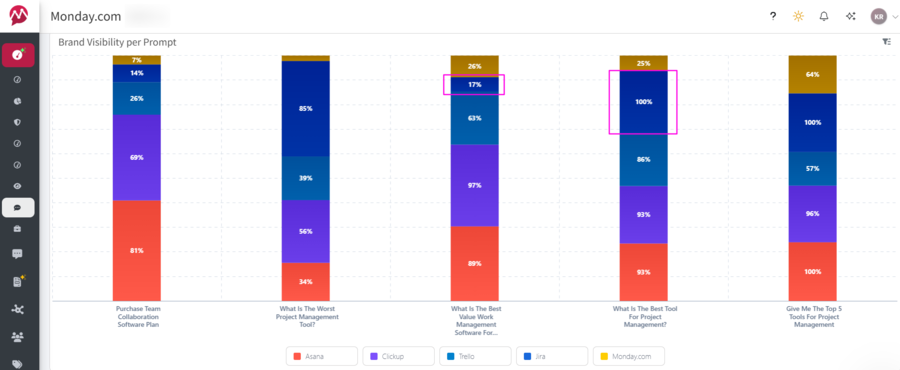
With this logic, you can track which competitor wins a specific niche, and if you compete there, you can check the sources LLMs used and make sure you’re listed as the best option for that specific use case.
In this case, for example, the most used source for this is the Celoxis blog post “7 Best Project Management Software for Marketing Agencies”.
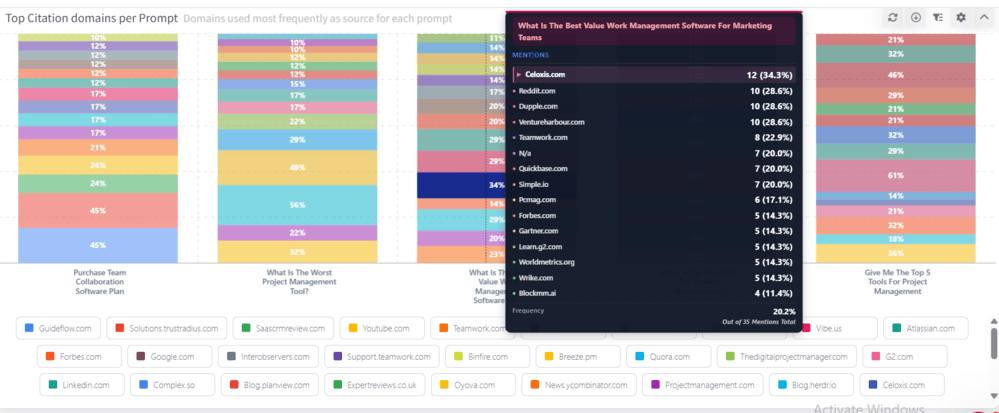
These pieces of information you get from LLM prompt monitoring are far more useful than a simple visibility score or number of LLM mentions. They can point to specific patterns related to your brand and your competitors. And tracking these patterns over time can help you discover:
- Prompts and topics your competitors currently dominate
- Product features and use cases associated with each brand
- Competitors that frequently appear alongside you
- Websites, reviews, and publications cited in their favor
- Gaps where no brand has established strong LLM brand visibility yet
In other words, you can monitor your competitive environment the same way your customers do, and see who is getting recommended constantly by AI. You can also quickly identify where your brand has the best chance to move in before everyone else notices the empty seat.
How LLMs See Your Brand
LLMs don’t see your brand as a website, logo, or carefully created “About us” page your team revised a thousand times. They build an understanding of your brand from pretrained material and information scattered across the web, which could be basically anything, from a Reddit comment, product documentation, a LinkedIn post, a YouTube review, or another website that mentions your brand in its articles.
Your own content may or may not influence AI answers because AI platforms like ChatGPT might opt for your competitors’ blog post where they list your brand as one of the alternatives, and whatever information is there is going to affect the response.
LLM answers also change over time as models are updated, new content is published, different sources are retrieved, and competitors strengthen their online presence. Two people may even receive different responses to the same prompt.
That is why checking one question in ChatGPT does not tell you how LLMs see your brand. It gives you one snapshot from one platform at one moment. To see the full picture, you need to track multiple prompts across different LLMs and continuously monitor appearances, citations, sentiment, and competitors.
Tired of Manual Prompting?
Mentionlytics shows you real visibility in AI-generated answers in ChatGPT, Gemini, Google AI Overviews, AI Mode, Copilot, and Perplexity with the list of AI citations that impact the responses.
5 Simple Steps to Track Your Brand’s LLM Visibility with Mentionlytics
Now that we know LLMs can present a slightly different version of your brand depending on the prompt, platform, and day of the week, the next question is obvious: how do you turn all those shifting answers into something measurable?
Mentionlytics brings the data into dashboards for ongoing analysis and customizable reports for sharing the results. Here is how to set up your LLM visibility tracking in five simple steps.
Step 1: Create Your LLM Visibility Tracking Project
Start by creating a new AI Visibility project in Mentionlytics. Add your brand, the competitors you want to benchmark against, and the prompts that reflect how potential customers search for products or services like yours.
Your prompt list should cover more than your brand name. Include questions related to:
- Product categories
- Customer problems and use cases
- Important features
- “Best tool” recommendations
- Brand comparisons
- Reputation and customer opinions
For example, for monitoring Mentionlytics’ own LLM visibility, we track the “What’s the worst brand monitoring tool?” prompt so we can catch any negative AI mentions. So far, we’ve seen none (pheeew), but better be safe than sorry.
If you lack the inspiration for the prompts, you can always use our AI prompt suggestions.
Determine which LLMs you want to track, for which countries, and how often (from one to four times a day, weekly, monthly, quarterly, or yearly).
These settings matter because LLM answers can differ by platform, country, and even from one run to the next. Running important prompts more frequently provides a more reliable picture of your visibility, while less frequent schedules may be enough for broader, long-term benchmarking.
Once the project is active, Mentionlytics will run the prompts according to your selected schedule and begin collecting data about AI brand appearances, competitor mentions, sentiment, products and services, and cited sources. In other words, you configure the experiment once; Mentionlytics handles repeated questioning without prompting fatigue and analyzes your brand visibility in AI answers.
Step 2: Give Mentionlytics Enough Time to Collect Data
Your first results provide an initial snapshot, but LLM visibility becomes much more useful when you track it over time. Give it a week, two, or a month to see if the results are consistent or there’s significant fluctuation.
AI answers are not fixed. A brand may appear today, disappear tomorrow, and return next week accompanied by three competitors it has never been compared with before. This is exactly why one manual ChatGPT search cannot tell you much.
Give Mentionlytics enough time to run your prompts repeatedly and build a meaningful data history. As more results are collected, you can distinguish genuine visibility trends from the occasional LLM plot twist.
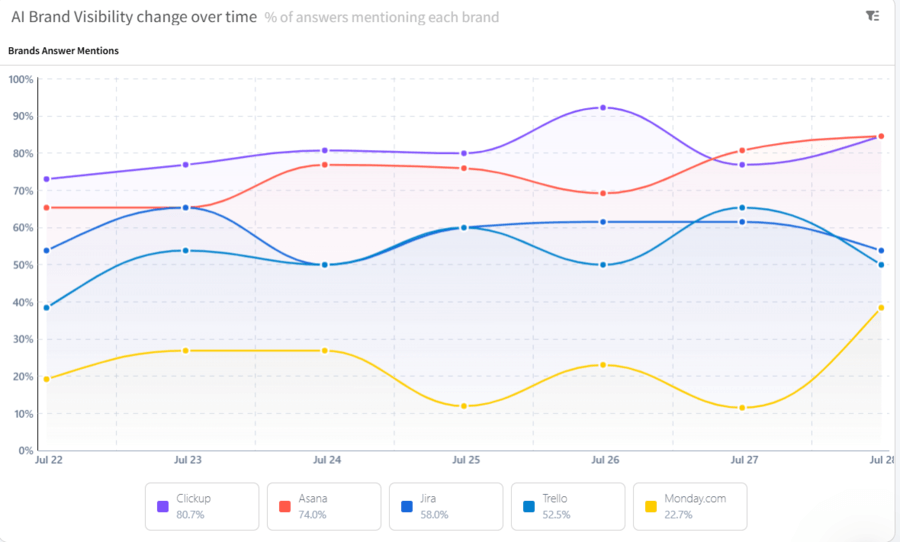
Step 3: Review Your LLM Visibility Dashboards in Mentionlytics
Once the results start coming in, use your dashboards in Mentionlytics to check how your brand stands in terms of LLM visibility and what is influencing its position. Mentionlytics provides three dashboards for LLM brand monitoring, and each focuses on a different part of your visibility.
- AI Visibility Overview
This is your quick LLM visibility checker. It brings together the core metrics you need to evaluate your performance, monitor changes, and report the results.
At a glance, you can review:
- AI Visibility change over time
- Brand visibility score in percentages
- AI Share of Voice
- Sentiment
- Average appearance
- Average rank
- Total appearance
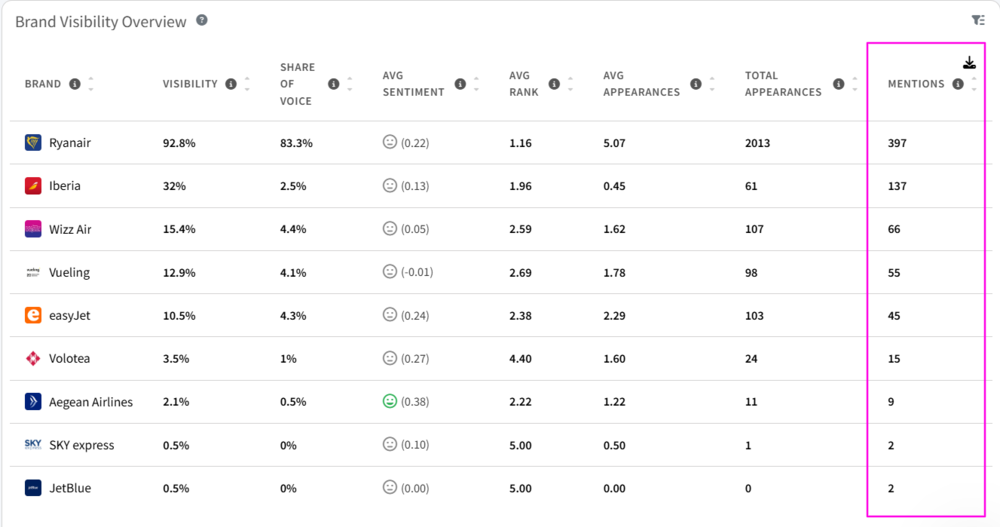
- Number of mentions
- Brand visibility per LLM
- Brand visibility per prompt
- Domains used as a source for the answers
- Top URLs for citations
- Answer Analysis
The Answer Analysis dashboard helps you understand what is happening inside the AI responses.
Here, you can benchmark your brand against competitors, discover which other companies appear in the same answers, and identify the products and services associated with each brand.
You can also see which prompts generate the most recommendations for your brand, where competitors outperform you, and which influential voices or sources may be shaping those results.
- Citation Analysis
Citation Analysis is probably the most actionable dashboard, particularly for generative engine optimization (GEO).
It shows which external sources LLMs rely on and where you may need to focus your content, SEO, digital PR, or outreach efforts.
You can analyze:
- Domains used as a source in the answers
- Top citation domains per prompt
- Brand visibility per LLM
- Source domain citations per LLM
- Top URLs for citations (clickable links take you directly to the source)
And here is a useful little bonus: every chart element is clickable. If a number catches your attention, you can open the underlying LLM answers and investigate what caused it. Because sometimes a visibility score tells you something changed; the actual answer tells you whether to celebrate or call an emergency meeting.
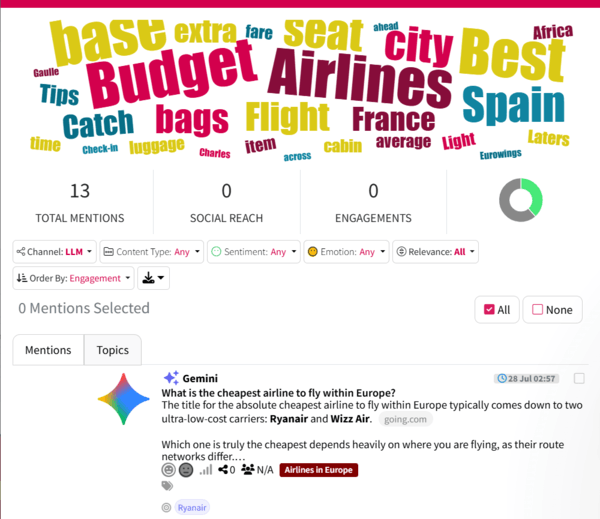
Step 4: Customize Your LLM Visibility Reports
Not all metrics are for every report. It all depends on who you are presenting the report to. A CEO probably won’t be impressed with a co-mentions products and services chart, but your product development team will find it most valuable.
Now, since Mentionlytics reports are highly customizable, you can choose which element you want to include in your report.
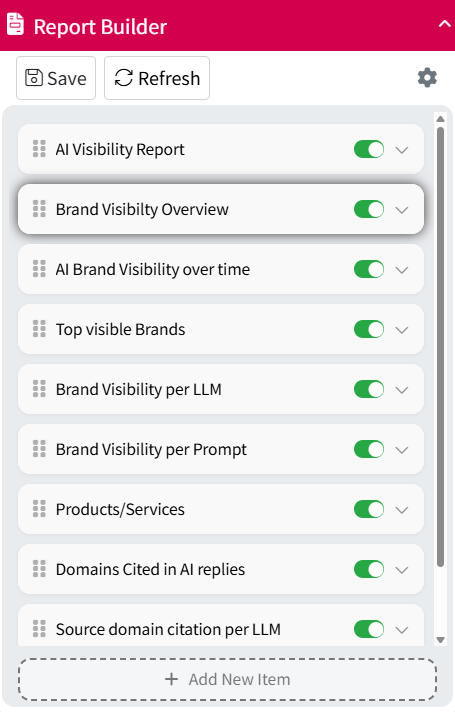
You can add report elements such as:
- AI Visibility: Compare your visibility score with competitor scores.
- AI Visibility Over Time: Show whether each brand is gaining or losing visibility.
- Brand Visibility per Prompt: Identify the prompts your brand wins, loses, or fails to appear for.
- Brand Visibility per LLM: Compare your performance across ChatGPT, Gemini, Copilot, and other monitored platforms.
- Top Visible Brands: Discover which companies appear most frequently in the selected answers.
- Products and Services: See which offerings LLMs associate with your brand and its competitors.
- Citation Domains and Top URLs: Reveal which websites and individual pages are influencing AI answers.
- Overview and Sentiment Share: Summarize appearances, mention trends, and positive, negative, or neutral brand coverage.
And if you want to build a targeted report instead of sending each department the same collections of charts, here are a few examples:
| Department | Elements of the Report |
| CEO and executives |
|
| Marketing teams |
|
| SEO and GEO teams |
|
| PR and reputation management teams |
|
| Product teams |
|
| Agencies | Who do you report to? Once you determine who the report is for, you can adjust it accordingly. |
The goal is to answer the questions each group actually has.
- A CEO wants to know whether the brand appears in AI answers more often.
- A product team wants to know what AI says the product does.
- A GEO specialist wants to know why Wikipedia keeps getting invited to every answer while the company blog waits outside.
Customizable reports make it easy to present valuable insights for each group while keeping the focus.
Step 5: Download Your LLM Visibility Insights and Share with Team or Clients
Finally, download your customized report and share it with the people responsible for SEO, content, PR, brand reputation, product marketing, or overall strategy.
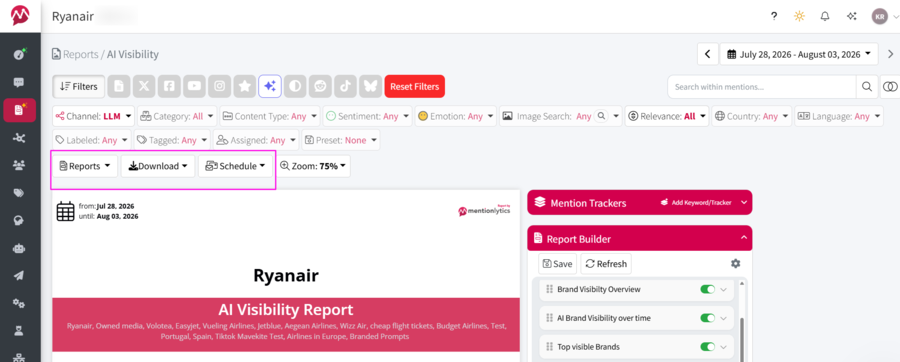
Mentionlytics lets you:
- Download the report as a PDF for easy sharing.
- Export it as a PowerPoint presentation when the findings need more explanation.
- Export it to Canva to customize the design or turn the data into a client-ready presentation.
- Embed it directly into your CRM or another internal platform.
- Schedule reports to be sent automatically at your preferred frequency.
This gives you several ways to use the same insights. You can send executives a scheduled PDF, prepare a PowerPoint for a quarterly strategy meeting, polish a client presentation in Canva, or embed a live report where your team already works.
Get Your LLM Visibility Report
And surprise your team, clients, or CEO with valuable insights with Mentionlytics’ AI Visibility Tool!
Additional LLM Visibility Metrics to Measure and Get The Complete Picture
Some metrics are very popular, and you’ll see them in every discussion as the “critical ones”. But on their own, they are just fragments. You need a more holistic approach to LLM visibility, and a full set of metrics to understand how to improve brand presence in LLM answers and AI search results.
So, here are some metrics that might not be in the spotlight, but will give you a clearer picture of your brand performance within LLMs and generative AI search.
AI Share of Voice
This metric shows you who’s taking the largest piece of the LLM visibility cake across Google AI Overview, AI Mode, Gemini, ChatGPT, and other platforms. It compares your brand’s presence in LLM answers with that of your competitors.
It counts how many times a brand appears, including multiple appearances in a single answer.
Average Sentiment
Average Sentiment reveals whether LLMs describe your brand positively, negatively, or neutrally. Plenty of mentions may look impressive until you discover that AI keeps recommending your competitor and listing you under “alternatives with mixed reviews.”
AI Mentions
AI Mentions counts how many times your brand is named across the collected answers. It helps you measure overall exposure and track whether your content, SEO, PR, and GEO efforts are leading to more frequent inclusion in relevant responses.
Citations
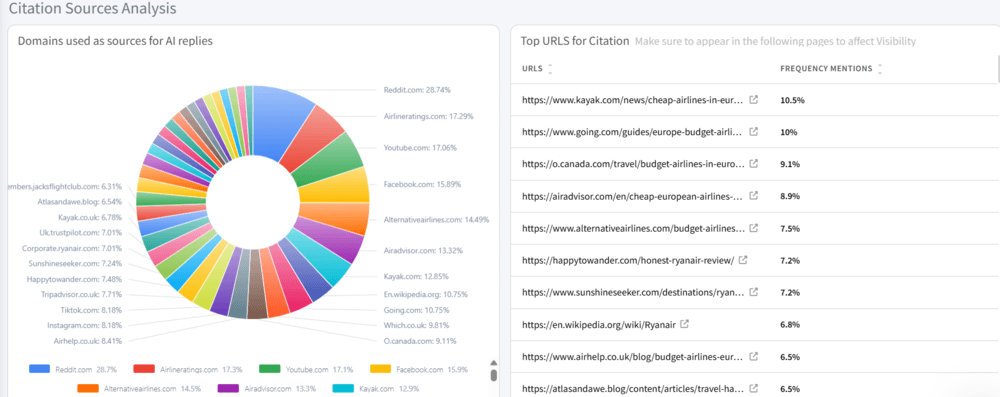
Citations show which domains and individual pages LLMs use to support their answers. Tracking them helps you identify the sources already influencing your brand narrative, discover valuable content and PR opportunities, and spot competitor pages that AI platforms apparently cannot stop quoting.
With Mentionlytics’ Citation Sources Analysis, you can see exactly how, in percentages, one domain and a specific URL have been used.
Brand Visibility per Prompt
Brand Visibility per Prompt shows exactly which questions include your brand and which ones leave it out. It helps you find the topics, features, audiences, and buying scenarios you already own, as well as the commercially important prompts where competitors are currently taking all the seats.
This metric reveals gaps in how AI systems perceive and position your brand. By tracking prompts for specific features, audiences, or use cases, you can see where your brand appears, where it is missing, and which companies LLMs recommend instead. You might even discover a competitor you never considered a real threat.
How Can I Analyze My Competitors’ Visibility in LLMs?
Competitor analysis in Mentionlytics can go far beyond checking whether another brand has a higher AI Visibility Score. Used properly, it can show you which parts of the AI-generated customer journey your competitors already control, why LLMs recommend them, and where your brand still has room to move in.
The best way to do this is in several layers.
Build Your Real LLM Competitor List
Start by adding your known competitors to the competitor list in your AI Visibility project. Mentionlytics will monitor those brands across the same prompts, countries, scheduled runs, and LLMs as your own brand.
This allows you to compare:
- LLM Visibility Score
- AI Share of Voice
- Visibility change over time
- Average rank and appearances
- Number of mentions
- Average sentiment
- Visibility per prompt
- Visibility per LLM
- Products and services associated with each brand
- Citation domains and URLs
- Changes in visibility over time
But here is where it gets more interesting: your business competitors and your LLM competitors are not necessarily the same.
The Answer Analysis dashboard can reveal brands repeatedly appearing in the same responses as yours, including companies you did not add to your original competitor list. A smaller specialist tool, a new startup, or even a platform from an adjacent category may be winning prompts that matter to your customers.
In other words, do not build your competitor list only from the brands your sales team has been discussing for the past five years. Let the LLM answers show you who is actually competing for attention now.
Find Out What Each Competitor Owns
Once you know who appears, use Brand Visibility per Prompt to discover what each competitor is visible for.
You can see, for example, that Ryanair shows up in almost every prompt except when it comes to safety. There, the score goes a bit down, and gets closer to Iberia.
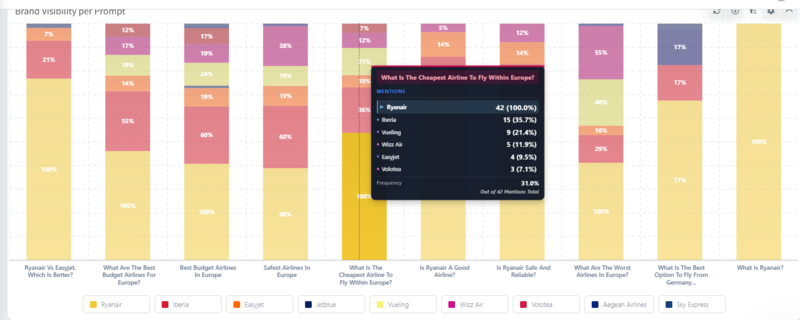
This is more useful than simply knowing who “won” AI Share of Voice. It reveals the territory each brand occupies inside LLM answers.
Group your prompts around strategically important themes, such as:
- Products and services: What are the best payroll platforms for international companies?
- Features: Which project management tool has the best workload-planning features?
- Industries: What is the best inventory management software for manufacturers?
- Customer types: What is the best CRM for a small B2B sales team?
- Use cases: What are the best platforms for managing wholesale orders online?
- Problems customers want to solve: What software can reduce cart abandonment for an eCommerce store?
- Pricing or affordability: What are the best affordable accounting platforms for startups?
- Alternatives and comparisons: What are the best alternatives to Salesforce?
- Reputation and customer experience: What is the worst airline for traveling in Europe?
You can then create a competitor visibility map. It may show that your brand has strong overall visibility but disappears from prompts related to a profitable use case. Or perhaps a competitor ranks frequently but is usually presented as expensive, difficult to implement, or suitable only for large companies.
That distinction matters. High visibility is not automatically good visibility, and low visibility does not always mean your competitor is harmless.
Create Your Own Competitor Visibility Map
Mentionlytics will provide you with the insights you need, and all you have to do is connect the dots. Experience a new level of competitor analysis!
Add Prompts Focused Entirely on a Specific Competitor
Your project does not have to contain only category prompts or direct “[Your Brand] vs. [Competitor]” comparisons. You can add questions focused entirely on a particular competitor to investigate how LLMs understand its brand. For example:
- What are the best alternatives to [Competitor] for [specific need]?
- Which tools offer [important feature] that [Competitor] lacks?
- What is a more affordable alternative to [Competitor]?
- Which platform is easier to use than [Competitor]?
- What are the disadvantages of using [Competitor] for [audience/use case]?
- Which companies should avoid [Competitor]?
- I’m considering [Competitor] and [Your brand]. Which is better for [specific need]?
- What are the most common complaints about [Competitor]?
These prompts help you see your competitor through the lens of LLMs: positioning, strongest features, target audiences, reputation, and vulnerabilities. They can also reveal which brands LLMs consider its closest alternatives, and whether your brand makes that shortlist.
Because Mentionlytics lets you schedule prompts from one to four times per day or run them weekly, monthly, quarterly, or yearly, you can monitor high-value competitive prompts more frequently and use less frequent runs for broader market research.
You can also run them across different LLMs and countries. A competitor may dominate ChatGPT answers in the US while barely appearing in Gemini responses for Germany. One global visibility score would hide that difference completely.
Reverse-Engineer Why Competitors Are Winning
Finding out that a competitor dominates a prompt is only the diagnosis. Citation Analysis helps you investigate the cause. Check:
- Which domains are cited in answers featuring the competitor
- The top citation domains for each prompt
- Which sources particular LLMs rely on
- The individual URLs cited in those answers
- The influential voices shaping the responses
The clickable URLs take you directly to the source, while clickable chart elements let you inspect the underlying LLM answers. This gives you the context behind the number.
Perhaps a competitor is winning because it appears in several authoritative comparison articles. Maybe its documentation answers a particular question exceptionally well. It could be supported by Reddit marketing, customer reviews, industry publications, or one highly cited page that has quietly become an LLM favorite.
That tells you what action to take. You may need to create better content, clarify your positioning, update product pages, strengthen third-party coverage, pitch specific publications, earn inclusion in comparison articles, or encourage more authentic customer conversations.
The goal is to understand the type of evidence LLMs trust for the prompts you want to win.
Track Whether Their Advantage Is Growing or Slipping
One isolated result cannot tell you whether a competitor has established a durable advantage or simply enjoyed a lucky LLM cameo.
Use AI Visibility Over Time, AI Share of Voice, average appearances, rank, mentions, and sentiment to monitor changes. Then open the underlying answers when you notice something unusual. For example:
- Did a competitor’s visibility increase after a product launch?
- Did new media coverage improve its sentiment?
- Is it suddenly appearing for prompts it never owned before?
- Has it gained visibility in one LLM but lost it in another?
- Did a new citation source begin influencing several answers?
- Is your brand replacing it in important recommendation lists?
This turns competitor tracking into an early-warning system. You can spot new positioning, emerging threats, reputation problems, and content strategies before those changes become obvious in traditional search or traffic reports.
Create a Dedicated Competitor Project When the Stakes Justify It
If one competitor is particularly important, you can create an entire LLM Visibility monitoring project around that brand.
This gives you room for a much broader prompt set covering its products, audiences, features, reputation, pricing, alternatives, strengths, weaknesses, and customer concerns. You can also include that competitor’s closest rivals, which may reveal a competitive environment that looks very different from your own.
A dedicated project makes sense when:
- You are preparing to enter a competitor’s market.
- You are planning a major product launch.
- Sales regularly loses deals to that company.
- The competitor suddenly gains LLM visibility.
- You need research for positioning or messaging.
- You are preparing a replacement or alternative campaign.
- A client needs a detailed competitive intelligence report.
You can then turn the findings into a customized report for marketing, product, PR, sales, or leadership and download it as a PDF or PowerPoint, edit it in Canva, embed it into an internal system, or schedule its delivery.
Used this way, Mentionlytics shows you what each competitor owns, who and what is strengthening its position, where that position is vulnerable, and which actions could help your brand take its place.
That is competitor analysis with somewhere to go, ideal for agencies that run a deep analysis before suggesting an LLM visibility strategy.
Start Tracking Your LLM Visibility Now
Everyone is already asking ChatGPT, Gemini, and other LLMs which brands they should trust, compare, avoid, or buy from. The only question is whether AI mentions your brand and in what context.
Mentionlytics helps you track your LLM visibility across the prompts, platforms, competitors, and countries that matter to your business. You can see where your brand is recommended, which competitors are taking your place, how AI describes your products, and which sources are shaping the answers. Then, you can turn those insights into content, SEO, GEO, PR, product, and reputation management actions that improve your position.
LLM brand visibility is still new enough to create an advantage, but it will not stay that way for long. Start tracking it today for free and build the visibility your brand will need to win tomorrow.
FAQ
How to monitor LLM visibility of my brand?
Track a set of prompts that potential customers use to discover, compare, and evaluate brands in your category. Monitor whether your brand appears, its position and sentiment, which competitors appear alongside it, and which sources LLMs cite. Mentionlytics automates this process across multiple LLMs, countries, and repeated prompt runs.
What is the role of user-generated content in LLM brand visibility?
Reviews, forum discussions, social posts, and other user-generated content help LLMs understand how real people experience and describe your brand. Positive recommendations can reinforce your authority, while recurring complaints may shape less flattering answers. Your website explains what your brand promises; user-generated content reveals whether people believe it.
How to automate reporting of AI search visibility performance in LLMs?
Some of the best LLM search visibility tools, like Mentionlytics, have the option to schedule reports for automatic delivery, embed them in your CRM, or export them as a PDF, PowerPoint, or Canva.
How to test prompts for LLM search visibility?
Build prompts around the ways customers actually research your category: recommendations, features, use cases, comparisons, alternatives, pricing, and reputation. If you’re doing the testing manually, make sure to stay logged out and to use incognito mode to avoid personalization. But you have to be aware that large language models (LLMs) work on a probability basis, meaning the answers will not be the same even if you run the same question from the same country. That’s why it’s best to use a tool for LLM brand tracking.
What are the causes of low visibility in LLM search results?
Low LLM visibility may result from limited online coverage, weak topical authority, unclear brand positioning, few credible third-party mentions, or content that does not answer the questions users ask. Your competitors may also have stronger reviews, comparison-page coverage, media mentions, or content cited by LLMs. Mentionlytics’ Citation Analysis can help you identify the sources supporting their visibility and the gaps you need to address in content creation.
How does LLM visibility affect local SEO?
LLMs can influence which local businesses people consider before they visit a website, open a map, or make a booking. They may use business listings, local media, review platforms, directories, and customer discussions to recommend providers in a particular area. Tracking location-specific prompts helps you see whether your brand enters these recommendations, how it is described, and which nearby competitors AI prefers.
