


AI brand visibility competitive analysis shows you where your brand stands compared to competitors in LLM answers. You can do it through five easy steps:
- Finding competitors
- Creating a set of prompts
- Finding a tool to track everything
- Measuring the right metrics continuously
- Understanding why your competitors are winning, and turning these findings into actionable insights
As you can see, brands now have a new terrain where they have to beat competitors. That’s LLMs and AI search land. So far, you’ve been competing with other brands in your industry on the streets, radio shows, TV, the internet, forums, and social media, and now it’s time to benchmark in AI answers.
If AI models recommend your competitors and ghost your brand, it’s time to perform a competitor analysis in AI search and see how to improve your position in the eyes of AI.
In this article, we’re going to explain what AI brand visibility competitive analysis is, give you a step-by-step process to follow to do it right, find the best software solution for doing it, and give you the option to try it for free. Just to check where it will take you.
Table of Contents
What is AI Brand Visibility Competitive Analysis?
AI brand visibility competitive analysis explains which competitors are showing up in the AI answers, which URLs from your competitors’ domains large language models (LLMs) use, what prompts competitors are winning, and what answers you dominate. Overall, you track, measure, and benchmark your brand against your competitors within AI search engines, LLMs, and generative answers.
Monitoring competitors has always been a part of marketing strategy. It’s one of the essential steps you take before you determine how to improve your brand positioning. But now, alongside the traditional one, you need to do competitive analysis for AI visibility.
So, why are we doing all of this? Why bother when ChatGPT will always choose a well-known brand instead of yours… Well, because things are not black-and-white; there are a lot of shades of gray where you can influence things just by doing the analytics and correcting minor (or major) gaps.
The customer journey has changed, and staying loyal to a system that no longer functions is the same as not doing the analysis at all. If your customers moved their queries from the traditional Google search to Gemini or AI Mode, you need to know what’s going on there and make things right, so your brand shows up next time someone asks about the best solution in your industry.
According to a McKinsey study from last year, 50% of consumers actively use AI-powered search today. So, if you’re not in the answer, you might lose 50% of your potential customers.
Some will say life was much easier without AI adding pressure to your marketing team, but the truth is much simpler: you just need to shift focus.
Fortunately, you don’t have to do the job manually. I’m pretty sure it’s impossible with the amount of data you need to analyze. There are a lot of tools to analyze AI Visibility that can help you. All you have to do is choose the right one and follow the steps below.
Our Tested 5-Step Process to Perform AI Brand Visibility Competitive Analysis
Let me show you the fastest and most accurate way to perform an AI brand visibility competitive analysis, without needing to expand your team or to invest a lot of time and money into it.
Build your competitor set and a buyer-intent prompt library
This is probably the step you’re going to spend most of your time on. You already know who your competitors are, but you might be surprised by some brands you might not even consider as a threat, yet they take your space in AI answers.
So, research a bit (play manually with Gemini, AI Mode, and the rest of LLMs and AI search engines), and see who shows up.
Or, if you want to shorten the process, you can choose a tool that will show your AI share of voice, in comparison with the competitors you entered and others that show up (which you might not even know existed, and yet LLMs consider them significant).
Now the prompts… what could you ask? Or better put, what would your potential customers ask LLMs? The possibilities are endless, since people do get creative when chatting with LLMs, but what you can do is group prompts into four categories:
- Informational prompts: “What is AI brand visibility, and why does it matter?”
- Instructional prompts: “How do I track where my brand appears in AI-generated answers?”
- Comparative prompts: “Which tools are best for monitoring brand visibility across ChatGPT, Gemini, and Perplexity?”
- Transactional prompts: “Which AI visibility platform should I book a demo with?”
You can also group these questions according to the marketing funnels, and it looks something like this:
| Funnel stage | Search intent | Example prompt |
| Awareness | Informational | “What is AI brand visibility, and why does it matter?” |
| Problem exploration | Informational / Instructional | “How can I find out whether AI platforms mention my brand?” |
| Consideration | Comparative | “What are the best tools for tracking brand visibility across ChatGPT, Gemini, and Perplexity?” |
| Evaluation | Comparative / Commercial | “How does Mentionlytics compare with Semrush for AI visibility tracking?” |
| Decision | Transactional | “Which AI visibility platform should I book a demo with?” |
| Post-purchase | Instructional | “How do I set up AI visibility tracking for my brand and competitors?” |
For real insight (not sporadic screenshots), it would be most valuable to run prompts 2-3 times a day at the beginning of your AI visibility tracking, just to check consistency. Since most tools offer only daily, weekly, or monthly scans, try finding the tool that offers more frequent scanning options to get more realistic data.
Scan AI Up to 4 Times a Day
…with Mentionlytics’ AI brand visibility competitive analysis capabilities and get the most realistic results!
Pick a tool to track competitor citations and mentions in AI search results
To pick the best tool for competitive positioning, you need to define and answer some of the main questions: What do you expect the tool to do? What analysis do you want to conduct? And what’s your marketing focus on the most?
To help you shape your intent more clearly, and consequently choose the right tool, here are some things you might choose as your goals:
- Overall competitive visibility. If you’re focused on who appears most often across AI-generated answers, you should measure:
- AI visibility score
- Total brand appearances
- AI share of voice
- Average answer position
- Prompt and funnel performance. If you’re focused on where in the customer journey each competitor is winning, you should measure:
- Visibility by funnel stage
- Visibility by prompt category
- Prompt-level brand appearances
- High-intent prompt gaps
- Competitor performance in comparison prompts
- LLM and market performance. If you’re focused on whether competitive visibility changes across platforms or markets, measure:
- Visibility per LLM
- Visibility by country
- Brand perception and positioning. If you’re focused on how AI describes your brand compared with competitors, you should measure:
- AI sentiment
- Attributes, products, and people associated with each brand
- Products and features accuracy
- Strengths and weaknesses mentioned
- Competitor co-mentions
- Citation and source influence. If you’re focused on finding why certain competitors appear more often and which sources help them get there, you should track:
- Citation share
- Top cited domains and URLs
- Source types
- Competitor-owned content being cited
- Third-party sources mentioning competitors
- Missing citation opportunities
- Performance over time. If you’re focused on whether your competitive position is improving, declining, or simply having a dramatic jump, measure:
- Historical AI visibility trends through AI Visibility changes over time
- Changes in AI share of voice
- Prompt-level gains and losses
- AI citations growth
- Answer volatility
- Changes following content, SEO, or PR campaigns
These are things you might be interested in, and I’m going to talk about specific tools for AI competitive analysis that could help you with that later on.
Measure key AI visibility metrics and find the citation gaps
Major AI visibility metrics you want to track when it comes to your competitors are AI Share of Voice, Sentiment, Visibility per LLM, and Visibility over time. Each metric will give you insights on a specific segment of your competitive environment in AI engines.
- AI Share of Voice is probably the most used metric when you benchmark competitors across various LLMs and AI search engines. It tells you what percentage of mentions your brand takes compared to other brands showing up in the same answer.
- Sentiment is something we’re all familiar with when it comes to social listening. And the principle is the same; only with AI sentiment, we measure whether the AI mentions were positive, negative, or neutral.
- Visibility per LLM is (at least from my perspective) the most important metric, because not all LLMs will use the same sources, and your visibility will not be the same in all of them.
- Visibility over time is the metric that tells you how things develop. How good was your strategy, and who among your competitors did a visibility audit the right way, and now it’s at the peak of the graph.
Now, I have to mention citations here (as the other side of the coin). AI recommendations will be based on pre-trained knowledge and sources LLMs pull when you hit your prompt. And here I’m talking about your brand or various third-party sources that might pop up as one of the favorite URLs LLMs keep returning to.
So yes, there are two basic types of AI citations: one is yours (your landing page, blog post, YouTube channel, LinkedIn post, Reddit community, Facebook group), and the other is the third party’s (that includes your competitors as well) article, news, post, Substack or Medium article, or G2 review. And if your competitor is winning there, it’s fair to say they impact the answers.
With thorough AI citation analysis, you might find out that for a specific prompt, for example, AI Overview uses one domain, and Perplexity uses a totally different set of domains.
For competitive AI visibility, that’s very important, because if your competitor is mentioned in the article Perplexity is leaning toward, and your brand isn’t, you might lose the battle on that ground. On the other hand, you might want to improve your AI visibility on Perplexity because your customers are using it the most (and don’t use AI Overviews at all), and this is an excellent starting point for your AI search optimization strategy.
So, what you want to track is:
- Citation share of voice
- Top domains and top domains per LLM and per prompt (all three might look different)
- Your citation frequency compared to your competitors’
- Top citations (and if you’re not in, reach out and make your brand mentioned there)
Understand why your competitors are winning those prompts
AI search visibility is a relatively new thing, and if your competitors are winning prompts, it’s best to look at it from every single possible angle: AI visibility analysis, social listening results, and (of course) manual research. On top of that, we have pre-trained knowledge that we can not influence until the next batch of input.
Why do I think it’s the best approach? Because AI search competitive analysis doesn’t restrict the AI search platform only to the sources the AI models use; they are fed previously with training material (yes, that good old Wikipedia all forgot about. It’s still there, just not on the list of sources).
I came to this conclusion by analyzing Monday and its competitors in the project management software industry.
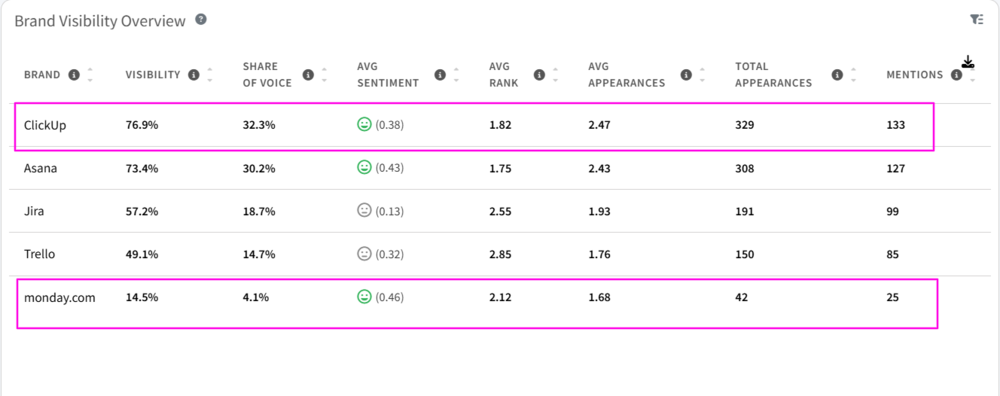
If you look at the dashboard table I created in Mentionlytics, you can see that the situation is not that impressive for Monday. It has appeared in the answers only 14.5% of the time, with a 4.1% share of voice. ClickUp is winning the race, showing up in the answers 76.9% of the time, and with a 32.3% share of voice.
So I checked the sources and found out that ClickUp’s own domain was used just slightly more than Monday’s, so that can not be the reason.
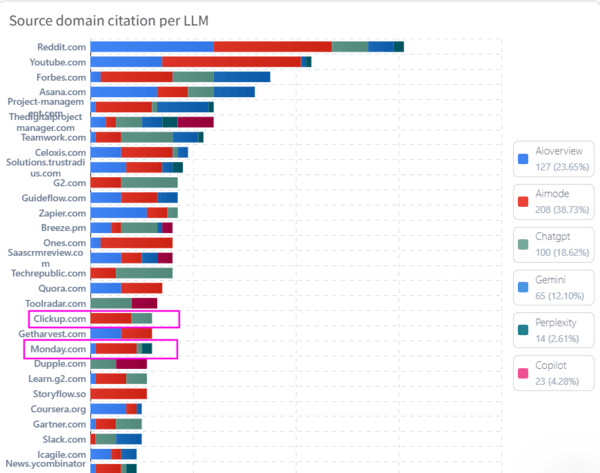
But if you pay attention, you’ll see that Reddit is at the top of the list of cited domains. Of course, that would vary from prompt to prompt, from LLM to LLM, but in general, being mentioned in meaningful and impactful Reddit conversations does move the needle.
So, within Mentionlytics, I checked their presence on Reddit, and the results just backed up the theory: ClickUp was mentioned 261 times (around 76%), while Monday was mentioned 81 times (around 24%).
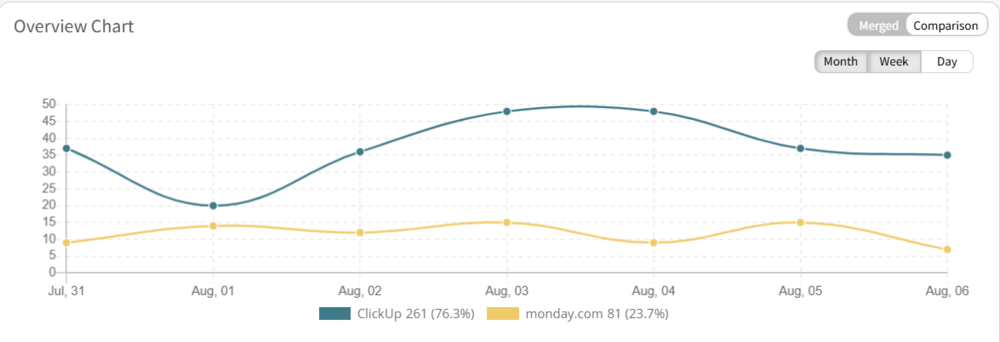
This means that social chatter can be a nice indicator of your AI visibility, especially social media that’s been used as a source. And you have to be very careful here, because there’s no general social media you need to push mentions on. Each prompt and each LLM will have its own favorable source.
And that’s exactly the manual part you need to tick. To find the gap, you need to go through your report on AI visibility and compare the data with all other signals you’re sending online to your audience, and consequently to AI.
Here’s what you can do:
- Check AI Share of Voice
- Check top-used domains (and find out which LLM uses what sources the most)
- Check what sources were used for each prompt separately
- Implement the elimination system (if you find that both you and your competitor’s website are used as sources equally, the reason is somewhere else)
Turn findings into an action plan and re-monitor
If you did your analysis right, you might have in your hands very powerful data. You should be able to know exactly:
- What domains and URLs used by LLMs are giving AI visibility advantage to your competitors.
- What prompts your competitors are winning with and why.
- Where you should put your marketing efforts to increase your AI share of voice.
So here’s a simplified table of an action plan you might use for any industry or niche:
| Findings | Action plan |
| Competitor’s domain has been used as a source significantly more than yours |
|
| The competitor is mentioned significantly more than you on a specific social media platform that’s one of the sources used in AI answers |
|
| Competitors are mentioned by media outlets used as a source by LLMs more than your brand |
|
What’s the Best Software for Competitor Analysis in AI Search?
So, what is the leading vendor for competitor analysis in AI search? The market offers several options you might find useful, and my picks are these five:
Mentionlytics: Actionable AI Visibility Insights combined with Social Listening Data
Mentionlytics spans two different environments: social media and the web, and LLMs and AI search engines. That way, your competitive analysis is complete. You can see who’s winning which prompt, in which LLM, and what sources support the claims in the answers. It’s prompt-based and doesn’t use an API, which results in human-like queries with answers that would be presented to anyone using LLMs.
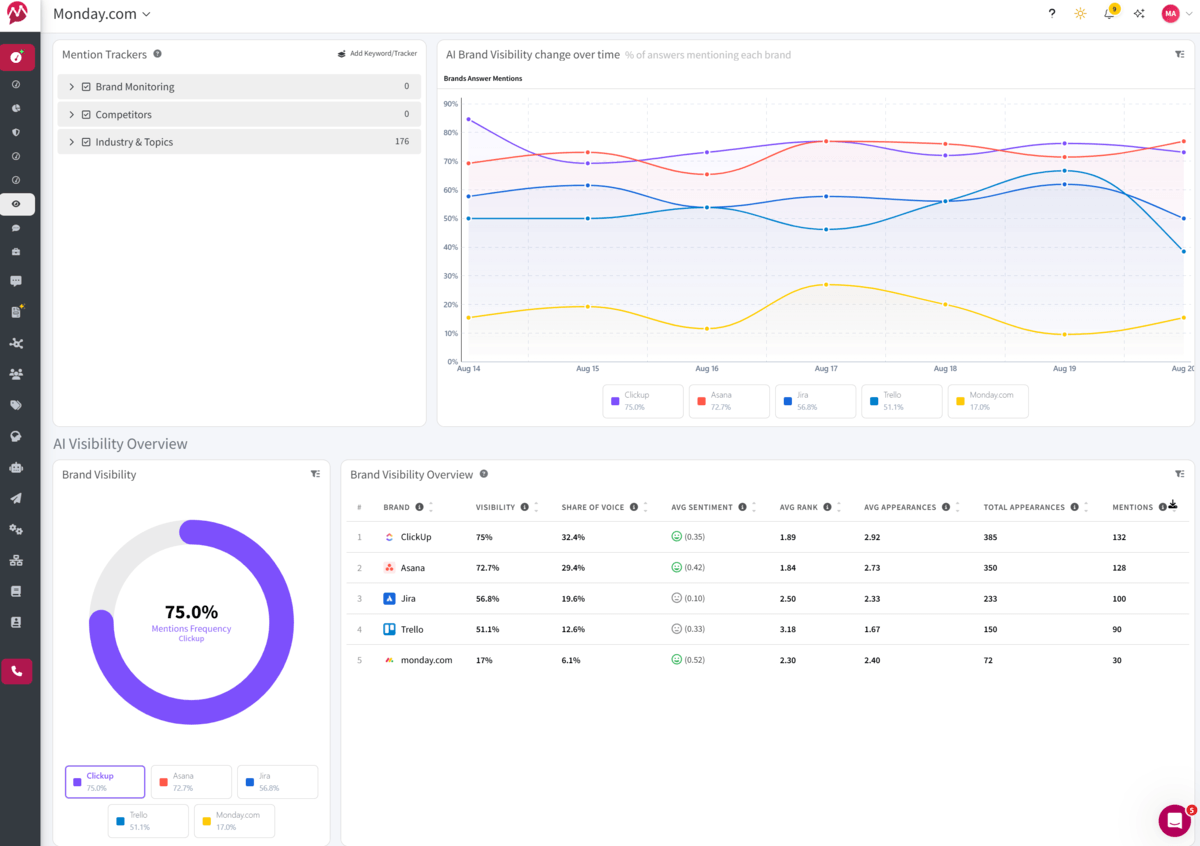
Through Mentionlytics’ AI Brand Visibility software, you can check:
- AI Share of Voice
- Brand visibility over time (your brand against your competitors)
- Co-mentions
- Top domains per LLM and prompt
- Sentiment
It’s useful for marketers, SEO and GEO teams, and leadership because it provides in-depth analysis of competitors’ positioning in AI answers and AI search data that can help you improve your brand’s position.
Best for: Marketing, SEO, PR, and agency teams that want complete competitor analytics and actionable insights for improving visibility across AI search channels.
Pricing: AI Brand Visibility is available as an add-on to any of the existing plans and starts at $49 per month, billed monthly, and you have a 14-day free trial.
Profound: For Industry-Focused AI Competitive Analysis
Profound lets you analyze your industry through the lens of AI with co-mention analysis, topic clusters, and mention-position answers. In combination with your website audit and citation analysis, you get an accurate picture of your competitive environment.
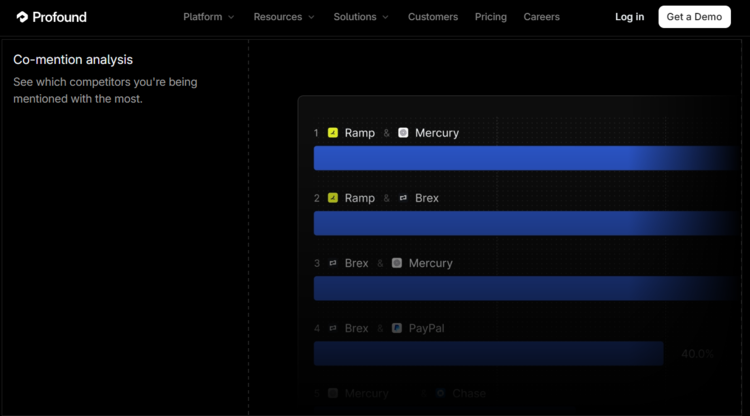
Through Profound, you can check:
- Who your brand is most mentioned with
- Your position in the LLM answer
- Which brands are showing up in specific topics
- Which sources are used the most by major AI engines
It’s useful for all industries since it has a large library of users’ prompts (over 1.5 billion) and can help you define prompts where a brand should show up and improve your AI competitive position.
Best for: Brands with large teams that span across multiple markets that want to stay ahead of competitive position shifts.
Pricing: Starter begins at $99 per month for ChatGPT and 50 prompts.
Ahrefs: Extended SEO Analysis with Visibility in AI Search
SEOs that already use Ahrefs will tell you it’s the best choice. The environment is familiar, and you don’t have to switch tools to get your AI competitors’ analysis. You can check your AI Share of Voice alongside search demand, web visibility, and YouTube visibility.
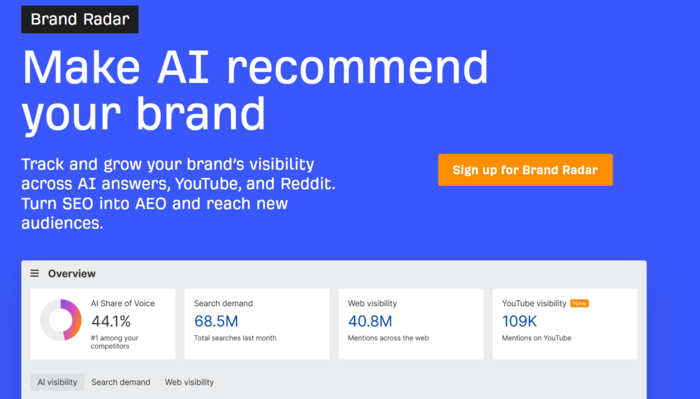
Brand Radar combines a huge database of organically discovered prompts with custom prompt tracking, allowing you to benchmark your brand against your competitors.
Since it’s primarily an SEO tool, the competitive analysis is based on visibility score, what brands show up in the prompts with you, and what third-party citations resulted from it.
Best for: SEO teams already using Ahrefs that want to combine AI competitive analysis with the rankings they regularly use.
Pricing: Individual AI platform indexes cost $199 per month.
Scrunch: AI Visibility Optimization Tool
Scrunch has an inside-out approach, scanning your site, telling you what should be fixed first, and then comparing you to suggested competitors. It’s a refreshing way, similar to traditional competitive analysis. You find the gaps and fill them out, and then check the results.
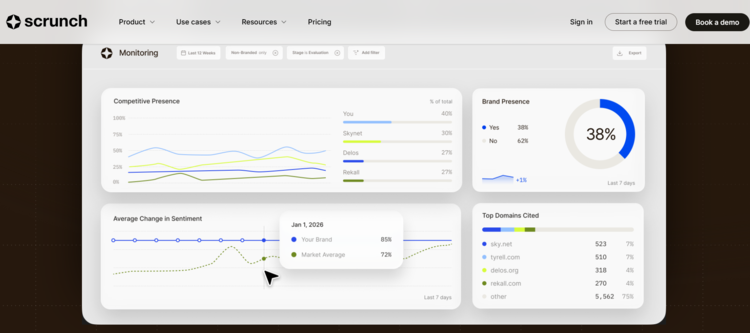
You can compare your AI presence with your competitors, check visibility (presence), track fluctuations over time, and see the top domain sources used in AI.
Best for: SEO and marketing teams that want to optimize their website for AI search, address factors that influence AI, and understand how it reflects on the competitive landscape.
Pricing: The pricing starts at $250 per month.
HubSpot: Essential Competitor Analytics with Recommended Actions
HubSpot recently introduced its AI visibility feature, where you can check your visibility score, how often you show up in the answers compared to competitors, and what you should do to beat them in ChatGPT, Perplexity, and Gemini.
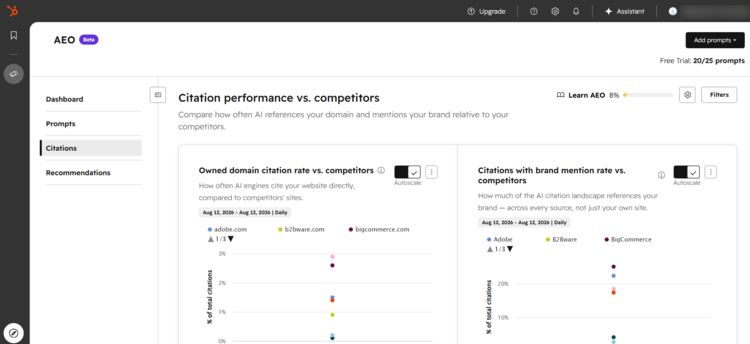
With HubSpot AEO, you can check competitors in AI through:
- AI visibility tracking
- Prompt monitoring
- SEO analytics
Best for: Teams already using HubSpot Marketing Hub that need additional info about AI visibility within their HubSpot reports.
Pricing: The pricing starts at $50 per month, and they offer a 28-day free trial.
Do AI Search Competitor Analysis Now for Free
Whether you’re new to the AI visibility concept or you’re already on the quest for a visibility tool, one thing is for sure: As traditional search is slowly being replaced by LLMs, your competitive intelligence needs to follow it.
Generative AI answers can boost your brand or crush your dreams in the zero-click era. The best thing you can do is conduct competitive analysis across all fields, fill the gaps, and win the game.
Mentionlytics’ free 14-day trial will give you enough time and data to conduct AI brand visibility competitive analysis and give you actionable insights that can turn the wheel in your favor.
FAQ
Which AI search visibility platforms have good competitive analysis features?
There are several AI search visibility platforms with excellent competitive analysis. There’s Mentionlytics, due to its in-depth analysis of citations, prompts, and LLMs and its combination of tracking both AI and social media and web mentions. Then there’s Ahrefs, a famous SEO tool, that makes a great combo of traditional SEO and AI visibility. Also, there’s Profound, mostly because of its industry and topic segmentation.
Where can I find competitive analysis for AI search visibility?
If you want detailed competitive analysis in AI responses across Google AI Overviews, Google AI Mode, Gemini, Perplexity, ChatGPT, and Microsoft Copilot, you should opt for Mentionlytics.
How to improve GEO rankings through AI visibility competitor analysis?
Checking whether the brand is mentioned in AI-generated answers as an isolated case will not shed light on what you should do to improve GEO rankings. Instead, check the citations used as the sources for a specific prompt and a specific LLM because they don’t use the same sources. The citations are part of your competitive set, because your competitor might be listed in some of the sources and your brand not. These URLs are your go-to list. Make sure you start showing up in the sources LLMs already use.
How often should I run competitor analysis for AI visibility?
You can run it on a weekly, monthly, or quarterly basis, but you should also check daily fluctuations, especially if you have an ongoing PR campaign, to see the effects.
How does competitor analysis boost brand visibility in AI search?
In-depth competitor analysis provides you with insights about which prompts your competitors are winning, which sources support LLMs’ choice to recommend your competitors instead of you, what domains are cited the most, and what topics your competitors wrote about that LLMs picked up as the source. Based on the findings, you can fill the gaps by creating new content, restructuring existing ones, running PR campaigns, getting mentioned in already used sources, or spreading the word about your brand on social media.
