

If you compare social listening vs social monitoring, you’ll see they both track mentions. But social media monitoring tracks only where and who mentioned your brand, tagged you, or used a specific keyword you track. Social listening goes a step further by showing the context of your mentions, the sentiment and emotion behind them, and conversational patterns, emerging industry trends, and what you should do based on these insights.
So yes, while both social monitoring and social listening track mentions, social listening helps you get the bigger and more accurate picture of your brand’s online presence and the shifts within the industry or your specific niche.
In this article, we’ll go through where these two differ, what the similarities are between monitoring and listening, how to know which one you need, and help you make the right choice.
Table of Contents
- Social Listening vs Social Monitoring: Differences and Similarities
- Social Media Monitoring vs Social Listening: We Measured the Gap
- How to Choose Whether Your Brand Needs Social Media Monitoring vs Listening
- Simple Monitoring or Powerful Social Listening – Mentionlytics Helps You Decide
Social Listening vs Social Monitoring: Differences and Similarities
With all the changes we’ve experienced over the past two or three years, since LLMs shook up the online world and changed the customer journey, getting alerts when someone tags you on social media platforms has become insufficient for real social strategy and marketing analysis. But it’s still very useful for instant fixes and replies, especially for customer care.

And while we used to compare social media listening vs. monitoring just a few years ago, now that the channels have expanded beyond social media, and the sentiment that impacts your AI visibility, listening itself has become more advanced and broader than before.
So let’s look at the key differences between social monitoring and listening, and at which points they are very similar today.
Social Listening vs Monitoring: Differences
I framed social monitoring vs social listening differences in four categories:
- Analytical capabilities: collecting individual mentions vs analyzing conversations collectively
- Lasting effects: Handling a specific situation vs supporting broader business improvements
- Perspective: Looking at individual conversations vs seeing the bigger picture
- Approach: Reacting to what has happened vs anticipating what may happen next
Analytical capabilities: What vs Why
Looking at individual brand mentions, comments, reviews, and conversations can tell you what happened and where the conversation is taking place. And that’s exactly what social media monitoring does. You can see that a customer complained about your product, praised your customer service, tagged you about a missing delivery, or asked you about a specific feature.
On the other hand, social listening will analyze all individual mentions, tagged or untagged, across all channels and give you a hint as to why it is happening. If delivery complaints suddenly increase, listening can reveal whether they concern delays, damaged packages, poor tracking, or one particular courier.
Lasting effects: Immediate Resolution vs Long-Term Improvements
Social monitoring helps you act immediately on individual online call-outs. For example, a customer complains about your product on X; your customer support team finds it through a social media monitoring tool, replies, and the problem is (hopefully) solved. The result usually concerns that particular customer or conversation.
And while monitoring can save the day for a specific customer needing urgent explanation, help, or attention in general, listening data can make a long-term impact by fixing the root cause, reducing the volume of these sporadic urgent messages in the future.
Perspective: Individual Mentions vs. the Bigger Picture
Social monitoring looks at conversations one by one. Each comment, review, tag, or message is treated as a separate item that requires attention at the moment. This is especially useful for customer service, managing communities, and quickly catching urgent mentions.
Now, if one problem keeps showing up in individual messages, that’s something AI-powered social listening can detect, and it’s no longer an issue raised by one customer; that’s a pattern and a signal that something is off with a specific segment, and that you need to fix the core issue. Spotting these patterns on time may save you from thousands of new individual complaints.
Approach: Proactive vs Reactive
Social media monitoring is mostly reactive. You spot a mention calling out your brand; you reply to it. So basically, the conversation has already happened. You’re just reacting to it.
But social media listening tools take a different approach: they scan the environment, analyze mentions, trends, and sentiment, and provide actionable tips to prevent emerging issues or improve your overall brand perception.
For example, you might find through social listening that your customers have repeatedly asked for one specific feature on social media, but it has never reached your product development team.
Once you identify the recurring customer need and spot the patterns, you can share findings with your development team to include this feature in the roadmap. That way you’re improving your product based on the actual needs of your customers, and improving the sentiment around your brand.
Social Monitoring vs Listening: Similarities
You can see that both monitoring and listening start with mentions. And that’s the main theme. Online conversations are the essence of both. Both involve tracking mentions of brand names, products, competitors, keywords, hashtags, campaigns, and relevant industry topics, tagged or untagged.
But if I needed to sort it into groups, I would say that both:
- Track online conversations: Mentions as the basis, and the rest of the data around these mentions collected through social listening.
- Operate in real-time: Both are capable of doing so, one for catching posts needing immediate attention, while the other catches early signals of public relations crises.
- Help protect brand reputation: Individual answers or taking care of viral posts through PR activities have the same goal: to protect your brand’s online reputation.
- Support multiple teams: Your marketing team is not the only one using monitoring and listening. It’s useful for product development teams, customer service, PR, content teams, and sales.
Social Media Monitoring vs Social Listening: We Measured the Gap
Curious to see what these differences look like in practice? We’ll show you what happens when you conduct social media monitoring through native platforms’ tracking systems vs. social listening across social media platforms and beyond, using a real example from a real brand. Does social listening really provide broader insights, and what’s the actual gap?
Methodology: How we measured this
So, we wanted to compare and measure how monitoring through native analytics on social media platforms differs from data collected through an advanced social listening platform, and show you what that difference looks like in numbers:
- We used Mentionlytics to set up an account for Ryanair and collect mentions.
- We scanned X, Facebook, YouTube, and Reddit, platforms that either will not include your brand’s mentions if you’re not tagged, or are missing most of the analytic metrics.
- To get the most qualified examples, we excluded Ryanair’s owned media from the list through Mention Trackers (which is not possible with simple monitoring).
- We observed the period from July 31st to August 6th, 2026.
- We excluded tagged mentions through Boolean search to compare the results of the overall number of mentions and untagged mentions, because through native platforms where you’re monitoring a brand, that’s not possible.
The initial data we started with was a simple number of mentions, engagement, and reach. These are metrics you can find in almost every social media platform’s native analytics. For Ryanair, it was 16,686 mentions, with 4 million social engagement and 700 million reach.
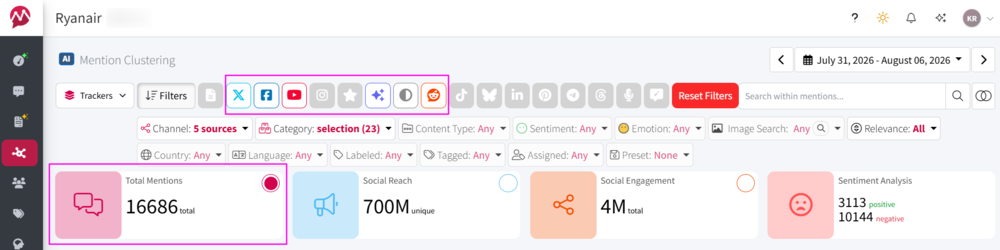
We could also see that the sentiment is mostly negative, which you couldn’t see through native platforms. But then we got curious and wanted to see what these results would look like through the lens of X, Facebook, YouTube, and Reddit native analytics.
How many brand mentions never tag the airline’s handle?
The main problem is that native platforms don’t count mentions where you’re not tagged. So we ran an experiment to see how the numbers would look if we used only the platforms’ analytics.
We used Boolean search to present only tagged social media mentions Ryanair had in this period.
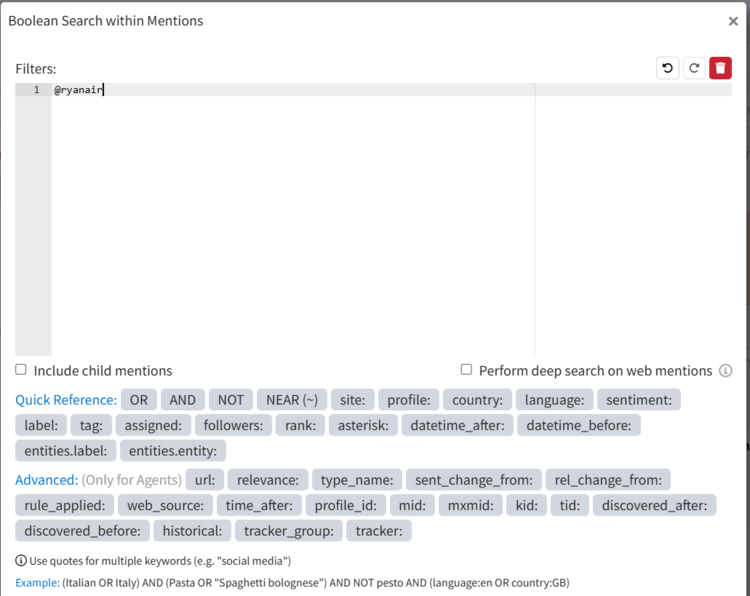
The results showed that, with monitoring only tagged mentions, Ryanair is missing a huge chunk of online conversation.
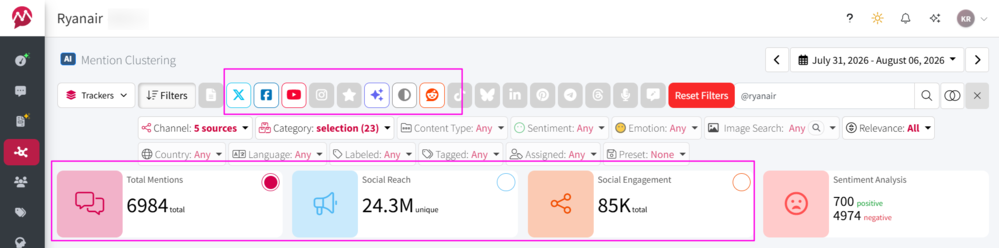
Instead of 16,686 mentions that exist on these four platforms, you’re seeing only 6,984, with a social reach of around 24 million and 85,000 social engagements.
That’s a huge difference, meaning you’re missing 9,702 mentions from your data, which further impacts all other social metrics.
For example, your sentiment changes. Original social listening data shows 3,113 positive mentions and 10,144 negative mentions. But if you’re seeing only tagged mentions, that means you’re missing 2,413 positive mentions and 5,170 negative ones.
What social monitoring misses at volume level
But let’s stick to the numbers. This small experiment with a simple Boolean search filtering showed you the very basics of what data might be missing from your equation, and explained why you can’t correlate data from basic native platform analytics with the reality your brand is experiencing.
If we use this case study as the base, we can say that:
- 58.1% of the mentions were untagged.
- Monitoring data is missing 77.5% of the positive mentions.
- Monitoring data doesn’t catch 50.9% of the negative mentions.
This indicates that if you use only basic monitoring, you’ll catch only 22.5% of positive mentions, since they are less commonly tagged, and you will fetch around 49.1% of tagged negative mentions. This will give you a slightly more negative perception of your brand than it actually is.
There’s another important angle, and that’s the fact that the untagged conversation was actually larger than the tagged one. For every 10 tagged mentions, there were 14 untagged, which means most people talking about the airlines were talking around it, not to it.
Key Takeaway: Relying only on tagged mentions gives you one distorted version of the truth. In this case, it erased 58.1% of the online conversation and made it look much more negative than it is in reality.
What Percentage of Online Communications Are You Missing?
Dive deep into conversations, UGC, reviews, and casual mentions throughout the internet with Mentionlytics.
How to Choose Whether Your Brand Needs Social Media Monitoring vs Listening
We know both social listening and social monitoring can help; it depends on your company’s size, the scope of mentions, the channels your audience uses, industry, reputation risks, and the analytics you need. So let’s see what kind of data from social media you need in your case:
Your mention volume
If your brand has only a few mentions a week, monitoring them individually will work just fine. You can read each post, analyze the answers individually, and get a reasonable idea of what triggers people.
On the other hand, receiving hundreds or thousands of mentions will require more advanced analytics tools, because reading them one by one is impossible, and you won’t get a clear big picture of what’s going on. You need social listening to group these mentions, track sentiment, discover recurring topics, and cut the noise.
Number of platforms and online sources
If most conversations about your brand happen on one or two platforms and in smaller volumes, monitoring may be sufficient. For example, a local restaurant discussed mainly on local Facebook groups and Google Reviews probably doesn’t need full social listening analytics.
But when the conversation spans X, Instagram, Reddit, Facebook, G2, Google Reviews, Bluesky, and news sources, you need social listening to understand how your brand is perceived and presented, and whether customers are experiencing any general issues with your brand.
Number of languages
If your audience communicates in one language, individual monitoring can still be manageable, especially in combination with a low volume of mentions.
The moment your brand’s mentions start appearing in different languages, it’s time to level up your monitoring game to social listening. Why? The same product may receive praise in one language and complaints in another, while customers may use different terms, slang, misspellings, and product names in each market.
Social listening helps analyze these conversations by language instead of mixing everything into one misleading overall result.
Make sure the tool you choose understands the languages your audience uses, especially when it comes to sentiment and emotion analysis.
Understand 180+ Languages
And get 96% accurate sentiment and emotion analysis, even for smaller language groups, with Mentionlytics!
Market size and geographic coverage
A small local brand operating in one market can easily track individual mentions through monitoring and get the basic analysis simply by reading the mentions and replying to them. With fewer customers, competitors, and mentions, the bigger picture is still small enough to see without the lens.
But for brands operating nationally or internationally, with far more variables to measure, social listening capabilities are essential to a comprehensive social media strategy. Global brands need to identify how conversation volume, social media sentiment, customer needs, and competitive position differ by country or region. A complaint that appears insignificant globally may be a major recurring issue in one particular market.
Company’s size and number of products
Social media monitoring helps if you have a small business with just one product. You can catch mentions of your brand, product, and reply to questions, reviews, or mentions online using a monitoring tool.
Now, if you have a developed brand with multiple products, your analytics are a bit more complex. At the same time, chances are that your competitor list multiplies, and there’s no chance you can check up on all of them and calculate percentages of media share, spot hot topics, and track sentiment for your entire business environment. That’s where social listening is crucial for creating a proper marketing strategy.
Reputation risk
Some industries are highly affected by negative conversations, such as tourism and hotels, airlines, banks, healthcare, and even the food industry. They have very high reputation risk; therefore, if you’re in this industry, regardless of your market size or number of mentions, it’s always better to opt for a crisis management platform with social listening capabilities.
For most efficient crisis management, you need social listening because you can see analytics, get alerts when something outside the patterns starts peaking online, and prevent potential crises in time.
And if you run a small fashion brand, you probably won’t have that challenging and sensitive environment, so you could rely only on social monitoring.
Company’s goals
If your goal is to find mentions and respond to customers, focus on monitoring. If you want to understand customer preferences, investigate sentiment changes, compare competitors, spot trends, or improve products, you need listening.
A practical approach is to start with monitoring and add listening as your conversation volume and business questions grow. But don’t wait for your company to become enormous. If you have enough data to reveal patterns (or enough risk that missing one could be expensive), it is already time to listen.
Available team and resources
Social monitoring requires someone to review mentions, decide which ones need attention, and respond or forward them to the right person. A small team with limited time may initially focus on urgent mentions, customer questions, and negative comments rather than analyzing every conversation.
Social listening requires additional time and expertise to interpret trends and turn them into action. Someone must investigate why sentiment changed, compare topics or competitors, and share the findings with marketing, PR, product, or customer service. Automated analysis can do much of the sorting, but it cannot change a product, rewrite a campaign, or call the courier for a very uncomfortable conversation.
This means the decision is not simply about whether you can afford a listening tool. It is also about whether your company has people who can use the insights it produces. If resources are limited, begin with monitoring and a few focused listening reports.
As the team, mention volume, and business needs grow, you can expand the analysis.
Simple Monitoring or Powerful Social Listening – Mentionlytics Helps You Decide
Want to dip a toe into the world of powerful insights that might change your perception of your target audience, customer experience, and your brand image? Comparing social listening vs. social monitoring will show the deep analysis you get when you use social listening, which you could never see just by monitoring your brand’s online presence.
Get your free 14-day trial with Mentionlytics and find out the true benefits of monitoring and social media listening.
You’ll never know until you try!
