

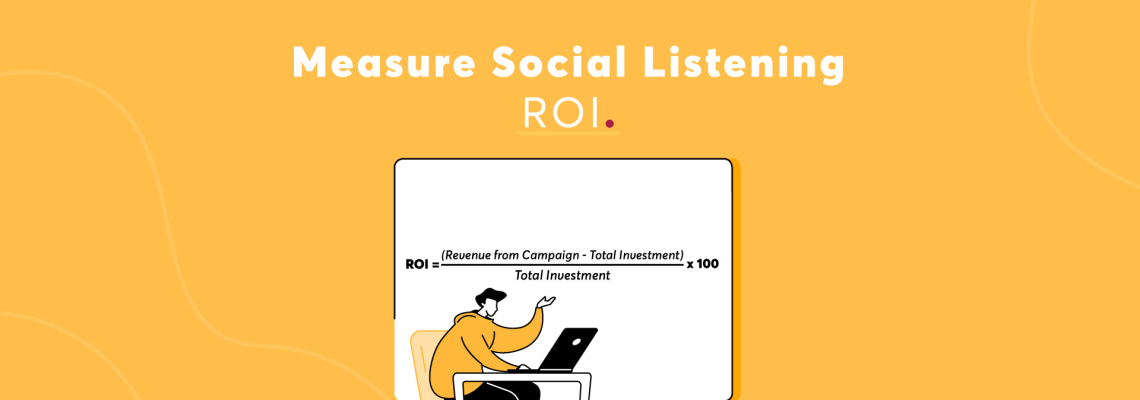
Have you ever wondered whether your social listening investment was worth it? Are likes, shares, and comments all you can expect? Of course not, but how do you measure social listening ROI?
What KPIs and insights from socials should you see to understand the impact?
Your common sense needs to justify the investment (which might be significant considering time and money) in social listening. But you have to know that the results can be tangible and intangible, and you need to take both into consideration.
Let us show you the way!
Table of Contents
What is Social Listening ROI?
Social listening ROI can be defined as the return on investment you have from your social listening efforts. It’s always about the valuable insights you get and the effect of these insights on your business.
Whether it’s increased brand visibility, better understanding of your audience preferences and feelings, or better benchmarking, it’s always what comes as a result of these insights.
It’s about how you tweak your marketing campaign or social media strategy to align with the current online atmosphere around your brand, competitors, or trends.
And that is crucial if you want to see tangible results. By adjusting your marketing strategy every time you get a new insight, you’re going with the flow, spotting opportunities to shine, and fixing minor problems before they become bigger-than-life issues.
Nothing is set in stone, especially not your target audience’s feelings, industry trends, or your competitors’ strategies.
The audience changes their opinion, they follow trends (which change more often than you think), and they are influenced by other people through reviews and comments.
Your competitors evolve, change their strategies, and sometimes even pop out of nowhere like plot twists. If you want to win the game, you need to keep an eye on them.
And it is impossible to track all these changes on foot. That’s why you use social listening tools.
What is the Value of Social Listening Really?
Social listening ROI might sometimes seem like a treasure hunt. You know it’s there, but you don’t always have the map or compass.
Many professionals use social media listening to gain basic data, such as engagement rate, tracking mentions, or Share of Voice, but there are so many hidden gems that you can find along the way if you know where to look.
Here are a few ideas.
Understand the True Need of Your Target Audience
Yes, you can get hot leads, no doubt about that, but… The true value of social media channels is that you can detect the emotions of your audience, their preferences, wishes, dissatisfaction, frustrations, hopes, needs, and dreams. You can learn a lot about them.
Once you gather all the data, you start to understand them and know exactly what you need to do to get their attention.
“Tell me what you yearn for and I shall tell you who you are. We are what we reach for, the idealized image that drives our wandering.”
James Hillman
The idea isn’t new; it existed as far back as marketing itself.
Why do you think McDonald’s menu differs from country to country? They realized the impact of traditional taste on their customers’ preferences. And they just adapted their products (meals) for each market.
Benchmarking the Right Way: Competitor Analysis Done Right
No, it’s not about counting who has more posts on social media. You have that raw data, but what really counts is how the audience feels about your competitors.
Or even better, what are they frustrated about? Remember, that’s exactly where you can shine through.
That’s the true benefit of social platforms and has to be a part of your social listening strategy: Finding out where competitors failed to fulfill the customer expectations, and that’s your door of opportunity.
You can also get insights about products your competitors don’t have but customers are asking for on social media. This might be a great starting point for new product development in your team.
Creating a Better Brand Reputation
Brand reputation is something you can’t exactly measure with numbers. The most commonly accepted definition of brand reputation says it as the image of your company or the credibility your brand has among users.
But here’s the catch. According to the research paper: “Social listening: a potential game-changer in reputation management”, the Internet and social media have a great impact on forming brand reputation, especially with the young audience (more than 50% influence).
There are many factors that could influence your reputation:
- Corporate strategy
- Management
- Communication
- Product or service quality
- Interest and demand
- Financial performance
- Employer branding
But here’s the thing — no matter what you do internally, your brand’s reputation will ultimately be shaped by online conversations, often driven by third parties.
In other words, everything you say or do publicly, directly or indirectly, impacts how people perceive your brand.
That’s where social listening steps in. It doesn’t just help you respond when your brand is mentioned — it lets you feel the pulse of your audience.
You can uncover what they truly value and work on aligning your brand with those expectations.
How to Prove Your Social Listening ROI
Calculating ROI for social listening might not be a straight line, but more of a zig-zag route. Here is what you can do to measure it.
Step 1: Start From Your Goals
What’s your goal? What do you want to achieve? Is brand awareness in your focus? Do you need more high-quality leads? Do you want to enhance customer support and improve customer experience? Or do you want to beat your competitors?
You have to know what you want to achieve to get the right data and calculate the ROI for that. Because each of these fields has different metrics and different things to look at.
So, even before you start listening, check your company’s goals and see what you want to improve. There might be one or several goals, but make sure to define all of them separately.
Step 2: Gather as Much Data From Your Social Listening Tool
The best social listening tools on the market offer so many features that help you gather and process raw data. But still, you need to know if the features cover your goals.
That’s why the best way is probably to try the tool first.
Explore Our Features
No credit card. No lifetime commitment! You can always change your mind with Mentionlytics.
Now, what data should the tool collect for you, and what should you do with them?
First of all, AI-powered tools have an advantage because they automatically process data. But in case your tool isn’t that advanced yet, you can always play a little puzzle game and get valuable insights from these pieces of information.
But what do these data tell you? Separately, they don’t tell much. It’s only numbers. But you have to be able to see the big picture here.
By combining and processing social listening data, you can find out interesting things. For example, the moment you spot an increase in mentions from popular content creators, you know you’ve leveled up.
So, in this case, you combine the number of mentions and the top mentioners. And if you see that sentiment is positive, and your mentions’ most often emotion is joy, you’re in heaven.
Step 3: Calculate ROI
Now that you know what you can do with your social media analytics, you can hit the base and calculate the ROI!
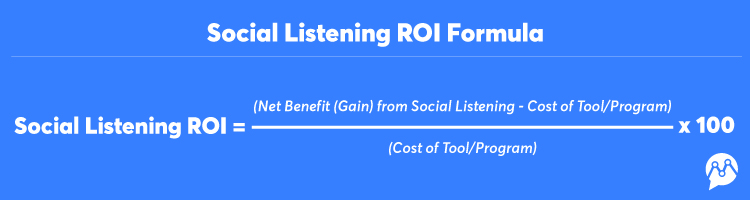
The confusion starts with the net benefit because it can be both tangible and intangible. Remember the question from the beginning: What do you want to achieve?
For example, you have two goals (yes, there’s rarely one). You want to boost brand awareness, and you want to get new leads. Let’s see what happens:
1. Brand awareness:
- Through Mentionlytics, you were able to detect 1,200 monthly mentions, 40% of which were untagged and previously invisible to your social media management team.
- You discovered that several micro-influencers had mentioned your brand on TikTok and YouTube.
- You reached out and turned these mentions into co-branded content and shares.
- Estimated value of earned media (based on reach and average CPM): $9,000 over 3 months
2. Lead Generation Gains
- The sales team was alerted to multiple product recommendation threads on Reddit and X (Twitter).
- They jumped in, added value, and captured 6 qualified leads, with 2 converting into customers.
- Revenue from those leads: $6,000 for 3 months
3. Surprise Bonus: Crisis Averted
- A negative blog post reviewing a buggy feature started getting traction on a niche subreddit.
- Thanks to the SIA alerts, the team caught it early, responded with a fix, and even got an update from the original poster.
- Estimated savings from lost business + PR costs avoided: $5,000 (based on churn prevention and avoided ad spend)
ROI of Social Media Listening
Total Net Benefit: $9,000 (awareness) + $6,000 (leads) + $5,000 (crisis averted) = $20,000
Cost of Tool: $4,000/year
Calculation:
ROI of Your Social Listening= ((20,000 – 4,000) / 4,000) x 100 = 400%
Step 4: Highlight How Social Listening Has Already Helped Your Team(s)
Each team has its own focus, and you might be surprised how differently they use social listening. Some may rely on it for tracking brand reputation, others for lead gen, customer service, or content inspiration.
That’s why it’s important to ask all your teams how social listening helped them. You might discover benefits you hadn’t even considered.
If you have a large team, run a quick survey and try to find out how social listening has improved and made their work much easier.
You can ask, for example:
- How much time do you estimate that X tool has been saving you every day?
- What’s the most valuable insight you’ve gained from social listening?
- Have you discovered new platforms, communities, or audiences talking about our brand? Which one?
- Has the tool helped you communicate customer sentiment or public opinion more clearly?
- Is there a specific alert, dashboard, or report that’s made your life easier? Why?
The findings from the survey are an excellent addition for you to present to the upper management.
Bonus: Don’t Measure ROI Too Early
Now, don’t measure your ROI too early! Why? Because you won’t get any valuable results in a day, week, or month.
You need time to spot the patterns, and you can’t do it overnight.
“Social listening is a marathon, not a sprint. If you want to see the results, you must give it time, at least 6 months. Everything below that is pure guessing, because you can’t spot the patterns, and feel the pulse of the audience in a short period of time.”
Manos Perakakis, Ph.D., Co-founder of Mentionlytics & University Lecturer in Digital Marketing and UX Research
The good thing is that these results are long-term, not like marketing campaigns, which have a bit of a “comet” vibe — they appear, shine, burn, and disappear in the night sky. Social listening is more like a constellation — always present, quietly guiding your path, revealing patterns over time.
So, be patient, and the results will come!
Metrics to Measure ROI from Your Social Listening Efforts
What metrics should you track to showcase the impact of social listening? These are the key ones — the most insightful, the ones that speak volumes.

1. Share of Voice
Share of Voice is typically a brand awareness metric and shows you where you stand against your competitors. You can see who won the hearts of the audience and measure the online impact you have.

You can find your weak spots when compared to other brands from your niche, and you can work on improvement and filling the gaps. It’s just what ContentCal did, which led them to the Adobe acquisition.
2. Positive vs Negative Mentions Volume
Measure the volume of the positive and negative mentions related to your brand through sentiment analysis. More positive ones mean your reputation is improving.
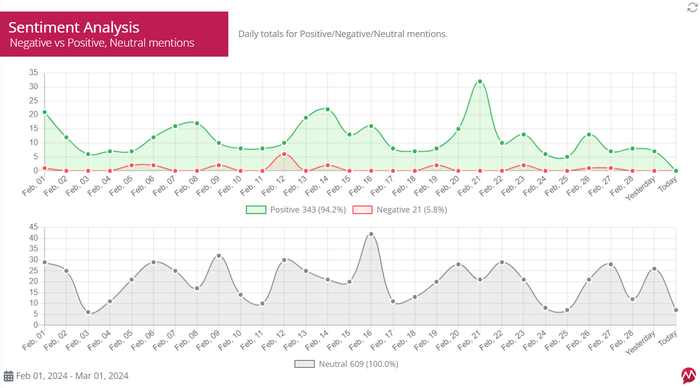
On the other hand, if you spot a negative trend, it’s a red flag that indicates it’s time for crisis management moves.
3. Number of Hot Leads Identified Through Your Tool
One of the most valuable benefits of social listening is generating hot leads. Your sales team’s (and your CEO’s) dream.
There are several ways to do that. For example, by choosing the right industry keywords and including terms such as “recommend” or “review“, you can access all the online conversations where potential users seek tools, products, or services recommended by others. And here’s the exciting part – you might be the one offering the solution with your own tool, product, or service!
Bonus: Watch our webinar on how to find new leads and boost your sales!
4. Number of New Influencer Collaborations
Another great benefit of social listening is the ability to increase the number of influencer collaborations. You can check which creators already speak about your brand or are experts in your niche, and you can reach out to them for collaboration.
All you have to do is choose some industry keywords and check the list of the Top Mentioners. You can filter the specific social media platform you’re interested in, or you can filter mentioners by the number of followers, engagement, or activity.

That way, you will save budget and find those creators that align with your brand voice and purpose.
5. Engagement Rate
Likes, shares, comments, saves, these are all metrics that show engagement rate. How well your content performs, how many users react to your content, and whether you are hitting the target.
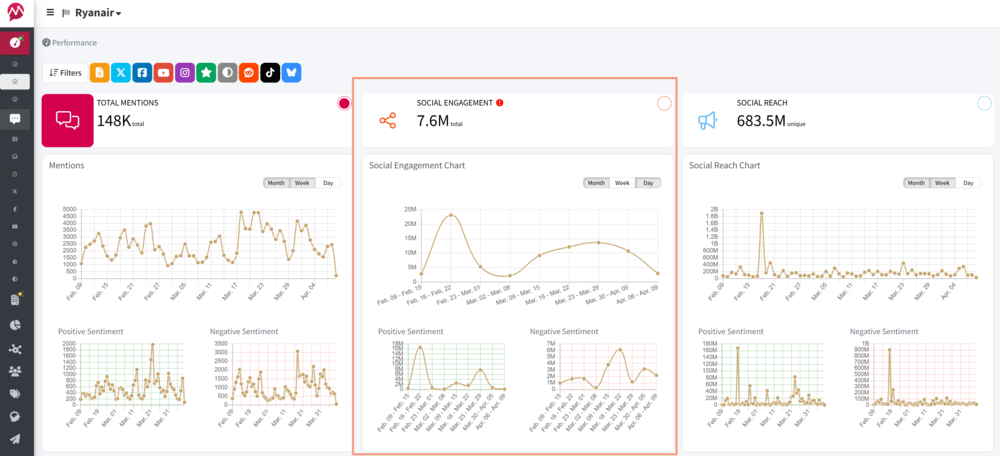
You can see what content resonates with the audience and what does not. According to the findings, you can always adjust your social media strategy.
But engagement is a two-way street.
You need to engage in conversations related to your industry to become recognized and attract an audience. You can discover topics related to your industry with the listening tools and participate in conversations.
The more you engage, the better your engagement rate gets.
6. Audience Growth
You can track your audience growth, yes. On all platforms. But the true meaning behind these numbers is getting to know your audience better.
Who are they? Where do they come from? What are their needs? That’s why it is important to track the growth of the audience.
Only when you understand your audience will you be able to craft highly resonating content and ads. And that is the real budget-saver.
7. Number of Web Mentions – New Backlinks
Social listening is not limited to social media platforms; it spans the internet. You can check websites that mention your brand but do not link to you and use them as a new backlink opportunity. It’s an excellent and trackable KPI.
8. Number of Small Issues Resolved (especially from unlinked mentions)
Unsatisfied customers often complain online. According to the American Marketing Association, one of the most common reasons for complaints on social media is customer service.
The importance of addressing these online complaints is that other potential users read these comments, which might have a negative effect on their purchasing decision and have a tendency to escalate.
The trick here is that many of these complaints are untagged or unlinked brand mentions. Therefore, you can’t detect them without social listening.
Increase Your Social Listening ROI with Mentionlytics
It all sounds great in theory, right? But your current tool just isn’t doing it for you. Your management team wants results, and you’re stuck staring at a dashboard that feels more “meh” than meaningful.
If the ROI isn’t adding up, maybe it’s not you — maybe it’s the tool.
You need powerful actionable insights, smarter alerts, and an interface that actually helps you connect the dots. Try Mentionlytics for free, run it side-by-side with your current tool, and see the difference yourself.
No pressure. No credit card. Just real value waiting to be discovered.

