

Imagine launching your biggest campaign of the year. Mentions explode, your dashboard shows 82% positive sentiment, your marketing team celebrates… Then sales drop. What happened? It turns out thousands of people were joking about your campaign. The software interpreted sarcasm as praise. And that’s the problem with social media sentiment analysis in 2026.
Collecting mentions is easy. Understanding what people actually mean is the difficult part.
Sentiment analysis is the process of automatically determining whether a piece of content expresses a positive, negative, or neutral opinion. When applied to social media, it helps brands understand how people truly feel about their products, campaigns, competitors, or industry by analyzing millions of posts, comments, reviews, and conversations in real time.
Sounds simple, but in reality, it’s anything but.
Social media is full of sarcasm, irony, memes, emojis, slang, and inside jokes that can completely change the meaning of a sentence. That’s why choosing the right sentiment analysis tool matters just as much as collecting the data itself.
In this article, we’ll explain how social media sentiment analysis works, why it’s more challenging than it seems, the different methods used today, how to validate accuracy, and how to analyze brand sentiment automatically with Mentionlytics.
Table of Contents
- Is Sentiment Analysis Difficult?
- What Methods Can Be Used for Sentiment Analysis?
- What is a Real-Life Example of Social Media Sentiment Analysis?
- How to Do Sentiment Analysis on Social Media with Mentionlytics
- What is a Good Accuracy for Sentiment Analysis?
- Try the Best Way to Do Social Media Sentiment Analysis
- FAQ
Is Sentiment Analysis Difficult?
Yes, sentiment analysis is difficult but it depends on what you’re analyzing. For example, classifying a product review that says “Excellent quality, fast shipping” is relatively straightforward. Most humans (and most AI models) would agree it’s positive.
Now compare that with a social media post saying: “Love spending my Friday evening waiting three hours for customer support. Fantastic.” Humans instantly recognize the sarcasm. Some sentiment analysis tools still classify it as positive because they focus on words like “love” and “fantastic” while missing the context.
That’s why not all sentiment analysis is equally difficult.
What are the Three Types of Sentiment Analysis?
Researchers classify sentiment analysis in different ways depending on the objective of the analysis. One of the most widely used practical classifications divides it into three main types:
- polarity detection
- emotion analysis
- aspect-based sentiment analysis
Each answers a different business question.
Polarity Detection
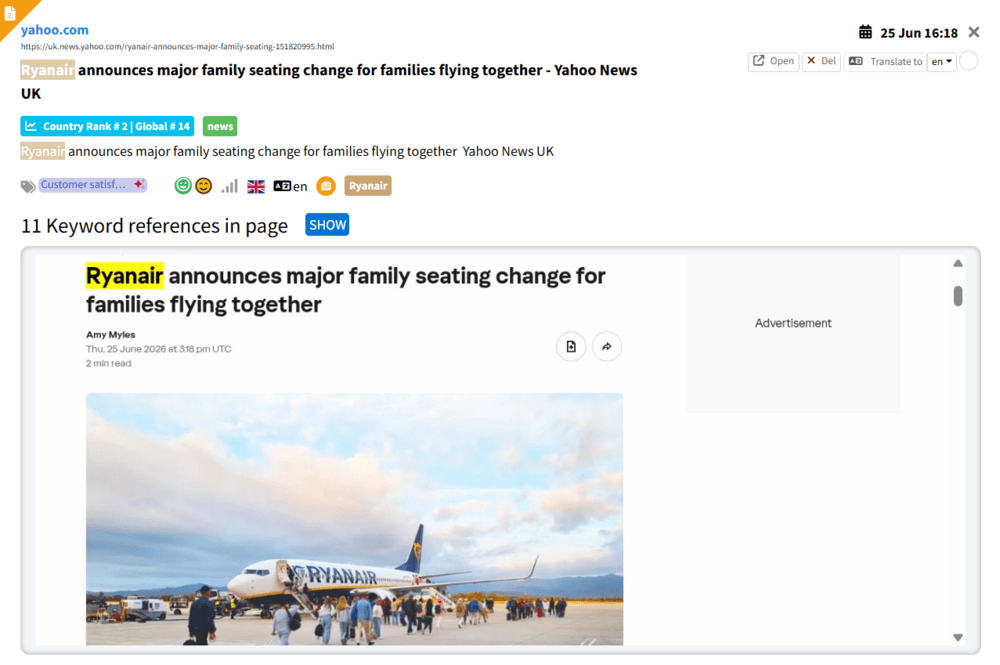
This is the most common type of sentiment analysis. It classifies a piece of content as positive, negative, or neutral. For example, news about Ryanair’s decision to allow families to sit together during flights is clearly positive.
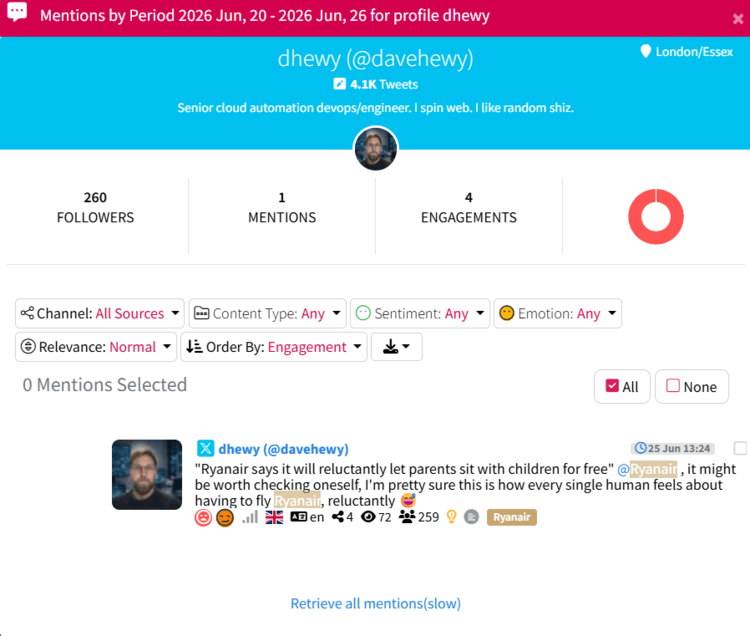
Likewise, a comment on X, related to the same news that says “Ryanair says it will reluctantly let parents sit with children for free @Ryanair”, it might be worth checking oneself, I’m pretty sure this is how every single human feels about having to fly Ryanair, reluctantly 😅“, would be classified as negative.
Polarity detection is fast and effective for measuring overall brand sentiment, campaign performance, or customer satisfaction. However, it doesn’t explain why people feel that way.
Emotion Analysis
Emotion analysis goes one step further. Instead of simply asking whether a comment is positive or negative, it seeks to identify the underlying emotion.
Depending on the model, emotions may include:
- Joy
- Anger
- Sarcasm
- Fear
- Sadness
- Neutral
This provides much richer insights. For example, two negative comments may express completely different emotions. Take a look at the first one is this in the screenshot below.
Now look at the the second one below.
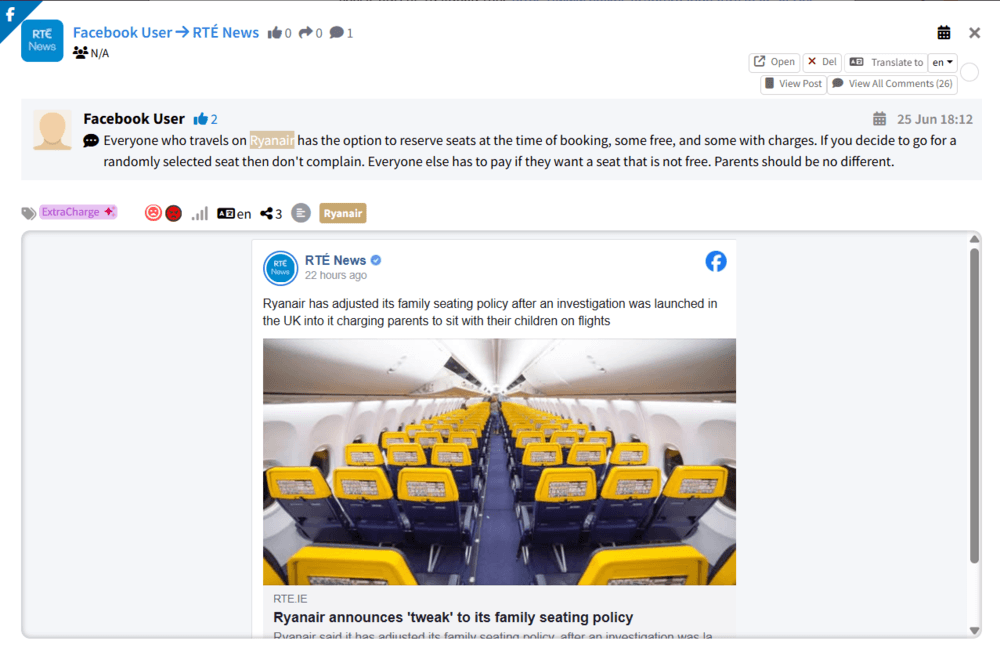
Both are negative, but one reflects sarcasm, while the other signals anger. Knowing the difference helps marketing, customer support, and PR teams respond more effectively.
Aspect-Based Sentiment Analysis
Aspect-based sentiment analysis (ABSA) identifies exactly what people are talking about and determines the sentiment for each specific aspect.
For example: “The camera is incredible, but the battery life is awful.”
Instead of assigning one overall sentiment, aspect-based analysis recognizes two separate opinions:
- Camera: Positive
- Battery life: Negative
This level of detail is particularly valuable for product teams because it reveals which features customers appreciate and which ones need improvement.
What are the Challenges of Sentiment Analysis?
Even the best AI models face obstacles when trying to understand human language. Some of the biggest challenges include:
- Sarcasm and irony that mean the exact opposite of the words being used.
- Mixed sentiment, where a single post contains both praise and criticism.
- Slang, abbreviations, and emojis that change meaning depending on the community.
- Different languages and dialects, each with unique expressions and cultural context.
- Lack of context, especially in replies or quote posts.
- Rapidly changing internet culture, where memes and trends appear overnight.
- Poor data collection, where important conversations are missed because the monitoring tool doesn’t gather enough relevant mentions across social media, news sites, blogs, forums, podcasts, review platforms, and the wider web.
Fortunately, modern AI has dramatically improved sentiment analysis tools over the past few years. Combined with comprehensive social listening, today’s best platforms can analyze millions of conversations with impressive accuracy, provided they understand not only the words people use, but also the meaning behind them.
What Methods Can Be Used for Sentiment Analysis?
Sentiment analysis has come a long way over the past two decades. Early tools relied on simple dictionaries of positive and negative words. But now platforms use machine learning and advanced AI models capable of understanding context, intent, and even subtle linguistic nuances.
Here’s how the main approaches compare.
Manual Sentiment Analysis
Before AI, there were humans. Researchers, customer support teams, or marketing professionals would manually read every comment, review, or social media post and label it as positive, negative, or neutral.
While this method is highly accurate for small datasets, it quickly becomes impractical.
Imagine manually analyzing 50,000 social media mentions after launching a new product. Even with a dedicated team, it could take days or weeks, and by then, the conversation has already moved on.
Manual sentiment analysis is still useful for validating AI models or analyzing small research samples, but it’s not a scalable solution for modern brands.
Rule-Based Sentiment Analysis
The first generation of automated sentiment analysis relied on predefined dictionaries (often called lexicons). The software simply looked for words associated with positive or negative sentiment.
For example:
- Amazing → Positive
- Terrible → Negative
- Disappointed → Negative
This works surprisingly well for straightforward sentences. Unfortunately, human language isn’t always straightforward.
For example, if Mentionlytics were running rule-based sentiment analysis, the following tweet should have been classified as positive because of the word “the best.”: “They sure are learning from the best @Ryanair”.
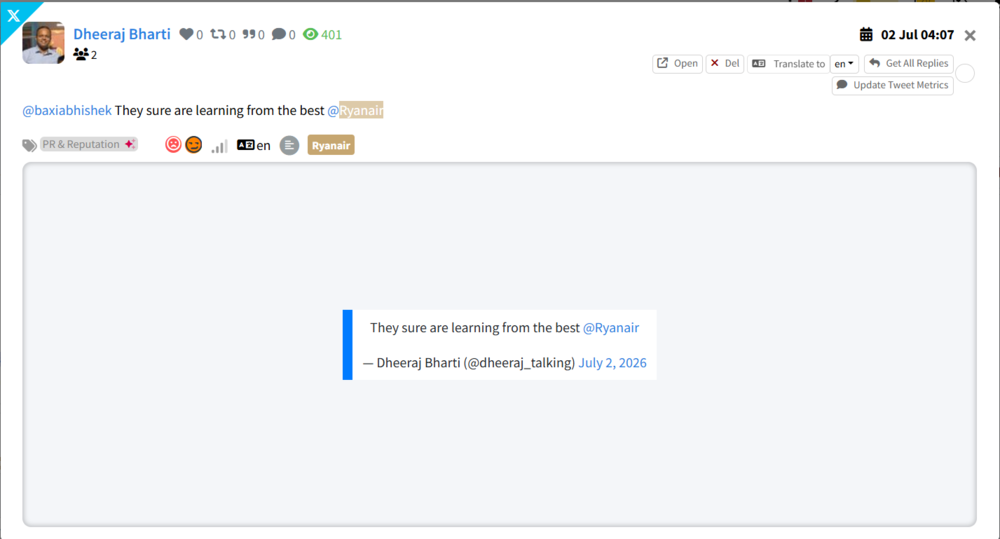
But as you can see from the icon in the image, Mentionlytics detected sarcasm and classified the mention as negative.
As social media became more conversational, the limitations of rule-based systems became increasingly obvious.
Machine Learning Sentiment Analysis
Machine learning represented a major leap forward. Instead of relying on fixed dictionaries, machine learning models learn from thousands, or even millions, of examples that have already been labeled by humans.
Over time, the model begins to recognize patterns, combinations of words, writing styles, and contextual clues that indicate sentiment.
This dramatically improves accuracy, especially when dealing with more natural language.
However, traditional machine learning models can still struggle with sentiment analysis on X (Twitter), for instance, due to humor, irony, rapidly evolving internet slang, or conversations that require broader context.
AI-Powered Sentiment Analysis
Leading sentiment analysis platforms now use advanced AI models capable of understanding language much like humans do.
Rather than simply counting positive and negative words, AI analyzes context, sentence structure, relationships between words, and the overall meaning of the conversation.
As a result, modern AI can often distinguish between:
- genuine praise and sarcasm
- frustration and disappointment
- neutral discussions and actual opinions
- mixed emotions expressed within the same post
AI sentiment analysis is particularly important for social media, where people rarely communicate in perfectly literal language.
Which Method Is Best?
For most businesses, AI-powered sentiment analysis is now the clear winner since manual analysis doesn’t scale and rule-based systems lack context.
Traditional machine learning remains effective but often requires extensive training and maintenance.
Modern AI combines speed, scalability, and contextual understanding, making it the most reliable approach for monitoring conversations across social media, news sites, blogs, forums, review platforms, and other online sources.
The real challenge is whether the system can understand what people actually mean, not just the words they typed.
In Case You’re Wondering…
What people actually mean (and feel) about your brand, turn on Mentionlytics and find out with just a few clicks.
What is a Real-Life Example of Social Media Sentiment Analysis?
Let’s take a real example captured by Mentionlytics while monitoring conversations about Ryanair on TikTok: “The flight was fighting for its life… but the perfume sales were thriving 💀✨ #ryanair”
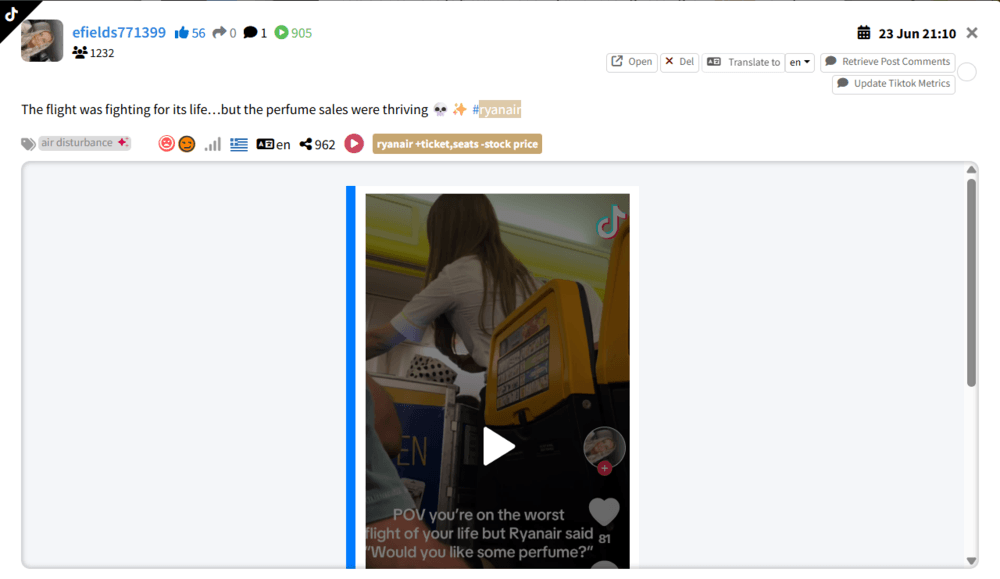
At first glance, this post might confuse a basic sentiment analysis model. It contains the positive word thriving and playful emojis, but the actual message is a sarcastic complaint. The user is joking that the flight felt unsafe while the cabin crew never missed an opportunity to sell duty-free products.
But humans immediately understand what’s happening. It’s a humorous post, but it’s also a genuine complaint based on a real customer experience.
This is why sentiment analysis has evolved far beyond simply counting positive and negative words. Modern AI models analyze the entire context, recognize sarcasm, understand the relationship between different parts of the sentence, and identify the true intent behind the message.
In this case, Mentionlytics correctly classified the post as negative and added another layer by identifying the dominant emotion behind the sentiment. Here, the emotional tone was classified as sarcasm, capturing the ironic tone used to express dissatisfaction.
That extra level of analysis helps brands understand not only what customers think, but how they feel, making it much easier to prioritize issues and respond appropriately.
How to Do Sentiment Analysis on Social Media with Mentionlytics
If you want to track your brand on social media, how it appears in the eyes of the audience, and how they feel about your product or service, it’s always best to use the most accurate sentiment analysis for social media tracking.
Your sentiment scores can show you what numbers of mentions, or even engagement rates, can’t. So, let’s see how that goes with Mentionlytics.
Step 1: Create Your Account
Sign up for a free Mentionlytics account and access your dashboard. AI is there to help you, so it shouldn’t take more than a few clicks. From there, you’ll be guided through creating your first monitoring setup, with no complicated configuration required.
Step 2: Add the Keywords You Want to Monitor
Keywords are the foundation of your sentiment analysis. They tell Mentionlytics exactly what conversations to collect and analyze.
Depending on your goals, you can monitor:
- Your brand or company name
- Product and service names
- Campaign names or hashtags
- Executive or spokesperson names
- Competitor brands
- Industry-related terms
To keep your results clean, you can also exclude irrelevant words and add competitors or industry keywords through the built-in setup options. The more precise your keyword selection, the more accurate your sentiment insights will be.
And if you think you’ve made a mistake during the setup, you can always go to your dashboard and edit it through the Add Keyword/Tracker option.
Step 3: Let Mentionlytics Collect the Conversations and Sentiment Data
After your keywords are active, Mentionlytics begins monitoring conversations across supported social media platforms, including X, Facebook, Instagram, TikTok, LinkedIn, YouTube, and Reddit, as well as news sites, blogs, forums, review sites, podcasts, and the wider web.
Alongside scanning social networks for mentions, Mentionlytics will track sentiment around those mentions and spot real-time sentiment shifts.
Social media users often express their satisfaction and dissatisfaction on social platforms. And since you’re not certain what platforms your users use most, or where they are most active, it’s crucial to monitor as many social channels as you can.
We all know it takes just one viral post to damage your reputation, and you can easily prevent that by tracking sentiment in real time.
Step 4: Explore Your Sentiment Insights
Every collected mention is automatically analyzed using AI and categorized as positive, negative, or neutral. Beyond the overall sentiment score, Mentionlytics helps you understand the context behind the numbers by showing:
- Sentiment trends over time
- Which platforms generate the most positive or negative conversations
- Geographic sentiment distribution
- Predominant emotions behind mentions
- The topics driving positive and negative discussions
- The keywords and hashtags most frequently associated with each sentiment
- Share of Voice compared to your competitors
- The influencers and authors shaping the conversation
Understanding customer sentiment requires a big-picture view. So, instead of manually reading thousands of posts, you can immediately see where your reputation is improving, where problems are emerging, overall social sentiment, and what’s driving both positive and negative emotions.
Step 5: Investigate and Take Action
If negative sentiment suddenly spikes, simply filter your mentions by sentiment, source, keyword, country, or date to identify exactly what caused the change.
You can drill down to the original posts, understand the context, and respond before a small issue turns into a larger reputation problem. That’s the easiest way for companies to use social media to do sentiment analysis.
Likewise, positive spikes reveal which campaigns, product launches, or customer experiences resonated most with your audience, helping you replicate what’s working.
With AI handling the social media and sentiment analysis automatically, your team can spend less time sorting through social media posts and more time making informed marketing, PR, and customer experience decisions.
How to Visualize Sentiment Analysis of Social Media?
When you use a flexible, customizable platform for social listening, like Mentionlytics, you have easy ways to visually present social media sentiment analysis to your clients, CEO, board members, or other stakeholders.
Your dashboards and reports should help your clients understand what you’re talking about in a second, not need to use a calculator to do the math like it’s 1990.
Standard Charts & Visualizations
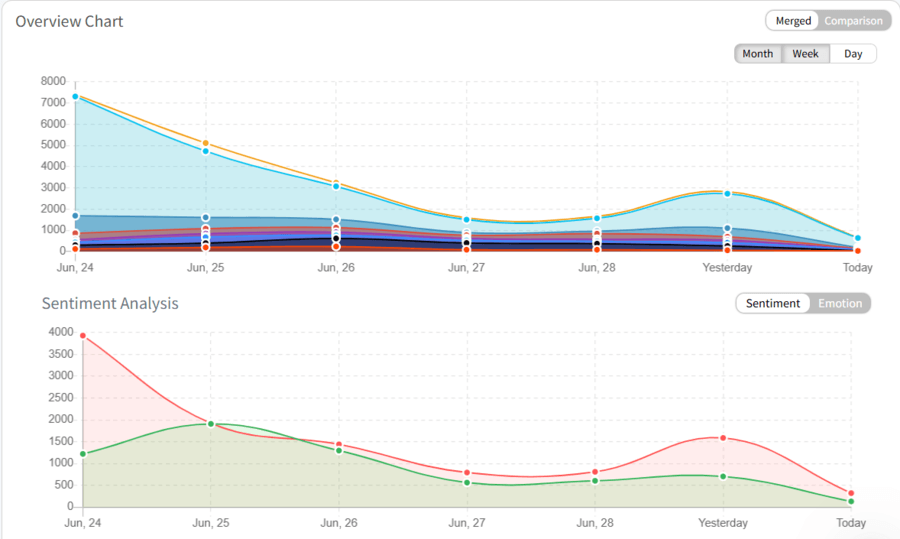
- Overview Charts: Fully interactive line and bar graphs displaying your total mentions, social reach, and engagement across all selected platforms over time. You can easily filter it by sentiment, and clicking any data point lets you drill down into the specific mentions.
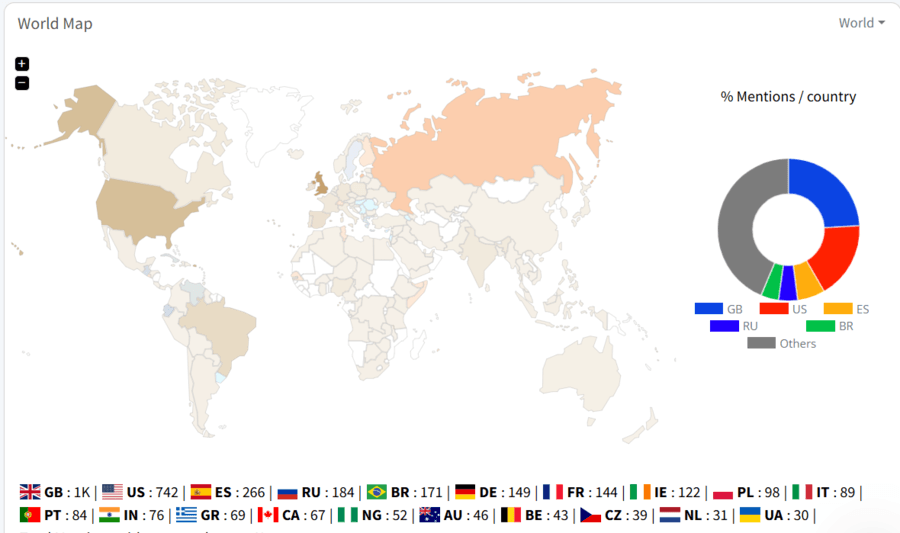
- World Map Comparison: Geographical maps that highlight the specific countries and regions where your brand or your competitors’ brands are being discussed based on the sentiment of the conversation.
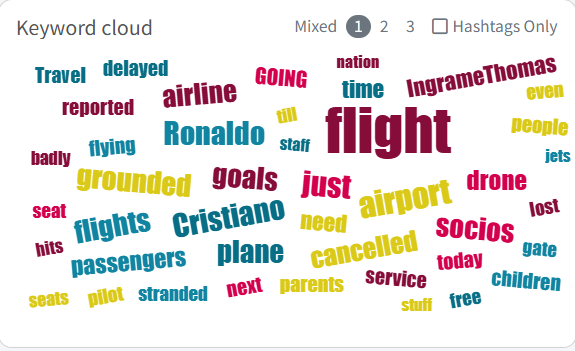
- Word Clouds: Visual representations of your most frequently used keywords and trending hashtags filtered by sentiment. You can see which words are most often associated with negative or positive connotations on social media.
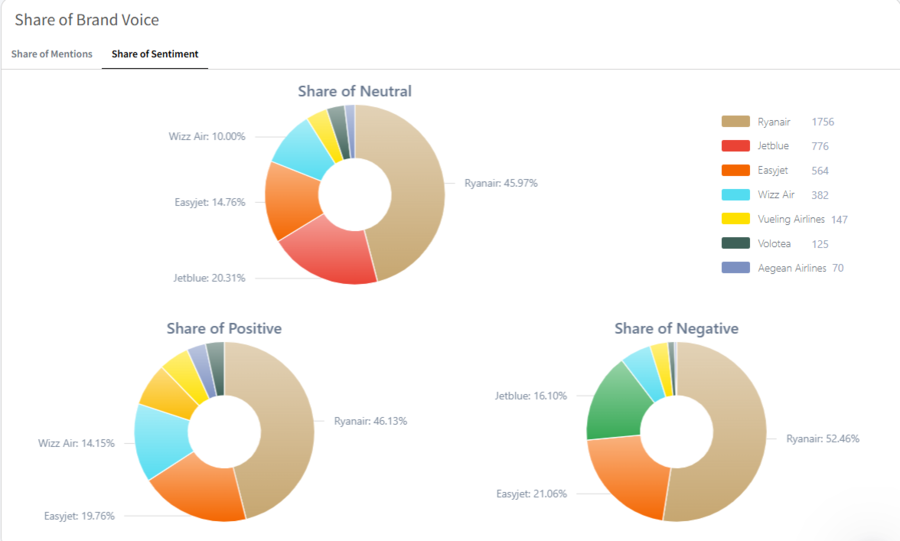
- Pie/Doughnut Chart: Used to visualize the percentage of negative, positive, and neutral sentiment, but you can use it within your reports for any other set of data.

- Share of Voice by Sentiment (Positive, Negative, Neutral) shows you visually how your sentiment looks against your competitors’ sentiment.
Advanced Component Analytics
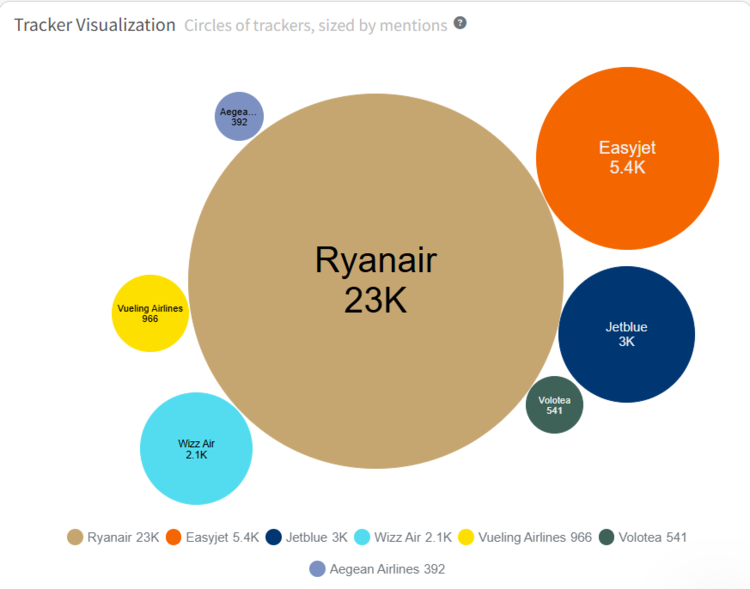
- Mention Virality (Bubble Chart): A dynamic tracker visualization where the size of the circle represents the brand’s virality; the larger the circle, the more buzz and engagement the brand generates. It can be filtered by sentiment, so might prove the point that even though your competitor is leading in the number of mentions, it’s also leading in negative ones, and you’re still leading in the positive sentiment.
- Emotion Analysis Graphics: Specialized visualizations that break down nuanced emotions in mentions (e.g., Joy, Anger, Sadness, Fear, and Sarcasm).

Custom Dashboards & Reports
- Dynamic Component Builder: Now, if you want something more customized and different types of charts, you can include histograms, table views, polar charts, metrics, and layouts in your report.
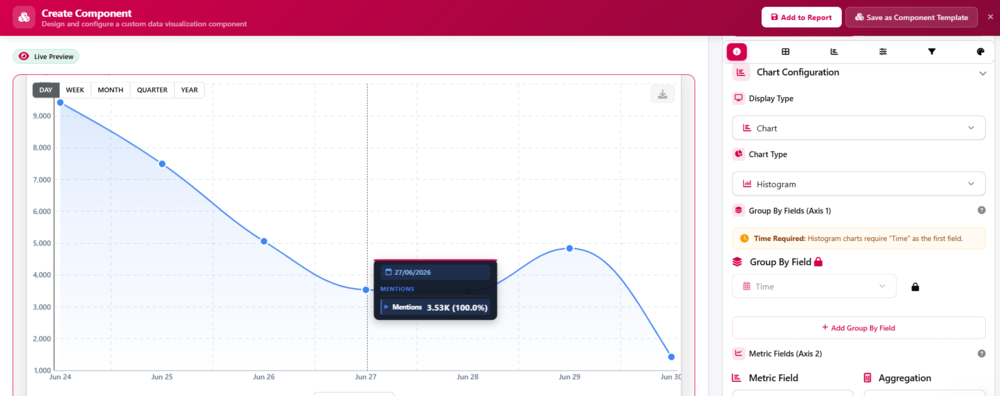
- Styling Options: Custom reports allow you to adjust colors, border thickness, fill modes (Solid or Gradient), and even add hover effects for digital presentations.
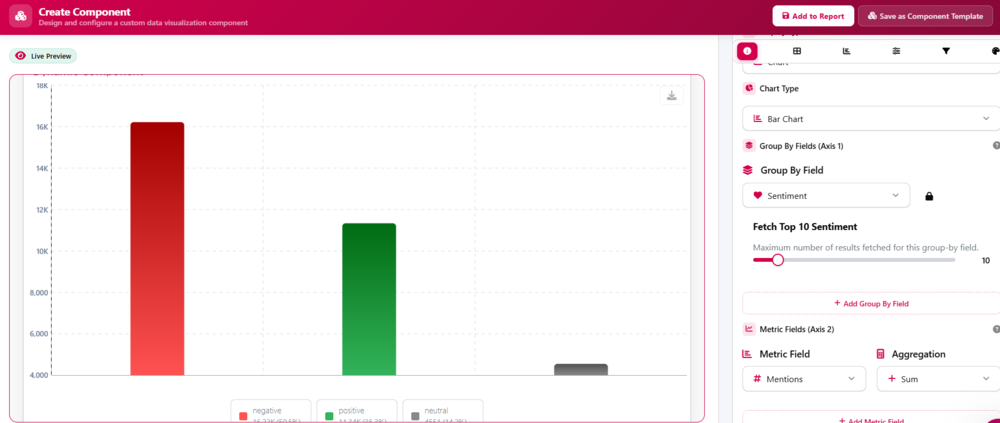
Data can be viewed directly on the dashboard or exported as polished PDF and Excel reports.
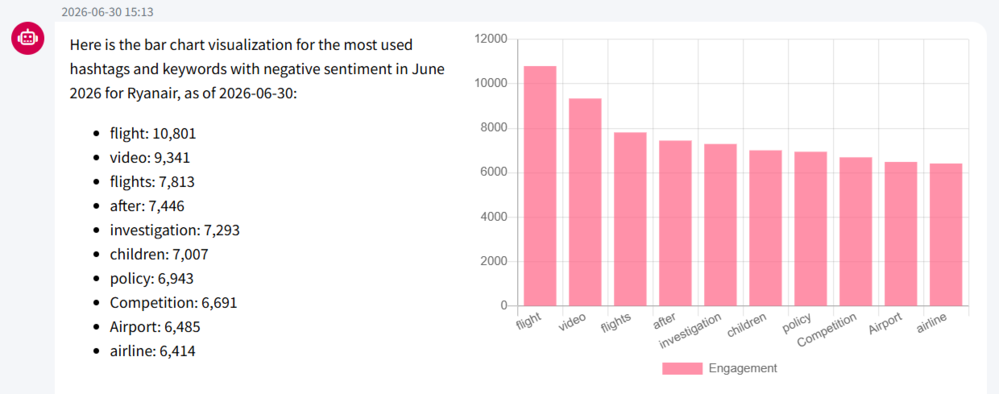
And if you need a quick update on any insights, you can use Mentionlytics’ SIA Chatbot to get your analysis with or without a chart (based on your needs).
For example, you can ask the SIA Chatbot to pull the most-used keywords in mentions with positive or negative sentiment for the previous month.
What Type of Data Would Be Used in Sentiment Analysis of Social Media Posts?
If you want a detailed and accurate sentiment analysis of social media posts, you should look into these details:
- Which platform is driving the negativity? Is Reddit angry while LinkedIn loves you?
- Which countries are happy customers, and where is your reputation taking a hit?
- What emotions are behind the posts? Fear? Joy? Anger? Sarcasm?
- Which topics create praise, and which ones trigger complaints?
- Which keywords and hashtags keep appearing in positive vs. negative conversations?
- Are you winning the conversation against competitors, or are they getting all the positive buzz?
- Who are the people shaping the discussion, and what do they actually think about your brand?
Once you gather all the information, you have a broader picture of why your brand’s sentiment looks the way it does and where and what you should focus on to balance it out. That’s the true purpose of sentiment analysis tools for social media.
What is a Good Accuracy for Sentiment Analysis?
When it comes to brand reputation, one of the most important things is sentiment analysis accuracy. Because if your customer feedback is labeled as positive, and in fact it’s just being ironic, then your sentiment analysis can give you a false promise that everything is rosy.
And you would probably love to see 100% accuracy when it comes to social listening tools… but the truth is, human accuracy in spotting the right sentiment tops out at 80%. So, that means that everything around 80% accuracy is a good sentiment analysis.
That means that Mentionytics, with a 96% accuracy level (according to our users’ feedback), is way surpassing average human capability to categorize social media posts by sentiment.
How to Validate Sentiment Analysis?
If someone tells you their sentiment analysis model is 96% accurate, the first question that pops into your mind is probably: Compared to what?
In academic research, sentiment analysis models aren’t considered reliable just because they “look right.” They go through several validation steps to ensure they’re producing meaningful and consistent results.
Compare AI predictions with human judgment
The most common validation method is comparing a model’s predictions against a gold-standard dataset, a collection of posts, tweets, or reviews that have already been manually labeled by human annotators.
For example, researchers might ask several experts to classify 10,000 X posts as positive, negative, or neutral. The AI model is then evaluated based on how closely its predictions match those human labels.
The interesting thing is that researchers don’t evaluate the AI before evaluating the humans. Before creating a gold-standard dataset, they measure inter-annotator agreement, in other words, how consistently different people assign the same sentiment to the same piece of text.
Why? Because sentiment isn’t always obvious.
A sarcastic tweet, an emoji-heavy comment, or a phrase like “Well… that went well 🙃“ can easily be interpreted differently. If humans struggle to agree, expecting an AI model to be perfect would be unrealistic.
Measure More Than Accuracy
Accuracy is important, but it doesn’t tell the whole story. That’s why researchers usually report additional metrics such as Precision, Recall, Matthews Correlation Coefficient (MCC), and the F1-score.
Together, these measurements show not only how often a model is correct, but also how reliably it identifies positive, negative, and neutral sentiment without introducing bias toward one category.
Among these metrics, the F1-score is one of the most widely reported in sentiment analysis research because it balances precision and recall, making it particularly useful when sentiment classes are unevenly distributed. A 2020 study also recommends reporting MCC, as it provides an even more robust evaluation for imbalanced datasets and helps avoid overly optimistic accuracy scores.
Test It on Real-World Data
Finally, researchers perform error analysis by reviewing the posts the model classified incorrectly.
This step often reveals the biggest challenges for sentiment analysis, including sarcasm, irony, slang, emojis, abbreviations, and rapidly evolving internet language. It’s one of the reasons why analyzing social media conversations is considerably more difficult than analyzing product reviews or formal text.
Why It Matters
At the end of the day, sentiment analysis should ensure that labels for positive, negative, and neutral sentiment reflect how real people interpret the conversation. That’s why the best sentiment analysis tools are continuously tested against human judgment, benchmark datasets, and real-world social media content.
That’s how Mentionlytics’ sentiment analysis function works. After all, your marketing decisions are only as good as the data they’re based on.
Panagiotis Tsagkouris, Full-Stack Developer at Mentionlytics
Try the Best Way to Do Social Media Sentiment Analysis
You don’t need an enterprise budget to understand how people feel about your brand. All you need is a social listening tool with the most accurate sentiment analytics possible, and a dataset from which you gather all the info about your brand.
That’s why we recommend Mentionlytics, with its AI-powered social media sentiment analysis, Share of Voice, hashtag analytics, emotion analysis, competitor monitoring, top mentioners, and AI summaries. Because we believe a good sentiment analysis should be available to everyone.
Start your free 14-day trial, no credit cards, no strings attached.
FAQ
Which tool is commonly used for sentiment analysis?
The most commonly used sentiment analysis tools for social media monitoring include Mentionlytics, Brandwatch, Talkwalker, Sprout Social, and Meltwater, while researchers often use Python libraries such as VADER and TextBlob.
What is sentiment analysis in social media posts?
Social media sentiment analysis is the process of using artificial intelligence (AI) and natural language processing (NLP) to determine whether online conversations express positive, negative, or neutral opinions. More advanced tools can also identify emotions such as joy, anger, frustration, or surprise, helping brands understand public perception beyond simple engagement metrics.
Is sentiment analysis legal?
Yes, sentiment analysis is generally legal when it analyzes publicly available data and complies with privacy regulations such as GDPR or CCPA. Companies should always respect platform terms of service and avoid collecting or processing personal data without an appropriate legal basis.
What are the four main steps of sentiment analysis?
Most sentiment analysis workflows follow four steps:
- Collect data from social media or other sources.
- Clean and preprocess the text.
- Classify the sentiment using AI or machine learning models.
- Analyze and visualize the results to identify trends, topics, and business insights.
Is sentiment analysis AI or ML?
Sentiment analysis uses both AI and ML. Modern sentiment analysis combines artificial intelligence (AI), machine learning (ML), and natural language processing (NLP). While earlier systems relied on predefined dictionaries of positive and negative words, today’s models learn from large datasets and can better understand context, slang, emojis, and sarcasm.
What is sentiment analysis on social media comments?
Sentiment analysis on social media comments automatically evaluates how people feel about a brand, product, campaign, or topic based on the language they use. Instead of manually reading thousands of comments, AI classifies them by sentiment, and often by emotion, to reveal trends, customer pain points, and emerging opportunities.
Does Facebook do sentiment analysis?
No, Facebook provides analytics about page performance, audience demographics, and engagement, but it doesn’t offer built-in sentiment analysis for comments or mentions. Businesses typically use social listening platforms like Mentionlytics to monitor sentiment across Facebook alongside X, Instagram, Reddit, YouTube, blogs, news sites, and other online sources.
What is the best sentiment analysis tool?
Mentionlytics is a strong choice for businesses seeking accurate, AI-powered sentiment analysis, emotion detection, and social listening across multiple platforms. Enterprise organizations may also consider Brandwatch, Talkwalker, or Meltwater, while developers often build custom models using NLP frameworks.
What are the benefits of sentiment analysis in social media?
Sentiment analysis helps businesses understand how customers feel about their brand, products, or campaigns. It can detect reputation risks early, measure campaign impact, identify customer pain points, evaluate competitor perception, and uncover trends that traditional engagement metrics alone cannot reveal.
Is sentiment analysis considered AI?
Yes, modern sentiment analysis is considered an application of AI because it uses machine learning and natural language processing to interpret human language. Advanced models can recognize context, emotions, sarcasm, and other linguistic nuances that rule-based systems often miss.
What’s the top social media listening tool for sentiment analysis?
Several platforms offer high-quality sentiment analysis, including Mentionlytics, Brandwatch, Talkwalker, Sprout Social, and Meltwater. If you’re looking for a balance between AI-powered insights, affordability, and multi-platform monitoring, Mentionlytics is one of the strongest options, with sentiment analysis available from its Basic plan.
How can companies use social media to do sentiment analysis?
Companies typically use social listening and brand monitoring tools to collect mentions from social media platforms and classify those conversations by sentiment and emotion. The insights can be used to improve customer service, measure campaign performance, monitor competitors, identify brand advocates, and respond quickly to reputation issues.
What are the uses for social media sentiment analysis?
Social media sentiment analysis is commonly used for brand reputation management, customer experience monitoring, competitive analysis, campaign measurement, product feedback, crisis detection, influencer marketing, and market research. It transforms thousands of online conversations into actionable business insights.
Which sentiment analysis tools work best for social media monitoring?
The best tools combine sentiment analysis with broader social listening capabilities. Mentionlytics, Brandwatch, Talkwalker, and Meltwater can monitor mentions across multiple platforms while analyzing sentiment, emotions, hashtags, competitors, and trends. This provides far more context than monitoring engagement metrics alone.
