


Let’s admit it — emotions rule our lives. No matter how rational you are, you’re surrounded by other people, and as a social being, you react to their emotional state. Oh, and not just that, emotions also seem to drive our business. And that’s where emotion analysis comes into play.
Antonio Damasio, professor of neuroscience at the University of Southern California, claims that emotions are essential ingredients of every decision we make in life, including, of course, what to buy.
Our brain processes the emotional states of others and ourselves and creates reactions based on those. That means all our other emotions highly impact our decision-making.
That’s why it’s important to recognize, understand, and influence the emotions of your target buyers. It’s something called Emotional Intelligence (EI).
Now, when it comes to business, instead of EI, we use AI for emotion analysis — to recognize and understand what drives or triggers our customers.
Acknowledging and understanding the emotions behind what people say about your business enables you to truly get their needs and plan strategies accordingly.
In this article, we dive deep into emotion analysis and how it can help businesses better understand their audience.
“People don’t buy WHAT you do; they buy WHY you do it.”
Simon Sinek
Table of Contents
What is Emotion Analysis?
Emotion analysis involves analyzing text, speech, or visual data to identify specific emotions, such as happiness, anger, or fear.
Uncovering the emotional tone behind various online communications with customers gives businesses actionable insights to manage crises effectively and better understand user behavior. This leads to smarter decisions and improved marketing results.
According to Paul Ekman’s theory, these emotions could be any of the basic six emotions:
Happiness – Anger – Sadness – Fear – Disgust – Surprise
And they could be expressed in text, speech, or other forms of communication.
Unlike sentiment analysis, emotion analysis provides a deeper understanding of emotional expressions, e.g. in brand mentions, comments, reviews, and more. That makes it valuable for:
- Customer experience
- Crisis management
- User behavior analysis
And many more use cases!
The purpose of emotion analysis is to detect the underlying tone of communication. Based on the emotions, it offers valuable insights into how people feel and react in specific contexts.
Now, how is it possible to use this emotion recognition for your business? Emotion analyses use AI tools and methods, such as natural language processing (NLP), machine learning algorithms, sentiment lexicons, and others, for detailed emotional insights.
The goal is to extract and interpret people’s emotions behind the data. These methods often combine advanced AI techniques with psychological theories to ensure accurate and meaningful results.
What Your Business Can Get From Emotion Detection

Emotion detection can help in interacting with customers, managing feedback, and making decisions. By using emotional insights, companies can:
- Improve Customer Experience:
Detecting emotions like frustration or satisfaction in real time can be of great help. Companies can tailor responses and use insights to resolve emerging issues which results in increased customer loyalty. - Strengthen Brand Reputation:
Businesses can monitor social media and reviews for emotional trends about their brands. If they address negative emotions instantly, they reduce the chance of potential crises. - Increase Sales and Conversions:
Companies have a great advantage by knowing the emotional triggers that lead to purchase decisions. They can create emotionally persuasive content. - Enhance Marketing Campaigns:
Companies can analyze how target audiences emotionally react to ads, slogans, or campaigns. That way, they can refine marketing strategies to create emotionally resonant messages. - Data-Driven Decision Making:
Businesses can use emotion detection to align their products, UX, and campaigns with customers’ preferences.
What Are the Different Types of Emotional Analysis?
If we talk about the classification of emotional analysis, there are 3 primary types:
- text-base
- voice-based
- video-based
Text Analysis
Text analysis remains the base of emotion recognition as written communication still dominates digital interactions.
This method uses natural language processing (NLP). It identifies emotional signals from word choice, syntax, and semantic context. It can analyze product reviews, tweets, or emails. It’s best at uncovering sentiments such as joy, anger, or sadness present in written content.
For instance, imagine a customer leaving feedback on a marketplace: “I loved the product, but the delivery was so late I might never order again.” Text-based emotion analysis would pick up the conflicting emotions.
It would be “joy” for the product, but “frustration” with the delivery. Knowing those feelings, businesses can refine their processes, like changing the delivery service.
Voice Analysis
Our voice can tell a lot through tone, pitch, and rhythm. By analyzing it, we can discover subtle distinctions.
Voice analysis often uses machine learning algorithms and trained models to decode emotions from speech. It is especially valuable in customer service, where understanding vocal signs can guide agents. Customer Success teams can provide empathetic and tailored responses based on that.
Consider a call center interaction where a customer’s voice starts to tremble or rise in pitch. Voice-based emotion recognition can detect these subtle changes. It can flag the conversation for potential escalation or immediate resolution.
Video Analysis
Images and videos have become almost dominant forms of communication. That’s expected due to the omnipresence of visual devices like smartphones. Compared with text or voice, visuals are often more vivid and intuitive in expressing emotions.
Video-based emotion analysis uses computer vision to study:
- Facial expressions
- Body language
- Eye movements
For example, a business can analyze user reactions to an advertisement. Video analysis can capture real-time facial cues such as smiles, furrowed brows, or raised eyebrows.
Thus, you can see how viewers truly feel about the content. This visual feedback is invaluable for crafting more engaging and emotionally resonant campaigns.
Finally, it’s worth noting that advanced AI models have now implemented combined approaches to understand consumer behavior better.
The Difference Between Sentiment and Emotion Analysis Explained
Have you ever wondered why a chatbot seems to know whether you’re happy or frustrated? Or why do some tools just label your tone as “positive” while others say you’re “thrilled”? You’ve come across the difference between sentiment analysis and emotion analysis. Let’s break it down.

If we compare sentiment analysis vs emotion analysis, we can conclude that sentiment analysis can provide just a general overview. On the other hand, emotion analysis goes in depth.
Sentiment analysis (also known as opinion mining) is like the broad strokes of emotional interpretation. It’s designed to tell you whether a statement is positive, negative, or neutral.
Sometimes, it goes a step further with categories like “very positive” or “very negative.” Think of it as the macro view of your mood.
For example:
- “This product is fantastic!” → Positive
- “I hate waiting for my order.” → Negative
Sentiment analysis often uses machine learning models or sentiment lexicons to categorize overall polarity. It’s most often used for brand monitoring and analyzing customer feedback through reviews.
On the other hand, emotion analysis takes things up a bit — it’s more about the fine details. Instead of just labeling something as positive or negative, it’ll tell you the emotion behind it. Is it joy, anger, fear, sadness, or even more complex feelings like anticipation or trust?
It typically uses frameworks like Plutchik’s Wheel of Emotions or Ekman’s Basic Emotions. And it can identify specific emotions from text, voice, or visuals. For instance:
- “I’m so nervous about tomorrow!” → Fear
- “I’m beyond thrilled with my purchase!” → Joy
It’s ideal to understand why people feel the way they do. Excellent for improving user experiences or uncovering product flaws.
Have Sentiment & Emotion Analysis at Your Fingertips
With Mentionlytics, you can have all your mentions analyzed and categorized by sentiment AND emotion with the power of AI!
How Emotions Affect Purchase Decisions
Once you realize how to trigger your customers’ emotions, your business can start scaling. If you want to connect with your customers on a deeper level, you need to understand them. Understand how emotions influence purchasing decisions.
It’s not a myth; When consumers feel good, they are more likely to make purchases, often to prolong their positive mood. But happiness is not the only emotion that drives sales.
There are so many examples around us from brands that played this game so well.
Let’s explore two key emotional drivers, nostalgia and a sense of belonging mixed with FOMO, using real-life examples to illustrate their impact.
Nostalgia Marketing: Evoking Fond Memories to Drive Sales
Nostalgia marketing targets consumers’ fond memories. It impacts purchasing behavior by creating an emotional connection. That element from the past brings positive emotions, leading to increased engagement and sales.
Example: Nintendo’s Classic Mini Consoles
Nintendo effectively used nostalgia marketing. They released miniature versions of their vintage gaming consoles — the Nintendo Entertainment System (NES) Classic Mini and the Super NES Classic Mini.

These products allowed consumers to relive their childhood gaming experiences. They even had a complete set of pre-installed classic games.
The strategy was not targeting only long-time fans but also younger audiences. The campaign was a hit, selling out quickly and driving up demand for Nintendo’s newer consoles.
Social Proof: Leveraging Collective Behavior to Influence Purchases
Social proof is the psychological phenomenon where people look to others’ actions to determine their own. In marketing, showcasing how others use and endorse a product can attract new buyers.
Example: Rare Beauty’s TikTok Influence
Besides the fact Rare Beauty is a cosmetics brand founded by Selena Gomez, it has skyrocketed in success by strategically partnering with TikTok influencers. These popular TikTokers were creating a buzz that resonated with a massive audience.

As a result, Rare Beauty experienced extraordinary growth. Sales went up beyond $350 million in estimated annual revenue, and their TikTok presence amassed over 4,1 million followers.
Their social proof strategy turned viral influencer videos into significant revenue. Wondering why it worked? Influencers acted as relatable advocates for the brand. They created trust and validated Rare Beauty’s quality among consumers.
How to Conduct Emotion Analysis With AI
You need to understand your audience’s emotions to shape how your brand communicates, engages, and grows. And yes, it’s impossible to do it “on foot.” You need a tool with AI emotion analysis, such as Mentionlytics.
Let’s explain how you can detect and analyze the emotions behind your mentions using the Mentionlytics platform as an example.
Step 1: Choose a Social Listening Tool with AI Capabilities
First things first — you need the right tool for the job. An AI-powered social listening tool saves you from manually sifting through mentions. It ensures you get accurate, high-quality data. So, you need a tool with AI features beyond simple monitoring to deliver actionable insights.
Remember, by automating data collection, you can rest assured you’ve scanned all online sources for mentions, feedback, and comments from your audience.
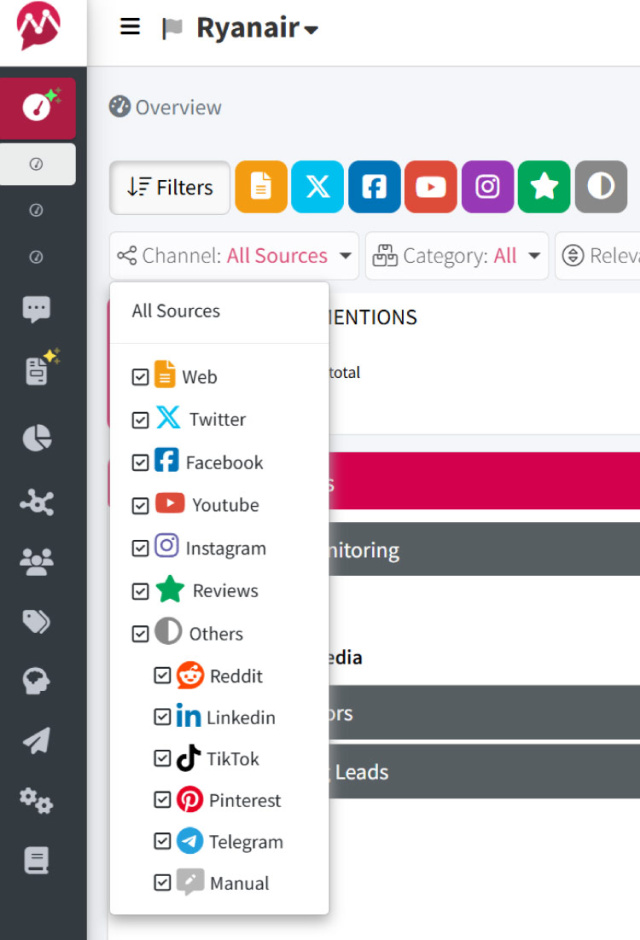
All Mentionlytics Data Sources in Filters
Step 2: Set Up Your Account
Once you’ve chosen your tool, set up your account and tailor it to your needs. Use keywords related to your brand, competitors, or industry trends. That way, you can effectively monitor the emotions of your audience.
For instance, you can track:
- Brand mentions like “Product Name”, e.g. “Frappuccino”
- Competitor names like “Adidas”, “Nike”, “Reebok”
- Industry phrases like “best coffee machine” and “vegan cosmetics”.

Example of keyword set up in Mentionlytics
Step 3: Gather Social and Web Mentions
Now, sit back and let the tool do its magic. It scans social media platforms, websites, blogs, and news sources and gathers information.
It’s pulling every relevant mention into a neatly organized dashboard. No need to search manually — everything you need is already collected for you in a social media dashboard (your best friend).
Step 4: Run AI Emotion Analysis
Here’s where the real magic happens. Mentionlytics’ AI-powered Emotion Analysis feature can break down your mentions into emotional categories. It could be joy, sadness, anger, or fear.

Example of Emotion Analysis in Mentionlytics Reports
This feature shows you the overall emotional tone of your mentions and the emotions expressed in them. Besides that, it highlights specific content driving those emotions.
For example:
- Joy: Mentions celebrating your latest product launch
- Sadness: Mentions expressing disappointment in a delayed delivery
Step 5: Study the Results and Draw Conclusions
Now that you’ve got the results, it’s time to dig deeper. Look for patterns in the emotional data:
- Explore joy mentions to understand what your audience loves most.
- Analyze sadness mentions to identify areas where your brand might be falling short.
- Dive into anger mentions to address critical concerns and prevent PR crises.
By understanding these emotional insights, you can adjust your strategy, whether it’s fine-tuning your messaging, improving customer support, or revising your product offerings.
Bonus: Share It with Your Team with Downloadable Reports
Once you’ve uncovered key insights, sharing them should be simple. The tool you choose should allow you to download detailed reports, which are perfect for presentations, team collaborations, or keeping your boss in the loop.
Get Customizable Reports Ready to Present
Use Mentionlytics’ Report Builder to showcase emotion analysis and other key analyses and impress your team and clients!
Limitations of Emotion Analytics
Emotion analytics has come a long way. It offered businesses invaluable insights into how their audience feels. However, like any technology, it’s not without its challenges.
1. Context: The Challenge of Interpretation
Context matters — a lot. Machines can struggle to understand phrases’ true meaning without understanding their context. For example, slang or the phrase “No way!” could mean disbelief, excitement, or anger, depending on how it’s used.
Without proper contextual understanding, emotion analytics tools might misinterpret such expressions. And it could lead to inaccurate insights.
2. Sarcasm: The Subtle Enemy
Even humans sometimes miss sarcasm, so it’s no surprise that machines find it tricky, too. A comment like “Oh great, another update…” could be genuine praise or a sarcastic complaint, depending on tone and context.
Detecting sarcasm remains one of the toughest hurdles for emotion analytics. It often requires more than just linguistic analysis. It needs cultural and situational awareness, too.
3. Data Quality: The Foundation of Accuracy
Emotion analytics is only as good as the data it analyzes. Low-quality or biased data can skew results, leading to unreliable conclusions. Gathering data from a narrow range of sources — or data filled with irrelevant noise — limits the insights you can gain.
Make Sure You Use Only High-Quality Data
Mentionlytics gathers only high-quality data from a wide variety of sources, ensuring your emotion analysis results are both accurate and actionable. Get a glimpse of it now!
Analyze the Emotions of Your Audience Automatically
Emotion analytics is crucial for understanding how your audience feels about your brand. Emotions were always the triggers for our actions, and they were often used for marketing purposes.
While there are some challenges (no, AI is still not perfect), the right tools can turn limitations into opportunities.
Don’t let emotions go unnoticed — turn them into actionable insights with Mentionlytics!
Explore Mentionlytics’ AI Emotion Analysis today!
FAQ
What is Emotional Analytics?
Emotional analytics is the process of using AI and data analysis to detect and understand human emotions from text, voice, or visual data. It helps businesses gain insights into how people feel and respond. It enables smarter decision-making.
What is the 5 Basic Emotions Theory?
The 5 Basic Emotions Theory, introduced by psychologist Paul Ekman, identifies five universal emotions. These are happiness, sadness, anger, fear, and disgust. These emotions are fundamental because they are recognized across all cultures and play a key role in human survival and communication.
What Are the Techniques Used in Emotion Analysis?
Emotion analysis uses techniques like Natural Language Processing (NLP), machine learning, lexicon-based approaches, and deep learning (like neural networks) to detect emotions in text.
Can We Get Emotion from Sentiment Analysis?
Not really. Sentiment analysis just classifies text in three categories: positive, neutral, or negative, while emotion analysis goes deeper, discovering emotions behind the text. That way, emotion analysis can discover that a negative comment contains emotions like anger or sadness.
Some emotion analysis tools are so sophisticated that they even detect sarcasm, meaning the text sentiment analysis would label a text as positive, but advanced emotion analysis can reveal that it’s actually sarcasm, so it’s negative.
Does Sentiment Analysis include Emotion?
Basic sentiment analysis doesn’t include emotions, but the advanced models (like the ones Mentionlytics uses) include emotion categories.


