


You’ve probably been searching for a way to improve brand visibility in AI answer engines for a while now.
You’ve done your homework: SEO is ready, landing pages are clear and polished, and you have tons of optimized blog posts and AI crawlers enabled, but the traffic… nope. When someone asks ChatGPT about the best tools for this and that, your brand is invisible.
And after all the effort you’ve put in, you’re wondering, “Where did I go wrong, and how the hell is this whole thing functioning now?”
The worst part is that nobody tells you what to do and how to improve brand visibility in AI search engines. Well, have you tried reverse engineering? In this article, we’ll go through a whole process that goes like this:
- Check your AI visibility before changing anything on your website.
- Double-check if crawlers can access the full content and fix it if there are some gaps.
- Make your content extractable and quotable.
- Build an off-site footprint AI learns from.
- Monitor sentiment and correct what AI gets wrong.
Sounds simple, doesn’t it? Yes, but it takes time.
Table of Contents
How AI Search Engines Decide Which Brands to Cite and Recommend
Here’s the thing: AI won’t recommend or cite you if it isn’t confident your brand fits the answer. It needs repeated and consistent evidence to risk naming you. It will run its own background search (fan-out queries) almost every time someone hits the prompt and checks co-occurrence networks, authority, consensus, clarity, sentiment signals, and other things.
So are you worth risking? That’s the main question, and everything else derives from it.
Co-occurrence networks: how AI learns what your brand is “for”
Let’s begin with an example. If your restaurant name was most often tied to the “great pizza” term throughout your social media posts, UGC, and reviews, chances are that it would be recommended by AI search engines when someone asks for a great pizza restaurant (though you might have delicious seafood). And that’s how co-occurrence works in practice.
A co-occurrence network is basically a giant mental map AI builds to understand which words, brands, topics, and entities tend to appear together across the internet.
If two things show up near each other often enough, the AI assumes: “Ah… these belong together,” and starts linking them semantically. This is a huge factor in how AI search decides who gets mentioned in answers.
So, if your brand keeps appearing:
- next to certain keywords
- on reputable sites
- in discussions
- in reviews
- in comparisons
…it builds a semantic connection. Semantic connections, on the other hand, build confidence, and confidence builds AI visibility.
Now, what would AI models use co-occurrence networks for? LLMs want to be sure the answer they provide is the best possible, with no hallucinations. And to do that, they check third-party sources, topical authority, and how other people perceive your brand online.
In other words, the stronger your co-occurrence footprint, the more likely AI is to summarize you, reference you, or accurately describe your brand.
The signals that push a brand into the AI answer set
So, what are the signals you can send to LLMs to choose your brand for citation or recommendation? It’s a mix of traditional Search Engine Optimization (SEO) and Generative Engine Optimization (GEO), with a sprinkle of Answer Engine Optimization (AEO)… yes, all that.
- Authority and consensus across sources: Does your brand stand out within your niche or industry, and do third-party sources agree on that? Do you have authority and trust? Those are the basic signals AI systems look for before they generate answers.
- Entity clarity: Are you consistent in your online appearance, or does your brand get described as a giraffe with wings? Check your pages (because in most cases the confusion starts there), use a social listening platform to find hidden user-generated content (UGC) or a Reddit thread you’ve never seen, and look at third-party sources (like competitors’ comparison blog posts, listicles, or YouTube reviews of your brand) to see what they say about you.
- Machine-readable structure: If LLMs can’t read your site, they cannot confirm from official sources (your website) whether the third-party claim is accurate. So make sure you have clear headings, schema markup (despite some strong voices saying it’s unnecessary), lists and tables, simple, clear definitions, and data with sources (the best option is your own data backed by research or a case study). As a cherry on top, add FAQs, since the query format calls for short answers.
- Real-world sentiment signals: How your users and third parties perceive your brand will most likely be reflected in AI answers. ChatGPT, Perplexity, Gemini, Google AI Overviews, and any other LLM or AI search engine will check up on you, and if most sources have negative sentiment, you’re not going to show up in the “Best XX for XY” query as the answer. So, to increase AI visibility in AI answer engines, you need to earn positive third-party brand mentions across the internet.
- Freshness: All AI platforms and search engines will try to find the most recent content for AI-generated answers, because at the same time it’s the most time-relevant. If you have great content on your website, the best ways to improve brand visibility in AI search results are to audit your existing content or publish fresh content if you see major topics are missing.
Some parts of this list are definitely in the AI searchability group (enabling AI to access your content, first of all), but most of it closely resembles E-E-A-T (experience, expertise, authoritativeness, trustworthiness)… hello, good old SEO.
Why AI visibility moves without warning
A few weeks back, in mid-August 2026, ChatGPT decided, out of the blue, that Reddit would no longer be its favorite citation source. And most marketers relying solely on this channel went “whaaat???”
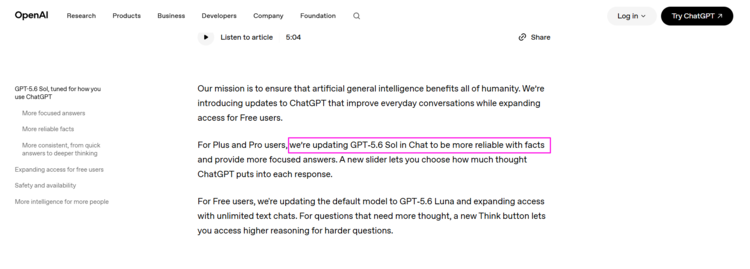
There was no warning, no signals, no official announcements — just cut. Or did we just overlook an official update release from OpenAI on August 6, 2026?
“…we’re updating GPT-5.6 Sol in Chat to be more reliable with facts” — that’s what it says, loud and clear. And we all know where reliable facts do not come from… forums and anonymous accounts. But somehow, this announcement went unnoticed. Nobody wrote about it.
Now, this isn’t the first (nor the last) time AI platforms like ChatGPT have made these shifts. Every now and then (every six to 12 months), LLMs will run backend algorithmic updates, and they might not be that specific when telling the world about it. But if you read carefully, you might see where it’s coming from and what it will affect. And every update introduces the AI model to new behaviors, different reasoning skills, or structural formatting.
On top of that, sources change in citations daily. That’s because of Retrieval-Augmented Generation (RAG), which all LLMs rely on. They scrape the latest data across the web first to ensure fresh, up-to-date answers. So, your position in citations might change in a day, which is why a one-time check isn’t reliable for an overall LLM visibility strategy. It simply might not show you the real results.
That means if you want to improve visibility in AI, your strategy must be versatile and flexible because LLMs will check multiple sources; some will be in your favor… but just for a while, then their attention will shift to another. Your answer engine optimization strategy must focus on fresh data, because AI systems need up-to-date sources for reliable answers.
Our Tested 5-Step System to Improve Your Brand Visibility in AI Answer Engines
We went through these 5 steps (and we’re still going through them), and we want to share only what we see working.
Step 1: Measure Your AI Visibility Before You Change Anything
Before making any changes to your website or strategy, get a good AI visibility software, measure your brand, and review the data you get from it, including citations, prompts, answers, competitors that show up in the answers, frequency, and other metrics you’ll compare against once you finish the changes.
Without a baseline, you have nothing to compare your improvements against. You don’t have a starting point, so how can you confirm you’re doing the right thing? How can you figure out what to change or who’s doing better without the basic data?
One more important thing: don’t focus only on the AI visibility score. It might lead you to a totally different path (not the one you aimed for). You might see that you have quite a good visibility score, but if you dig deeper, you can find out, for example, that you show up only in citations and for informative queries. That doesn’t complement your brand. You want to be cited and recommended for your most important prompts.
And to find out that, you need more metrics than just an overall score.
Before doing anything, check your brand positioning right now for each LLM, because all AI models will act differently; from there, you can see what to change, where you can improve brand visibility in AI answer engines, and whether your brand is mentioned in AI answers or cited.
The five metrics that define AI visibility
One prompt you can always run through all AI models you want to increase visibility in, but the moment it exceeds three prompts, you’ll find yourself in a messy situation. You’ll end up with too much raw data to interpret without hours of additional work, and it will eat up your time.
But if you want to check your AI visibility from different angles, you need to run multiple prompts (10 to 100). The more prompts you track, the more realistic your scores will be.
Of course, you can’t do it manually; the scope is just too big. You can use any of the AI visibility tools, like Mentionlytics, that have these metrics:
- Source Domain Citation per LLM: Find out which domains dominate for each LLM separately. That way, you can increase referral traffic from each AI engine by tapping into these domains (get mentioned in blog posts, increase your presence on specific social platforms, start posting videos on YouTube, etc.). Remember, AI Mode and Google AI Overviews still check Reddit regularly!

- Top URLs for Citations: This metric not only shows you whether or not LLMs use your website as a source, but also points out the third-party sources impacting the AI answers. This is probably the most actionable insight you can get if you want to improve brand visibility in AI answer engines. Don’t forget to pay attention to frequency, because the URLs that appear most often should be at the top of your outreach list.
- Brand visibility per prompt: Your visibility won’t be the same for each prompt, and if you get less traffic from AI engines, the reason might lie here — you’re cited but not recommended. That’s why you need to check your scores for each prompt and see who’s leading and where your brand stands.
- AI brand visibility changes over time: Your brand visibility is not a flat line. If you check your AI visibility tracker, you’ll see fluctuations, and that’s perfectly normal. But if you see a sudden dip, that’s an alarming sign that something went wrong.
- Brand visibility per LLM: If you want to implement strategies to improve brand visibility in LLM responses, you need to check first which LLMs mention, cite, or recommend your brand, because the optimization methods will vary depending on the AI model. That’s why this metric is a must.
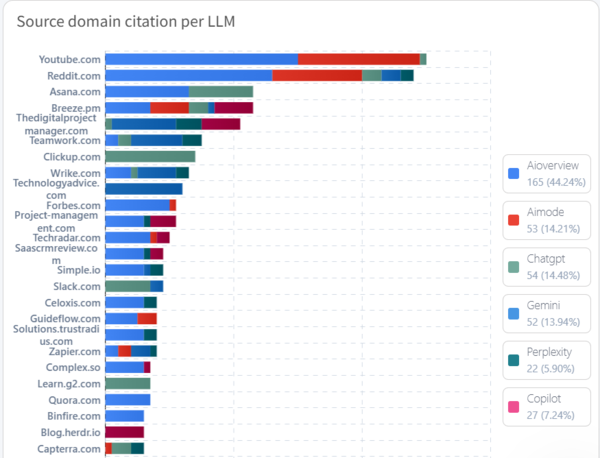
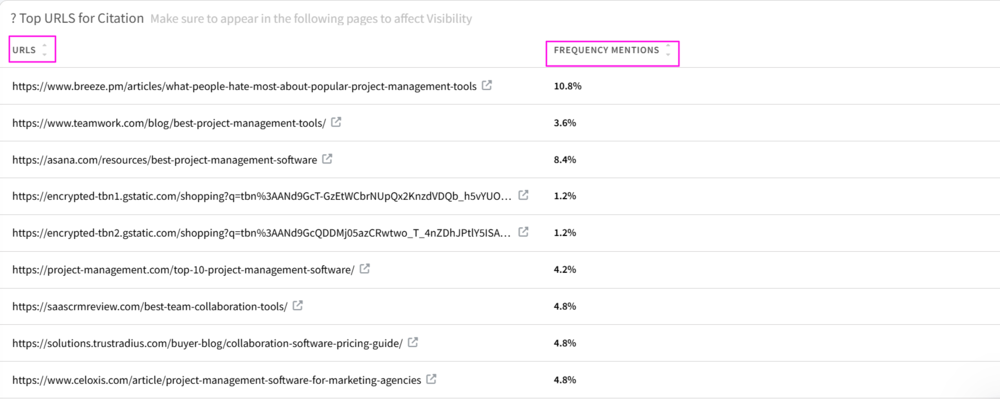
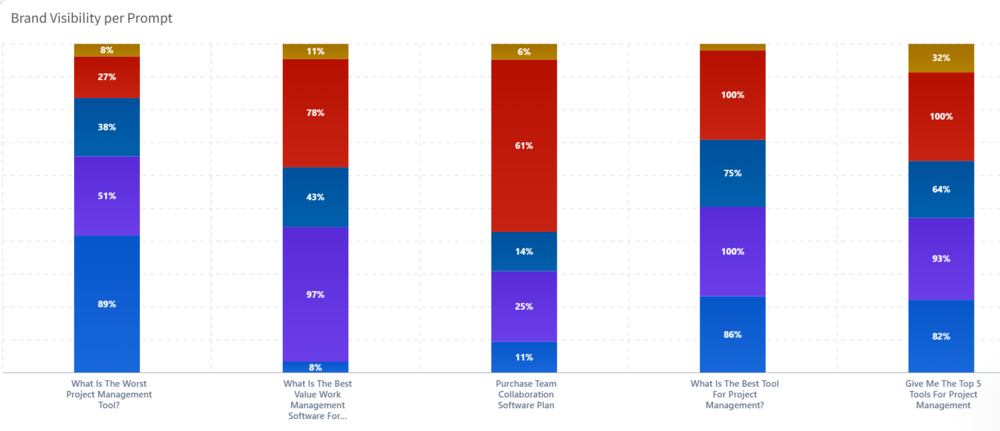
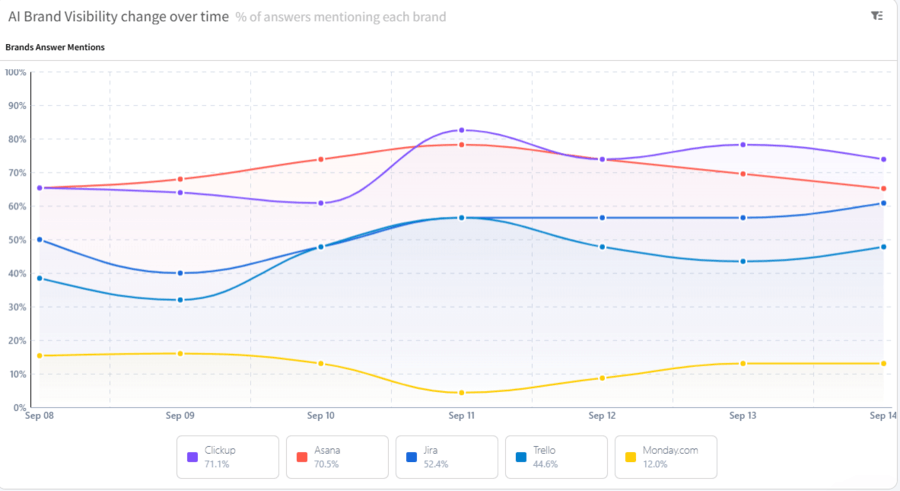
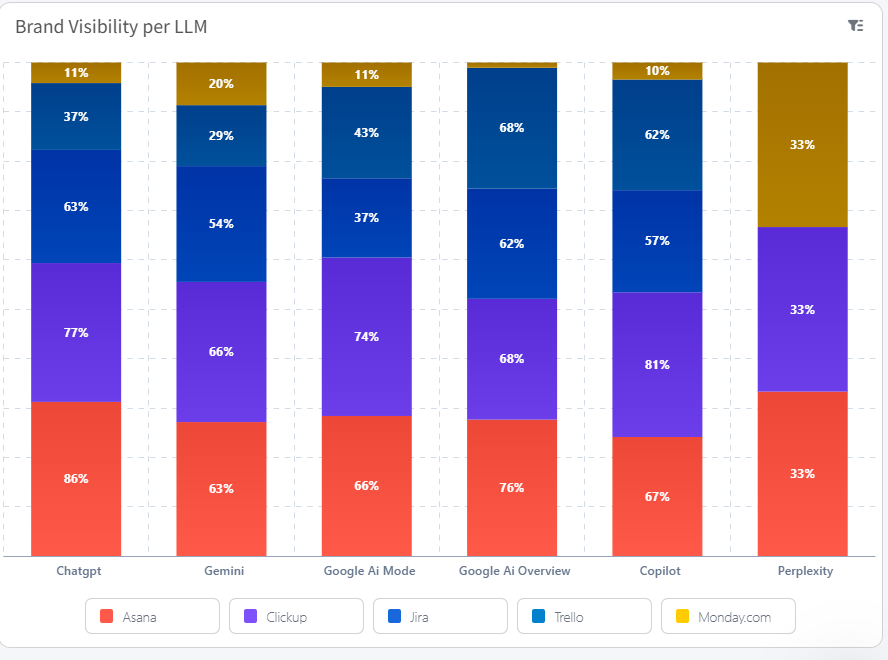
Besides these metrics, Mentionlytics gives you an overview of the basics, like AI share of voice, rank, how often you show up in answers, your competitors, and the sentiment of your mentions. You can also choose how often to run prompts: once to four times a day, weekly, or monthly. The recommended frequency is twice a day (for quick results) or once a day (for at least two weeks of tracking).
Step 2: Fix What AI Crawlers Can’t Read on Your Site
We all want to appear in AI answers, but some still forget that AI can’t cite or recommend what it can’t read. We had the same situation with Google indexing before; if you don’t let AI crawlers read your content, it’s as if it doesn’t exist in the eyes of AI (or Google).
But Google bots are rarely blocked by default, while AI crawlers most often are. And sometimes the website owner doesn’t even know it’s blocked.
So, you have to check your website and fix these things if you notice they’re blocking access:
- Create robots.txt, and allow each AI search engine to have access to your website.
- Third-party software solutions, such as Cloudflare, could, by default, block AI crawlers.
- Schema markup, with special attention to FAQPage schema.
- Fix rendering issues by putting the most important information in the HTML format. Don’t let it sit locked behind JavaScript.
Step 3: Write Content AI Can Extract and Quote
AI is not a regular reader, like some John from Nebraska, who appreciates your wit and long sentences. You need to make content that AI can easily read, extract, and cite.
And don’t forget: content built to rank and content built to be quoted are different things. While content built to rank (SEO) has a well-known structure of an intro, long narrative, and keyword variations, content built to be quoted is formatted in a less narrative way. It needs short, compressed paragraphs that deliver the full info in a few lines.
Step 4: Build the Off-Site Footprint AI Learns From
Now, here’s the hard truth: no matter how good, well-crafted, concise, or AI-crawler-enabled a website is, AI will check third-party sources to see what they have to say about your brand. And if you’re not existing outside your own content, the chances of you appearing in citations and recommendations are very slim.
Get mentioned on the domains AI already cites
Have you noticed that most of the URLs cited for prompts like “what is the best xx for xx” are listicles? According to Neil Patel, listicles show up in 57% of sources.
We checked Monday (the project management tool) through Mentionlytics’ AI Brand Visibility dashboards and found that 8 of the 10 most frequent citations were listicles. Even the three YouTube videos were basically listicles.
So, yes, that’s where your focus should be if you want to get recommended. Check the sources, sort them by frequency, and reach out to those listicles.
Get an Outreach List That Will Improve Your AI Visibility
With Mentionlytics, your URL list is clickable and ready for link building and PR outreach.
Multiply your reviews
Beyond listicles, pay attention to online reviews your customers leave on G2, Capterra, Trustpilot, Google Business Reviews, or other review platforms in your niche. Because they might not show up on your citation tracking list, but they are building an online image of your brand that impacts AI answers. The more positive reviews you have, the more likely AI is to consider your brand.
On the contrary, if your review pages are flooded with negative sentiment, without any explanation (reply) from your side, it’s a very bad signal for AI, and your brand might be described in a negative connotation.
Make your founder/CEO visible
You know what boosts credibility and trustworthiness? When your founder or CEO goes viral. That means a real person stands behind your brand. Your brand has a face and voice, and it’s someone who knows what they’re doing.
So, get your CEO on podcasts, conference talks, LinkedIn, and expert commentary, and it might even be the thing that triggers your brand to show up in AI answers.
Step 5: Monitor Sentiment and Correct What AI Gets Wrong
Check the tone AI is using when talking about your brand. Is the sentiment positive, or is it slightly negative? That minor thing can be a huge differentiator for users prompting AI. And the worst part is, the answer doesn’t even have to be true.
When AI describes your brand inaccurately
Visibility scores are great metrics, but they don’t show you how AI perceives your brand. It might be outdated pricing, a hallucinated feature, or even inaccurate positioning. So check the answers and the sources behind them, and fix them.
Negative sentiment quietly suppresses you
If your brand appears across review platforms, forums, third-party sources, and social media in a negative context, there’s a high chance AI will repeat this pattern, no matter how you praised yourself on your website.
AI models read sentiment, and the emotional tone of the conversation around you will impact AI responses, and it might just opt to recommend your competitor because you’re too risky to be recommended.
Inconsistency across the web is a confidence killer
Who are you? Who are your products for? What do you want to be famous for? Run these three questions through every blog or social media post, across your website, LinkedIn, Reddit, press releases, or directories. Keep it consistent so AI search engines have no doubt you’re the perfect match for the query.
Your First 90 Days: What to Do in What Order to Improve Brand Visibility in AI Search
We all knew how, when, and what to do in traditional SEO, but now it feels messy, and most marketers don’t know where to start. So, here it is: a simple timeline for SEOs, marketers and PR professionals wanting to improve brand visibility in AI answer engines.
| Phase | Timing | Work | Why now |
| 1. Baseline | Weeks 1–2 | Build the prompt set, run it, record visibility score, SoV, citation domains, and sentiment | You need a scan before you do any improvements |
| 2. Foundation | Weeks 3–4 | robots.txt, crawler access, JS rendering, schema | AI can’t cite what it can’t reach |
| 3. Content | Weeks 5–8 | Rewrite top pages answer-first, build comparison pages, close cluster gaps | Now the pages are citable |
| 4. Off-site | Weeks 6–11 | Digital PR to the domains from Phase 1, review motion, community presence | Amplify pages that deserve it |
| 5. Re-measure | Week 12 | Re-run the same prompt set, compare to baseline | Separate progress from noise |
Why do you need to stick to this timeline? Because if you mix this up, the results might not be as expected.
For example, if you start “fixing” something on your website or within your content, you might find afterward that the original content was getting cited but now not, or you might build off-site presence prematurely, so that when AI checks your website it doesn’t find anything supporting the claims from social media, and it will automatically dismiss them.
Start Improving Your Brand Visibility in AI Search Today
AI won’t go away, and your best chance of being recommended or cited is to start making changes. Do you have structured data on your website? Are third-party sources sending trust signals about your brand to AI? Does everyone agree on what your brand is for and what it does best?
The answers to all these questions will affect how LLMs perceive your brand and how often you show up in AI-generated answers.
Check where you stand with Mentionlytics free trial, and take the first step to improve brand visibility in AI answer engines. In 14 days, you’ll have a baseline and the AI visibility data you need to move the needle.
FAQ
How to improve SEO for AI search?
SEO for AI search differs from traditional SEO and can be divided into two segments: AI searchability and content structure. Make your content accessible to AI crawlers and readable and extractable for AI engines.
How does community content improve brand visibility in AI search?
If the community agrees with your claim that your brand is best for a specific use case, LLMs will pick that up and recommend your brand. And if third-party sources show inconsistencies or negative sentiment about your brand, it creates doubt in AI.
How long does it take to improve brand visibility in AI?
It depends on your brand’s starting visibility in AI. If you have a low visibility score or your brand is presented negatively, it may take longer, but if the answers are correct and you just have lower visibility, you may see results after 90 days.
Can you pay for visibility in AI answers?
You can’t pay to be integrated into an organic AI answer, but major platforms offer advertising options. For Google AI Overview and AI Mode, it’s Google Ads; for ChatGPT, it’s OpenAI Ads Manager; for Copilot, it’s Microsoft Advertising; and Perplexity has just started its pilot program, Managed Publisher Deals. If you use the ad option, it will not affect the generated answer; your brand will just appear before or after it with a “sponsored” label.
How do you measure whether your AI visibility is improving?
You make the scan at the beginning of your improvement process, and you measure the visibility score for each prompt and each LLM, the number of citations you get, the number of recommendations, and sentiment (whether it improved or not).

