

When someone asks ChatGPT, Gemini, or Perplexity to recommend a product, compare tools, or explain a topic, some brands pop up in the AI answer. Those appearances are AI brand mentions and refer to the references of your brand in AI-generated recommendations, comparisons, summaries, and conversational responses.
Unlike traditional search engines, large language models (LLMs) don’t simply match a query with a list of clickable pages. They generate an answer based on the information, patterns, and brand associations available to them. And unlike traditional SEO, your brand doesn’t need a link to earn visibility. It can be mentioned, described, recommended, or compared directly in the response.
The more frequently and positively your brand is associated with a relevant topic across credible online sources, the more likely AI engines are to include it in their answers. But first, you need to know whether they mention you at all, and what you can do to earn more of these mentions.
In this article, we’ll cover the best ways to monitor and increase your AI mentions, what content types can help you, and how to benchmark against the competition.
Table of Contents
- What’s the Difference Between Branded and Unbranded Mentions in AI Responses?
- Why Tracking Brand Mentions in AI Search Matters More Than Your Rankings
- 3 Best Ways to Monitor Your AI Brand Mentions
- 3+1 Ways to Increase Your AI Brand Mentions that Do the Trick
- 4 Content Types that Earn Brand Mentions in AI Answers
- How to Benchmark Your AI Brand Mentions Against Competitors
- Track Your Brand Mentions in AI Search with Mentionlytics
- FAQ
What’s the Difference Between Branded and Unbranded Mentions in AI Responses?
The difference between branded and unbranded mentions in AI responses is whether AI mentions your brand specifically or only the general category you fall under. Branded mentions happen when an AI model explicitly names a company, product, or service in its response, while unbranded mentions describe a solution, capability, or category without naming a specific brand.
Branded mentions are powerful because they:
- Build direct brand awareness
- Position the brand as a known solution
- Shorten the path from discovery to consideration
In AI-powered discovery, this is the closest equivalent to ranking #1 for your own category.
On the other hand, with unbranded mentions, AI explains the concept but leaves the brands out of it. Unbranded mentions are still valuable because they indicate that the topic is relevant and frequently discussed.
Why Tracking Brand Mentions in AI Search Matters More Than Your Rankings
Welcome to the age of zero-click marketing. Around 68% of US Google searches now end up without a click, which means even strong rankings don’t necessarily turn into website visits. Your page might still sit proudly near the top of the Google search list, while users get what they need directly from an AI-generated answer. Congratulations on the ranking; shame about the traffic.
But this doesn’t mean visibility has disappeared. It has simply moved.
So, here are three good reasons why you should regularly check your mentions across AI platforms.
Reason #1: The AI Shortlist Is the New Page One
More people are turning to ChatGPT, Gemini, Perplexity, Google AI Mode, and Google AI Overviews for direct answers, product comparisons, and recommendations. And now, when the traditional linear user journey has collapsed, appearing as the first blue link matters less than being included in the generated answer.
If an AI assistant recommends three tools and your competitor is one of them, their traditional Google position is no longer the only ranking that counts.
That’s why brand monitoring went beyond SERP positions. So, you need a tool to track brand visibility within AI engines, and check mentions, how often your brand appears, which prompts are triggering it, and whether it is recommended positively, criticized, or quietly ignored.
Reason #2: Avoid Getting Misconceived by AI
Being mentioned by AI is only useful if the information is accurate! For years, brands have used social listening to understand how customers perceive them. Now, there is another audience to monitor: AI models. You need to know not only whether ChatGPT, Gemini, or Perplexity mentions your brand, but also what they say about you.
AI misrepresentation usually appears in three forms:
- Absence: Your brand is never mentioned, even when it is relevant to the question.
- Inaccuracy: The answer includes outdated pricing, discontinued features, incorrect use cases, or positioning you abandoned three rebrands ago.
- Negative framing: Your brand appears, but with a qualifier such as “affordable but limited“, “suitable only for small teams“, “less advanced than its competitors“, or “good brand, but missing xx feature“.
That third failure is particularly easy to miss. An AI visibility report may show that your brand was mentioned and count it as a win. Meanwhile, the answer is quietly telling potential customers to choose someone else.
So, if you track only visibility, you can easily get into a trap: Visibility is achieved, but reputation is still under investigation. The final result: no sales and reputation crisis signals.
That’s why AI brand visibility is more complex than you might think when you start your brand mention tracking. You need to pay attention to sentiment, prompts in which your brand appears, the narrative around it, whether there is any information that might harm reputation, etc. If you focus only on the score, you might not flag something that slowly dissolves your reputation.
Reason #3: Know Your Co-Mentions (a.k.a. Who You’re Named Alongside)
Your brand rarely appears alone in an AI-generated answer. It is usually named alongside competitors, alternatives, products, or events that the model considers similar.
These are your AI co-mentions: the brands, products, people, and categories that regularly appear in the same answers as yours. And if you pay close attention to this list, you will be surprised how much you can learn from it. It reveals how AI systems position your brand.
For example, I used Mentionlytics AI Visibility to track the project management software industry through several prompts, including “What is the best value work management software for marketing teams?” and I could see that Monday appeared alongside ClickUp, Asana, Jira, Trello, Notion, Microsoft Project, and other project management tools, putting it in the big-players league.
What’s interesting is that I could see team collaboration tools like Slack and Microsoft Teams on the list.
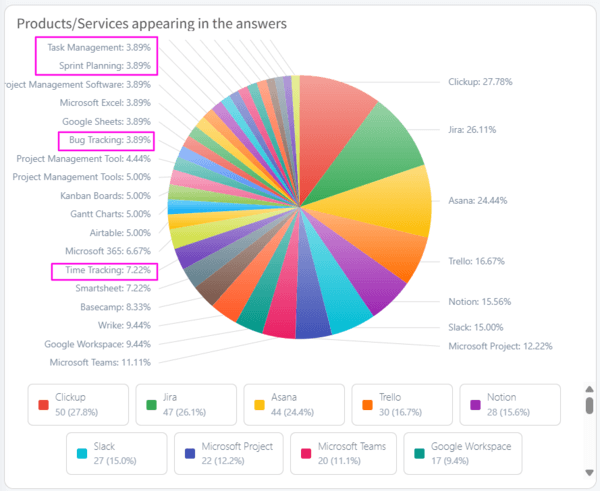
And if you take a look at the specific functionality often mentioned, you can see four of them dominating the answers:
- Time Tracking: 7,22%
- Bug Tracking: 3,89%
- Sprint Planning: 3,89%
- Task Management: 3,89%
These recurring feature associations show what AI engines consider important when comparing tools in the category. If your platform offers these capabilities but your brand name is rarely associated with them, you may need stronger product pages, comparison content, customer reviews, and third-party coverage that explicitly connects your brand with those use cases.
Co-mentions also reveal who influences the AI conversation
My analysis also showed which creators and sources were cited in answers about project management software. YouTube videos from Benjamin Preston, George Vlasyev, ProcessDriven, and Jessica Black appeared alongside a LinkedIn article by Bill Boulden and older Reddit comments from users such as Spushnik and Whitechill.
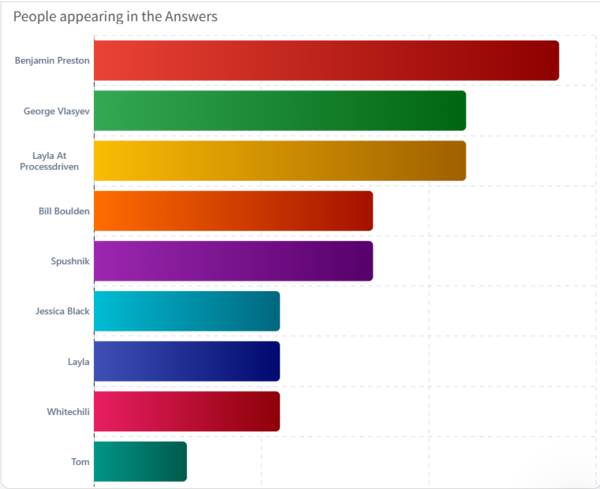
This tells you where AI search engines are finding objective information about your category. In this example, YouTube creators and individual Reddit contributors shaped the answers alongside established software websites. Some of the cited content was also several years old, an important reminder that outdated discussions can continue influencing how AI presents a market.
YouTube creators and Reddit threads were mostly cited as sources for AI Mode and AI Overviews, and we mustn’t forget that the latest stats show AI Mode reached 1 billion users, making these citations very impactful on your brand’s visibility.
Find Out Who Impacts AI Answers in Your Niche
With Mentionlytics, you get the list of creators and accounts that LLMs cite and use as referent sources.
3 Best Ways to Monitor Your AI Brand Mentions
You can check AI brand mentions manually, use a dedicated brand visibility platform, or add AI tracking to your existing SEO workflow. Each method has its place, but they offer very different levels of coverage and consistency.
Method 1: Use Mentionlytics’ AI Brand Visibility Tracker
The most reliable way to monitor AI brand mentions is to use a dedicated tracker that checks relevant prompts repeatedly across multiple AI platforms. Mentionlytics gives you the option to choose:
- How many prompts you want to track. The more various types of prompts you track, the more precise your scores are.
- To write your own prompts or to use our AI prompt generator. AI suggestions are there to help you choose the right prompts.
- To set up which country you want to check visibility for because the results will differ country to country.
- Which AI engines you want to check (ChatGPT, Copilot, Gemini, Google AI Mode, Google AI Overviews).
- Frequency of prompts, meaning how many times you want Mentionlytics to check your prompts (1-4 times a day, weekly, monthly).
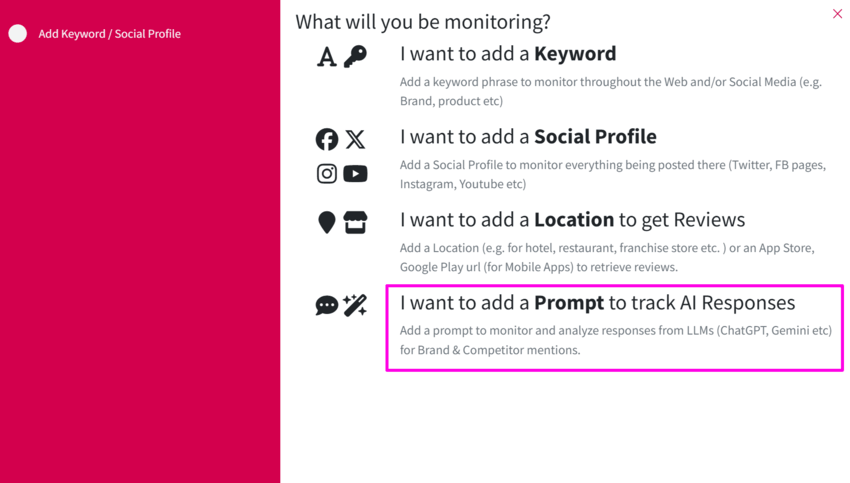
Now, by using Mentionlytics, you can get a complete analysis of your visibility in AI models and act upon these insights.
So, instead of getting only a visibility score, you can analyze:
- How frequently your brand and your competitors appear
- Your AI Visibility Score and competitive AI share of voice
- Which prompts mention (or exclude) your brand
- How visibility differs between LLMs
- Which products, services, and features appear in the answers
- The sentiment and context surrounding each mention
- Which domains and URLs AI engines use for citations
- Which other brands, people, and topics appear alongside yours
You can also review the complete AI-generated answers instead of relying solely on an aggregated score. That matters because a mention is not automatically good news. “A suitable option for very small teams with basic needs” technically counts as visibility, but your enterprise sales team probably won’t be opening champagne.
Mentionlytics stores and refreshes the results, allowing you to perform historical trend analysis of AI mentions. This lets you see whether AI visibility improved after a new content campaign, product launch, PR campaign, website update, or particularly enthusiastic Reddit discussion.
More importantly, it shows whether an apparent increase is a lasting trend or simply one unusually friendly round of responses.
What makes the Mentionlytics AI visibility tracking tool so convenient is the fact that you can monitor brand mentions in Google AI Overviews alongside appearances in conversational AI platforms. This connects two forms of visibility that are often measured separately: whether your brand is named within the answer and whether your website or another source discussing your brand is used as an AI citation.
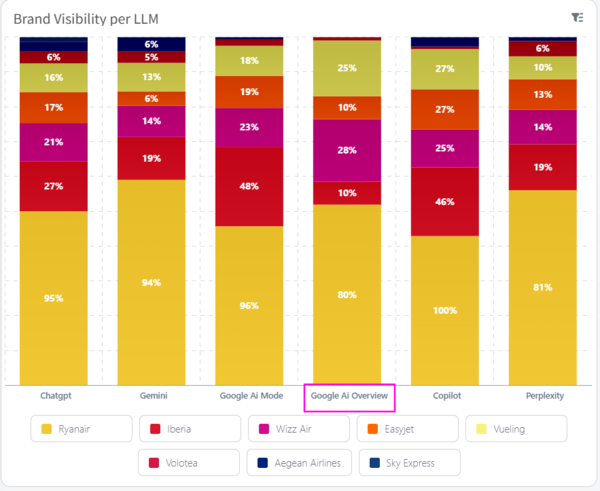
The advantage is consistency. The same prompts, brands, and competitors are checked repeatedly, giving you a stable baseline for measuring change. You are no longer comparing one ChatGPT answer from Monday with a completely different Gemini session three weeks later and calling it a trend.
Method 2: Manual Prompt Testing (And Why It Breaks)
Manual prompt testing is the easiest place to start. It is free, requires no setup, and lets you see exactly how an AI assistant presents your brand.
Open ChatGPT, Gemini, Perplexity, Google AI Mode, or another platform and test a small group of prompts representing different stages of the buyer’s journey.
Here’s a five-prompt starter set you can copy and customize:
| Category query | What are the leading (product category) tools, services, products, platforms? |
| Best tool for a specific audience | What is the best (product/service category) for (target audience or use case)? |
| Brand comparison | (Your brand) vs (competitor). Which is better for (specific need)? |
| Negative category query | What are the worst (product/service category) for (target audience or use case) and why? |
| Alternative discovery query | What are the best alternatives to (leading competitor)? |
Once you run all these prompts, record whether your brand appears, where it appears, how it is described, which competitors surround it, and what sources are cited. Repeat the prompts across several platforms to identify obvious differences.
Now, what you need to know is that manual testing has a low ceiling. AI-generated responses are non-deterministic, meaning the same prompt can produce different answers when repeated. Results may also vary by location, model version, account history, previous messages, personalization, and prompt wording.
The method becomes even less manageable when you add ten competitors, five AI engines, several markets, and dozens of prompts. Before long, you have created a spreadsheet whose main finding is that you need a tracking tool.
You Need More Insights than a Spreadsheet Could Ever Do?
Let Mentionlytics do the job for you: analyze your prompts across AI search results and LLMs!
Use manual testing for an initial spot check, fact-checking, or investigating a particularly important prompt. Do not use a handful of manually generated answers as evidence that your overall AI visibility increased.
Method 3: Use Trusted SEO Tools with AI Visibility Features
If your primary goal is to connect visibility in AI search with organic search performance, established SEO platforms are another useful option.
For example:
- Ahrefs Brand Radar tracks brand mentions, citations, AI Share of Voice, visibility across major AI platforms, and connects this data with search demand, web visibility, YouTube, and Reddit.
- Semrush AI Visibility Toolkit provides visibility benchmarking, competitor research, prompt tracking, sentiment analysis, citation opportunities, and technical AI-readiness audits.
- SE Ranking AI Visibility Tracker monitors mentions, links, sources, competitors, and historical performance across AI Models.
Their major advantage is context. SEO teams can compare traditional rankings with AI citations, identify pages appearing in Google AI Overviews, discover relevant prompts, and connect gaps in AI referrals with keyword and content opportunities.
However, AI visibility inside an SEO platform still tends to be viewed primarily through a search-performance lens. That is for measuring pages, keywords, citations, and optimization opportunities, but it does not always provide the wider brand intelligence required by PR, product marketing, and social media teams.
3+1 Ways to Increase Your AI Brand Mentions that Do the Trick
It’s always good to know where your brand stands against your competitors by tracking mentions in LLMs and AI search engines, but what to do with those insights? The next question is obvious: How do you earn more AI brand mentions?
There is no magic line or code that makes ChatGPT fall hopelessly in love with your brand. Increasing AI visibility requires strengthening the signals AI engines use to understand what your brand is, what it does, and whether it deserves to be recommended.
Way #1: Get Mentioned Where the Models Are Reading
The big truth is that not every online mention contributes equally to AI visibility. Being featured in a blog post that doesn’t impact how generative AI engines reply to prompts will not move the needle.
So, start with the domains and URLs already being cited for your most important prompts. Prioritize them in the order:
- Listicles, comparison pages, and review sites already cited for your category
- Niche publications, creators, forums, and professional communities
- Broader news and media outlets
And you have to know that each industry and every LLM will have different trustworthy sources.
For example, I used Mentionlytics to track the project management software solutions market, and the AI visibility showed that LLMs turn to Reddit, Asana, Slack, YouTube, Zapier, TrustRadius, G2, and other industry-leading brands and review platforms.
But what’s interesting is that only Forbes out of all other well-established news outlets made it to the list.
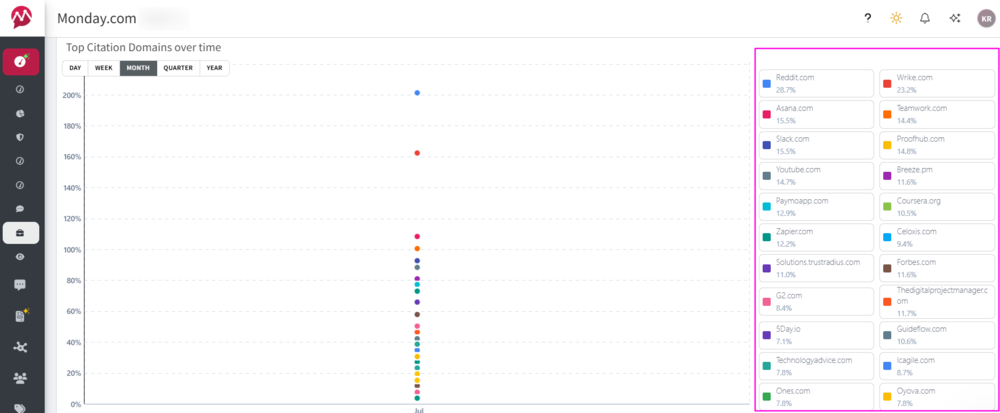
That doesn’t mean every LLM will stick to those sources. Copilot, which has 1.3% of the market share, will opt for Τhe Digital Project Manager, Breeze, Toolradar, Dupple, and TrustRadius.
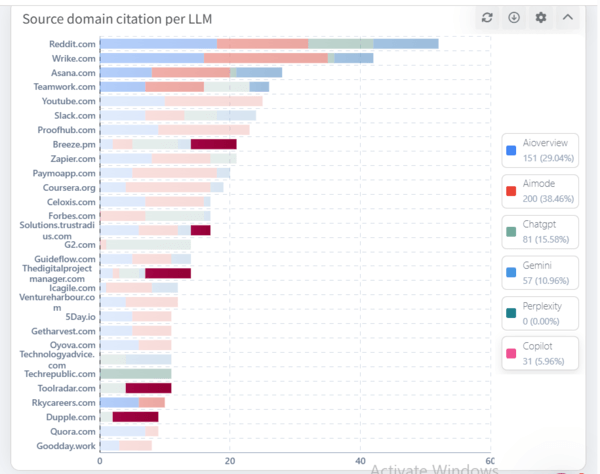
And if this seems too complex, you can always go with the pages cited by AI while monitoring brand mentions across platforms with Mentionlytics. You get clickable links that take you right to the source.
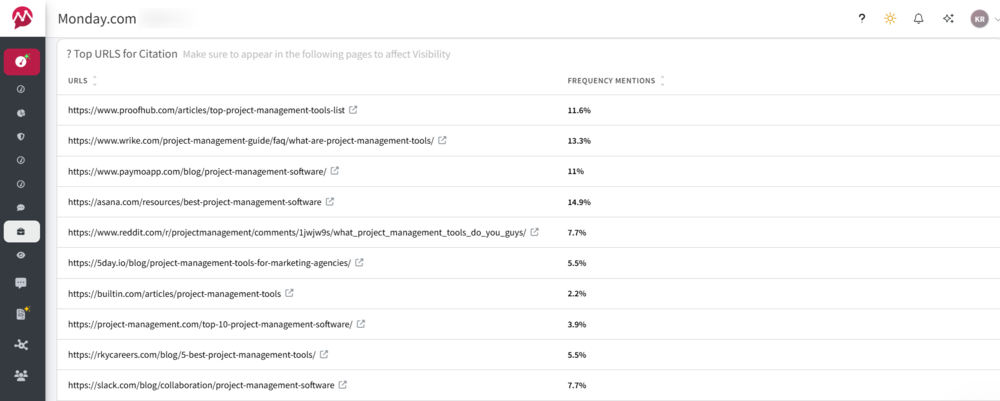
From there, you can:
- Pitch your brand for inclusion in relevant roundups.
- Offer updated data or expert commentary to cited authors.
- Build relationships with niche creators covering your category.
- Correct outdated information on pages already influencing AI answers.
- Identify listicles where competitors appear, but your brand does not.
Way #2: Build Entity Consistency Across the Web
Before an AI engine can recommend your brand, it needs to understand that all the information it finds refers to the same entity.
That sounds straightforward until your company is described as an “AI marketing platform” on its homepage, a “social media management tool” on LinkedIn, a “brand intelligence solution” in press releases, and something entirely different across software directories.
Each description might be technically correct, but together they can create a blurry brand identity.
AI systems use recurring information and relationships to understand entities: your official name, category, products, website, founders, locations, social profiles, and the topics consistently associated with you. If those signals conflict, the model may misunderstand your positioning, confuse you with another company, or leave you out of recommendations altogether.
Use this checklist to strengthen entity consistency:
| 1. | Use the same official brand and product names across your website, profiles, directories, and press material |
| 2. | Choose a clear category description and repeat it naturally across authoritative sources |
| 3. | Keep pricing, features, company information, and positioning up to date |
| 4. | Add appropriate structured data to your website |
| 5. | Maintain consistent information across review platforms and business directories |
| 6. | Create or improve Wikipedia and Wikidata entries only when your brand meets their notability and sourcing requirements |
| 7. | Correct outdated third-party descriptions whenever possible |
The main goal is to create a consistent brand image across various sources, because if the web cannot agree on what your brand is, the model is unlikely to guess correctly.
Way #3: Seed and Sustain Community Conversation
A few years ago, social listening was the strategy brands would go to figure out how the audience perceives their brand, analyze the sentiment of the chatter, and spot any potential crises. And then everyone started talking about AI listening, and it might seem to you that social listening lost its meaning, but there’s one thing you must remember: AI engines do not learn about brands exclusively from corporate websites and polished press coverage.
They also gather information from Reddit discussions, YouTube videos, forums, LinkedIn posts, customer reviews, and other places where people share actual experiences.
That makes community conversation an important source of AI brand mentions, and at the same time, a very tempting place for marketers to make terrible decisions.
Start by identifying threads and discussions that already rank for your category terms or appear as citations in AI-generated answers. Look for questions your team can answer meaningfully, especially when you have first-hand data, product knowledge, or practical experience to contribute. The operative word is meaningfully!
And before you enter a six-month-old Reddit thread with “Great question! Our innovative solution solves this. Book a demo” try a different approach:
- Answer relevant questions without forcing your brand into every response.
- Disclose your affiliation when mentioning your company or product.
- Correct inaccurate claims politely and with supporting evidence.
- Encourage satisfied customers to share honest experiences in their own words.
- Help subject-matter experts from your company participate under their real identities.
- Monitor recurring complaints and use them to improve the product and its communication.
- Follow up when community members raise unresolved concerns.
There’s been a lot of talk around Reddit as the #1 cited source in ChatGPT, but what we mustn’t forget is that YouTube, LinkedIn, and Facebook also make their way to citations, and review platforms, such as G2, are often the source with recommendation queries.
And there’s no easier way to track these discussions across social media, blogs, forums, reviews, and the web than through a social listening tool. With Mentionlytics, you can monitor brand and competitor mentions, analyze sentiment, identify influential conversations, and spot negative narratives before they spread into more sources or AI-generated answers.
For example, you’re tracking the project management niche because your brand is a project management software, but the Reddit post “10 AI Productivity Tools That Can Save Hours Every Week” has just listed ClickUp and Trello, as you may see in the screenshot below.
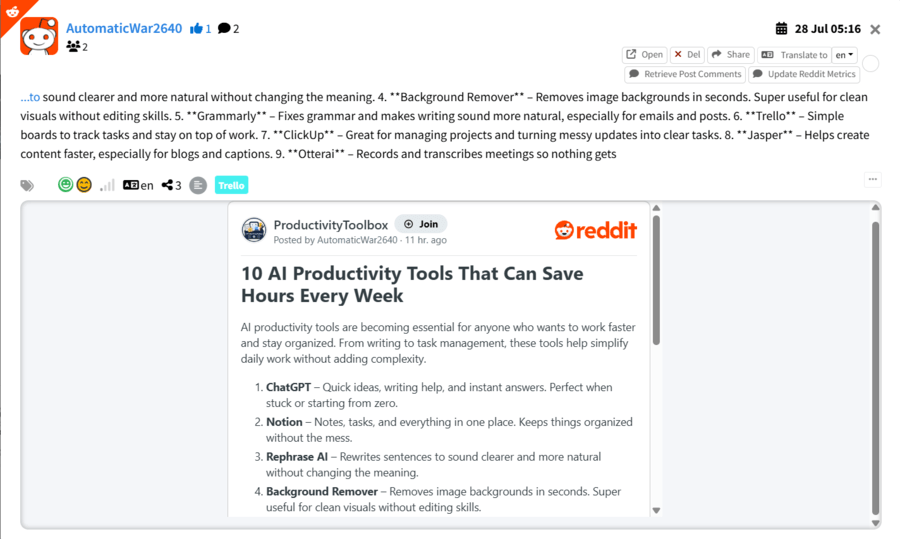
The best option is to enter the conversation and explain what your tool can do and why it could be an even better fit for the list, because next time someone asks ChatGPT, “Hey, what are the top 10 AI productivity tools that save time?”, this Reddit post, or its comments, might surface as a source.
Don’t Wait For AI to Pull Conversations You’re Not Participating In
Use Mentionlytics to appear at the right place, at the right time, with the right answers.
Way #4: Develop Content that is Worth AI Citations
Publishing more content does not automatically produce more AI citations. The internet already has enough articles explaining that “customer experience is important”. AI engines do not desperately need your 1,001st version.
To earn citations, create information that adds something special, original, or verifiable to the conversation, such as:
- Original research and proprietary data
- Surveys with clearly explained methodologies
- Industry benchmarks and trends reports
- Expert commentary based on first-hand experience
- Case studies with measurable results
- Detailed comparisons using transparent criteria
- Definitions and explanations that answer narrow questions clearly
- Regularly updated statistics, pricing, and product information
- Free tools, calculators, templates, and datasets
Original research is especially valuable because it gives other publishers, creators, and communities a reason to reference your brand. One useful dataset can earn citations across articles, videos, LinkedIn posts, newsletters, and industry discussions, creating multiple consistent associations between your brand and the topic.
Make the content easy for both people and AI systems to interpret. Use descriptive headings, answer the main question directly, explain your methodology, label tables clearly, identify authors and experts, and link to primary sources. If important information is hidden inside vague promotional copy, an AI engine cannot cite what it cannot confidently extract.
You should also update high-performing resources instead of continuously publishing near-identical articles. An authoritative annual report with fresh data is more useful than five lightweight posts competing against one another.
The aim is not merely to mention your brand more often in your own content. Of course, your website mentions you (it would be concerning if it didn’t), but the real goal is to create material valuable enough that other sources cite, discuss, and associate with your brand. That is how one owned asset can generate AI visibility far beyond your own domain.
4 Content Types that Earn Brand Mentions in AI Answers
Not all content will help you rank your website on ChatGPT and other AI search engines. Some formats are far more likely to get picked up, repeated, and reused in AI-generated answers, not because they’re optimized for AI, but because they explain things clearly, credibly, and in context.
Here are the best content types that consistently earn brand mentions in AI answers, and why they work.
Original Research
Original research is one of the strongest signals you can give to AI tools. When you publish data that doesn’t exist elsewhere, such as surveys, benchmarks, trend reports, and industry stats, you’re creating a reference point.
LLMs rely heavily on repeated facts and widely cited data. If your research gets quoted, summarized, or referenced across multiple sources, your brand becomes tied to that insight. Over time, AI remembers the stat and (more importantly) who published it.
This works especially well when the research answers common questions, supports decisions, or explains why something is happening. Data-backed content tends to outlive blog posts and gets reused in summaries, explanations, and comparisons.
Comparison Pages
Comparison pages are extremely AI-friendly because they mirror how people ask questions.
Users don’t ask, “Tell me about Brand X.” They ask, “What’s the difference between X and Y?” or “Which tool is better for my case?”
Well-structured comparison pages help LLMs understand:
- How brands relate to each other.
- Where the differences are.
- Which use cases each brand fits best.
The key here is balance. Pages that clearly explain strengths, limitations, and positioning (without pretending to be neutral while secretly selling) are much easier for AI machines to reuse in answers.
In-Depth Guides
LLMs love content that explains things thoroughly. In-depth guides work because they provide structured context: definitions, steps, examples, use cases, and outcomes.
When a guide clearly connects problems to solutions, AI can reuse those explanations when answering similar questions. This type of content helps associate your brand with a specific use case, workflows, or real-world problem-solving.
Community-Driven Content
Community-driven content teaches AI how real people talk about problems.
Discussions, Q&As, forum threads, and user stories are where brands are mentioned naturally, often alongside frustrations, constraints, and honest opinions. That language is incredibly valuable for LLMs trying to understand context, which is probably why marketing on Reddit is becoming a hot topic these days.
This type of content helps AI learn who uses the brand, why, and when it’s recommended (and also, when it’s not).
It’s messy, imperfect, and sometimes critical, but that’s exactly why it’s useful. Brands that show up consistently in real conversations tend to feel more “real” to AI systems than those that only live on their own webpages.
How to Benchmark Your AI Brand Mentions Against Competitors
Knowing that your brand appears in AI answers is reassuring. Knowing that it appears in 18% of relevant answers, while your closest competitor appears in 62%, is considerably more useful… and slightly less relaxing.
AI brand benchmarking compares how frequently, prominently, and positively your brand appears against the companies competing for the same recommendations. This gives you a realistic reference point: a 20% visibility score might indicate progress in a crowded market or a serious gap in a category dominated by two brands.
The Metrics Worth Tracking
Focus on metrics that reveal both visibility and positioning.
- AI Visibility Score: How frequently your brand appears across the tracked prompt set compared with competitors
- Visibility over time: Whether each brand’s presence is growing, declining, or remaining stable
- Visibility per prompt: Which questions your competitors dominate and where your brand enters (or disappears from) the shortlist
- Visibility per LLM: How brand performance differs across ChatGPT, Gemini, Perplexity, Google’s AI Mode, Copilot, and Google’s AI Overview
- Sentiment share: Whether each brand is recommended positively, criticized, or presented neutrally
- Co-mentions: Which competitors, products, people, and categories regularly appear beside your brand
- Product and feature associations: Which capabilities AI engines connect with your brand and your competitors
- Citation sources: The domains and URLs supporting mentions, revealing potential content, SEO, and PR opportunities
- Top citation domains over time: Presents the dynamic of how each citation source is used in the LLMs’ responses over time
Building a Historical Baseline
A single AI visibility audit is little more than a snapshot of a moving target. AI-generated recommendations are probabilistic; repeating the same prompt can change the brands included, their order, and even the number of recommendations.
Multiple research studies confirm LLMs’ inconsistency when answering the same question repeatedly, which indicates that a one-time sample can’t provide accurate results. You need to repeat the process (prompt) in the same environment, so the main indicator of improvement in visibility is not the score itself, but the trend line (AI Brand Visibility change over time chart).
Track Your Brand Mentions in AI Search with Mentionlytics
You can’t deny the impact LLMs have had on the buyer’s journey. Search, discovery, comparison, and decision-making have all been shaken up, stirred together, and served back to us as one AI-generated answer. Now brands have to adapt to a new reality: if an AI engine names your brand, you’re good (for now), but if it doesn’t mention you, many potential buyers may never discover you.
Tracking AI mentions continuously reveals what is really happening with your brand visibility: how often you’re mentioned, what sources AI used for the claims, what prompts you’re winning against your competitors, who shows up in the answers beside you, who are the voices AI platforms trust and cite, and what domains each model uses the most. More importantly, it shows you which content, SEO, and PR opportunities to pursue to improve your visibility.
Book a demo to activate Mentionlytics AI Brand Visibility and make sure to be one step ahead of every change that might come up.
FAQ
Is it possible to track brand mentions in AI search?
Yes, AI brand mention tracking tools can monitor whether your brand appears in answers generated by ChatGPT, Gemini, Perplexity, Copilot, Google AI Mode, and AI Overviews. You can measure mention frequency, sentiment, prompt-level visibility, citations, co-mentions, competitor performance, and changes over time.
How to see if AI mentions your brand?
Start by entering relevant prompts manually into different AI platforms. Test category searches, product recommendations, competitor comparisons, and negative queries to see whether your brand appears and how it is described. For continuous monitoring, use an AI visibility tool, like Mentionlytics, that repeats a fixed set of prompts across multiple platforms. This provides a more reliable picture than occasionally asking ChatGPT whether it remembers you.
How does AI analytics track brand mentions?
There are two main approaches: API-based and Interface-based tracking. API-based trackers submit prompts through an AI provider’s API and analyze the resulting answers at scale. This approach is efficient and consistent, but API outputs may not fully match what users see inside the platform’s public interface.
Mentionlytics uses interface-based tracking, running queries through user-facing AI platforms and search experiences to capture the answers people are more likely to encounter in practice. It records whether your brand appears, how it is presented, which competitors are mentioned, and which sources support the answer. You can see the complete answers as if you’d run the test yourself. Repeating these checks over time turns individual, unpredictable responses into measurable visibility trends.
Is tracking brand mentions in Perplexity AI effective?
Yes, particularly because Perplexity searches the web in real time and provides links to the sources supporting its answers. This allows you to track not only whether your brand is mentioned, but also which websites, reviews, articles, and community discussions influence that mention. However, Perplexity represents only one part of the AI search landscape. Its answers and citations can differ from those in ChatGPT, Gemini, Copilot, Google AI Mode, and AI Overviews, so it is more effective to monitor Perplexity alongside other platforms.
What’s the impact of forum backlinks on brand mentions in AI?
Forum backlinks can help AI engines discover sources and understand the relationship between a brand and a topic, but the link alone is not the main prize. The surrounding conversation matters more: what users say about the brand, which problems they associate it with, and whether their experiences appear genuine. Useful forum discussions can be cited or reflected in AI-generated answers, especially when they address specific questions that official brand content does not. But negative complaints, spam, and manufactured recommendations can travel too. Focus on earning authentic mentions in relevant discussions rather than planting backlinks with all the subtlety of a billboard in someone’s living room.
