AI sentiment analysis refers to the use of artificial intelligence technologies, especially natural language processing (NLP), to identify, extract, quantify, and study affective states and subjective information from text. The primary goal of sentiment analysis is to determine the attitude, emotions, or opinions expressed in a given piece of text, which can range from positive and negative to neutral, or even more complex emotions like happiness, sadness, anger, etc.
Lately, AI marketing has become the driving force behind business decisions, reshaping strategies and optimizing operations for unprecedented efficiency.
In fact, the anticipated size of the AI market is projected to hit $4.8 trillion by 2033. Now that AI is everywhere, understanding sentiment analysis has become more critical than ever for marketers.
In this article, we’re going to dive into sentiment analysis using AI and its impact on interpreting customer emotions.
Let’s get started!
Table of Contents
(Updated: October 9th, 2025)
What is AI-driven Sentiment Analysis?
AI sentiment analysis is a process used in artificial intelligence and natural language processing to determine the emotional tone behind a body of text.
This is often used to understand the attitudes, opinions, and emotions expressed in an online mention, a review, or a piece of text.
The primary goal is to categorize the sentiment of the text as positive, negative, or neutral. However, more advanced systems can identify specific emotions such as happiness, anger, or sadness.
This technology is widely used in customer service and market research to gauge public opinion about products, services, or topics.
Consequently, some businesses use intelligent sentiment analysis tools to calculate a total sentiment score for customer opinions.
An example of sentiment analysis using AI in retail would be the identification of customer feelings toward a new product or service. Artificial intelligence accelerates the process and refines accuracy, providing insights that humans might overlook.
AI Sentiment Analysis Use Cases
AI sentiment analysis has many applications. However, we chose to focus on three pivotal practical applications of businesses leveraging advanced text analysis.
Elevating Brand Reputation
With AI, social media monitoring and sentiment analysis go beyond keeping tabs; They become parts of proactive online reputation management.
In detail, AI algorithms pick up sentiments, alerting brands to potential issues or crises quickly. Brands leverage AI to create an effective crisis management strategy.
Take product reviews, for instance; Advanced analytics not only gauge sentiments but also notify businesses when something starts going wrong.
Afterward, PR managers have time to release a public statement or move on to other damage control actions.
Boosting Customer Experience
In reality, AI sentiment analysis is the key to unlocking customer feedback’s full potential.
By focusing on identifying online sentiments, businesses gain profound insights into customer experiences. AI sentiment analysis models go through reviews and big data analytics to understand the emotional undertones.
Brands get to adapt, refine, and tailor their offerings based on authentic customer sentiments.
This ensures a personalized and customer-centric approach that goes beyond satisfaction, towards genuine delight.
Market Insights via Social Media Analysis
What do you get when social media sentiment analysis meets AI trends?
A game-changer combination in deciphering consumer sentiments and behaviors.
The process goes beyond clustering social data; Understanding audience preferences, trends, and market dynamics is important for those who want to lead the industry.
AI sentiment analysis transforms the challenge of online noise into a strategic advantage, leading businesses to enhanced industry insights.
Best 3 AI Sentiment Analysis Tools
So far, we’ve covered multiple categories for best tools, such as best AI tools for social media.
However, a list of AI-driven sentiment analyzers feels like a niche category.
So, pay attention to our selection of the best platforms for the job!
1. Mentionlytics
With AI-powered social listening features, Mentionlytics provides the most accurate (96%+), human-like sentiment analysis in all languages, which goes way beyond traditional positive or negative sentiment.
Mentionlytics is your go-to social listening tool for extracting the best value from every mention, whether it’s an online review, customer feedback, or a question from a potential buyer posted on a social media platform about your brand.
Let’s unwrap what AI-powered features you can find on our platform:
- AI Sentiment Analysis: How does your audience feel about your brand? Are the comments and mentions positive, negative, or neutral? Is there a shift in sentiment? When did it happen and why? You get the answer to all these questions.
- AI Emotion Analysis: Go above and beyond the usual sentiment. Profound emotions, so typical for every human being, are often challenging to recognize by LLMs, but our AI Emotion Analysis does it just like humans. Sadness, anger, joy, fear, or neutral; our software can recognize it with more than 96% accuracy across languages. Sarcasm? No problem, we get it too.

Example of sentiment and emotion analysis for Ryanair in Mentionlytics.
- AI Mention Clustering: We know it takes a lot of time reading through all your mentions to grasp what’s going on. That’s why we have AI Mention Clustering, which groups your mentions into different clusters and provides a brief summary of their content. How many posts are referring to the same topic? What’s their reach, sentiment, and which platforms are on fire? This feature gives you an instant hint of what’s happening around your brand and industry.

Example of discussions about Monday.com in Mentionlytics’ AI Mention Clustering
- Social Intelligence Advisor (SIA): SIA is our AI brain that focuses on your brand’s online presence. It analyzes your mentions across social media and the internet, identifies patterns, spots opportunities, threats, and trolls, as well as the best-performing posts and hashtags, most efficient social media platforms, and the optimal time to post on a specific platform. SIA’s actionable advice will depend on what’s happening with your brand in real-time. It will also peek to see what’s going on with your competitors so that you can do better.
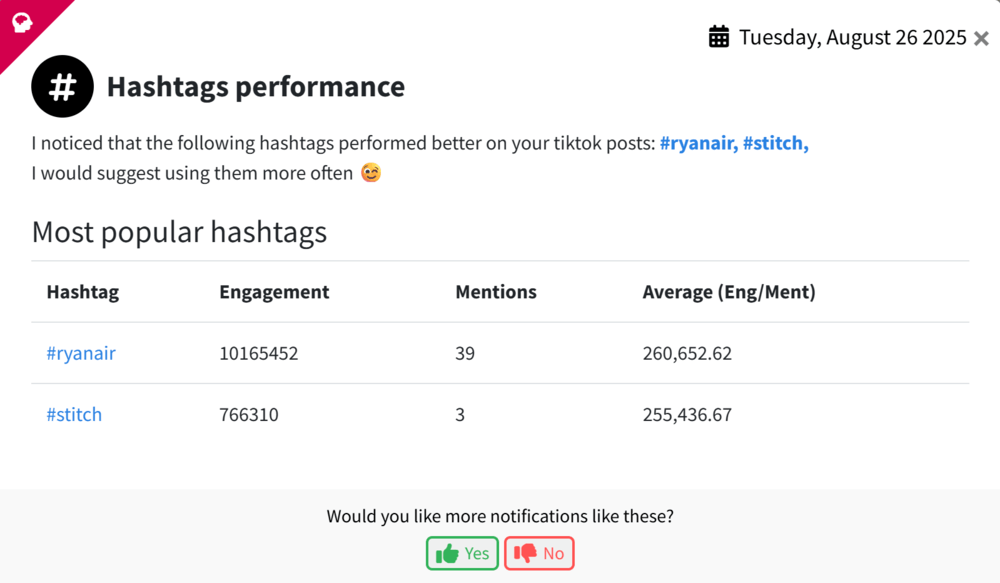
- AI Anomaly Detection: This AI-powered feature is like a detective with a nose that can sense trouble miles away. It learns your patterns, including the number of mentions that typically occur on a daily, weekly, monthly, or yearly basis. And if something unusual happens, something that’s out of the ordinary, that breaks your usual mentions’ pattern, it will alert you that the online storm is approaching.

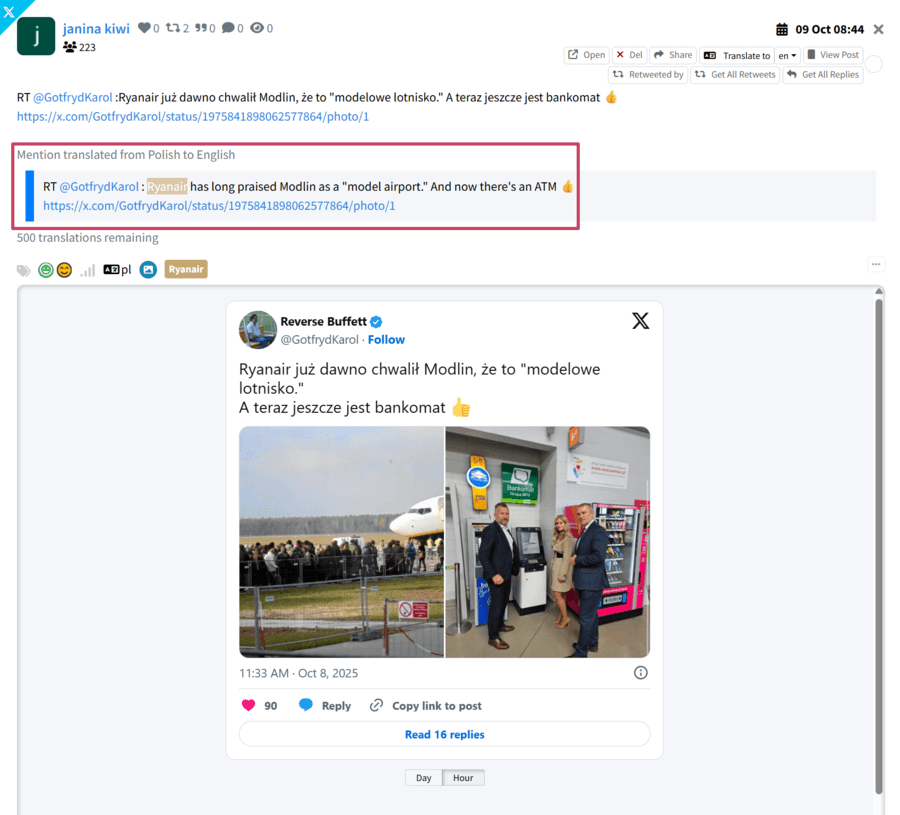
- AI Mention Translate: Do you have mentions in another language that you don’t fully understand? AI Mention Translate does the translation for you from any language to your desired language (you can choose English, Spanish, Portuguese, or Greek). You no longer need to use Google Translate anymore to understand your mentions and extract insights.
Are we stopping here? Not a chance. This is just the beginning. Since 2018, we’ve been at the forefront of AI-powered social listening, and we’re only getting started. Our users continue to inspire us to create smarter, more practical tools that make social insights truly actionable.
Other key features you can find in Mentionlytics include:
- Advanced Boolean Search with Basic Operators and Extra Filters
- Customizable Social Media Report Builder
- Competitor Monitoring & Market Research
- Influencer Identification & Review Monitoring
- Team Collaboration Features & Real-time Alerts
Pricing starts at €69/month.
2. ChatGPT

ChatGPT is a versatile language model designed by OpenAI, offering users a robust platform for Natural Language Understanding and Generation.
But can ChatGPT do sentiment analysis?
Yes, people can manually use the platform’s generative AI for sentiment analysis.
The viral sensation offers cool features, like:
- Sentiment Classification
- Contextual Understanding
- Multi-language Analysis
Is AI sentiment analysis free? With ChatGPT, yes, it is.
However, while it’s a good solution for low-budget small companies, it wouldn’t be able to handle larger datasets.
3. Lexalytics

Lexalytics stands as an intelligent powerhouse utilizing machine learning and Natural Language Processing (NLP) for cutting-edge text analysis.
The platform offers a cloud-based sentiment analysis API, named Semantria, as well as a text analytics library, named Salience.
It’s a multi-faceted platform. In fact, Lexalytics deals with multiple tech problems, but you might have to be tech-savvy to understand.
Some valuable features include:
- Boolean Queries & Custom Entities
- Robotic Process Automation (RPA)
- Part of Speech Tagging
- Text Summarization
Unfortunately, pricing details for Lexalytics remain undisclosed.
Why Should You Use an AI Sentiment Analysis Tool?
Summarizing previous facts and expanding on the idea, here are 5 reasons to use an AI sentiment analysis tool:
- Real-time Insights: Gain immediate awareness of public sentiments, allowing prompt responses to emerging trends and issues.
- Competitor Analysis: Stay ahead by analyzing sentiments around competitors, identifying opportunities, and addressing gaps.
- Product and Service Improvement: Utilize feedback sentiments to refine and enhance products and services based on audience expectations.
- Campaign Effectiveness Assessment: Evaluate the success of marketing campaigns by understanding audience reactions and fine-tuning social media posts.
- Brand Building: Shape and strengthen your brand building by leveraging sentiment analysis to understand how audiences perceive and engage with you.
See for Yourself Why Users Love Mentionlytics
It’s not our haircut or our witty posts… It’s the Mentionlytics’ AI features that bring instant insights about your online presence.
Tips on Using AI Sentiment Analysis
Here’s a list of things you should focus on — or should not forget — while performing sentiment analysis using AI.
1. Contextual Understanding
When using AI sentiment analysis, prioritize contextual understanding to accurately classify texts.
Recognize that sentiments can vary based on context, sarcasm, or cultural nuances. Fine-tune your model by incorporating industry-specific terms and training it to comprehend contextual intricacies.
Remember, the effectiveness of sentiment analysis lies in its ability to grasp not just individual words but the holistic context.
This is a very tricky part of some sentiment analysis algorithms. That’s why it needs constant updating on meanings, references, initialisms, etc.
2. Continuous Training
As mentioned above, machine learning is important 24/7 when it comes to AI effectiveness. Embrace the power of continuous training to enhance the accuracy of sentiment analysis using machine learning algorithms.
Regularly update your model with new training data to adapt to evolving language trends and expressions. Ongoing training ensures that your sentiment analysis tool remains robust and adept at interpreting the changing dynamics of human language.
This results in more nuanced and accurate assessments of sentiments across diverse content sources.
3. Integrate with Customer Relationship Management (CRM)
Boost the effectiveness of your AI sentiment analysis by seamlessly integrating it with your Customer Relationship Management (CRM) system. Aligning sentiment insights with CRM data enhances the depth of customer understanding.
For example, you can uncover patterns in sentiments tied to specific customer interactions and optimize your strategies. By doing that, businesses can tailor their approaches, fostering stronger customer relationships and more targeted, impactful marketing initiatives.
4. Sentiment Trend Analysis
Leverage sentiment trend analysis for a deeper understanding of public opinion.
Use multiple social media platforms to track sentiments over time.
For instance, Twitter sentiment analysis is a necessity for most businesses that focus on following trends before they become viral.
You can identify patterns, shifts, and emerging trends to proactively shape your strategies.
Analyzing sentiment trends equips you with valuable insights into evolving public perceptions for brands seeking to stay ahead.
5. Combining with Other Analytics Tools
Maximize the impact of AI sentiment analysis by integrating it with other analytics platforms.
For example, by combining social media monitoring and email marketing, businesses dive into their audience’s demographics and psychographic online behaviors.
Uncover correlations between news coverage and public sentiment, refining strategies for effective brand management.
This synergy ensures a comprehensive approach to analytics, empowering organizations to make informed decisions rooted in both sentiment and context.
Try AI Sentiment Analysis for Free
By all means, AI sentiment analysis is the compass guiding businesses to improve their brand health. Elevate your brand’s social media presence today with the power of AI sentiment analysis.
Ready to boost your brand to the top spot in your industry?
Sign up for a free trial with Mentionlytics and take control of your digital narrative now.