

It seems 2026 is bringing some slight changes to influencer marketing trends, and if you’re relying heavily on influencers, you might want to double-check your strategy and make some tweaks.
You thought nothing could surprise you after Granny Spills and other AI influencers getting attention worldwide in 2025, but hey, the rules are changing by the minute, so you might want to check what traditional and AI-powered search engines and social media have in mind for this year, when it comes to content creation.
With Adam Mosseri talking about authenticity as the most important update to the Instagram algorithm, and the Google Discovery core update featuring in-depth, well-researched, original content, and more local content, we can see where this year is heading…
And if the audience is no longer keen on blindly trusting celebrities and content creators with millions of followers, but rather turns to niche-specific influencers with just a couple of thousand or hundreds of followers, you might have a hunch in which direction we’re going.
In this article, we’ll discuss 6 top influencer marketing trends for 2026, compare how your marketing strategy fits these trends, and how you can prepare for this year.
Table of Contents
6 Influencer Marketing Trends We Spot Rising in 2026
There are no revolutionary influencer marketing trends 2026 that we didn’t see the preview of in 2025, but we predict the following ones will really take the stage this year.
Authority, trust, platform-segmented audience, niche influencers, true metrics, and the right balance between AI-generated and human-made content will mark 2026.
Trend #1: An Influencer with Authority Brings More to the Table
Now first, let’s distinguish authority from followers. The previous decade was all about one particular metric: how many followers the influencer had, and not much about what they actually knew about your brand, industry, or niche.
It was enough to have an influencer with one million followers by your side, and you would automatically see the boost whenever some of them praised your brand.
But in the past years, and increasingly in 2025, we can see that the audience’s preferences have changed. They don’t trust celebrities as much as they used to. It became too noisy, too pushy, and too much in any sense.
And we can see the effect in the 2026 social media trends, where people are withdrawing from that noise or starting to look for more genuine creators.
The audience began looking for authentic creators in specific niches who offer honest opinions, reviews, and advice on a single, narrow topic. And a recent study showed that nano influencers have much higher conversion (4.5%) and engagement rates (8.4%) than macro-influencers (with 0.9% conversion and 1.8% engagement rate).
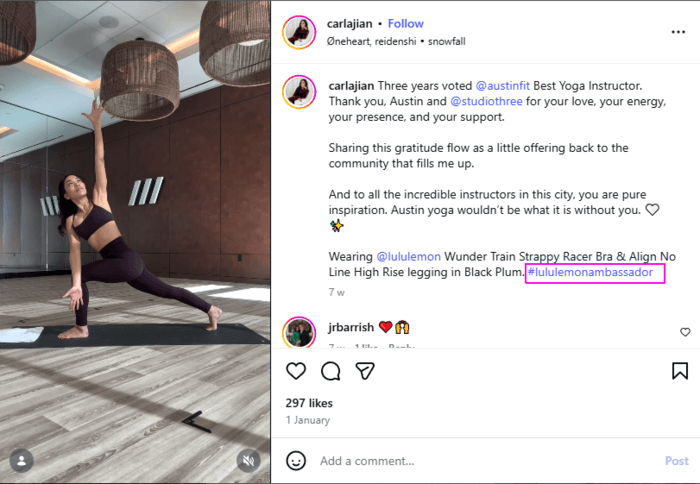
Look at Carla Jian, an Instagram nano-influencer with just slightly below 10K followers and posts reaching more than 600 likes. She’s a niche influencer in yoga, Reiki, and meditation, and she’s a Lululemon ambassador.
Seems like “Jack of all trades” is not working anymore.
Find Your Perfect Nano Influencer
It takes just a few minutes with Mentionlytics to find the right influencer for your brand, who was probably under your radar.
Trend #2: Long-term Partnership with Influencers
Regardless of the influencer’s tier, 2026 will not be the year of speed dating. Instead, brands should opt for long-term partnerships because they signal to the audience that they can trust the influencer more.
The principle is pretty simple: if a brand trusts the influencer enough to have a long-term partnership, why wouldn’t we?
The second reason is that long-term partnerships are transparent, and the audience knows exactly what relationships the influencer and your brand have, so it eliminates any doubt they might have about recommendations. In fact, the study shows that 64% of consumers don’t trust influencers who are not transparent about the sponsorship or partnership. More transparency = more trust.
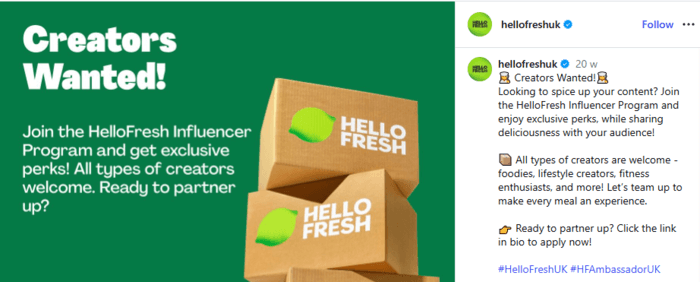
Look at HelloFresh, for example. For years, they’ve been leaning towards nano and micro YouTube influencers, and they have many long-term partnerships. That’s why you’ll often see Kate Ferdland, Jamie Dwitt, Adam Lao, and Joe Swash preparing food under the umbrella of the HelloFresh logo.
But a few months ago, you might have seen their Instagram post inviting more influencers to join a partnership.
Trend #3: You Need Influencers from the Social Media Platforms Your Audience Uses
Platform fit beats popularity. You can have the most credible TikTok influencer in your niche, but if your audience doesn’t live on that platform, you’re basically invisible.
In 2026, we’ll see fewer brands choosing influencers based on fame and more brands choosing them based on platform relevance.
That means you’ll need to get to know your audience pretty well before committing to one influencer, or you might need several of them.
Let’s say your audience:
- scrolls TikTok or Instagram during lunch
- reads Reddit in the morning
- watches YouTube tutorials or listens to podcasts on weekends
- and checks LinkedIn only when they’re job hunting
So, why would you invest 80% of your influencer marketing budget in one platform? The more platforms you cover, the greater the chance you’ll reach your target audience.
And one influencer can hardly cover all the platforms on your list. Remember that algorithms are platform-specific ecosystems, and an influencer who performs exceptionally on TikTok won’t necessarily convert on Instagram. Different formats, behavior, and trust signals.
Before launching your influencer campaigns, ask yourself, “Where does our audience actually spend time?” because in 2026, a platform mismatch will cost more than choosing the wrong influencer tier.
Trend #4: B2B Influencer Marketing is Stepping Out from the LinkedIn-Only Frame
Now, when it comes to B2B influencer marketing trends, we can see some shifts on the horizon for this year.
First of all, the channels… There were some discussions about the channels B2B companies used for promotion, and LinkedIn was one of the first choices. But something changed over the past two years, and B2B brands started experimenting with other platforms, such as Reddit or YouTube.
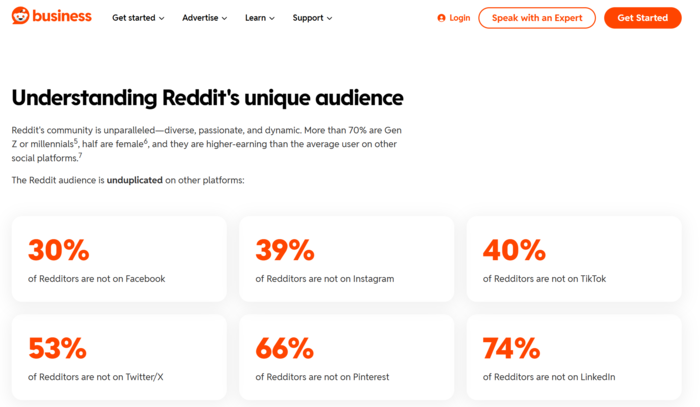
Now, why would brands invest in Reddit creator partnerships? Because the audience is split between platforms, and if you want to reach the audience your LinkedIn influencer doesn’t cover, you’ll opt for the other one. And surprisingly, 74% of the Reddit audience is not on LinkedIn.
The second reason is that AI cites Reddit so often that it has become a digital marketing trend for the past 2 years. But instead of building your own authority there (which will definitely eat up your time), we’ll see more and more brands seeking to partner with Redditors that already have the #topvoice status in a specific subreddit.
And if we dig a bit deeper, we’ll see that podcasts are also a powerful channel. Choosing an influencer who uses this medium can be pretty efficient. The statistics show that when a brand is mentioned in a podcast, it brings higher engagement rates, reaching on average 16% according to a 2019 BBC study.
Now, if you’re leaning towards LinkedIn creators, you can find influencers from your niche pretty easily, since their profiles openly suggest that — with their experience and posts indicating authority.
But when it comes to Reddit, your expert influencer is probably hidden in some of the niche-specific subreddits. As for podcasts, you also need to find the perfect fit for your brand. And no, you don’t have to do it manually; you can use Mentionlytics that tracks Reddit and podcasts.
No Manual Work – Just Pure Social Listening
Let Mentionlytics do your homework, track Reddit conversations, listen to podcast episodes from your niche, and find those perfect fits for your brand.
Trend #5: AI Fatigue vs. AI Adoption – The Split Audience Era
No, we can’t talk about 2026 without mentioning AI. But the thing is, we’re in the middle of the split audience times. On one side, we have people fascinated by AI, early adopters, and highly tech-oriented communities; on the other hand, we have AI-fatigued users, skeptical consumers, and those actively seeking human-made content.
The catch is to strike the right balance and opt for influencers who create content that engages audiences on both sides of the spectrum: those adoring AI and those feeling fatigue, running to platforms with less AI-generated content.
Influencers who lean too heavily into AI-generated everything may lose credibility with one segment, while those who completely ignore AI may look outdated to another.
So, where is the silver lining? How do you make this trend work for you?
First, stop looking for the “perfect one”, an influencer that will satisfy both sides. That unicorn doesn’t exist. Instead, think in layers.
You might collaborate with one creator who openly experiments with AI tools and talks about automation, productivity, and future-focused workflows (someone your tech audience relates to).
At the same time, you may partner with another creator who emphasizes hands-on experience, behind-the-scenes processes, and human storytelling. It’s someone who reassures the AI-fatigued segment that your brand is still built by people, for people.
When choosing influencers, you have to look at how different creators position themselves toward technology. And don’t forget, both are influential, only to different segments.
Here’s the key: consistency within each partnership matters more than jumping between extremes because in 2026, audiences won’t penalize influencers for using AI, but they’ll penalize them for feeling inauthentic.
So the winning influencer strategy won’t be “AI-driven” or “AI-free.” It will be aligned. Aligned with the platform, the creator’s voice, and the expectations of their specific community.
Trend #6: Measurable Impact Matters More Than Any Vanity Metrics
Let’s say it out loud: 2026 won’t care about how many likes you got!
For years, influencer marketing reports looked impressive. Screenshots of posts with 120K likes, comments flooding in, and reach in the millions. Wow! Everyone nodding in approval during meetings…
And then, someone quietly asks, “So… how many actual leads did this bring?”
Silence.
Because likes don’t pay salaries and reach doesn’t convince your CFO, all this started to sound suspiciously vague, and 2026 is the year when influencer marketing will be forced to evolve.
It’s not as if it doesn’t have a solid ground for that. The stats are on the influencer marketing side, saying 58% of 18+ consumers bought a product after an influencer’s recommendation.
This shift in focus has not come out of the blue. We could see it coming by platforms themselves adapting: more advanced tracking, affiliate integrations, in-app shopping, creator marketplaces with performance insights.
None of this exists for aesthetics. It exists for accountability, and brands are responding.
You’ll see more and more brands focusing on ROI, number of conversions, and average order value (AOV).
What Does the Future of Influencer Marketing Look Like Beyond 2026?
If we zoom out for a second, we’ll be able to see that something bigger is happening. Influencer marketing is growing up.
The wild west phase with random collaborations, fake followers, overnight virality, and the hope that one perfectly timed post will magically change everything is slowly fading. This pretty chaotic, experimental era served its purpose: it helped the industry explode. So in 2025, we had a worldwide influencer marketing market size of $ 32.55 billion. But at the same time, it made it noisy, inflated, and sometimes exhausting.
What we believe is that we’re moving toward a much more structured ecosystem.
Authority is starting to matter more than popularity. Ongoing brand collaborations and partnerships are replacing one-off promotions, brands are choosing platforms based on audience behavior instead of assumptions, and data is taking the spotlight from vanity metrics.
Yes, it may seem less flashy, but it’s far more sustainable.
Influencers are also evolving. They’re no longer just content amplifiers, creating 100% brand content under their accounts. They became trusted advisors in specific niches, educators with a clear point of view, and community leaders who shape conversions rather than just participate in them.
And that’s completely changing the dynamic.
Brands that continue treating influencers as temporary distribution channels will struggle. But brands that treat them as long-term strategic partners, and people who genuinely influence perception, trust, and decision-making, will build something much harder to replicate.
And we’re coming to the harsh truth: when AI can generate endless content in seconds, content itself stops being rare.
Trust doesn’t. It doesn’t spike overnight… It accumulates.
And that’s what influencer marketing beyond 2026 will really be about.
Keep Up With Influencer Trends Easily
You can see it coming… without a crystal ball. All you need is a reliable social listening tool to track platforms where your audience is hanging out.
Trends don’t appear out of nowhere. They show up first in conversations, in sentiment shifts, in niche communities discussing specific creators, platforms, and topics. If you’re tracking the right platforms where your audience actually spends time, you’ll spot the change on time.
Finding the right influencer should not be a “let’s try and see what happens” experiment, but a data-driven decision.
Spot the most influential voices in your niche on each platform with Mentionlytics’ free trial in the spirit of influencer marketing trends for 2026.
FAQ
What are the latest trends in influencer marketing?
The biggest trends in influencer marketing we see coming are:
- Authority over follower count
- Long-term partnerships over one-off campaigns
- Measurable impact over vanity metrics, with brands focusing on real ROI instead of just reach
- Brands are focusing on niche creators
- Platform-specific strategies
- B2B influencer marketing is expanding beyond LinkedIn to platforms like YouTube, Reddit, and podcasts.
Overall, influencer marketing is becoming more strategic and less experimental.
What is the current trend in influencer marketing?
Trust is the current trend in influencer marketing. Audience prefers niche influencers who actually know what they’re talking about, regardless of their number of followers. In fact, people trust those with fewer than a million followers more than celebrities.
How is AI changing influencer marketing in 2026?
AI is influencing both content creation and discoverability. Creators are using AI tools to enhance their workflow, but audiences still expect human authenticity. Meanwhile, AI-powered search engines increasingly reward original, in-depth content and even surface discussions from platforms like Reddit. Balance is the key.
What industries are investing most in influencer marketing in 2026?
Beauty, fashion, fitness, travel, gaming, and food industries remain strong investors in influencer marketing, but B2B industries, like SaaS, fintech, and eCommerce, are rapidly increasing their influencer budgets in 2026.
How can I keep up with influencer marketing trends?
The best way to keep up with influencer marketing trends is to track industry-relevant conversations on platforms where your audience hangs out. With social listening tools, like Mentionlytics, you can monitor sentiment, emerging creators, and platform shifts, spot changes early, and choose influencers based on data.

