


Digital marketing trends are getting harder to predict by the minute. Everything is moving so fast. One moment, you think AI is taking over, the next moment, Firefox rolls out “oh, do shut up, AI” button. Are we there already? If anything, 2026 will be full of contradictions, but don’t let that fool you. The key will be in balance.
Digital marketers will have to learn to juggle AI and human-made content, more ad channels than ever, a growing pile of social platforms, multiple content formats, and a never-ending list of optimization tweaks.
In this article, we’re going to present six rising digital marketing trends that we see coming in 2026, give you advice on how to stay ahead of these trend shifts if you’re working in an agency dealing with multiple clients, and how to keep up throughout the year (because we have a hunch more shifts are coming).
Table of Contents
6 Digital Marketing Trends We See Growing in 2026
Knock, knock! Who’s there? It’s 2026, bringing a few unexpected twists, some reality checks, and a polite but firm request to stop doing shallow marketing “just because it worked once“.
Trend #1: ChatGPT Ads – New AI Channel for Promotion
We already know that audience behavior around search is rapidly changing, leading to fewer clicks, more answers served directly by AI, and a growing habit of asking conversational questions rather than typing a single keyword.
And we had that already in 2025, but… it didn’t stop there. Now, these AI search engines are no longer only for discoverers; they are becoming promotion channels.
A November 2025 study shows that 29% of shoppers already shopped by using solely AI, without even thinking of Google search, and 87% of shoppers trust AI overviews enough not to need to visit a brand’s website at all.
Before you jump to the conclusion that you don’t need a website any longer, remember that AI is gathering information about your brand all over the internet (including your website)! And one more thing: you really need a website if you want to rank on ChatGPT or other LLMs (and every marketer wants that right now).
So, back to the trend… ChatGPT announced it will start testing ads in the US in 2026. And it already did, displaying ads to free users.
Though social media is flooded with Claude’s Super Bowl clips poking fun at ChatGPT’s direction, the impact of AI-native advertising shouldn’t be underestimated, especially knowing that ChatGPT has 67.7 million monthly active users.
View this post on Instagram
Key Takeaway for Agencies
Search is no longer confined to search engines. If your advertising strategies stop at Google Ads and social ads, you’re already late. Don’t wait for the train to pass by you; catch it in time. Experiment and see how it goes. Does it suit your target audience, or doesn’t it bring you any ROI increase? You’ll never know if you never try.
Trend #2: Digital PR Meets Local Optimization
No, digital PR never left the building, but it did lose a lot of publicity over some other forms of digital marketing. And now (finally) we’re realizing its true power: positive brand mentions across reputable publications, local media, and industry platforms increase your visibility in AI suggestions. Bam!
So if you, by any chance, neglected this type of marketing, it’s time to weave it into your 2026 strategy.
As AI-driven search and recommendation systems increasingly rely on trusted sources, this is especially true for local and regional visibility, something Google has been quietly reinforcing for a while now.
The February 2026 Google Discover core update made this shift even clearer by prioritizing locally relevant, original content in discovery-based surfaces like Google Discover.
Key Takeaway for Agencies
In 2026, digital PR, local authority, and meaningful brand mentions work together and represent core visibility drivers across both search engines and AI-powered discovery.
Trend #3: Trust, Long-run, and Evergreen Content
These three aren’t separate ideas — they go hand in hand. Evergreen content works over the long run, and over time, it builds trust. That’s the connection.
Fast content spikes are losing their charm. Yes, they are still necessary, especially for e-commerce and retail, where seasonal moments play a big role, but they last just a few weeks. Therefore, they can’t be the base for building authority because they don’t have the power to constantly attract an audience.
That’s where the evergreen content jumps in. It’s editable, refreshable, and built to grow stronger over time. You can continuously update it with new data, optimize it for long-tail keywords, and earn new backlinks that compound rather than disappear.
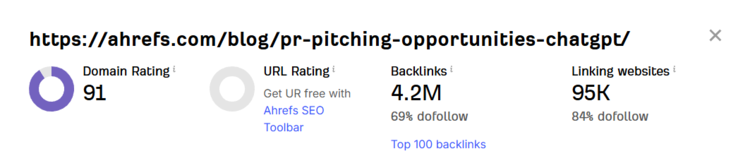
Look at Ahrefs. They are doing a great job when it comes to evergreen content, and this evergreen blog post we examined below already has 4.2 million backlinks, posted only 6 months ago!
The flip side? It takes time.
You won’t build authority overnight. A trendy post might go viral in a few hours, while evergreen content needs months to mature. And yes, you still need that “espresso content”.
But don’t forget that both search engines and AI are increasingly designed to favor sources they can rely on long-term, not pages created just to ride a trend for 48 hours.
Evergreen content, consistently updated and rooted in expertise, builds something far more valuable than traffic spikes: trust.
Key Takeaway for Agencies
Evergreen content will bring authority and trust to your clients. Think of case studies, comparison pages, glossaries, comprehensive guides, and best practice lists. Invest in them, maintain them, and watch visibility grow steadily over time.
Trend #4: YouTube and Podcast – Give Your Brand Face and Voice
Text alone isn’t enough to build trust anymore: audiences want faces, voices, and formats that feel alive. Podcasts and video content have exploded: roughly 584 million people worldwide are regular podcast listeners, and this number is expected to rise in 2026.
Now, how did we come to this point? And why do podcasters have such a great influence on their audience?
In a digital environment flooded with AI-generated articles, audiences and algorithms are looking for stronger credibility signals. Video and audio formats provide something that written content increasingly struggles to prove: human presence.
Seeing a person speak on YouTube or hearing them explain an idea on a podcast creates context. Tone, hesitation, emphasis, confidence, all the subtle cues that signal expertise and authenticity are suddenly visible. That’s why podcasts and long-form video accelerate trust.
This matters because authority today isn’t built only on what you publish, but on who stands behind it.
Podcast hosts and video creators are perceived as more accountable. They show up consistently, explain their thinking, respond to feedback, and build familiarity over time. That’s why listeners are far more likely to change their opinion, trust a recommendation, or remember a brand mentioned by a real voice, not a faceless page.
From a visibility perspective, this human layer compounds, videos are indexed, podcast episodes are transcribed, quoted, shared, and referenced across platforms. AI systems increasingly rely on these signals to understand who is knowledgeable, not just what keywords appear on a page.
And let’s admit it, in a world where you can publish content with a click, showing your face and owning your voice is becoming a competitive advantage. Brands that invest in consistent audio and video presence aren’t just building awareness; they’re building recognition, credibility, and long-term trust.
Key Takeaway for Agencies
If your clients want to build authority in 2026 and do it fast, written content alone isn’t enough. Encourage them to put real experts in front of the camera or behind the microphone. A recognizable face and a consistent voice do more for trust and long-term visibility than another perfectly optimized blog post ever could.
Your task would be to find the perfect fit, and you could start by monitoring which podcasts mention your client’s brand with Mentionlytics and suggest the right collaboration.
Trend #5: Authenticity and Human-Made Content
You don’t have to be an expert to figure out that in the sea of AI content, “made by humans” stands out immediately and feels more reliable. And yes, AI search engines are starting to recognize that difference, too.
So whether your goal is to earn visibility in AI-powered search or to spark genuine engagement with real people, your content needs to be authentic and carry clear signs of human touch.
When discussing future trends in digital marketing, we can’t forget the 100% human content will get momentum over AI-generated content. People will not ask you to be perfect, but authentic.
Social media platforms are already heading that way (look at Instagram’s new focus for 2026), and it’s just a reflection of the overall situation and saturation with generic content.
This is not a randomly picked trend; it’s something that Ipsos research showed. Over three years (2023-2025), the percentage of people claiming they want more human-made content in various categories than AI increased, and in 2025, it ranged from 64% to 75%, depending on the content category.
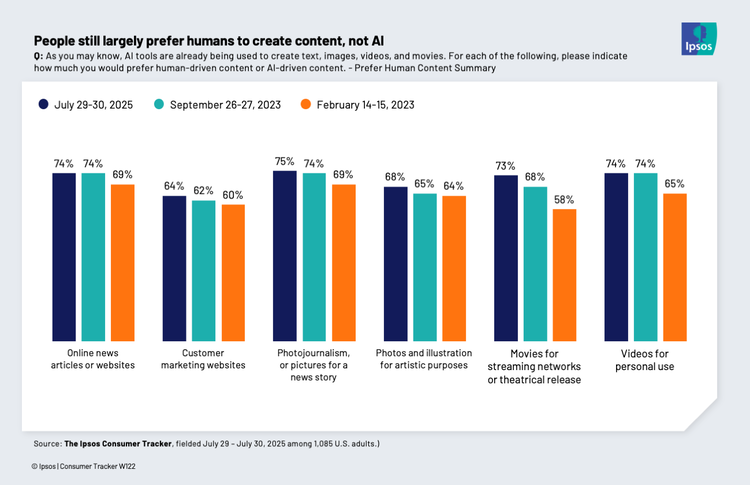
Source: Ipsos Consumer Tracker Survey
That means brands must change the way they use AI tools in content creation. Content needs to have a soul, to offer a real solution for a problem, or to give a clear opinion on some topic. But the best part of this trend is that it doesn’t have to be perfect. It needs to be high-quality in terms of the value it provides.
Key Takeaway for Agencies
Encourage clients to use AI as a support tool, not a replacement for thinking. Content should reflect real experience, clear opinions, and human judgment.
Trend #6: Deep Research Over Superficial
By now, the pattern is hard to miss: surface-level content is losing ground. Social media algorithms don’t like it, Google is putting its heart and soul into diminishing it, and all you’re left with is to dive deep into your digital marketing strategy and put some weight on your content.
Short, generic articles written just to “cover a topic” may still exist, but they’re no longer enough to compete, neither in search engines nor in LLMs. As both humans and machines get better at filtering noise, depth is becoming a differentiator.
This shift was reinforced again with the February 2026 Google update, which placed even more emphasis on original, well-researched content in discovery-based environments such as Google Discover. Pages that add real insight, context, and expertise are being surfaced more often than content that simply summarizes what’s already out there.
Deep research doesn’t mean academic writing or complex jargon. It means understanding a topic well enough to explain why something works, when it doesn’t, and how it applies in real-life scenarios. It means adding perspective instead of repetition.
If your content only restates common knowledge, it’s easily replaceable. But content grounded in research, experience, and original thinking is harder to replicate and easier to trust.
Key Takeaway for Agencies
Invest less in volume and more in substance. Fewer pieces, deeper research, clearer insights. Content that genuinely answers questions, challenges assumptions, and adds value will outperform dozens of shallow articles, both in search rankings and AI-powered discovery.
Find Out What the Audience Truly Cares About
Craft a content strategy and write about the topics that move the needle with Mentionlytics’ social listening insights.
How Can Agencies Stay Ahead of Digital Marketing Trends?
For agencies, staying ahead of trends means spotting meaningful shifts early, understanding why they matter, and knowing when to act, before clients start asking uncomfortable questions.
The key is to keep your eyes and ears wide open, and social listening can be of great help because it’s impossible to be a social media and web watch-guard 24/7. You track industry-relevant keywords for your clients and spot shifts in audience preferences, sentiment, and emerging topics.
When you see how people react to different topics, you can anticipate what’s coming, because they represent just a tip of the iceberg.
How agencies stay updated on digital marketing trends
Most agencies don’t struggle with ideas but with signal overload. What does it mean?
Between platform updates, algorithm changes, client industries, competitors, and emerging social media trends, it’s nearly impossible to stay current by manually checking newsletters, social feeds, and news sites.
But if you use Mentionlytics, you can maintain common sense.
Mentionlytics gives agencies a helicopter view of what’s actually happening in their clients’ niches: which topics are gaining traction, which conversations are accelerating, and how sentiment is shifting in real time.
By tracking brand mentions, industry keywords, competitors, and emerging narratives, agencies can spot trends while they’re forming, not a month later in a recap post.
Instead of relying on assumptions or outdated benchmarks, agencies can ground their strategies in live market conversations and data-backed insights.
How agencies adapt to changing digital marketing trends
Is it easy to adjust? No. Is it necessary? Yes. So here’s how successful agencies adapt to constantly changing digital marketing industry trends:
- Pivot strategy early when audience behavior or sentiment starts shifting.
- Adjust PR campaigns in real time instead of waiting for quarterly reports.
- Testing new channels and formats on a small scale before rolling them out fully.
- Leverage brand collaborations and partnerships to enter new conversations faster and borrow trust from established audiences.
- Doubling down on what resonates, based on actual audience conversations.
- Aligning PR, content, and SEO around emerging narratives rather than isolated tactics.
How to Keep Up With Digital Marketing Trends All Year
Life would be easier if one strategy could last for years, but digital marketing doesn’t work that way. Trends move fast, shift quietly, and catch you off guard if you’re not actively listening.
Social listening is the only way to stay ahead: track the conversations shaping your clients’ industries, follow the keywords that signal change, and catch momentum before it turns mainstream.
Meet the tool that moves as fast as digital trends do. Mentionlytics gives you speed, flexibility, and wide coverage. It hears, sees, and measures sentiment across all the channels that matter.
Catch the digital marketing trends with Mentionlytics’ 14-day free trial!
FAQ
What are the current trends in digital marketing?
Current digital marketing trends focus on:
- AI-powered search and AI-native advertising channels (such as ChatGPT ads)
- Digital PR combined with local optimization to build authority and visibility
- Trust-driven, long-run evergreen content instead of short-lived traffic spikes
- YouTube and podcast content to give brands a recognizable face and voice
- Authentic, human-made content that stands out in an AI-saturated environment
- Deep research and expertise-led content over superficial, high-volume output
How to stay up to date with digital marketing trends?
The most effective way to stay up to date with digital marketing trends is continuous listening. Instead of relying on trend reports alone, track real conversations in your industry, monitor relevant keywords, and watch how sentiment and narratives evolve. Social listening tools like Mentionlytics help marketers and agencies stay informed without having to chase updates across dozens of platforms.
What are the latest trends in digital marketing?
The latest trends in digital marketing include AI becoming a discovery and advertising channel, stronger emphasis on brand authority and trust signals, increased importance of video and audio formats, and a clear shift toward content that demonstrates expertise rather than volume.
What trends are gaining traction in digital marketing?
Trends gaining traction include AI-native advertising, digital PR tied to local optimization, podcast and YouTube-led authority building, and content strategies focused on long-term relevance instead of short-lived spikes.
Which three trends are affecting the landscape of digital marketing?
Three major forces shaping digital marketing today are:
- AI-driven discovery
- Trust and authenticity as ranking and engagement factors
- The shift from quantity-focused content to depth and research-driven content
How do industry trends affect digital marketing strategy?
Industry trends influence where brands invest, how they communicate, and which channels deliver results. Agencies that monitor trends early can pivot strategies faster, reduce wasted spend, and align campaigns with how audiences actually behave.
How do agencies educate clients about digital marketing trends?
Successful agencies educate their clients about digital marketing trends by translating these trends into clear business impact. Instead of overwhelming clients with updates, they use data, examples, and real-time insights to explain why a shift matters and how it affects performance, visibility, or ROI.
How can local businesses stay ahead of digital marketing trends?
Local businesses benefit most from focusing on local authority, authentic communication, and consistent presence across relevant platforms. Tracking local conversations, reviews, and industry keywords with Mentionlytics helps them respond faster to changes in customer expectations and search behavior, thus staying ahead of digital marketing trends in their niches.
What are some emerging trends in digital marketing?
Emerging trends in digital marketing include AI-generated answers replacing traditional clicks, growing reliance on trusted sources for discovery, increased importance of personal brands, and content strategies that prioritize credibility over speed.
Where do most digital marketing trends take place?
Most digital marketing trends start in conversations: on social media, forums, news sites, reviews, podcasts, and comment sections. By the time they appear in trend reports, they’re usually already happening.

